
Malleable Penile Implant: 6 Honest Trade-Offs vs Inflatable
Malleable penile implant explained through 6 honest trade-offs on cost, concealment, reliability, dexterity, partner satisfaction and inflatable options.
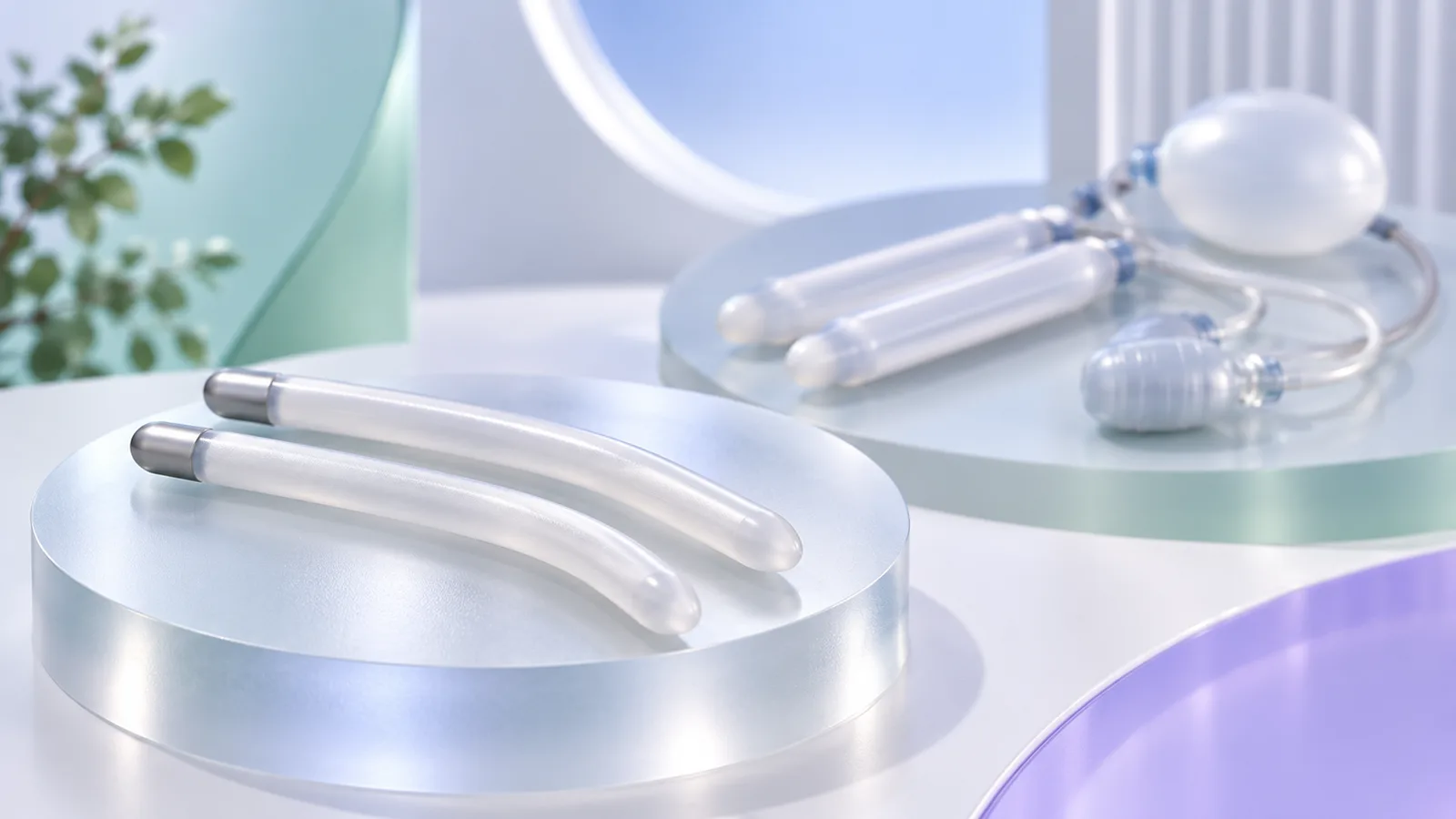
- A malleable penile implant uses two bendable internal rods and requires no pump or fluid reservoir, making it simpler to operate than an inflatable prosthesis.
- Malleable implants generally have fewer mechanical failure modes and lower cost, but the penis remains semi-rigid and is usually harder to conceal than a deflated three-piece implant.
- Comparative evidence generally finds higher patient and partner satisfaction with inflatable penile prostheses, while mechanical failure is more common with inflatable devices.
- Limited hand dexterity can make a malleable implant the better clinical choice because the patient does not need to locate, squeeze and deflate a scrotal pump.
- Modern malleable devices include Tactra, Genesis and Rigi10, but current evidence does not establish one manufacturer as universally superior.
A malleable penile implant is a pair of bendable rods placed inside the penis to provide permanent internal rigidity for intercourse. It is simpler, usually less expensive and has fewer mechanical parts than an inflatable prosthesis, but the penis remains semi-rigid all the time. For some men, that simplicity is an advantage rather than a compromise.
The phrase malleable penile implant sometimes creates the wrong impression.
Patients may hear:
“simple implant”
and assume:
“cheap implant.”
They may then assume that a three-piece inflatable penile prosthesis is automatically the premium or medically superior choice.
That is not how penile prosthesis selection should work.
Modern urology recognizes both inflatable penile prostheses and semi-rigid or malleable penile prostheses as established implant categories. The European Association of Urology notes that semi-rigid devices are comparatively easy to use and implant, but their persistent firmness can make concealment more difficult. The EAU also identifies limited manual dexterity as one situation in which a semi-rigid prosthesis may be particularly useful.
In other words, malleable implants involve a real set of trade-offs.
They generally offer:
simpler operation;
fewer mechanical components;
no scrotal inflation pump;
no abdominal reservoir;
usually lower cost;
and reliable rigidity.
But they also involve:
persistent semi-rigidity;
more difficult concealment;
a less natural resting state;
potentially different partner perceptions;
and tissue-pressure considerations that matter particularly in selected high-risk patients.
The correct question is therefore not:
“Is a malleable implant worse than an inflatable implant?”
It is:
“Which trade-offs matter most in my medical situation?”
This guide looks at the six differences that matter most.
It also explains what a semi-rigid penile implant actually feels like, how contemporary devices such as the Tactra malleable penile implant are designed, what the evidence says about satisfaction and mechanical failure, and which patients may reasonably choose malleable even when they can afford an inflatable prosthesis.
What Is a Malleable Penile Implant?
A malleable penile prosthesis is a non-inflatable device used to create sufficient penile rigidity for sexual intercourse.
Two rods are surgically placed inside the corpora cavernosa.
These are the same paired erectile chambers that normally fill with blood during a natural erection.
The rods stay inside permanently.
Unlike an inflatable implant, there is:
no pump;
no fluid reservoir;
no hydraulic tubing;
and no inflation or deflation process.
The penis therefore remains firm enough to provide support.
When the patient wants intercourse, he positions the penis outward or upward.
When intercourse is finished, he bends or positions it downward toward the body for concealment.
The implant is commonly described using several terms:
malleable penile implant;
malleable penile prosthesis;
semi-rigid penile implant;
semi-rigid penile prosthesis;
bendable penile implant;
non-inflatable penile implant.
These terms refer broadly to the same device category.
The Urology Care Foundation describes a malleable implant simply: the rods remain firm, the patient positions the penis for intercourse and moves it back toward the body afterward.
How Is a Malleable Implant Different From an Inflatable Implant?
An inflatable penile prosthesis creates two distinct states.
When deflated, the penis becomes relatively soft.
When inflated, the cylinders become firm.
A three-piece inflatable implant accomplishes this using:
two intracorporal cylinders;
a scrotal pump;
a separate fluid reservoir;
and connecting tubing.
A two-piece inflatable device eliminates the separate abdominal reservoir but still uses a hydraulic pump.
A malleable implant eliminates the hydraulic system completely.
It consists mainly of two positionable internal rods.
That difference affects almost every practical part of life with the implant.
It affects:
how the penis looks at rest;
how the patient prepares for intercourse;
how easy the device is to operate;
how many mechanical components can fail;
how easily it can be concealed;
surgical complexity;
and cost.
For the general differences among all implant types, see our penile implant surgery guide.
Malleable Penile Implant vs Inflatable: The Quick Comparison
Feature | Malleable implant | Three-piece inflatable |
|---|---|---|
Two internal cylinders/rods | Yes | Yes |
Scrotal pump | No | Yes |
Separate reservoir | No | Yes |
Hydraulic tubing | No | Yes |
Permanently semi-rigid | Yes | No |
Becomes soft when deflated | No | Yes |
Manual pump required | No | Yes |
Requires hand squeezing | No | Yes |
Mechanical complexity | Low | Higher |
Mechanical failure risk | Generally lower | Generally higher |
Concealment | More difficult | Usually easier |
Natural-feeling resting state | Less natural | More natural |
Cost | Usually lower | Usually higher |
Useful with poor hand dexterity | Often | Sometimes difficult |
Partner satisfaction | Can be high, but some studies favor inflatable | Generally higher in comparative evidence |
The table explains why the decision is not simply good versus bad.
Every advantage creates a corresponding compromise.
Trade-Off 1: Simplicity vs a More Natural Resting State
The defining advantage of a malleable implant is simplicity.
There is no inflation sequence.
There is no deflation button.
There is no fluid reservoir to position.
The patient does not need to locate a pump inside the scrotum.
If the rods are functioning and positioned correctly, the mechanical task before intercourse is simply to reposition the penis.
That simplicity can be enormously valuable.
But it produces the biggest disadvantage too:
the penis is always semi-rigid.
The EAU guideline describes semi-rigid prostheses as producing a firm penis that can be manually positioned and notes reduced concealability and an unnatural persistent erection as important disadvantages.
The word “erection” here can be slightly misleading.
A malleable penis is not continuously sexually aroused.
The patient is not experiencing a permanent natural erection.
The rods simply provide permanent structural firmness.
There is no continuous increase in sexual desire.
There is no continuous vascular erection.
There is no requirement to remain sexually stimulated.
Nevertheless, the external appearance and feel are different from those of a deflated three-piece prosthesis.
What does the resting penis feel like?
It remains firm internally.
The patient usually positions it downward, sideways or against the body.
Modern malleable implants are designed to bend and maintain position better than the earliest devices.
Even so, they cannot become as soft as properly deflated inflatable cylinders.
That distinction matters most to patients who strongly value:
a natural flaccid feel;
discrete changing-room appearance;
tight-fitting clothing;
or the largest possible difference between flaccid and erect states.
For those priorities, an inflatable implant may be preferable.
When simplicity matters more
Other patients care much less about the flaccid state.
A man may say:
“I want the device with the fewest things I need to operate.”
For him, permanent firmness may be an acceptable price for simplicity.
That can be a completely rational choice.
Trade-Off 2: Easier Operation vs Harder Concealment
A malleable implant does not require pump manipulation.
This makes it one of the simplest penile prostheses to operate.
That matters much more than it may appear when looking at implant diagrams.
An inflatable prosthesis requires the patient to:
locate the pump through the scrotal skin;
hold it securely;
repeatedly squeeze the inflation mechanism;
create sufficient cylinder pressure;
identify the deflation mechanism afterward;
activate it correctly;
and often compress the penis to complete deflation.
Many patients learn this without difficulty.
But not everyone can.
Manual dexterity can determine the correct implant
The EAU specifically notes that malleable devices may be an option for men with limited manual dexterity.
This can apply to selected patients with:
severe arthritis;
neurological disease;
hand weakness;
stroke-related impairment;
spinal cord injury;
tremor;
poor finger strength;
or difficulty identifying and squeezing a scrotal pump.
For these men, an inflatable device can be technically sophisticated yet practically useless if they cannot operate it independently.
A malleable prosthesis requires much less fine motor control.
The patient mainly needs to position the shaft.
This is why describing malleable implants as “the budget option” can be medically misleading.
For a man who cannot reliably use an inflatable pump, the malleable device may actually be the better functional prosthesis.
The trade-off is concealment
Permanent semi-rigidity has to be managed under clothing.
Some patients adapt easily.
Others find it bothersome.
Factors that influence concealment include:
implant rigidity;
implant diameter;
penile length;
body habitus;
clothing;
positioning;
and individual comfort.
Loose trousers generally make concealment easier than tight clothing.
A patient who works in clothing where the genital contour matters may care more about this than another patient.
This should be discussed before surgery.
Trade-Off 3: Lower Mechanical Failure vs Permanent Internal Firmness
One of the strongest engineering advantages of a malleable prosthesis is the absence of complex hydraulic components.
There is:
no pump valve;
no reservoir;
no fluid leak;
no inflatable cylinder system;
and much less that can fail mechanically.
A 2024 meta-analysis comparing malleable and inflatable penile prostheses found that mechanical failure was significantly more frequent with inflatable devices, while infection rates did not differ significantly between the groups included.
A separate 2023 review of contemporary implant technology similarly concluded that malleable prostheses generally have lower mechanical failure rates, while inflatable devices tend to provide higher satisfaction and lower erosion rates.
This makes intuitive sense.
A bendable rod has fewer mechanisms than a hydraulic prosthesis.
But the phrase “lower revision risk” needs careful handling.
Not every revision is caused by mechanical failure.
A malleable implant can still require revision because of:
infection;
erosion;
pain;
poor positioning;
dissatisfaction;
sizing problems;
tissue problems;
or conversion to an inflatable device.
So:
fewer mechanical failures does not mean no future revision surgery.
If a prosthesis ever requires another operation, the patient's anatomy has already been surgically altered.
Revision should therefore be part of the original counselling.
You can read more about what revision involves on our penile prosthesis revision surgery page.
Trade-Off 4: Lower Cost vs Usually Higher Satisfaction With Inflatable Devices
A malleable penile implant is generally less expensive than a three-piece inflatable prosthesis.
There are several reasons.
The device contains fewer components.
The implantation procedure is mechanically simpler.
There is no separate reservoir.
There is no hydraulic pump system.
Device acquisition costs are often lower.
A 2023 review of contemporary malleable prostheses identifies lower cost as one of the major advantages of the category, particularly in markets where patients do not have broad insurance coverage.
That can make malleable implants an important option for self-paying international patients.
However, cost should not be separated from satisfaction.
What do comparative studies show?
The most useful recent evidence is a 2024 meta-analysis comparing malleable with inflatable penile prostheses.
It found significantly higher patient satisfaction and partner satisfaction with inflatable devices, while mechanical failure was more frequent with inflatable implants. Infection and ease-of-use outcomes were not significantly different in the included studies.
That creates the central trade-off clearly:
malleable: simpler and mechanically more robust
versus
inflatable: usually more natural and more satisfying overall.
Another 2025 systematic review and meta-analysis including 83 penile prosthesis studies and more than 12,000 patients found overall patient satisfaction around 83% and observed higher satisfaction in men with three-piece prostheses. Partner satisfaction also increased with inflatable devices.
These numbers should not be interpreted as proof that an individual man will prefer an inflatable prosthesis.
They describe population trends.
A patient who cannot operate a pump may be far more satisfied with a malleable implant than with an inflatable device that he struggles to use.
Cost is relevant, but it should come second
A responsible device discussion should sound like this:
“These devices are clinically suitable for you. Here are their trade-offs and costs.”
It should not sound like:
“This one is cheaper, so this is the one you should have.”
For current self-pay planning, see our dedicated guide to penile implant surgery cost in Turkey.
Trade-Off 5: Easier Surgery vs Greater Pressure and Erosion Considerations
Malleable implant surgery is mechanically simpler than placing a three-piece hydraulic prosthesis.
The surgeon still needs to:
access the corpora cavernosa;
dilate them appropriately;
measure the internal corporal length;
choose an appropriate rod;
position both rods symmetrically;
close the corporal openings;
and close the surgical wound.
But there is no need to:
create a scrotal pump pocket;
place a fluid reservoir;
connect hydraulic tubing;
fill a system;
or cycle the device intraoperatively.
That can make implantation faster and technically less complex.
However, simplicity does not remove surgical risk.
Constant tissue pressure matters
A malleable implant remains firm inside the penis.
Unlike an inflatable device, it cannot be fully decompressed.
That means the device exerts persistent structural pressure.
In most properly selected and correctly implanted patients, this is manageable.
But tissue quality matters.
Patients with poor sensation, vascular disease or repeated urethral instrumentation may require particular caution.
Spinal cord injury is a useful example
Malleable implants have historically been used in men with spinal cord injury because:
they are easy to position;
hand function can be limited;
and a firm penis can sometimes assist external urinary-device management.
But spinal cord injury populations can have higher complication risks.
A systematic review found penile prostheses useful in this group but reported higher infection, erosion and explantation rates than in men without spinal cord injury. The review concluded that inflatable prostheses may be preferred when feasible because of lower erosion risk, although inflatable devices require adequate hand dexterity.
This is exactly the type of clinical situation where a simplistic rule fails.
Poor dexterity may favor malleable.
Reduced sensation and erosion risk may favor inflatable.
The surgeon has to balance both.
Trade-Off 6: Reliable Rigidity vs Partner and “Naturalness” Expectations
A malleable penile implant can provide reliable rigidity for penetration.
That is the central functional goal.
But sexual satisfaction involves more than penile hardness.
Patients and partners may care about:
how the penis feels at rest;
how it looks;
how much the glans fills;
whether the erection feels spontaneous;
whether the device feels natural during touch;
and whether the penis can be concealed easily.
This is where malleable implants tend to lose some ground compared with inflatable devices.
What partners have reported
An older study of 50 men with malleable prostheses and their partners found patient satisfaction of 70% and partner satisfaction of 57%. The most common partner complaint was a sense of unnaturalness.
Those devices and methods are older, so the percentages should not be treated as a forecast for today's implants.
But the underlying lesson remains relevant:
partner expectations matter.
Another long-term study in men with Peyronie's disease treated with semi-rigid prostheses reported complaints including poor concealment, reduced girth perception, a cold glans and a sense of unnatural intercourse among dissatisfied patients or partners.
Again, this was an older study in a very specific population.
It should not be used to claim that contemporary malleable implants cause these experiences in every couple.
It does show why counselling needs to go beyond:
“Will I be hard enough for intercourse?”
A more recent perspective
Modern evidence continues to show that inflatable prostheses tend to outperform malleable devices on average for patient and partner satisfaction.
That does not make a malleable implant a bad choice.
It means patients should understand the experience they are choosing.
Who Is Actually a Good Candidate for a Malleable Penile Implant?
A malleable implant may be particularly attractive for a man who values simplicity over a natural flaccid state.
Potential scenarios include:
Significant difficulty operating a pump
A patient with limited hand function may be unable to use an inflatable device reliably.
The EAU explicitly identifies limited manual dexterity as a possible reason to consider a semi-rigid prosthesis.
Preference for the simplest mechanics
Some patients simply do not want a hydraulic implant.
They may prefer the device with the fewest moving components.
That preference is legitimate if the concealment trade-off is understood.
Cost sensitivity
When insurance does not cover penile implant surgery, the price difference between malleable and inflatable prostheses can be substantial.
For some patients, a malleable device makes definitive treatment financially possible.
Selected salvage situations
Malleable prostheses are also used by some prosthetic surgeons during salvage management after an infected inflatable prosthesis has been removed.
The malleable rods can help preserve corporal space and length while reducing the complexity of immediate reimplantation.
This is a specialist indication rather than routine primary implantation.
Severe fibrosis or difficult anatomy
Certain scarred corporal situations may make a malleable prosthesis useful.
The decision depends on the anatomy.
This should not be generalized to every patient with fibrosis.
Selected neurological patients
Malleable implants may be useful when dexterity or urinary-device management is part of the clinical problem.
However, erosion risks and sensory impairment must also be considered carefully.
Who Is Usually Better Suited to an Inflatable Implant?
An inflatable prosthesis is often favored when the patient:
can comfortably use the pump;
strongly values concealment;
wants the softest possible resting penis;
prefers a clearer change between flaccid and erect states;
and has anatomy suitable for inflatable device placement.
Three-piece implants are especially attractive because they can transfer fluid out of the cylinders into a separate reservoir.
This allows the resting penis to become significantly softer.
The EAU notes that many patients prefer three-piece inflatable implants because of the more “natural” erection they produce.
In contemporary high-income markets, three-piece implants are frequently considered the standard inflatable option.
But “standard” does not mean mandatory.
Is a Malleable Penile Implant Always Hard?
It remains semi-rigid.
That means the rods themselves remain structurally firm.
However, the position of the penis changes.
The patient can generally:
position it upward or outward for intercourse;
then reposition it downward toward the body afterward.
Modern devices use materials and internal cores designed to provide both axial rigidity and bendability.
The goal is to remain sufficiently firm for penetration while still allowing concealment.
But the device cannot become physiologically soft.
That is the fundamental distinction from an inflatable prosthesis.
What Does a Malleable Penile Implant Feel Like?
The rods sit inside the erectile chambers.
The patient can generally feel that the penis is internally supported.
The prosthesis itself is under the tissues rather than sitting externally.
A partner may perceive firmness differently from a natural vascular erection.
The penis can still have:
normal skin sensation when sensory nerves are intact;
sexual arousal;
orgasm;
and ejaculation if those functions were present beforehand.
The implant does not create desire or orgasm.
It provides rigidity.
The Urology Care Foundation notes that penile implants do not inherently change sexual sensation, ejaculation or orgasm.
Does a Malleable Implant Affect Penile Sensation?
It is not intended to.
Penile sensation comes mainly from the nervous system.
The implant sits inside the corpora cavernosa.
The sensory nerves are not replaced by the prosthesis.
A man with intact sensation before uncomplicated surgery would generally expect to retain penile skin sensation.
But underlying disease can change this.
Examples include:
diabetic neuropathy;
spinal cord injury;
previous pelvic surgery;
prior penile surgery;
and neurological disease.
The device therefore cannot restore sensation that was already lost.
Can You Still Orgasm With a Malleable Implant?
Yes, many men can.
Orgasm and erection are different physiological functions.
A malleable implant provides erection-like rigidity.
It does not remove the brain and nerve pathways involved in orgasm.
If orgasm was normal before surgery, implantation itself is not intended to stop it.
However, men who already have anorgasmia because of:
neurological disease;
medication;
psychological factors;
or previous surgery
should not expect the prosthesis to correct that problem.
Can You Ejaculate With a Malleable Implant?
A penile prosthesis does not normally block the urethra.
If ejaculation was present before surgery and no other condition prevents it, ejaculation can generally continue.
But men receiving penile implants often have other medical histories.
A man after radical prostatectomy will usually not produce a semen-containing ejaculation because the structures responsible for producing and delivering most seminal fluid have been removed.
A malleable implant cannot reverse that.
The same applies to an inflatable prosthesis.
Device choice does not restore lost ejaculation.
Does a Malleable Penile Implant Make You Bigger?
No penile prosthesis should be sold primarily as a penis-enlargement operation.
The surgeon measures the internal corpora and chooses rods appropriate for the available space.
Correct sizing is essential.
Oversizing in an attempt to create more length or girth can increase complications.
A study examining malleable implant rod diameter found that surgeons sometimes try to use larger rods because patients worry about girth, but larger diameter was associated with greater complication risk without a corresponding improvement in satisfaction.
That is an important finding.
The goal is not:
largest implant possible.
The goal is:
safest implant that fits correctly and provides reliable function.
Why Malleable Rod Diameter Matters
Modern malleable prostheses come in different diameters and lengths.
The surgeon selects dimensions based on:
corporal width;
corporal length;
tissue quality;
fibrosis;
glans support;
and the characteristics of the specific device.
Patients may assume a wider rod will automatically make the penis look better.
The evidence does not support aggressive oversizing.
The 2022 study on malleable rod diameter found a relationship between larger rods and more complications without better patient satisfaction.
This is another reason penile implant sizing belongs in the surgeon's hands rather than being chosen from a catalogue by the patient.
What Is the Tactra Malleable Penile Implant?
The Tactra malleable penile implant is a contemporary semi-rigid prosthesis produced by Boston Scientific.
It represents a newer generation of malleable device design.
A 2023 review of commercially available malleable prostheses describes Tactra as using a Nitinol nickel-titanium core surrounded by a dual-layer silicone exterior. The design aims to combine rigidity for intercourse with bendability for positioning.
The same review notes that Tactra was introduced in 2019.
It comes in different lengths and diameters so the surgeon can match the device to corporal dimensions.
Importantly, the review stated that at the time of publication there were not yet published clinical-outcome studies specifically evaluating Tactra.
That means we should not invent a Tactra-specific satisfaction percentage.
The broader evidence for malleable prostheses does not automatically become Tactra-specific evidence.
That distinction is important for medical device content.
What Other Malleable Penile Implants Exist?
The contemporary market includes several malleable devices.
A 2023 review identified major models including:
Boston Scientific Tactra;
Coloplast Genesis;
Rigicon Rigi10;
Zephyr ZSI 100;
Promedon TUBE;
and Shah prostheses.
These devices differ in:
internal core materials;
outer materials;
available diameters;
available lengths;
coatings;
flexibility;
trimming systems;
and extenders.
There is no robust evidence proving that one malleable manufacturer is universally superior to all others.
The EAU similarly states that there are no head-to-head studies demonstrating overall superiority of one penile implant manufacturer over another.
Therefore, a website claiming one malleable model is definitively “the best” should be treated cautiously.
What Is the Coloplast Genesis?
The Genesis is another established malleable penile prosthesis.
The contemporary device review describes it as using flexible silicone elastomer with a hydrophilic surface and internal metal support.
It has been used for years and comes in different sizes.
Published comparisons with older malleable devices have generally not established clear superiority.
Like every prosthesis, the practical result depends not only on the device but also on:
sizing;
placement;
anatomy;
tissue quality;
and patient expectations.
What Is the Rigicon Rigi10?
Rigi10 is a newer malleable penile prosthesis.
The 2023 state-of-the-art review includes it among contemporary commercial devices and describes multiple diameter options and a hydrophilic coating.
At the time of that review, specific published clinical-outcome evidence for the device remained limited.
Again, this is important.
Product availability is not the same thing as long-term comparative evidence.
A patient can reasonably choose a newer device, but the surgeon should distinguish:
manufacturer specifications
from
independent clinical outcome data.
What Does “Silicone Penile Implant” Mean?
This is a particularly important search term because it can describe very different things.
A malleable penile prosthesis may contain silicone elastomer as part of its outer construction.
For example, contemporary malleable devices can use silicone around a metal or Nitinol structural core.
That is a medically implanted erectile prosthesis.
It is placed inside the corpora cavernosa to treat erectile dysfunction.
This is completely different from a cosmetic subcutaneous silicone sleeve or silicone augmentation implant designed to alter penile girth.
The two procedures:
have different indications;
occupy different anatomical planes;
have different risk profiles;
and treat different problems.
A man researching penile silicone implant or silicone penile implant should therefore establish whether the page is discussing:
erectile prosthesis surgery
or
cosmetic penile augmentation.
They should never be treated as interchangeable.
What Does a Malleable Implant Look Like Before and After Surgery?
Searches for malleable penile implant before and after often reflect concern about the resting appearance.
Before surgery, the device consists of two narrow medical rods.
After surgery, the rods are not externally visible as separate objects.
They are inside the corpora cavernosa.
The visible difference is functional:
the shaft remains semi-rigid.
There may initially be:
swelling;
bruising;
incision healing;
and temporary discomfort.
Those early postoperative changes should not be used to judge the final appearance.
Once healed, the main visual difference compared with an inflatable implant is that the penis cannot be completely deflated.
For privacy and medical professionalism, clinical diagrams are generally more useful than explicit before-and-after photographs for understanding the mechanism.
Is a Malleable Implant Easier to Hide After Healing?
Compared with the early postoperative period, yes.
Compared with a fully deflated three-piece implant, usually not.
Modern malleable designs have improved bendability and positional memory.
Patients learn how to place the penis comfortably.
Clothing choice also makes a difference.
However, the persistent internal rigidity remains.
That is an inherent design characteristic, not a surgical complication.
If maximum concealment is one of a patient's top priorities, this should be discussed before choosing a malleable prosthesis.
Can a Malleable Implant Break?
Mechanical failure is possible but generally less common because there are few moving components.
Contemporary malleable devices are engineered to tolerate repeated bending and repositioning.
However, “mechanically simple” should not be translated into:
“guaranteed never to fail.”
Materials can fail.
Devices can become damaged.
An implant can also require replacement for non-mechanical reasons.
The more accurate statement is:
Malleable prostheses generally have fewer mechanical failure modes than inflatable prostheses.
Can a Malleable Implant Become Infected?
Yes.
Any implanted prosthesis can become infected.
The EAU identifies infection as one of the principal complications of penile prosthesis implantation.
A 2020 systematic review found that infection rates across the literature have fallen over time as:
surgical technique improved;
prosthetic coatings became more common;
and infection-prevention protocols developed.
A 2024 comparative meta-analysis found no statistically significant difference in infection rates between malleable and inflatable prostheses in the studies it included.
Therefore:
do not choose malleable simply because you think it cannot become infected.
That assumption is incorrect.
What Happens If a Malleable Implant Becomes Infected?
A clinically significant prosthesis infection often requires surgery.
The infected device may need to be removed.
In selected patients, an experienced prosthetic surgeon may perform salvage surgery, which involves removing infected material, washing out the operative space and placing another prosthesis.
In other situations, reimplantation may be delayed.
Infection management depends on:
severity;
tissue condition;
organism;
patient health;
timing;
and surgeon experience.
For a fuller explanation, see our penile prosthesis complications guide.
Can a Malleable Implant Be Converted to an Inflatable One Later?
Yes, conversion may be possible.
Some men initially receive a malleable prosthesis and later choose an inflatable implant.
Reasons may include:
concealment concerns;
preference changes;
partner feedback;
or reconstruction after previous infection.
However, conversion is revision surgery.
It should not be presented as a trivial upgrade.
The surgeon must operate in previously implanted corporal spaces.
There may be:
scar tissue;
altered anatomy;
tissue thinning;
or other technical considerations.
The possibility of conversion is reassuring, but patients should still choose their first device carefully.
Is Revision Surgery Easier With a Malleable Implant?
Not necessarily.
The device itself is simpler.
But revision complexity depends on why surgery is required.
Replacing an uncomplicated malleable prosthesis for preference is different from operating because of:
infection;
erosion;
severe fibrosis;
distal tissue damage;
or urethral involvement.
Revision after infection can be complex regardless of the original device.
For this reason, the expected lifetime treatment pathway matters more than the number of pieces in the original prosthesis.
What About Partner Satisfaction?
Partner satisfaction should be discussed before surgery, not treated as an afterthought.
The strongest contemporary comparison suggests that partners tend to report higher satisfaction with inflatable devices.
Potential reasons include:
a more natural transition between flaccid and erect states;
concealment;
perceived naturalness;
and differences in rigidity and penile fullness.
But partner satisfaction varies.
A recent Arabic-language questionnaire validation study following malleable implantation found patient satisfaction of 90.8% at six months and partner satisfaction of 84.2% in that study population.
This shows something important.
High satisfaction is entirely possible with a malleable prosthesis.
The device is not inherently unsatisfactory.
Selection and expectations matter enormously.
How Important Is Preoperative Counselling?
Very important.
The 2023 state-of-the-art review of malleable prostheses concluded:
“Appropriate patient selection and strict counselling regarding what to expect with malleable prostheses … are paramount.”
— Eric Chung and Juan Wang, 2023.
That may be the single most useful message in the article.
Many implant disappointments are not caused by mechanical failure.
They come from a mismatch between:
what the device was designed to do
and
what the patient imagined it would do.
A man who understands permanent semi-rigidity before surgery can decide whether he accepts it.
A man who learns about it only afterward may experience the same technically successful device very differently.
Is a Malleable Implant Better for Older Men?
Age alone should not determine implant type.
A healthy 75-year-old with strong hand function may use a three-piece implant easily.
A 52-year-old with severe neurological hand weakness may be better suited to a malleable device.
The relevant factors are:
dexterity;
cognition;
anatomy;
medical condition;
tissue quality;
and personal preference.
Age is only one part of that assessment.
Is a Malleable Implant Better for Diabetes?
Not automatically.
Diabetes can affect:
erectile function;
nerve sensation;
wound healing;
vascular health;
and infection risk.
A malleable device has fewer mechanical components, but that does not eliminate infection.
Poor sensation may also matter because persistent rod pressure can become more important when the patient cannot feel early discomfort normally.
Therefore, diabetic patients need individualized evaluation rather than a blanket rule that one implant type is safer.
Is a Malleable Implant Better After Prostate Surgery?
Again, not automatically.
Erectile dysfunction after radical prostatectomy is a common reason for penile prosthesis surgery.
Both malleable and inflatable implants can be used.
A three-piece implant requires reservoir placement, and previous pelvic surgery can change the normal anatomy.
But experienced prosthetic surgeons can often use alternative reservoir positions.
A two-piece inflatable implant can also avoid a separate reservoir.
Therefore, prostate surgery does not automatically create a malleable indication.
The choice depends on the patient's anatomy and priorities.
Is Malleable Better in Severe Fibrosis?
Sometimes it can be useful, but the answer depends on how severe the fibrosis is.
Dense corporal scarring can make placement of any prosthesis difficult.
The surgeon may need:
specialized dilators;
smaller-diameter cylinders;
reconstructive techniques;
or staged management.
Malleable rods can be particularly useful in certain salvage or fibrotic situations because of their simpler configuration.
But severe fibrosis is a specialist problem.
The patient should not choose the device independently based on internet descriptions.
Is Malleable Better After an Infected Inflatable Implant?
A malleable prosthesis can play an important role in selected salvage pathways.
After removal of an infected inflatable device, some surgeons place malleable rods immediately.
This can help maintain corporal space while avoiding the extra pump and reservoir components of a new inflatable system during an infection-related operation.
Later, the patient may keep the malleable prosthesis or convert to an inflatable system.
This technique is one reason malleable devices remain important in advanced prosthetic practice.
They are not merely entry-level devices.
Does a Malleable Implant Need Cycling?
No hydraulic cycling is required.
An inflatable implant needs to be inflated and deflated as part of normal use.
Postoperative cycling may also be taught during recovery.
A malleable implant does not inflate.
The patient learns how to position it.
This can simplify postoperative device training considerably.
The surgical wound still needs to heal before sexual activity resumes.
“Simple device” does not mean the patient can use it immediately after surgery.
When Can You Have Sex After Malleable Implant Surgery?
The exact timeline should be given by the operating surgeon.
The corpora and incision need to heal regardless of implant type.
Many penile implant patients are cleared for intercourse after several weeks, commonly around four to six weeks after uncomplicated surgery.
But individual recovery varies.
Factors include:
swelling;
wound healing;
pain;
infection risk;
additional reconstruction;
and medical health.
The patient should wait for clearance rather than assuming the absence of a pump means faster permission for sex.
Is Recovery Easier Than With an Inflatable Implant?
The operation may involve fewer implantation steps.
There is no pump pocket or reservoir placement.
That can reduce some surgical manipulation.
However, it would be misleading to promise an easy or painless recovery.
Both operations involve:
corporal surgery;
genital incision;
swelling;
bruising;
and postoperative discomfort.
Individual pain varies more than many patients expect.
The presence or absence of a reservoir is only one factor.
Is the Operation Shorter?
It often can be, because the device is simpler.
There is no reservoir to position and no hydraulic system to connect and test.
But operative time also depends heavily on:
surgeon experience;
fibrosis;
previous surgery;
anatomy;
infection;
and whether additional reconstruction is needed.
A difficult malleable implant can take longer than a straightforward inflatable operation.
Device category alone does not determine the operating time.
Is Malleable Better for Medical Travel?
It can offer practical advantages for selected international patients.
These include:
lower device cost;
simpler mechanics;
no hydraulic pump training;
no reservoir;
and fewer mechanical failure modes.
However, medical travel adds considerations that have nothing to do with implant design.
The patient still needs:
an appropriately qualified surgeon;
a licensed hospital;
safe infection prevention;
postoperative assessment;
a plan if complications occur;
and follow-up after returning home.
Choosing a simpler implant does not compensate for poor surgical infrastructure.
How Much Does a Malleable Penile Implant Cost?
There is no worldwide price.
The final cost depends on:
country;
implant model;
surgeon;
hospital;
anaesthesia;
medical tests;
hospital stay;
and package inclusions.
Malleable prostheses are generally less costly than premium inflatable systems.
But that does not mean every malleable package should be compared using a single international number.
A quote should name the actual device.
“European malleable implant” or “American semi-rigid implant” is not specific enough.
For current Türkiye pricing and package structure, review penile implant surgery cost in Turkey.
What Should a Malleable Implant Quote Include?
At minimum:
surgeon;
hospital;
exact prosthesis manufacturer;
exact prosthesis model;
device cost;
anaesthesia;
theatre;
hospital admission;
medical tests;
medications;
follow-up;
warranty;
and written exclusions.
International patients should also confirm:
hotel;
airport transfers;
hospital transfers;
interpreter support;
and the expected in-country stay.
The lower device price should not distract from incomplete package pricing.
What Warranty Comes With a Malleable Implant?
Warranty terms depend on the manufacturer and market.
Patients should request written information.
A key distinction is:
device warranty is not necessarily surgery warranty.
If a manufacturer replaces a failed prosthesis, the patient may still face:
surgeon cost;
operating theatre;
anaesthesia;
hospital fees;
travel;
and accommodation.
Never interpret “lifetime warranty” as automatically meaning “free future revision surgery.”
Should You Choose Tactra, Genesis or Rigi10?
There is not enough independent comparative evidence to declare one contemporary malleable prosthesis universally best.
A 2023 review describes the designs of all three and notes substantial technological advances across the category.
But product features do not replace patient-specific surgical selection.
The surgeon should consider:
available diameter;
corporal width;
required length;
fibrosis;
bend characteristics;
distal comfort;
coating;
local availability;
and experience with the device.
The useful question is therefore:
“Why is this model appropriate for my anatomy?”
rather than:
“Which brand wins online?”
Malleable vs Inflatable: Which Has Better Satisfaction?
On average, contemporary evidence favors inflatable implants.
The 2024 comparative meta-analysis found significantly higher patient and partner satisfaction with inflatable prostheses.
The 2025 large satisfaction meta-analysis also found higher patient satisfaction associated with three-piece devices and higher partner satisfaction with inflatable prostheses.
But average satisfaction does not choose the correct device for one patient.
Consider two men.
Patient A
He has excellent hand function.
He strongly values a soft resting penis.
He wears fitted clothing.
Cost is manageable.
He wants maximum concealment.
An inflatable implant may fit his priorities better.
Patient B
He has severe arthritis.
He struggles with scrotal pump demonstrations.
He values simplicity.
He accepts persistent semi-rigidity.
He wants the fewest mechanical components possible.
A malleable implant may fit his priorities better.
If both receive technically perfect surgery, Patient B could easily be more satisfied with the supposedly “less sophisticated” device.
That is patient-centered prosthetic selection.
Does a Malleable Implant Have Fewer Pros or More Cons?
Neither.
It has a different balance.
Main advantages
simpler device;
no pump;
no reservoir;
easy positioning;
fewer mechanical failure modes;
generally lower cost;
useful in selected patients with poor dexterity;
valuable in some salvage and complex cases.
Main disadvantages
penis remains semi-rigid;
less natural flaccid state;
concealment can be more difficult;
average satisfaction tends to be higher with inflatable implants;
persistent internal pressure can matter in high-risk tissues;
partners may perceive greater unnaturalness.
The correct choice depends on which side of that balance matters more to the patient.
12 Questions to Ask Before Choosing a Malleable Penile Implant
Before surgery, ask:
Why are you recommending a malleable prosthesis for me?
Am I also suitable for an inflatable implant?
What would I gain by choosing inflatable?
What would I gain by choosing malleable?
What exact malleable model will be used?
How will the penis look and feel at rest?
How difficult will concealment be for my anatomy?
What implant diameter and length are likely?
Do I have any erosion-risk factors?
What does the manufacturer warranty cover?
Can this prosthesis later be converted to inflatable?
What would make you personally recommend inflatable instead?
The last question is particularly valuable.
A surgeon should be able to explain the boundaries of his own recommendation.
Malleable Penile Implant: The 6 Honest Trade-Offs
The decision can be summarized in six lines.
1. Simpler operation — less natural flaccid state
There is no inflation mechanism, but the penis remains semi-rigid.
2. Easier use — harder concealment
No pump is needed, which can be extremely useful with limited dexterity, but persistent firmness is harder to hide.
3. Fewer mechanical failures — still not revision-proof
A malleable device has fewer components that can mechanically fail, but infection, erosion and dissatisfaction can still require another operation.
4. Lower cost — inflatable usually wins on average satisfaction
The device is generally less expensive, but comparative evidence favors inflatable implants for patient and partner satisfaction.
5. Simpler surgery — constant rod pressure matters
No pump or reservoir needs to be positioned, but persistent internal rigidity may be important in patients with reduced sensation or vulnerable tissues.
6. Reliable penetration — less “naturalness”
Malleable devices can provide dependable rigidity, but they cannot reproduce the soft-to-erect transition of a three-piece inflatable prosthesis.
Those are the real differences.
When the Malleable Implant Is the Better Device, Not the Cheaper Compromise
There are situations where the logic for a malleable implant is clearly clinical.
A patient may:
lack the hand function required for an inflatable pump;
prefer maximum mechanical simplicity;
have a salvage situation where malleable placement is advantageous;
have anatomy where the surgeon prefers a malleable solution;
or prioritize lower mechanical complexity over concealment.
In these cases, choosing malleable is not “settling.”
It is selecting a device around the patient.
That is exactly how prosthetic surgery should work.
When an Inflatable Implant Is Probably the Better Choice
An inflatable implant may be more suitable when the patient:
can use the pump comfortably;
strongly values a soft resting penis;
wants easier concealment;
wants a more natural-looking transition from flaccid to erect;
and accepts the additional mechanical complexity.
The higher average satisfaction observed with inflatable devices supports this choice for many patients.
But even then, informed preference matters.
The Bottom Line
A malleable penile implant is not simply a cheaper version of an inflatable prosthesis.
It is a different mechanical solution.
Two bendable rods are implanted inside the corpora cavernosa.
There is no scrotal pump.
There is no separate fluid reservoir.
There is no hydraulic inflation system.
That simplicity gives the malleable prosthesis several genuine advantages:
lower cost, easier operation, fewer mechanical components and suitability for selected men with limited manual dexterity.
It also creates its major disadvantages:
persistent semi-rigidity, reduced concealability and a less natural resting state.
Current comparative evidence generally favors inflatable prostheses for patient and partner satisfaction, while malleable devices tend to have fewer mechanical failures.
That makes the decision a genuine trade-off rather than a hierarchy.
For many men who can use an inflatable pump comfortably and strongly value concealment, a three-piece prosthesis may provide the experience they prefer.
For another man with severe arthritis, neurological hand impairment, a salvage situation or a strong preference for simple mechanics, a malleable device may genuinely be the more appropriate implant.
Modern options include devices such as:
Boston Scientific Tactra;
Coloplast Genesis;
Rigicon Rigi10;
and other regionally available malleable prostheses.
No credible evidence proves that one manufacturer is universally superior.
And none of these implants should be chosen by price or brand name alone.
The useful sequence is:
diagnosis → patient priorities → anatomy and hand function → surgeon recommendation → device → cost.
If you are already considering prosthesis surgery, review the main penile implant procedure and discuss both malleable and inflatable options before committing to one.
If you are comparing treatment packages in Türkiye, use the penile implant surgery cost in Turkey page to understand what should be included.
And if you have already had an implant or are worried about infection, erosion or mechanical problems, see penile prosthesis complications and penile prosthesis revision surgery.
If you want an individual assessment of which implant category may fit your circumstances, you can contact Andrology Abroad.
The goal is not to buy the most complicated device.
It is to choose the implant you are most likely to be able to use comfortably and live with confidently for years.
Common questions
What is a malleable penile implant?
Is a malleable penile implant better than an inflatable implant?
Can a malleable penile implant become soft?
Who is a good candidate for a malleable penile implant?
Does a malleable penile implant break less often?
Is a malleable penile implant cheaper?
What is the Tactra malleable penile implant?
Can you orgasm with a malleable penile implant?
Can a malleable implant be changed to an inflatable implant later?
Is a silicone penile implant the same as a malleable penile implant?
Sources
- European Association of Urology — EAU Guidelines on Sexual and Reproductive Health: Management of Erectile Dysfunction
- Urology Care Foundation — Penile Implant
- Chung E, Wang J. State-of-art review of current malleable penile prosthesis devices in the commercial market. Therapeutic Advances in Urology. 2023.
- Efficacy and safety of malleable penile prosthesis compared to inflatable penile prosthesis in erectile dysfunction patients. Systematic review and meta-analysis. 2024.
- Corona G, Santi D, Cocci A, et al. Long-term penile prosthesis couple's satisfaction: A systematic review and meta-analysis. Andrology. 2025.
- Habous M, Omar M, Farag M, et al. Malleable Penile Implant Rod Diameter Predicts Complications and Patient Satisfaction. Sexual Medicine. 2022.
- Pang KH, Muneer A, Alnajjar HM, et al. A Systematic Review of Penile Prosthesis Insertion in Patients With Spinal Cord Injury. Sexual Medicine Reviews. 2022.
- Mahon J, Dornbier R, Wegrzyn G, et al. Infectious Adverse Events Following the Placement of a Penile Prosthesis: A Systematic Review. Sexual Medicine Reviews. 2020.
Last reviewed 9 September 2026. We re-review this article by 26 February 2027. This article is for information and is not a substitute for advice from a doctor who knows your history.