
Penile Prosthesis with Peyronie’s Correction
Penile prosthesis with Peyronie’s correction is a reconstructive procedure for men who have both Peyronie’s disease and significant erectile dysfunction that does not respond adequately to conservative treatment. A penile prosthesis is implanted to restore reliable rigidity, while additional straightening techniques such as modeling, plication, or plaque incision and grafting may be used during the same operation when the implant alone does not adequately correct the curvature.
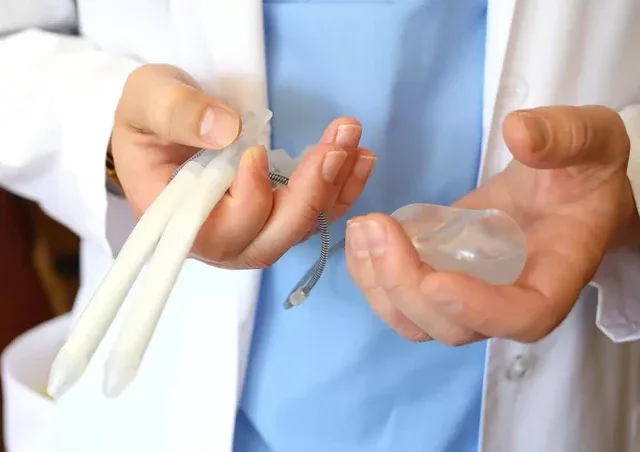 ✓ Clinician-reviewed information
- Penile prosthesis implantation is the preferred surgical pathway for men with Peyronie’s disease and erectile dysfunction that does not respond adequately to medical treatment.
- The prosthesis itself can straighten some penile curvature, but additional modeling, plication, incision or grafting may be required when meaningful deformity remains.
- Inflatable penile prostheses are commonly used because they provide strong rigidity and allow assessment and correction of curvature during surgery.
- The main goals are reliable erections, functionally adequate straightening and restoration of penetrative sexual function rather than guaranteed penile lengthening.
- Complex deformity, severe fibrosis and previous penile surgery can make the procedure more technically demanding.
About penile prosthesis with peyronie’s correction
This procedure combines treatment of two problems:
Erectile dysfunction
Penile curvature or deformity caused by Peyronie’s disease
Peyronie’s disease can produce curvature, narrowing, hourglass deformity, shortening and instability during erection.
Some men with Peyronie’s disease also develop erectile dysfunction.
When erections remain inadequate despite appropriate medication or other conservative ED treatment, straightening surgery alone may not solve the patient’s main functional problem.
In this situation, penile prosthesis implantation provides mechanical rigidity, while additional reconstructive techniques can correct any residual deformity.
Why is a penile implant used?
A penile prosthesis creates reliable penile rigidity independent of the patient’s natural erectile vascular mechanism.
This makes it particularly useful when Peyronie’s disease coexists with:
Severe erectile dysfunction
Poor response to PDE5 inhibitors
Significant penile fibrosis
Diabetes-related ED
Post-prostatectomy ED
Veno-occlusive dysfunction
Other irreversible erectile problems
The implant therefore treats erectile dysfunction while also providing a rigid framework that assists with straightening the penis.
Can the implant alone straighten Peyronie’s curvature?
Sometimes.
Insertion and inflation of an appropriately sized prosthesis can correct part or even most of the curvature in selected patients.
For mild or moderate residual deformity, no additional reconstructive procedure may be necessary.
If significant curvature remains after implantation, the surgeon can perform additional straightening maneuvers during the same operation.
What is penile modeling?
Penile modeling is one of the most commonly used additional techniques.
After the inflatable prosthesis is inserted and fully inflated, the surgeon carefully bends the erect penis in the direction opposite the curvature.
This controlled force stretches or disrupts the restrictive Peyronie’s tissue and can substantially improve residual curvature.
Modeling should be performed carefully because excessive force can injure the urethra or corporal tissues.
On your platform, Penile Modeling belongs under Techniques.
When is plication added?
If meaningful curvature remains after prosthesis insertion and modeling, penile plication may be added.
Plication shortens the longer side of the penis to improve alignment.
It can be particularly useful for residual curvature that remains localized and mechanically correctable.
Because shortening can occur, the surgeon balances straightening against preservation of penile length.
When is plaque incision or grafting required?
More complex deformities may require incision of the Peyronie’s plaque or tunica.
This can be necessary when the patient has:
Severe residual curvature
Significant hourglass narrowing
Hinge deformity
Severe shortening
Dense restrictive fibrosis
A graft may be used if the resulting tunical defect is large.
This represents a more complex reconstructive operation than prosthesis placement alone.
Which implant is usually used?
Inflatable penile prostheses are commonly preferred in men with Peyronie’s disease because they provide:
Strong rigidity
More natural flaccid appearance
Ability to repeatedly cycle the penis
Better assessment of curvature during surgery
Opportunity for postoperative remodeling
Malleable prostheses can also be appropriate in selected patients, particularly when:
Hand dexterity is limited
Device simplicity is preferred
Severe fibrosis makes implantation more difficult
Salvage or reconstructive considerations influence device choice
There is no single implant model that is appropriate for every patient.
What happens during surgery?
The operation generally begins with penile prosthesis implantation.
The surgeon creates space within the corpora cavernosa and places the cylinders.
For an inflatable prosthesis, a pump is positioned in the scrotum and a fluid reservoir is placed in the pelvis or another appropriate location.
The prosthesis is then inflated.
The surgeon evaluates:
Residual curvature
Penile symmetry
Hourglass narrowing
Hinge effect
Distal support
Cylinder position
If the penis is functionally straight, no additional correction may be necessary.
If deformity remains, the surgeon may proceed with:
Modeling
Plication
Plaque incision
Plaque incision and grafting
Other reconstructive maneuvers
The exact surgical plan may therefore only be finalized after the prosthesis is in place.
Is this the same as ordinary penile implant surgery?
Not exactly.
The implant component is similar, but Peyronie’s disease can significantly increase reconstructive complexity.
Additional challenges may include:
Fibrosis
Shortened corpora
Asymmetric corporal space
Calcified plaques
Severe curvature
Hourglass deformity
Previous Peyronie’s procedures
Patients therefore benefit from a surgeon experienced in both penile prosthetics and reconstructive Peyronie’s surgery.
Does the procedure restore penile length?
The primary goals are:
Reliable rigidity
Functional straightening
Ability to have penetrative intercourse
It should not be marketed as a guaranteed penile-lengthening procedure.
Many men with Peyronie’s disease have already lost length because of fibrosis, curvature, longstanding ED or previous surgery.
The prosthesis restores rigidity and may improve functional dimensions, but it cannot guarantee return to the patient’s original pre-disease length.
Why not do grafting alone?
Grafting relies on adequate natural erectile rigidity.
If the patient already has significant ED that does not respond to medication, correcting curvature alone may leave him with a straighter penis that still cannot become adequately rigid.
A penile prosthesis addresses both conditions at once.
Why surgeon experience matters
This procedure can range from straightforward implant placement with mild modeling to highly complex reconstructive surgery.
A specialist must understand:
Prosthesis sizing
Corporal fibrosis
Peyronie’s anatomy
Modeling technique
Plication
Grafting
Urethral protection
Device troubleshooting
Postoperative rehabilitation
For medical tourists, this level of subspecialty experience is more important than choosing a hospital based on price alone.
Who it is for
- •You have Peyronie’s disease together with erectile dysfunction that does not respond adequately to medication.
- •You cannot achieve sufficient rigidity for penetrative intercourse despite appropriate conservative ED treatment.
- •Penile curvature or deformity significantly interferes with sexual activity.
- •You have Peyronie’s disease with severe penile fibrosis and unreliable erections.
- •You have undergone previous Peyronie’s treatment but continue to have significant curvature and ED.
- •You have post-prostatectomy or vascular erectile dysfunction together with Peyronie’s deformity.
- •You understand that the prosthesis treats erectile rigidity and additional surgical maneuvers may be required to correct curvature.
- •You understand that straightening may involve modeling, plication, incision or grafting depending on operative findings.
- •You understand that penile length cannot be guaranteed.
- •You are medically fit for anesthesia and elective implant surgery.
- •Your erectile function is adequate for intercourse and your main problem is curvature alone that can be treated with plication or grafting.
- •Your Peyronie’s disease remains actively changing and erectile function is still adequate.
- •You have an untreated urinary tract infection.
- •You have an untreated genital or systemic infection.
- •You are medically unfit for elective prosthesis surgery.
- •You expect the prosthesis to restore or increase penile length beyond your anatomical limits.
- •Your main goal is cosmetic penile enlargement rather than treatment of ED and deformity.
- •You are unwilling or unable to operate the selected device and no suitable alternative device is acceptable.
- •You are unwilling to follow postoperative wound care, device training and activity restrictions.
Preparing for surgery
What recovery looks like
Risks and complications
Common questions
What is penile prosthesis surgery with Peyronie’s correction?
Who needs this procedure?
Can a penile implant straighten Peyronie’s disease by itself?
What happens if curvature remains after the implant is placed?
What is penile modeling?
Is modeling always necessary?
Can plication be performed with a penile implant?
Can grafting be performed with a penile implant?
Which penile implant is best for Peyronie’s disease?
Is an inflatable implant better than a malleable implant?
Does the procedure cure erectile dysfunction?
Does the procedure cure Peyronie’s disease?
Does the implant restore penile length?
Can the AMS 700 LGX increase length?
What if I already have severe penile shortening?
What if I have severe penile fibrosis?
How successful is the procedure?
Can the curvature come back?
Can the implant break?
How long does the surgery take?
How long should I stay in Turkey?
How long do I stay in hospital?
When can I return to work?
When can I have sex?
Can I fly after surgery?
Which doctor should perform this surgery?
Patient reviews
Been treated? Your honest review of Penile Prosthesis with Peyronie’s Correction helps the next patient.
No one has reviewed this yet. If you have been treated, your experience would help the next person.
Write the first reviewSources
- EAU Guidelines on Sexual and Reproductive Health — Penile Curvature https://uroweb.org/guidelines/sexual-and-reproductive-health/chapter/penile-curvature
- EAU Guidelines on Sexual and Reproductive Health — Management of Erectile Dysfunction https://uroweb.org/guidelines/sexual-and-reproductive-health/chapter/management-of-erectile-dysfunction
- Peyronie’s Disease: AUA Guideline https://www.auanet.org/guidelines-and-quality/guidelines/peyronies-disease-guideline
- A surgical algorithm for the treatment of Peyronie's disease https://pubmed.ncbi.nlm.nih.gov/?term=Levine+Dimitriou+surgical+algorithm+Peyronie%27s+disease
- A new treatment for Peyronie's disease: modeling the penis over an inflatable penile prosthesis https://pubmed.ncbi.nlm.nih.gov/?term=Wilson+Delk+modeling+inflatable+penile+prosthesis+Peyronie
- Comparison between AMS 700 CX and Coloplast Titan inflatable penile prosthesis for Peyronie’s disease https://pubmed.ncbi.nlm.nih.gov/?term=Chung+Solomon+DeYoung+Brock+Peyronie+prosthesis