
Skip to content
Procedure

Penile Plication Surgery

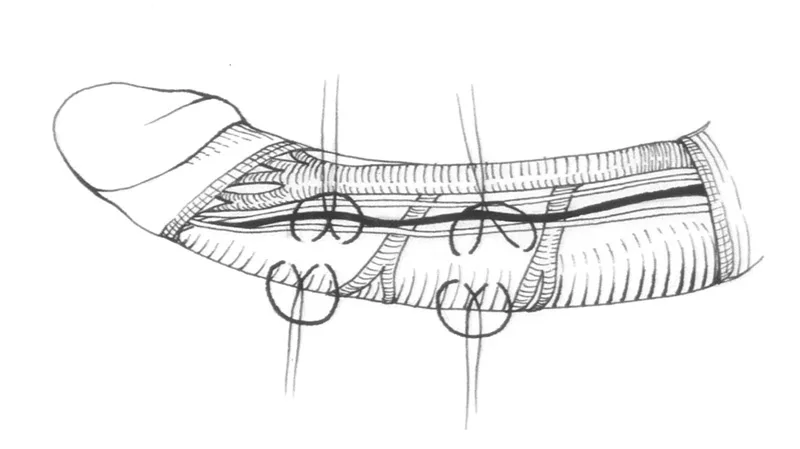
Penile plication surgery is an operation used to straighten a curved penis by placing sutures or modifying the tunica albuginea on the longer, convex side of the penis, shortening that side until the shaft becomes functionally straight. It is used mainly for congenital penile curvature and selected men with stable Peyronie's disease who have adequate erectile rigidity and enough penile length to tolerate some shortening.
AnaesthesiaGeneral
Operating time60–120 min
Hospital stay0–1 nights
Days in Türkiye5–7 days
Back to work1–2 weeks
Penile Plication Surgery: Curvature Correction & Recovery✓ Clinician-reviewed information
Key takeaways
  • Penile plication straightens the penis by shortening the longer side rather than cutting into and grafting the shorter side.
  • It is an established surgical treatment for congenital penile curvature and selected men with stable Peyronie's disease.
  • The best candidates usually have good erectile function, adequate penile length and no severe hourglass or hinge deformity.
  • Penile shortening is the most important trade-off patients should understand before choosing plication surgery.
  • EAU guidance recommends tunical-shortening procedures as a first surgical option in appropriately selected Peyronie's patients and recognizes plication techniques as established correction methods for congenital curvature.

About penile plication surgery

Penile plication is a reconstructive surgery used to straighten an abnormally curved erect penis.

The penis has two erectile cylinders called the corpora cavernosa. When one side of the penis is effectively shorter than the other, the penis bends toward the shorter side during erection.

Plication corrects this imbalance by shortening the opposite, longer side.

The surgeon places sutures or modifies the tunica albuginea — the strong tissue surrounding the corpora cavernosa — until both sides of the erect penis are functionally similar in length.

The goal is not necessarily to create a mathematically perfectly straight penis. The objective is to achieve sufficient straightening to permit comfortable sexual intercourse while preserving erectile function.

What conditions can penile plication treat?

Plication is principally used for:

Congenital penile curvature

Congenital curvature has usually been present since the patient's earliest erections and is not caused by Peyronie's plaques.

Surgery is the definitive treatment when curvature produces significant functional difficulty.

Peyronie's disease

Plication may also be appropriate for men with Peyronie's disease when:

  • Disease has stabilized

  • Curvature interferes with intercourse

  • Erectile rigidity remains adequate

  • Penile length is sufficient

  • Deformity is not excessively complex

Peyronie's disease should generally be stable before reconstructive surgery is performed.

How does penile plication work?

During surgery, the penis is usually assessed with an artificial erection.

This allows the surgeon to determine:

  • Direction of curvature

  • Maximum curvature angle

  • Point of greatest deformity

  • Whether additional deformities are present

The surgeon then places plication sutures or modifies tissue on the convex side, opposite the direction of curvature.

For example, if the penis curves downward, shortening is generally performed on the dorsal side.

The artificial erection is repeated during surgery until adequate straightening has been obtained.

Does plication remove the Peyronie's plaque?

Usually, no.

This is an important distinction.

Penile plication corrects the geometry of the penis without necessarily removing or cutting the Peyronie's plaque.

The plaque remains on the shorter side while the opposite side is shortened to compensate.

This is why plication is generally less invasive than plaque incision and grafting.

What are the advantages of plication?

Compared with tunical-lengthening or grafting surgery, plication generally offers:

  • Less extensive dissection

  • Shorter operating time

  • No graft requirement

  • Lower risk of postoperative erectile deterioration in appropriately selected men

  • Predictable curvature correction

  • Relatively straightforward recovery

The principal trade-off is penile shortening.

What are the disadvantages?

The most important disadvantage is that the operation works by shortening the longer side.

Consequently, patients may notice a reduction in erect penile length.

Other potential issues include:

  • Palpable suture knots

  • Residual curvature

  • Recurrent curvature

  • Altered penile sensation

  • Pain around sutures

  • Cosmetic dissatisfaction

Preoperative counselling is particularly important because patient satisfaction depends heavily on realistic expectations.

How much shortening occurs?

There is no universal amount.

Length change depends on:

  • Starting penile length

  • Degree of curvature

  • Direction of curvature

  • Number of plications

  • Surgical technique

  • Complexity of deformity

Greater curvature generally requires greater shortening to achieve straightening.

This is why plication is generally more attractive for men who already have adequate penile length.

Plication vs plaque incision and grafting

These procedures correct curvature in opposite ways.

Plication

The surgeon shortens the longer side.

Advantages include simpler surgery and generally lower risk of erectile deterioration.

The trade-off is penile shortening.

Plaque incision and grafting

The surgeon lengthens the shorter side by incising the restrictive tunica/plaque and covering the resulting defect with graft material.

This may be considered for:

  • Severe curvature

  • Significant shortening

  • Complex deformity

  • Hourglass deformity

  • Hinge deformity

provided erectile function is adequate.

Plication vs penile implant surgery

Patients with good erections generally do not require a penile prosthesis merely to correct curvature.

However, men with Peyronie's disease and erectile dysfunction that does not respond adequately to medication are generally better candidates for Penile Implant Surgery, with modeling, plication or grafting added when necessary.

What plication techniques exist?

Several methods have been developed.

These include:

  • 16-dot plication

  • Essed–Schröder plication

  • Nesbit-based shortening procedures

  • Yachia corporoplasty

  • Other tunical plication modifications

For Andrology Abroad, these belong under Techniques, not separate Procedure entities.

Current EAU guidance does not identify one plication technique as universally superior to all others.

Outcomes
EAU guidance reports overall curvature-correction success rates of approximately 90–100% in most published series of congenital penile curvature surgery, including plication/shortening approaches. For long-term Peyronie's-specific counselling, outcomes are more variable. One long-term series of 187 men treated with tunica albuginea plication reported 77% completely satisfied and 14% partially satisfied, with residual or recurrent curvature in 15 patients over extended follow-up.
Source: European Association of Urology — Congenital Penile Curvature guidelin

Who it is for

✓ May be suitable if
  • You have congenital penile curvature that makes penetration difficult or causes significant functional problems.
  • You have stable Peyronie's disease with curvature that interferes with sexual intercourse.
  • Your erections are sufficiently rigid for intercourse, either naturally or with medical treatment.
  • You have adequate penile length and accept the possibility of some postoperative shortening.
  • Your curvature is suitable for a tunical-shortening operation.
  • You do not have a major hourglass or hinge deformity requiring a lengthening/reconstructive approach.
  • You have realistic expectations about straightening, penile length and the possibility of residual curvature.
  • Your Peyronie's disease has been stable, generally without recent progression of curvature or other active changes.
  • You are medically fit for elective surgery and anesthesia.
✕ Not suitable if
  • You have severe erectile dysfunction that does not respond adequately to medication or other conservative ED treatment.
  • Your main problem is erectile rigidity rather than curvature.
  • Peyronie's curvature is still actively changing or progressing.
  • You have significant penile pain suggesting the disease remains in an active phase.
  • You have severe penile shortening and further shortening would be unacceptable.
  • You have a major hourglass deformity or hinge instability better suited to another reconstructive approach.
  • You have extremely severe or complex curvature for which grafting or another strategy is more appropriate.
  • You have an untreated urinary, genital or systemic infection.
  • You are medically unfit for elective surgery or anesthesia.
  • You expect surgery to increase penile length or girth.
  • Your curvature is mild and does not cause functional or meaningful personal difficulty.

Preparing for surgery

Send the surgeon photographs of the fully erect penis from several angles when requested through a secure medical channel.
Provide details about when the curvature began and whether it has changed recently.
Tell the surgeon whether the curvature is congenital or developed later in life.
Report penile pain, plaques, narrowing, hourglass deformity or hinge instability.
Describe whether penetrative intercourse is possible.
Inform the medical team about erection quality and any erectile dysfunction medication you use.
Provide previous penile Doppler, ultrasound or Peyronie's treatment records when available.
Provide a complete medication list.
Tell the medical team about anticoagulant or antiplatelet medications.
Do not independently stop prescribed blood thinners; follow instructions from the surgical and prescribing teams.
Complete requested blood and urine tests.
Treat active urinary or genital infection before elective surgery.
Stop smoking before surgery when possible.
Follow anesthesia fasting instructions.
Discuss expected penile shortening explicitly with the surgeon before consenting to plication.
Arrange enough time in Turkey for postoperative review before travelling home.

What recovery looks like

Day 0 — Surgery
Penile plication is performed under anesthesia after the surgeon confirms the direction and degree of curvature, commonly using an artificial erection. Sutures or tunical modifications are placed on the longer side until satisfactory straightening is achieved. Patients are monitored after anesthesia and may return to their hotel the same day or remain overnight depending on the surgeon's protocol and individual recovery.
Days 1–3 — Early recovery
During the first several days, penile swelling, bruising, tenderness and mild-to-moderate incisional discomfort are expected. Erections during sleep can feel uncomfortable because the tissues are newly tightened. Patients should walk gently but avoid strenuous activity, heavy lifting and sexual stimulation while taking prescribed medication exactly as directed.
Days 4–7 — Early follow-up
Swelling and discomfort should gradually begin to decrease during the first week. The surgeon assesses wound healing and checks for excessive swelling, infection or other early problems. International patients should ideally undergo this postoperative review before leaving Turkey.
Week 2 — Return to routine activity
Many patients with desk-based jobs can return to work during the first or second week if pain is controlled and healing is uncomplicated. Some residual swelling, sensitivity or awareness of the plication sutures may remain. Heavy exercise, cycling and sexual activity should still be avoided.
Weeks 3–4 — Continued healing
Bruising and swelling usually continue to resolve during weeks three and four. Patients often feel substantially more comfortable with normal daily activities, although the penis may still feel different during spontaneous erections. The internal plication sites continue to heal, so strenuous exercise and intercourse should not be resumed until the surgeon considers the repair sufficiently secure.
Weeks 4–6 — Increasing activity
Most uncomplicated patients can progressively return to exercise and more demanding activity according to surgical advice. Palpable suture knots or small areas of firmness may still be noticeable and are not automatically signs of a complication. Penile sensation and erection comfort generally continue to improve.
Around Week 6 and beyond — Return to sexual activity
Sexual intercourse can often resume at approximately six weeks once the incision is healed, erections are comfortable and the surgeon has confirmed adequate recovery. At this stage the patient can more meaningfully assess functional straightening. Mild residual curvature may remain acceptable if penetration is comfortable and stable.

Risks and complications

Penile shortening
Some reduction in penile length is an expected potential consequence because plication works by shortening the longer side of the penis. The amount varies with curvature severity, technique and starting length.
Residual curvature
The penis may not become perfectly straight. Mild residual curvature can remain even after technically successful surgery and may not interfere with intercourse.
Recurrent curvature
Curvature can recur over time because of suture failure, tissue remodeling or progression of underlying Peyronie's disease.
Palpable sutures or knots
Patients may feel small knots or areas of firmness beneath the penile skin where plication sutures were placed. These can occasionally be uncomfortable.
Penile pain
Temporary pain during healing and erections is common. Persistent pain is less common and should be assessed if it does not improve.
Altered penile sensation
Temporary or, less commonly, persistent changes in glans or penile sensation can occur.
Erectile dysfunction
New erectile dysfunction is possible but is generally less common after shortening procedures than after more extensive grafting surgery in appropriately selected patients. Existing ED may also persist because plication straightens the penis but does not treat underlying erectile dysfunction.
Under-correction
Insufficient straightening may leave functionally significant curvature.
Over-correction
Excessive correction can potentially produce curvature in the opposite direction.
Suture failure
Plication sutures can loosen, break or pull through tissue, potentially contributing to recurrent curvature.
Bleeding or hematoma
Bleeding can cause bruising or hematoma within penile tissues.
Infection
Surgical-site infection is uncommon but possible.
Wound healing problems
Delayed healing, wound separation or local irritation can occasionally occur.
Need for additional surgery
Persistent or recurrent curvature, significant discomfort or another complication may occasionally require further reconstructive surgery.

Common questions

What is penile plication surgery?
Penile plication is surgery that straightens a curved penis by shortening the longer side with sutures or tunical modification.
What conditions does penile plication treat?
It is primarily used for congenital penile curvature and selected men with stable Peyronie's disease.
Does penile plication remove Peyronie's plaque?
Usually not. Plication corrects curvature by shortening the opposite side of the penis rather than removing the plaque.
Is penile plication recommended for Peyronie's disease?
Yes, in appropriately selected patients. Current EAU guidance recommends tunical-shortening procedures as a first surgical option when penile length and erectile rigidity are adequate, curvature is less severe and complex hourglass or hinge deformity is absent.
Does Peyronie's disease need to be stable before surgery?
Yes. Surgical correction is generally reserved for stable disease when curvature has stopped progressing and the deformity interferes with sexual intercourse.
Can plication treat congenital penile curvature?
Yes. Surgery is the definitive treatment for congenital curvature causing functional impairment, and EAU guidance specifically recommends plication/Nesbit-type shortening procedures.
How successful is penile plication?
Published results vary with diagnosis and technique. EAU guidance reports 90–100% overall correction in most congenital curvature surgical series. A long-term Peyronie's plication study found 77% completely satisfied and another 14% partially satisfied.
Will my penis be perfectly straight?
Not necessarily. The goal is usually a functionally straight penis that permits comfortable penetration. A small residual curvature may remain.
Will penile plication shorten my penis?
It can. Because the operation corrects curvature by shortening the longer side, some reduction in erect length is an expected trade-off.
How much length will I lose?
There is no universal number. Greater curvature generally requires more shortening, and individual results depend on anatomy and technique.
Does plication increase penis length?
No. It is a straightening operation and should not be marketed as penile-lengthening surgery.
Can plication improve erectile dysfunction?
No. Penile plication corrects curvature but does not treat the vascular or neurological causes of ED.
What if I have Peyronie's disease and severe erectile dysfunction?
If erections remain inadequate despite appropriate medical treatment, penile prosthesis implantation with additional straightening when necessary is generally the preferred surgical pathway rather than plication alone.
What is the difference between plication and grafting?
Plication shortens the longer side of the penis. Grafting lengthens the shorter side by opening the restrictive tunica and covering the defect with graft material. Grafting is often considered for more severe or complex deformity when erectile function is good.
Is Nesbit surgery the same as penile plication?
They belong to the same family of tunical-shortening procedures, but the technical method differs. On Andrology Abroad, Nesbit should be modeled under your Techniques category rather than as another competing Procedure page.
What is 16-dot plication?
The 16-dot technique is a plication method using strategically positioned sutures to shorten the convex side of the penis. It belongs under Techniques.
Are the sutures permanent?
Many plication approaches use non-absorbable sutures intended to maintain correction, while specific material and technique vary between surgeons.
Can I feel the sutures afterward?
Yes. Some men can feel small knots or areas of firmness beneath the skin. They often become less noticeable with time but can occasionally remain bothersome.
Can curvature come back after plication?
Yes. Recurrent or residual curvature can occur. A long-term Peyronie's series documented residual/recurrent curvature in 15 of 187 patients, although it did not prevent intercourse in those cases.
Can plication be repeated?
Yes, selected patients with significant residual or recurrent curvature may undergo additional plication. A small salvage-plication series reported satisfaction in 6 of 7 patients at follow-up.
How long does penile plication take?
Approximately 60–120 minutes is a reasonable planning range for an uncomplicated operation.
Do I need to stay in hospital?
Many patients can leave the same day or after one overnight stay.
How long should I stay in Turkey?
Approximately 5–7 days is a practical international-patient planning period for an uncomplicated procedure.
When can I return to work?
Desk-based work is often possible within approximately 1–2 weeks, while physically demanding work may require longer.
When can I have sex after penile plication?
Many surgeons recommend waiting approximately six weeks, although the actual timing should depend on healing and surgical clearance.
Can I fly after penile plication surgery?
International travel is usually considered after early postoperative assessment when pain is controlled, mobility is good and no complication is suspected. Patients should obtain surgeon clearance before flying rather than relying on a fixed universal day.
Which doctor should perform penile plication?
A urologist or andrologist experienced in Peyronie's disease, congenital penile curvature and reconstructive penile surgery is the most appropriate specialist.

Patient reviews

Been treated? Your honest review of Penile Plication Surgery helps the next patient.

Write a review
No reviews yet

Be the first to share your experience of this procedure. We read and verify every review before it is published.

Write the first review

Sources

  1. European Association of Urology — EAU Guidelines on Sexual and Reproductive Health: Penile Curvature https://uroweb.org/guidelines/sexual-and-reproductive-health/chapter/penile-curvature
  2. American Urological Association — Peyronie’s Disease Guideline https://www.auanet.org/guidelines-and-quality/guidelines/peyronies-disease-guideline
  3. Long-term Peyronie’s plication outcomes — PubMed https://pubmed.ncbi.nlm.nih.gov/29195031
  4. Salvage plication for residual/recurrent curvature — PubMed https://pubmed.ncbi.nlm.nih.gov/33036958
  5. EAU congenital penile curvature guidance https://uroweb.org/guidelines/paediatric-urology/chapter/congenital-penile-curvature