
TESE — Testicular Sperm Extraction
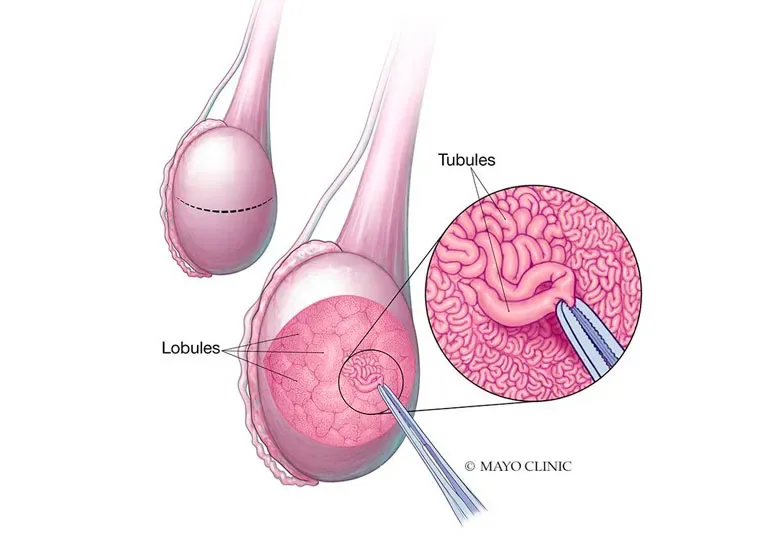
Testicular sperm extraction (TESE) is a surgical sperm retrieval procedure in which a small incision is made in the testicle and testicular tissue containing seminiferous tubules is removed and examined for viable sperm. Retrieved sperm can be used fresh or cryopreserved for intracytoplasmic sperm injection (ICSI), and TESE may be used for obstructive azoospermia and selected cases of non-obstructive azoospermia, although Micro-TESE is generally preferred when sperm production is severely impaired.
 ✓ Clinician-reviewed information
- TESE retrieves sperm by surgically removing small samples of testicular tissue rather than aspirating tissue through a needle.
- It can be used when sperm cannot be found in the ejaculate and surgical sperm retrieval is required for ICSI.
- Sperm retrieval is highly successful in obstructive azoospermia because testicular sperm production is usually preserved.
- Conventional TESE can also find sperm in some men with non-obstructive azoospermia, but Micro-TESE generally offers a more targeted approach when sperm production is severely impaired.
- Successful sperm retrieval does not guarantee fertilization, pregnancy or live birth; these depend on both partners and the IVF/ICSI process.
About tese — testicular sperm extraction
TESE stands for Testicular Sperm Extraction.
It is a surgical sperm retrieval procedure that obtains sperm directly from testicular tissue.
Unlike TESA, which uses a needle to aspirate testicular tissue through the skin, TESE involves making a small surgical incision in the scrotum and testicle.
Small samples of seminiferous tubules are removed and immediately examined by an embryology laboratory.
If viable sperm are identified, they can be used for ICSI or cryopreserved for future fertility treatment.
Why are sperm retrieved from the testicle?
Sperm are produced inside the seminiferous tubules of the testes.
Some men produce sperm but cannot release them into the semen because their reproductive tract is blocked.
Other men have severely reduced sperm production, with sperm occurring only in limited areas of testicular tissue.
TESE allows the fertility team to search directly within testicular tissue rather than relying on sperm being present in the ejaculate.
How is TESE performed?
The procedure begins with anesthesia and preparation of the scrotal area.
A small incision is made in the scrotal skin and the tissue surrounding the testicle.
The surgeon then creates a small opening in the tunica albuginea, the protective layer surrounding the testis.
A small amount of testicular tissue containing seminiferous tubules is removed.
The sample is immediately transferred to the embryology laboratory, where the tissue is processed and examined for sperm.
If adequate sperm are identified, additional tissue may be collected for cryopreservation when appropriate.
If sperm are not found in the first sample, additional biopsies from other areas may be taken.
The testicular opening and scrotal incision are then closed.
What is conventional TESE?
Conventional TESE refers to testicular sperm extraction performed without microsurgical selection of individual seminiferous tubules.
The surgeon takes one or more testicular biopsies from selected areas.
This differs from Micro-TESE, where the testis is opened more extensively and an operating microscope is used to identify seminiferous tubules that appear more likely to contain sperm.
This distinction is particularly important in non-obstructive azoospermia.
Who usually needs TESE?
TESE may be considered in several situations.
Obstructive azoospermia
In obstructive azoospermia, sperm production is preserved but sperm cannot reach the semen because of a blockage.
Potential causes include:
Previous vasectomy
Congenital reproductive-tract abnormalities
Epididymal obstruction
Vas deferens obstruction
Previous infection
Previous reproductive surgery
Because sperm production is usually preserved, testicular sperm retrieval is highly successful in appropriately diagnosed obstructive azoospermia.
Post-vasectomy infertility
Men who want biological children after vasectomy can consider:
Vasectomy reversal
Surgical sperm retrieval with IVF/ICSI
TESE is one method of obtaining sperm directly from the testicle when assisted reproduction is chosen.
Failed epididymal sperm retrieval
If PESA or MESA cannot retrieve sufficient epididymal sperm, testicular sperm retrieval may be performed.
Selected non-obstructive azoospermia
Conventional TESE has historically been used for NOA.
However, sperm production in NOA can occur in very small and unpredictable areas.
Multiple conventional biopsies may therefore miss those areas while removing unnecessary testicular tissue.
Micro-TESE was developed partly to address this problem.
TESE vs TESA
Both procedures retrieve sperm from the testicle.
TESA
TESA uses a needle passed through the scrotal skin.
It is:
Percutaneous
Less invasive
Usually faster
Particularly useful for obstructive azoospermia
TESE
TESE uses an open surgical approach.
It allows the surgeon to:
Directly obtain testicular tissue
Retrieve larger tissue samples
Take samples from multiple areas when necessary
Obtain sperm when needle aspiration has failed
For obstructive azoospermia, both approaches can be highly successful.
TESE vs Micro-TESE
This is the most important distinction for your page.
Conventional TESE
The surgeon takes one or several testicular biopsies without systematically examining individual seminiferous tubules under an operating microscope.
Micro-TESE
The surgeon opens the testicle and uses high-powered optical magnification to identify larger or more opaque seminiferous tubules that may be more likely to contain active sperm production.
Micro-TESE attempts to:
Improve sperm detection in focal spermatogenesis
Remove less unnecessary testicular tissue
Reduce tissue damage
Improve retrieval in difficult NOA cases
The EAU considers Micro-TESE the preferred surgical sperm retrieval approach for men with non-obstructive azoospermia.
For Andrology Abroad, TESE and Micro-TESE should therefore remain separate Procedure pages.
How successful is TESE in obstructive azoospermia?
Sperm production is usually intact in obstructive azoospermia.
As a result, sperm retrieval from the testicle is expected to be very high.
Published comparative studies have reported sperm recovery approaching 100% in appropriately selected obstructive azoospermia cases.
The more difficult question is usually not whether sperm exist, but which retrieval technique provides adequate sperm with the least unnecessary intervention.
How successful is conventional TESE in non-obstructive azoospermia?
Results are substantially less predictable.
Published studies report considerable variation depending on:
Cause of NOA
Testicular histology
Patient selection
Number of biopsies
Previous sperm retrieval
Surgical technique
The EAU reports conventional TESE sperm retrieval rates of approximately 50% in single-arm NOA studies, while comparative studies have sometimes reported lower rates.
Therefore, a single universal percentage should not be promised to an individual patient.
Why can multiple biopsies be needed?
Sperm production in NOA may be focal.
One part of the testis can contain no sperm while another small region may still have active spermatogenesis.
Conventional TESE may therefore involve biopsies from multiple areas.
However, taking more tissue increases the potential for:
Bleeding
Hematoma
Fibrosis
Loss of testicular tissue
Temporary or persistent changes in testosterone production
This is one reason Micro-TESE is often preferred for NOA.
What happens to the testicular tissue in the laboratory?
The embryology laboratory mechanically separates the seminiferous tubules and examines the processed tissue under magnification.
The goal is to identify viable sperm suitable for ICSI.
When sperm are found, they may be:
Used fresh
Cryopreserved
Divided between immediate treatment and storage
Close communication between the surgeon and embryologist during TESE is extremely important.
Why is ICSI used after TESE?
TESE sperm are normally used with intracytoplasmic sperm injection.
During ICSI, an embryologist selects a sperm and injects it directly into an egg.
This bypasses many steps required for natural fertilization.
Conventional IVF or intrauterine insemination generally requires larger numbers of motile sperm and is therefore usually inappropriate for surgically retrieved testicular sperm.
Can TESE sperm be frozen?
Yes.
If sufficient viable sperm are identified, testicular sperm can be cryopreserved.
Freezing sperm can:
Reduce the need for another operation
Allow future ICSI cycles
Separate the timing of male surgery from female egg retrieval
Provide backup sperm before an IVF cycle
However, men with very limited focal sperm production may not produce enough sperm for extensive cryopreservation.
Does TESE restore sperm to the semen?
No.
TESE retrieves sperm but does not repair the underlying cause of azoospermia.
Men with reproductive-tract obstruction remain obstructed afterward.
If natural conception is the objective, reconstructive surgery may be considered when appropriate.
TESE or vasectomy reversal?
For post-vasectomy infertility, this is an important decision.
Vasectomy reversal attempts to restore natural sperm passage.
TESE combined with IVF/ICSI bypasses the obstruction.
Factors influencing the decision include:
Female partner age
Ovarian reserve
Time since vasectomy
Female fertility factors
Desired number of future children
Previous fertility history
Availability of microsurgical reversal
Couple preference
Neither approach should automatically be presented as superior.
Why genetic evaluation matters in azoospermia
Some causes of azoospermia are genetic.
Depending on the clinical presentation, testing may include:
Karyotype
Y-chromosome microdeletion analysis
CFTR testing
Genetic counselling is particularly important because some abnormalities can affect the probability of sperm retrieval or potentially be transmitted to offspring.
Men with complete AZFa or AZFb Y-chromosome microdeletions should not undergo surgical sperm retrieval because sperm retrieval is not expected.
Why medical-tourism coordination matters
TESE should not be treated as an isolated operation.
The procedure needs coordination between:
Reproductive urologist or andrologist
Embryologist
IVF specialist
Cryopreservation laboratory
Female fertility team
Before travelling, patients should know whether sperm will be retrieved:
Before the IVF cycle and frozen
On the day of egg retrieval
As backup after another retrieval technique
This avoids unnecessary travel and poorly coordinated procedures.
Who it is for
- •You have obstructive azoospermia and require sperm retrieval for IVF/ICSI.
- •You produce sperm but a blockage prevents sperm from reaching the ejaculate.
- •You have infertility after vasectomy and have chosen sperm retrieval with IVF/ICSI rather than vasectomy reversal.
- •Epididymal sperm retrieval has failed or is not appropriate.
- •TESA has failed or is unlikely to provide sufficient testicular tissue.
- •Your reproductive team needs testicular sperm for ICSI.
- •You have selected non-obstructive azoospermia where conventional TESE has been considered appropriate after specialist evaluation.
- •You understand that Micro-TESE may be preferable to conventional TESE in NOA.
- •You understand that sperm retrieval does not guarantee pregnancy or live birth.
- •You are medically fit for surgery and the planned anesthesia.
- •You have not undergone adequate investigation to determine why sperm are absent from the ejaculate.
- •You have untreated genital, urinary or systemic infection.
- •You have an uncontrolled bleeding disorder or anticoagulation that cannot be safely managed.
- •You are medically unfit for elective surgery or anesthesia.
- •You have complete AZFa or AZFb Y-chromosome microdeletions, where sperm retrieval is not expected.
- •You have non-obstructive azoospermia for which Micro-TESE is considered the more appropriate first surgical retrieval approach.
- •You have potentially reversible hormonal suppression that should be addressed before surgical sperm retrieval.
- •Your reproductive plan does not include ICSI or another appropriate use for retrieved sperm.
- •Your primary objective is restoration of natural sperm passage and reconstructive surgery is the more appropriate treatment.
- •You expect TESE to restore sperm to the ejaculate or guarantee biological fatherhood.
Preparing for surgery
What recovery looks like
Risks and complications
Common questions
What is TESE?
Who needs TESE?
Is TESE surgery?
What is the difference between TESE and TESA?
What is the difference between TESE and Micro-TESE?
Is TESE or Micro-TESE better for non-obstructive azoospermia?
Can TESE be used for obstructive azoospermia?
What is the TESE sperm retrieval rate?
Can TESE be used after vasectomy?
Should I choose TESE or vasectomy reversal?
What happens if TESE does not find sperm?
Can Micro-TESE find sperm after failed conventional TESE?
Does TESE hurt?
How long does TESE take?
Do I need to stay in hospital?
How long should I stay in Turkey?
When can I return to work?
When can I exercise?
When can I have sex?
Can TESE sperm be frozen?
Can frozen TESE sperm be used for ICSI?
Is ICSI required after TESE?
Does TESE cure azoospermia?
Will sperm appear in my semen after TESE?
Can TESE affect testosterone?
Can TESE be repeated?
Can every man with azoospermia undergo TESE?
Which doctor performs TESE?
Patient reviews
Been treated? Your honest review of TESE — Testicular Sperm Extraction helps the next patient.
No one has reviewed this yet. If you have been treated, your experience would help the next person.
Write the first reviewSources
- The guideline discusses conventional TESE and Micro-TESE, sperm retrieval for obstructive and non-obstructive azoospermia, genetic evaluation and complications of surgical sperm retrieval. https://uroweb.org/guidelines/sexual-and-reproductive-health-2022/chapter/male-infertility
- Comparative study reporting 100% sperm recovery with both conventional and microdissection TESE in obstructive azoospermia, while Micro-TESE achieved higher retrieval in non-obstructive azoospermia. https://pubmed.ncbi.nlm.nih.gov/12187223/
- Systematic review reporting conventional TESE sperm retrieval rates ranging from approximately 16.7% to 45%, compared with approximately 42.9% to 63% for Micro-TESE across included comparative studies. https://pubmed.ncbi.nlm.nih.gov/24193894/
- Systematic review and meta-analysis of 1,890 patients showing higher sperm retrieval with Micro-TESE than conventional TESE and higher retrieval with conventional TESE than TESA in NOA. https://pubmed.ncbi.nlm.nih.gov/26263080/
- Large systematic review and meta-analysis of more than 21,000 men evaluating conventional and Micro-TESE sperm retrieval as well as pregnancy and live-birth outcomes following ICSI. https://pubmed.ncbi.nlm.nih.gov/31665451/
- Clinical study reporting a conventional TESE sperm retrieval rate of approximately 47.6% in men with NOA. https://pubmed.ncbi.nlm.nih.gov/26872565/
- Systematic review and meta-analysis evaluating factors associated with successful salvage Micro-TESE after previous failed conventional TESE or Micro-TESE. https://pubmed.ncbi.nlm.nih.gov/37172416/