
Skip to content
Condition

Penile Prosthesis Complications

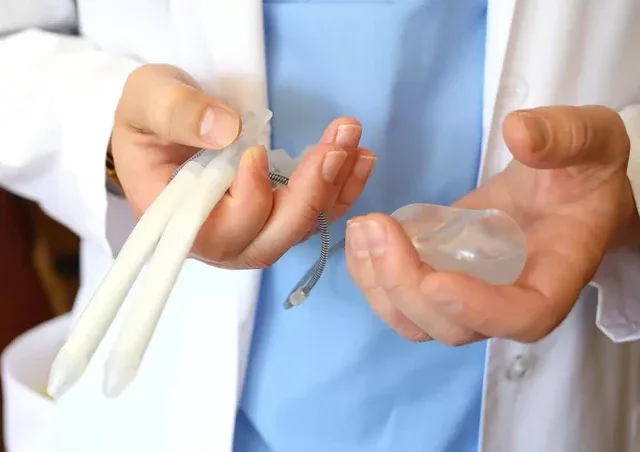
Penile prosthesis complications are problems that occur after implantation of an inflatable or malleable penile implant, including infection, mechanical failure, erosion, device migration or malposition, cylinder problems, pump or reservoir issues, pain, and corporal tissue complications. Some problems can be managed conservatively, but infection, erosion, severe mechanical failure, or device exposure often require revision or replacement surgery by an experienced prosthetic urologist.

Also known as: Penile implant complications, Penile prosthesis problems, Penile implant failure, Penile implant infection, Penile implant revision, Penile prosthesis revision, Penile implant erosion, Penile implant malfunction, Inflatable penile implant problems, Malleable penile implant complications, Penile prosthesis mechanical failure, Penile implant cylinder problem
Symptoms24 listed
ICD-10T83.490A
Treatable2 options
Penile Prosthesis Complications✓ Clinician-reviewed information
Key takeaways
  • Penile prostheses are established treatments for severe erectile dysfunction, but complications can occur after both inflatable and malleable implants.
  • Important complications include infection, mechanical failure, erosion, device exposure, migration or malposition, cylinder problems, pump or reservoir problems, and persistent pain.
  • Fever, wound drainage, increasing redness, severe swelling, device exposure, or rapidly worsening pain after implant surgery require prompt medical assessment.
  • Mechanical problems may require revision when the implant no longer inflates, deflates, or functions normally.
  • Revision surgery is usually more technically demanding than first-time implantation because scar tissue and altered anatomy may be present.

Overview

A penile prosthesis is a surgically implanted device used to create penile rigidity in men with erectile dysfunction that does not respond adequately to less invasive treatments.

The two main device categories are:

  • Inflatable penile prostheses

  • Malleable penile prostheses

Most implants function successfully for many years, but complications can develop during the early postoperative period or years later.

Problems may involve:

  • Infection

  • Device components

  • Penile tissue

  • Corporal positioning

  • Wound healing

  • Pump

  • Reservoir

  • Tubing

  • Cylinders

Some complications are urgent, while others develop gradually and primarily affect device function or comfort.

Early vs late complications

Complications can broadly be divided into early and late problems.

Early complications

These may occur during the initial postoperative period and include:

  • Infection

  • Hematoma

  • Wound problems

  • Severe swelling

  • Urinary retention

  • Device malposition

  • Early erosion

  • Significant pain

Late complications

These can occur months or years after implantation and include:

  • Mechanical failure

  • Cylinder aneurysm or defect

  • Pump failure

  • Reservoir malfunction

  • Tubing problems

  • Erosion

  • Migration

  • Device displacement

  • Chronic pain

  • Corporal fibrosis

  • Recurrent infection

The timing of symptoms helps guide diagnosis.

Why revision surgery can be more complex

Primary penile prosthesis implantation creates spaces within the corpora cavernosa for the device cylinders.

After surgery, the body forms scar tissue around the implant.

If the device later becomes infected, is removed, or requires revision, additional fibrosis may develop.

Revision surgery may therefore involve:

  • Dense corporal scar tissue

  • Altered tissue planes

  • Shortening

  • Tissue fragility

  • Higher technical complexity

  • Greater infection risk than uncomplicated primary implantation

For these reasons, complex revision should ideally be performed by a urologist with significant prosthetic experience.


Types of penile prosthesis complications

Penile Prosthesis Infection
Infection is one of the most serious complications of penile implant surgery. It may occur soon after surgery or present later. Possible signs include: Increasing penile or scrotal pain Redness Swelling Fever Drainage Wound breakdown Device exposure Pump fixation to inflamed tissue Persistent unexplained discomfort Treatment frequently requires implant removal or salvage revision, depending on the clinical situation.
Mechanical Failure
Mechanical failure occurs when one or more components stop working correctly. This may involve: Cylinders Pump Reservoir Tubing Connectors The implant may stop inflating, fail to stay inflated, fail to deflate, or function inconsistently.
Cylinder Failure
Cylinder-related complications can include: Leakage Rupture Aneurysmal expansion Incomplete inflation Asymmetric inflation Cylinder crossover Migration Distal positioning problems Cylinder malfunction can produce loss of rigidity or visible asymmetry.
Cylinder Crossover
Cylinder crossover occurs when one cylinder crosses the midline into the opposite corporal body instead of remaining in its intended corpus cavernosum. This can cause: Penile asymmetry Abnormal rigidity Device malposition Pain Poor functional result It may require surgical correction.
Cylinder Erosion
A cylinder can gradually erode through corporal tissue into surrounding structures. Potential sites include: Urethra Glans Penile skin Erosion may be associated with pain, infection, visible hardware, urinary symptoms, or device exposure. This generally requires urgent specialist evaluation.
Distal Cylinder Extrusion
A cylinder tip can migrate or erode toward the distal penis and become abnormally prominent beneath the glans or skin. This may produce: Local pain Thin overlying tissue Visible bulging Skin breakdown Impending exposure
Proximal Cylinder Migration
A cylinder may migrate proximally or become poorly seated within the corporal body. This can affect: Stability Symmetry Rigidity Penile appearance Revision may be required if function is significantly impaired.
Pump Complications
The pump used in a three-piece inflatable prosthesis can develop: Mechanical failure Malposition Migration Difficult access Adhesion to surrounding tissues Pain Infection A pump positioned too high, too deep, or in an uncomfortable location can make the device difficult to operate.
Reservoir Complications
The fluid reservoir of a three-piece inflatable prosthesis can develop: Leakage Migration Herniation Compression Malposition Rare injury to adjacent pelvic structures Reservoir-related complications are uncommon but can be technically complex.
Tubing or Connector Failure
Tubing can: Leak Disconnect Kink Become damaged Cause discomfort or palpable irregularity Loss of hydraulic fluid can make an inflatable implant fail to inflate adequately.
Penile Prosthesis Erosion or Extrusion
Any part of the device may erode through tissue and become exposed. Exposure dramatically increases concern for infection. This generally requires urgent prosthetic-urology assessment.
Device Migration or Malposition
A component may move from its intended location. This can affect: Cylinders Pump Reservoir Symptoms depend on which component has migrated.
Persistent Penile or Scrotal Pain
Some postoperative discomfort is expected initially. Persistent or newly worsening pain months after surgery can indicate: Infection Malposition Erosion Oversizing Tissue pressure Nerve irritation Chronic pain syndrome Persistent pain should not automatically be considered normal.
Corporal Fibrosis After Prosthesis Surgery
Repeated surgery, infection, implant removal, or chronic tissue injury can produce dense fibrosis of the corpora cavernosa. This can result in: Penile shortening Difficult reimplantation Reduced corporal space Complex revision surgery
Penile Shortening or Perceived Length Loss
Some men report loss of penile length after prosthesis implantation. This may relate to: Pre-existing erectile dysfunction Peyronie's disease Corporal fibrosis Previous prostate surgery Long periods without full erection Device sizing Patient expectations A penile implant primarily restores rigidity; it should not be presented as a guaranteed penile-lengthening procedure.
How common is it?
In contemporary primary penile prosthesis surgery, infection rates are commonly reported around 1%–3% in lower-risk primary cases, while rates are generally higher in revision surgery and in patients with certain risk factors.
Source: uroweb.org

Symptoms

Implant no longer inflates
Implant no longer deflates
Loss of penile rigidity
Partial inflation only
Uneven cylinder inflation
New penile asymmetry
Device feels displaced
Pump difficult to locate
Pump difficult to squeeze
Pain when using implant
Persistent penile pain
Persistent scrotal pain
Increasing swelling
Redness
Fever
Wound drainage
Skin breakdown
Visible implant component
Cylinder bulging beneath skin
Urinary symptoms
New curvature or deformity
Shortening
Device making unusual changes in function

Causes

Bacterial infection
Mechanical wear
Device component failure
Hydraulic fluid leakage
Tubing damage
Pump failure
Reservoir failure
Cylinder rupture or leakage
Incorrect component positioning
Tissue erosion
Corporal fibrosis
Repeated revision surgery
Previous implant infection
Trauma
Poor wound healing
Tissue fragility
Severe Peyronie's disease
Severe corporal fibrosis
Diabetes and other factors that can increase infection risk
Previous pelvic or penile surgery

Risk factors

Previous penile prosthesis surgery
Revision surgery
Previous prosthesis infection
Diabetes
Poor glycemic control
Immunosuppression
Spinal cord injury in selected populations
Recurrent urinary infection
Severe corporal fibrosis
Peyronie's disease
Previous priapism
Previous implant removal
Multiple previous penile operations
Poor tissue quality
Smoking
Obesity
Complex reconstructive surgery

How it is diagnosed

Diagnosis starts with determining exactly what problem the patient is experiencing and when it began.

Medical history

The prosthetic urologist may ask:

  • When the implant was placed

  • Implant manufacturer and model

  • Whether it is inflatable or malleable

  • Whether previous revisions were performed

  • Whether there was a previous infection

  • Whether the device ever worked normally

  • When function changed

  • Whether pain is present

  • Whether fever or drainage has occurred

  • Whether the implant inflates fully

  • Whether it deflates normally

  • Whether the pump can be located

  • Whether penile shape changed

  • Whether urinary symptoms developed

Patients should bring their implant identification card or device information when available.

Physical examination

The specialist examines:

  • Penis

  • Glans

  • Corporal bodies

  • Scrotum

  • Pump

  • Surgical wounds

  • Device position

  • Skin integrity

The device may be cycled during examination when appropriate to assess:

  • Inflation

  • Deflation

  • Symmetry

  • Cylinder position

  • Pump function

  • Rigidity

Evaluation for infection

Possible evidence includes:

  • Redness

  • Warmth

  • Drainage

  • Persistent swelling

  • Wound breakdown

  • Device exposure

  • Fixation of components

  • Systemic symptoms

Laboratory tests may include:

  • Complete blood count

  • CRP or inflammatory markers in selected cases

  • Urinalysis

  • Urine culture

  • Cultures from drainage or operative samples when appropriate

Normal blood tests do not completely exclude a localized prosthesis infection.

Imaging

Imaging is not necessary in every malfunction.

Depending on the suspected problem, specialists may use:

  • Ultrasound

  • X-ray in selected devices or circumstances

  • CT

  • MRI only in appropriately compatible circumstances and selected cases

Cross-sectional imaging can help identify reservoir position, migration, collections, or other complex anatomical problems.

Operative assessment

Some mechanical or corporal problems are definitively identified only during revision surgery.

When to see a doctor
  • The implant suddenly stops inflating.
  • The implant cannot be deflated.
  • Rigidity is significantly weaker than before.
  • One cylinder inflates differently from the other.
  • The penis becomes newly curved or asymmetric.
  • The pump changes position or becomes difficult to use.
  • You develop persistent or worsening penile or scrotal pain.
  • There is redness around the surgical wound.
  • There is drainage from the incision.
  • Fever develops after implant surgery.
  • Part of the device becomes visible through the skin.
  • The cylinder appears to be pushing through the glans or urethra.
  • You develop urinary symptoms with suspected erosion.
  • The implant was removed because of infection and you are considering reimplantation.

Treatment options

Reducing your risk
  • Choose an experienced prosthetic urologist.
  • Treat active urinary or systemic infections before implantation.
  • Optimize diabetes and general health before surgery.
  • Stop smoking when possible before elective surgery.
  • Follow wound-care instructions carefully.
  • Take prescribed medications correctly.
  • Avoid sexual activity until the surgeon confirms healing is adequate.
  • Learn how to inflate and deflate the device correctly.
  • Attend postoperative follow-up.
  • Do not force a pump or device that is not functioning normally.
  • Seek early evaluation for wound drainage, fever, severe swelling, or increasing pain.
  • Keep implant identification details for future medical care.

Common questions

What are the most common penile implant complications?
Important complications include: Infection Mechanical failure Erosion Malposition Cylinder problems Pump problems Reservoir problems Persistent pain Corporal fibrosis
How long does a penile implant last?
Modern penile prostheses often function for many years, but they are mechanical devices and cannot be guaranteed to last for life. Mechanical failure risk gradually increases over time.
What does penile implant mechanical failure feel like?
Patients may notice: Reduced inflation Inability to inflate Inability to maintain rigidity Difficulty deflating Pump malfunction New asymmetry
Can a penile implant break?
Yes. Any mechanical device can eventually fail. Inflatable prostheses contain cylinders, tubing, a pump, and a reservoir, any of which can develop a problem over time.
Can a penile implant become infected years later?
Yes, although late infection is much less common than early postoperative infection. Late infection can sometimes occur after bloodstream infection, erosion, or other tissue problems.
What are signs of penile implant infection?
Possible signs include: Increasing pain Redness Swelling Fever Wound drainage Device exposure Persistent tenderness Abnormal fixation of components Not every infection causes high fever.
Can an infected penile implant be treated with antibiotics alone?
Established prosthesis infection often requires surgical management because bacteria can form a biofilm on device surfaces. Antibiotics alone are generally insufficient for many confirmed implant infections.
What is penile prosthesis salvage surgery?
Salvage surgery involves removing an infected device, thoroughly irrigating the surgical spaces, and placing a new prosthesis during the same operation in appropriately selected patients. The decision depends on the severity and type of infection and surgeon experience.
Does every infected implant qualify for salvage?
No. Patient selection is important. Some severe infections, tissue necrosis, unstable patients, or other circumstances may require complete device removal and delayed reconstruction.
What happens if the implant is removed and not immediately replaced?
The corporal spaces can scar and contract. This may cause: Penile shortening Corporal fibrosis More difficult future reimplantation
Can a penile implant erode through the skin?
Yes. Erosion can allow a cylinder or another component to become exposed through penile, urethral, or scrotal tissue. This requires urgent evaluation.
Can a cylinder erode into the urethra?
Yes. Urethral erosion is an important complication and may cause: Pain Urinary symptoms Blood Infection Device exposure
What is cylinder crossover?
Cylinder crossover occurs when a cylinder passes into the opposite corporal space rather than remaining in its intended corpus cavernosum. It can cause asymmetry or poor function.
Can penile implant cylinders migrate?
Yes. Cylinder migration or malposition can occur and may produce discomfort, asymmetry, poor rigidity, or distal pressure.
What is cylinder aneurysm?
Cylinder aneurysm refers to abnormal localized expansion or bulging of an inflatable cylinder. Modern device design has reduced this problem, but structural cylinder failure remains possible.
Can the pump move?
Yes. The scrotal pump can migrate, rotate, become difficult to access, or become fixed in an uncomfortable position.
Can the reservoir move?
Yes. Reservoir migration or herniation can occur, although it is uncommon.
Can the reservoir damage the bladder?
Injury to adjacent pelvic structures is rare but possible, particularly in patients with altered pelvic anatomy from previous surgery.
Can penile implant revision fix mechanical failure?
Yes. Mechanical failure is commonly treated by revision or replacement of the malfunctioning device or components. The exact strategy depends on the implant, age of the device, and findings during surgery.
Is penile implant revision more difficult than the first surgery?
Usually, yes. Scar tissue, altered anatomy, previous infection, and existing components can make revision surgery more technically demanding.
Does revision surgery have a higher infection risk?
Revision procedures generally have a higher infection risk than uncomplicated primary implantation. Modern infection-reduction strategies have improved outcomes.
Can a penile implant cause shortening?
The implant itself primarily restores rigidity. Many men who perceive shortening already have length loss from longstanding ED, Peyronie's disease, prostate surgery, fibrosis, or absence of full erections before implantation. True postoperative shortening can also occur in complex situations.
Can a larger implant be used during revision to restore length?
Implant size must match corporal anatomy safely. Oversizing cylinders can cause pain, erosion, deformity, or tissue injury. A surgeon should not place an unsafe larger device solely to meet a length expectation.
Can a penile prosthesis be replaced more than once?
Yes. Multiple revisions are possible, but each operation may become more complex because of fibrosis, tissue changes, and infection risk.
What if there is severe corporal fibrosis?
Experienced prosthetic surgeons can often still place an implant using specialized techniques such as: Scar excavation Cavernotomes Corporal reconstruction Narrow cylinders in selected cases
Does a penile implant have a lifetime warranty?
Manufacturer warranties vary by brand, country, device, and reason for failure. A manufacturer's replacement policy is not the same as guaranteeing that the surgery, hospital costs, or revision procedure will always be free. Patients should receive the exact warranty terms for their specific implant.
Can the body reject a penile implant?
Penile prostheses are not rejected in the same way an organ transplant can be rejected. Problems such as infection, erosion, inflammation, or mechanical failure can occur, but these are different biological processes.
Which doctor treats penile prosthesis complications?
A prosthetic urologist or andrologist with substantial experience in penile implant revision surgery is usually the most appropriate specialist. Complex cases involving infection, erosion, severe fibrosis, or multiple previous operations particularly benefit from high-volume prosthetic expertise.

Sources

  1. EAU Guidelines on Sexual and Reproductive Health — Management of Erectile Dysfunction https://uroweb.org/guidelines/sexual-and-reproductive-health/chapter/management-of-erectile-dysfunction
  2. Erectile Dysfunction: AUA Guideline https://www.auanet.org/guidelines-and-quality/guidelines/erectile-dysfunction-(ed)-guideline
  3. Penile Prosthesis Infection Review https://pubmed.ncbi.nlm.nih.gov/?term=penile+prosthesis+infection+review
  4. Penile Prosthesis Revision Surgery https://pubmed.ncbi.nlm.nih.gov/?term=penile+prosthesis+revision+surgery
  5. Mechanical Reliability of Penile Prostheses https://pubmed.ncbi.nlm.nih.gov/?term=inflatable+penile+prosthesis+mechanical+survival
  6. Penile Prosthesis Salvage https://pubmed.ncbi.nlm.nih.gov/?term=penile+prosthesis+salvage+infection