
Penile Venous Ligation & Venous Leak Embolisation
Penile venous leak, properly called corporal veno-occlusive dysfunction, is the failure of the penis to trap blood during an erection — blood enters normally but drains away too quickly, so the erection starts and then fades. Two interventions target it directly: surgical ligation, in which the leaking veins are tied off through an incision, and venous leak embolisation, in which an interventional radiologist blocks the leaking veins from the inside using a liquid embolic agent through a needle puncture. Surgical ligation is no longer recommended by international urological guidelines because its results do not last. Embolisation is a newer, minimally invasive approach with encouraging prospective data at one to two years, and it is the version of this treatment we will discuss with you.
 ✓ Clinician-reviewed information
- Surgical venous ligation is not recommended by international guidelines. The AUA states plainly that penile venous surgery is not recommended, because it is unlikely to work long-term for the overwhelming majority of men and delays more reliable treatment. The EAU agrees. Early results looked good and then faded — long-term success after deep dorsal vein ligation has been reported at around 25%.
- Venous leak embolisation is a different, newer procedure with genuine current data. In a multicentre registry of 175 men, embolisation was technically successful in 99.5% of cases, and 59.4% achieved a meaningful improvement in erectile function score at around nine months.
- It improves erections; it does not usually normalise them. Average IIEF-15 scores in that registry rose from 31 at baseline to 43 at one year. That is a real, clinically meaningful gain — and it still leaves many men with some degree of erectile dysfunction. Any clinic promising you a cure is overselling it.
- It is worth most in mixed arterial-and-venous disease. In men who had failed penile revascularisation, only 11.5% had responded to arterial surgery alone; after venous embolisation was added, 65.4% did.
- The penile implant remains the reliable answer for severe venous leak. It has the highest satisfaction rates of any ED treatment and it works regardless of how badly your veins leak. Choosing embolisation first is reasonable; being steered away from an implant you are ready for is not.
About penile venous ligation & venous leak embolisation
What venous leak actually is
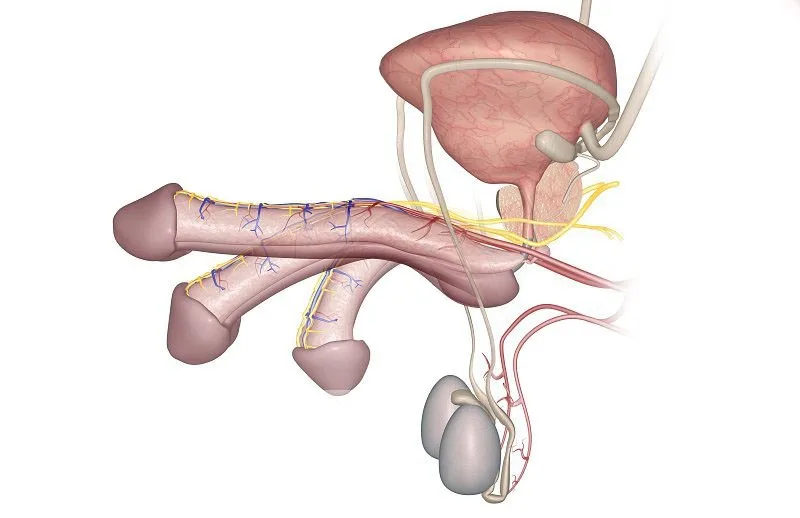
An erection is a hydraulic event. Arousal opens the arteries feeding the penis, blood floods into the two spongy cylinders that run its length — the corpora cavernosa — and as those cylinders swell, they press the draining veins flat against the tough fibrous sheath that surrounds them, the tunica albuginea. That compression is what traps the blood. It is not a valve or a muscle; it is a passive squeeze created by the expansion itself.
Venous leak, or corporal veno-occlusive dysfunction, is the failure of that trapping mechanism. Blood arrives normally, but the veins are not compressed properly and blood drains away as fast as it arrives. The result is characteristic and men describe it with striking consistency: an erection that begins normally and then fades within minutes, often on penetration, or an erection that is only maintained with constant stimulation and collapses the moment stimulation stops. Many men find they can achieve a firm erection lying down and lose it standing up. Tablets tend to help less than expected, because sildenafil and tadalafil work by improving inflow, and inflow was never the problem.
The underlying cause is usually structural rather than functional. The tunica albuginea can become less elastic with age, with diabetes, or with Peyronie's disease. Smoking damages it. Some men have abnormally large or numerous draining veins from birth. Pelvic trauma can disrupt it. After a long period of disuse or after nerve injury, the smooth muscle inside the corpora can be replaced by fibrous tissue that does not expand properly, so the veins never get compressed in the first place. That last mechanism matters enormously, and we will return to it, because it explains why blocking veins does not always help: if the cylinders are not expanding, the problem is not really the veins.
How venous leak is diagnosed
Nobody should be treated for venous leak on the basis of symptoms alone, and a proposal that offers you surgery without the following work-up is not a proposal we would send you.
The first-line investigation is penile duplex Doppler ultrasound with intracavernosal injection. A vasodilator is injected directly into the penis to produce an erection, and the blood flow is measured. Two numbers matter: the peak systolic velocity, which reflects arterial inflow, and the end-diastolic velocity, which reflects whether blood is draining away. Normal arterial inflow with a persistently raised end-diastolic velocity is the signature of venous leak. This test is not optional and it is not interchangeable with an ultrasound performed without injection, which tells you very little.
If intervention is being contemplated, CT cavernosography maps where the leak actually is — contrast is instilled into the corpora and imaged, showing which draining veins are carrying blood away and where they run. This is what makes targeted treatment possible at all, and in modern embolisation series it is used to classify the leak before anything is blocked.
Dynamic infusion cavernosometry measures the pressures directly and remains the reference standard, though it is used less often now that imaging has improved.
Alongside the vascular work-up, the ordinary causes of erectile dysfunction have to be excluded properly: testosterone, blood glucose and HbA1c, lipids, blood pressure, a medication review, and an honest conversation about psychological factors and about whether the tablets were ever taken correctly. A surprising number of men who arrive convinced they have a venous leak have never taken a PDE5 inhibitor at an adequate dose on an empty stomach with adequate stimulation on eight separate occasions, which is what an adequate trial actually means.
Penile venous ligation: what it is, and why it fell out of favour
Surgical venous ligation is the older of the two interventions. Through an incision at the base of the penis, the surgeon identifies the deep dorsal vein and its tributaries — and, in more extensive versions, the cavernosal and crural veins — and ties them off and divides them. The logic is straightforward: if the blood is escaping through these veins, close them.
The early results were genuinely promising, and the operation was performed widely through the 1980s and 1990s. Reported success in the first year after surgery ranged from 23% to 80% depending on the series and how success was defined. Then the follow-up data arrived.
Success declined consistently over time. Veins that were tied off recanalised. Collateral veins that had previously carried little blood enlarged and took over. And in many men, the underlying problem had never been the veins at all but the failure of the cavernosal tissue to expand and compress them — a problem no amount of ligation could fix. Long-term success after deep dorsal vein ligation has been reported at around 25%.
The guideline bodies responded accordingly. The AUA's erectile dysfunction guideline states that penile venous surgery is not recommended, a Moderate Recommendation, reasoning that randomised trials indicate venous ligation surgery is unlikely to result in long-term successful management of ED for the overwhelming majority of men, and that it delays treatment with more reliable options such as penile prosthesis surgery. The EAU's position is that venous ligation surgery for veno-occlusive dysfunction is no longer recommended because of poor long-term results. The procedure was, as one review put it, nearly abandoned across most medical societies worldwide.
We are telling you this on a page that could easily have sold you the operation instead. That is deliberate. If you have been quoted for penile venous ligation by a clinic that did not mention any of the above, you now know something about that clinic that has nothing to do with venous leak.
There is ongoing work on newer surgical variants, including internal pudendal vein ligation approached through the perineum, currently in randomised trial against penile prosthesis implantation. That trial has not reported. Until it does, surgical ligation is a research procedure, and it should be described as one.
Venous leak embolisation: the version with current evidence
Embolisation approaches the same problem from inside the vein, and it is not simply "ligation without the incision" — the technique, the reach and the evidence base are all different.
Under local anaesthetic with sedation, and with ultrasound guidance, the interventional radiologist punctures the deep dorsal penile vein directly. A venogram maps the leaking veins in real time. A liquid embolic agent — n-butyl-2-cyanoacrylate glue mixed with ethiodized oil — is then injected to occlude the efferent veins carrying blood away, which may include the periprostatic, internal pudendal and external pudendal veins. Because the agent is liquid, it can reach small collateral veins that a surgeon could never find and tie, which is the main technical argument for why it might succeed where ligation did not.
The evidence has moved quickly. An initial single-centre registry of 50 men with severe venous-leak ED unresponsive to tablets reported procedural success in 49 of 50, no major adverse events, and 68% of men achieving a clinically meaningful improvement in IIEF-15 score at six weeks.
The larger, prospective, multicentre follow-up is the study to know about. Across 175 consecutive all-comers, embolisation was technically successful in 193 of 194 procedures — 99.5%. At an average follow-up of just over nine months, 59.4% of assessed patients had achieved the primary endpoint of a four-point-or-greater improvement in IIEF-15. Mean IIEF-15 scores were 31 at baseline, 45 at up to three months, and 43 at one year. Venous leak recurred or persisted in 10.2% of men at an average of sixteen months.
Read those numbers carefully, because the way they are usually reported flatters them. Technical success of 99.5% means the veins were successfully blocked, not that erections were restored. The clinically meaningful figure is 59.4% — a little under two men in three. And the IIEF-15 improvement from 31 to 43, while statistically robust and genuinely worth having, does not represent restoration of normal function; it represents a meaningful improvement within a range that is still abnormal. Durability beyond one to two years is not yet established, which is precisely the point at which the old ligation data started to fall apart. Anyone who tells you embolisation is a proven long-term cure is going beyond what has been published.
Where embolisation clearly earns its place: mixed arterio-venous disease
The most persuasive single finding in this literature concerns men who have both arterial and venous problems, which is common.
In a series of 26 men with mixed arterio-venous ED who underwent arterial revascularisation, only 3 — 11.5% — reached the endpoint of a meaningful improvement in erectile function score. Six weeks after venous embolisation was added, 17 of the 26 reached it: 65.4%.
That is a large effect in a group that had already failed one operation, and it reframes venous embolisation from a competitor of revascularisation into its complement. If you are considering penile revascularisation, the venous side of your circulation needs assessing before, not after — and we would ask any surgeon proposing revascularisation how they have excluded or planned for venous leak. Corporal veno-occlusive dysfunction is in fact a contraindication to revascularisation on its own, and must be excluded before that operation is offered.
A separate group has reported combining ligation and embolisation in a single procedure in 171 men with drug-resistant cavernovenous leakage, with IIEF-5 scores improving from 10.7 to 15.9 and 80.7% reporting improved natural erections. It is a non-randomised series and should be weighted accordingly, but it is a live area of practice rather than a closed question.
The honest hierarchy of treatment for venous leak
Set against everything above, here is the order in which venous leak is properly treated. We publish this knowing it directs a large proportion of readers away from the procedure this page is about.
First, optimise what can be optimised. Blood pressure, blood sugar, lipids, weight, smoking, alcohol, sleep, testosterone if it is genuinely low, and a review of medications that impair erections. Vascular ED is a warning about your arteries generally, and men who present with it have a meaningfully raised cardiovascular risk. Treating the leak while ignoring the diabetes is treating the symptom of the symptom.
Second, an adequate trial of PDE5 inhibitors. Adequate means the right dose, correctly taken, on at least eight occasions, with adequate stimulation. Daily low-dose tadalafil suits some men with venous leak better than on-demand dosing. Many men who believe these drugs have failed them have never had a proper trial.
Third, intracavernosal injection therapy. This is the step most often skipped and it should not be. Injections produce a strong, reliable erection in the large majority of men, including many with significant venous leak, because they generate far greater cavernosal expansion than tablets. A man who responds well to injections has a working, non-surgical, reversible treatment. A man who does not respond to injections is unlikely to be helped by embolisation either, and that information is worth having before you buy a flight.
Fourth, a constriction ring, alone or with a vacuum device. Unglamorous, cheap, and specifically suited to venous leak, since the entire mechanism of a constriction ring is to do from outside what the tunica should be doing from inside. Some men need nothing more.
Fifth, venous leak embolisation — reasonable for men with confirmed, imaged venous leak who have failed the above, who want to preserve natural erectile function, and who understand the durability question is open.
Sixth, the penile implant. For severe venous leak, this is the treatment that reliably works, with the highest satisfaction rates of any ED intervention. It is definitive and it removes natural erectile function permanently, which is why it comes last. But it comes, and the AUA's specific objection to venous ligation is that it delays this. If you are already at the point of wanting a definitive answer, going through an embolisation first is a legitimate choice — and so is skipping it.
We have covered penile implant surgery in depth elsewhere on this site, and if that is where your case points, we will say so rather than sell you the intermediate step.
Having venous leak treated in Türkiye
Venous leak is one of the areas where medical tourism carries above-average risk, and it is worth being specific about why.
The diagnosis is expensive to make properly and easy to assert casually. A clinic can tell any man with erectile dysfunction that he has a venous leak, and a great many do, because it converts a difficult medical conversation into a surgical booking. The work-up described above — duplex with intracavernosal injection, CT cavernosography, and the full medical screen — costs money and takes time, and it disqualifies a proportion of the men who arrive convinced of their own diagnosis. Clinics that skip it convert more of them.
There is also a structural problem. Embolisation is performed by an interventional radiologist, not an andrologist, and the man who assesses you should not be the man who is paid to embolise you. The assessment and the procedure being under the same commercial roof, with no independent andrological opinion, is the arrangement that produces unnecessary interventions.
What we check before any venous leak proposal leaves us:
That a penile duplex Doppler with intracavernosal injection has been performed and reported with actual velocities, not a conclusion.
That cavernosography has been performed or is planned before any intervention.
That an andrologist, separately from the interventional radiologist, has assessed you and documented that non-surgical options were tried adequately.
That the quoted price names the embolic agent.
That the clinic will state, in writing, what the expected outcome is in terms of IIEF improvement rather than a percentage success rate with no denominator.
That nobody has told you this is a cure.
If a clinic cannot meet those, it does not go into your proposal, whatever it charges.
What happens on the day
You attend fasted. The procedure is performed in an angiography suite rather than an operating theatre. Local anaesthetic is infiltrated and sedation is given; you are drowsy but awake and will not remember much of it.
An erection is induced pharmacologically so that the venous anatomy can be seen under load. The deep dorsal vein is punctured under ultrasound guidance and a venogram is performed, mapping the leaking veins. The embolic mixture is then injected under fluoroscopic control to occlude them, with the radiologist watching the agent fill the target veins in real time and stopping before it can travel where it should not.
The puncture site needs only pressure and a dressing. You lie flat for a few hours and go home the same day. Most men have some penile bruising and swelling, and a dull ache for several days.
Surgical ligation, where it is performed at all, is a different day: general or spinal anaesthesia, an incision at the base of the penis or in the perineum, and an overnight stay.
Who it is for
- •You have venous leak confirmed on penile duplex Doppler with intracavernosal injection, with normal arterial inflow and a persistently raised end-diastolic velocity.
- •The leak has been mapped on CT cavernosography, so the target veins are known before anything is blocked.
- •You have had an adequate trial of PDE5 inhibitors — correct dose, correctly taken, on at least eight occasions — and they have not worked well enough.
- •You have tried or declined intracavernosal injection therapy with full understanding of what it offers.
- •You respond at least partially to injections, indicating your cavernosal tissue still expands and the veins really are the limiting factor.
- •You want to preserve natural erectile function and are not ready for a penile implant.
- •You have mixed arterial and venous disease, particularly if arterial revascularisation has already been performed without adequate benefit.
- •You accept that the durability of the benefit beyond one to two years is not yet established.
- •Your venous leak has not been imaged. A symptom pattern is not a diagnosis, and we will not arrange an intervention on the basis of one.
- •You have not had an adequate trial of tablets and injections. Skipping to an intervention is not a shortcut; it is a worse treatment pathway.
- •You get no response at all to a full-dose intracavernosal injection, which suggests the cavernosal tissue itself is not expanding — a problem embolisation cannot address.
- •You have severe corporal fibrosis, whether from priapism, from Peyronie's disease or from long-standing disuse. Blocking veins cannot restore tissue that has been replaced by scar.
- •Your erectile dysfunction is predominantly psychogenic, hormonal or medication-related, none of which is fixed by treating a vein.
- •You want a definitive, reliable solution and are ready for a penile implant. Going through an embolisation first will delay that by months and may not change the destination.
- •You are being offered surgical venous ligation and want us to arrange it. We will explain the guideline position and offer you the alternatives instead.
- •You have been promised a cure by another clinic and want us to match it. We cannot, because it does not exist.
Preparing for surgery
What recovery looks like
Risks and complications
Common questions
Is penile venous ligation surgery recommended?
Then why does this page exist?
How well does venous leak embolisation work?
How long does the benefit last?
Is it better than a penile implant?
I've been told I have a venous leak. Should I believe it?
Can venous leak be treated without any procedure?
I had a revascularisation and it didn't work. Is this worth trying?
Will this make my penis shorter or curved?
Is it painful?
Can I have this if I have Peyronie's disease?
Why do I need to fill in a questionnaire before I travel?
Patient reviews
Been treated? Your honest review of Penile Venous Ligation & Venous Leak Embolisation helps the next patient.
No one has reviewed this yet. If you have been treated, your experience would help the next person.
Write the first reviewSources
- Burnett AL, Nehra A, Breau RH, et al. Erectile Dysfunction: AUA Guideline. J Urol. 2018. — https://www.auanet.org/guidelines-and-quality/guidelines/erectile-dysfunction-(ed)-guideline
- Salonia A, et al. EAU Guidelines on Sexual and Reproductive Health — Management of Erectile Dysfunction. — https://uroweb.org/guidelines/sexual-and-reproductive-health/chapter/management-of-erectile-dysfunction
- Midterm Outcomes of Venous Leak Embolization in Patients with Venogenic Erectile Dysfunction Unresponsive to Phosphodiesterase-5 Inhibitors. Cardiovasc Intervent Radiol. 2025. — https://pubmed.ncbi.nlm.nih.gov/41162635/
- Diehm N, Pelz S, Kalka C, et al. Venous Leak Embolization in Patients with Venogenic Erectile Dysfunction via Deep Dorsal Penile Vein Access: Safety and Early Efficacy. Cardiovasc Intervent Radiol. 2023;46(5):610–616. — https://pubmed.ncbi.nlm.nih.gov/36949182/
- Diehm N, Hirschle D, Kalka C, et al. Venous Leak Embolization Results in Clinical Improvement of Patients with Mixed Arterio-Venous Erectile Dysfunction Not Responding to Arterial Revascularization Alone. Cardiovasc Intervent Radiol. 2024. — https://www.urotoday.com/recent-abstracts/men-s-health/erectile-dysfunction/156828-venous-leak-embolization-results-in-clinical-improvement-of-patients-with-mixed-arterio-venous-erectile-dysfunction-not-responding-to-arterial-revascularization-alone.html
- Hsu GL, et al. Penile venous surgery for treating erectile dysfunction: past, present, and future perspectives with regard to new insights in venous anatomy. Urol Sci. 2016. — https://www.sciencedirect.com/science/article/pii/S1879522615004443
- Ligation and Embolization in One Procedure for Cavernovenous Leakage in 171 Patients with Drug-Resistant Erectile Dysfunction. Ann Vasc Surg. 2025. — https://www.annalsofvascularsurgery.com/article/S0890-5096(25)00578-3/fulltext