
Micropenis
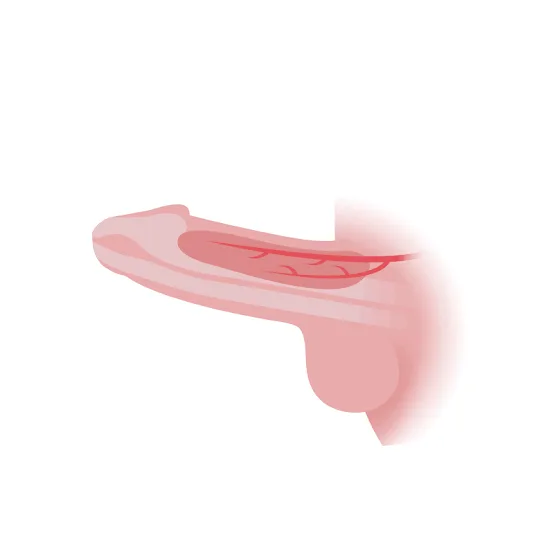
Micropenis is a medical condition in which the penis is structurally normal but has a stretched penile length more than 2.5 standard deviations below the mean for age and developmental stage. It usually results from hormonal, testicular, genetic, or developmental abnormalities affecting androgen production or action and should be distinguished from buried penis and normal variation in penile size.
Also known as: True micropenis, Micropenis syndrome, Abnormally small penis, Medically small penis, Congenital micropenis, Small penis from hormonal deficiency, Pathologically small penis
 ✓ Clinician-reviewed information
- Micropenis is diagnosed by objective stretched penile length, not by a patient's perception of penile size.
- The standard definition is a stretched penile length more than 2.5 standard deviations below the mean for age and developmental stage.
- It is different from buried penis, in which a normally sized penis is hidden beneath surrounding tissue.
- Causes include hypogonadotropic hypogonadism, primary testicular failure, disorders of androgen production or action, and genetic syndromes.
- Early diagnosis is important because hormonal treatment may improve penile growth in some children, while adult management depends on the underlying cause, sexual function, and individual goals.
Overview
Micropenis is a specific medical diagnosis describing a penis that is normally formed but substantially shorter than expected for the patient's age.
The defining measurement is stretched penile length (SPL).
A diagnosis is generally considered when SPL is more than 2.5 standard deviations below the mean for age and developmental stage.
Micropenis is therefore not simply a subjective description of a penis that a patient considers small.
Correct measurement and comparison with appropriate reference data are essential.
What does "structurally normal" mean?
In true micropenis, the penis generally has normal anatomical configuration.
This typically means:
The urethral opening is normally positioned
The shaft is normally formed
The foreskin and glans are structurally normal
The penis is not simply hidden beneath surrounding fat or skin
Other genital or developmental abnormalities may coexist depending on the underlying cause, but the defining feature of micropenis is true reduction in penile length.
Micropenis vs a small normal penis
Penile size varies naturally between men.
A penis that is below average is not necessarily a micropenis.
True micropenis is defined statistically using standardized stretched penile length measurements rather than an arbitrary cosmetic threshold.
Many men who are concerned about penile size have measurements within the normal population range.
These men should be classified under Penile Length Concerns, not micropenis.
Micropenis vs buried penis
These are fundamentally different conditions.
Micropenis
The penile shaft itself is genuinely shorter than expected according to standardized measurements.
Buried penis
The penis is generally normal in anatomical length but concealed beneath:
Suprapubic fat
Excess skin
Scar tissue
Lymphedema
Compressing the surrounding tissue in buried penis may reveal a normal-length shaft.
In true micropenis, standardized stretched penile length remains abnormally short.
Why does micropenis develop?
Normal penile development depends heavily on androgen signaling during fetal life, infancy, and puberty.
The hormonal pathway includes:
Hypothalamus
Pituitary gland
Testes
Testosterone production
Conversion of testosterone to dihydrotestosterone (DHT)
Androgen receptor activity
Abnormalities anywhere along this pathway can interfere with penile growth.
Micropenis can therefore provide an important clue to an underlying endocrine or genetic disorder.
Micropenis and puberty
Some boys with micropenis experience additional penile growth during puberty, particularly when endogenous testosterone production increases normally.
Others have inadequate pubertal growth because the underlying hormonal or testicular disorder persists.
Assessment of pubertal development and hormone production is therefore important.
Types of micropenis
Symptoms
Causes
Risk factors
How it is diagnosed
Diagnosis begins with standardized stretched penile length measurement.
Stretched penile length
The penis is gently stretched to its maximum comfortable length and measured along the dorsal surface from the pubic bone to the tip of the glans.
The suprapubic fat pad should be compressed during measurement.
This is essential because obesity or a large suprapubic fat pad can otherwise create the false appearance of a short penis.
The measurement is then compared with reference values appropriate for:
Age
Developmental stage
Population
A stretched penile length more than 2.5 standard deviations below the mean supports the diagnosis of micropenis.
Adult threshold
There is no single universal adult centimeter cutoff applicable to every population because normal values vary by ethnicity and measurement method.
Some clinical references use approximately 7–7.5 cm stretched penile length in adults as a general guide, but diagnosis should ideally be based on population-specific standard-deviation data rather than a universal number.
Physical examination
The doctor assesses:
Stretched penile length
Penile anatomy
Position of the urethral meatus
Testicular size
Testicular position
Scrotal development
Secondary sexual characteristics
Pubertal development
Presence of buried penis
Other genital abnormalities
Hormonal evaluation
Depending on age and clinical findings, testing may include:
Total testosterone
LH
FSH
DHT
Other pituitary hormones
Additional endocrine testing
Special stimulation tests may be used in selected pediatric or endocrine evaluations.
Genetic evaluation
Genetic testing may be appropriate when a congenital syndrome or disorder of sexual development is suspected.
Possible investigations include:
Karyotype
Targeted gene testing
Broader genetic testing in selected cases
Imaging
Imaging is not required solely to confirm penile length.
However, MRI or other imaging may be appropriate when pituitary, hypothalamic, or other congenital abnormalities are suspected.
- Penile size appears markedly below the expected range for age.
- A clinician has previously raised concern about micropenis.
- Stretched penile length appears substantially below normal reference values.
- Penile growth was limited during puberty.
- Micropenis occurs together with undescended testes.
- Puberty is delayed or incomplete.
- You have low testosterone symptoms.
- You have infertility together with very small penile or testicular size.
- You are unsure whether you have micropenis or buried penis.
- Penile size is causing substantial functional or psychological distress.
- You are considering penile enlargement surgery because you believe you have micropenis.
- Early identification of genital abnormalities in infancy or childhood.
- Appropriate endocrine evaluation when micropenis is suspected.
- Assessment of undescended testes or delayed puberty.
- Early treatment of clinically significant hormone deficiency when appropriate.
- Genetic counselling when a hereditary condition is identified.
- Avoiding unnecessary cosmetic treatment in men whose penile measurements fall within the normal range.
Common questions
What is micropenis?
What size is considered a micropenis?
How is penis length measured medically?
Is micropenis the same as having a small penis?
Is micropenis the same as buried penis?
Can obesity make the penis look like a micropenis?
What causes micropenis?
Can low testosterone cause micropenis?
Is micropenis diagnosed at birth?
Can micropenis grow during puberty?
Can testosterone treatment increase penile size?
Is testosterone appropriate for every case?
Can micropenis cause erectile dysfunction?
Can a man with micropenis have sex?
Can micropenis cause infertility?
Can micropenis be surgically enlarged?
Is ligament release a treatment for true micropenis?
Can penile implants increase the size of a micropenis?
What if my penis feels too small but measurements are normal?
Which doctor treats micropenis?
Sources
- Micropenis https://pubmed.ncbi.nlm.nih.gov/32965946/
- Etiology, Diagnosis and Treatment Approaches https://pmc.ncbi.nlm.nih.gov/articles/PMC3890219/
- Micropenis — 2023 Review https://pubmed.ncbi.nlm.nih.gov/37079255/
- Fate of the micropenis and constitutional small penis: do they grow to normalcy in puberty? https://pubmed.ncbi.nlm.nih.gov/31447312/
- Penile growth in response to hormone treatment in children with micropenis https://pubmed.ncbi.nlm.nih.gov/24235789/
- The inconspicuous penis in children https://pubmed.ncbi.nlm.nih.gov/25850928/