
Skip to content
Condition

Peyronie's disease

Peyronie's disease is a build-up of scar tissue inside the penis that causes curvature, often with pain, during erections. It's reported in roughly 3–9% of men in Western populations, more in some studies, and is most often diagnosed in men in their 50s and 60s.

Also known as: penile curvature, Induratio penis plastica, PD
Symptoms7 listed
ICD-10N48.6
Treatable7 options
Peyronie's Disease (Penile Curvature)✓ Clinician-reviewed information
Key takeaways
  • Peyronie's disease is caused by scar tissue (a plaque) forming inside the penis, which pulls it out of shape during erection.
  • A curve on its own isn't a disease — many men have some natural curvature. Peyronie's is diagnosed when curvature is new, worsening, or causing pain, shortening, or difficulty with sex.
  • It typically develops in two phases: an active phase where the curve changes and there may be pain, followed by a stable phase where the curve settles.
  • Studies consistently find high rates of anxiety and distress among men who seek treatment for it — this is a recognised part of the condition, not a separate overreaction.
  • Treatment ranges from monitoring and non-surgical options through to surgery, and the right approach depends heavily on which phase the condition is in.

Overview

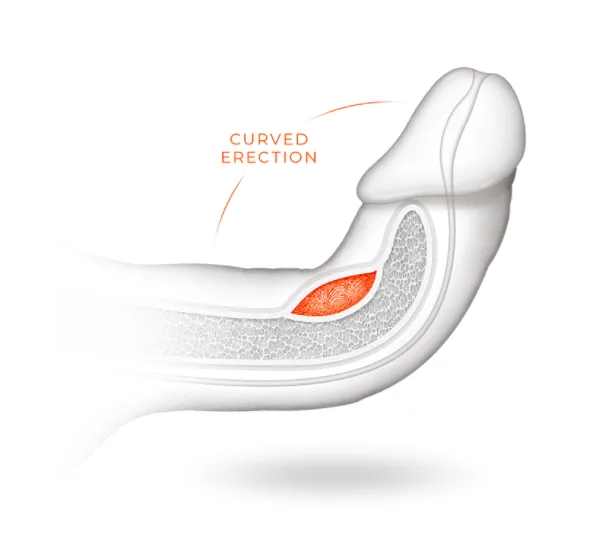
Peyronie's disease is a condition in which scar tissue — called a plaque — forms inside the sheath that surrounds the erectile tissue of the penis (the tunica albuginea). This plaque doesn't stretch the way healthy tissue does. So when the penis fills with blood during an erection, the scarred area holds back while the rest expands, and the penis bends towards the scarred side. The result is a curve, and sometimes narrowing, shortening, or an indentation, that wasn't there before.

It's worth being clear about what Peyronie's disease is not. A degree of curvature is normal and common in men who have never had any injury or disease — the penis is rarely perfectly straight, and mild curves present since puberty aren't Peyronie's disease. What distinguishes Peyronie's is change: a curve that is new, that is getting worse, or that appears alongside pain, a palpable lump, or narrowing. That distinction matters because it shapes whether monitoring is appropriate or whether treatment should start.

The exact cause isn't fully understood, but the leading explanation involves injury and abnormal healing. Repeated minor trauma to the penis during sex or other activity — often too subtle to be noticed or remembered at the time — is thought to trigger an abnormal healing response in some men. Instead of healing cleanly, the tissue forms a scar, and in some men that scar continues to build up rather than being remodelled away over time. Why this happens in some men and not others isn't fully clear, but genetics appears to play a real role. Men with a family history of Peyronie's disease, or who have a related connective tissue condition called Dupuytren's contracture — which causes thickening in the tissue of the palm — appear to be at meaningfully higher risk, a link discussed further in the FAQs below.

The condition usually moves through two recognisable phases. In the acute (active) phase, which guideline literature typically describes as lasting up to around a year, the curve is often still changing and pain during erection is common. In the chronic (stable) phase, the curve has usually settled into its final shape, and pain, where present, typically eases or resolves. This phase distinction is clinically important, because many treatment decisions — including whether surgery is appropriate — depend on the plaque and curve having stabilised first, rather than being made while the condition is still actively changing.

Reported rates of Peyronie's disease vary a great deal between studies and regions, partly because some rely on physician diagnosis and others on self-reported symptoms, and partly because there appear to be genuine differences in prevalence between populations. What's consistent across the literature is that this is not a rare or unusual condition, and that it can affect far more than the physical ability to have sex. Because it changes the appearance and function of the penis, often suddenly and without an obvious explanation, it's strongly associated with anxiety, distress, and — in a meaningful proportion of men — depression. It also frequently overlaps with erectile dysfunction, sometimes because the same vascular changes contribute to both, and sometimes because pain, curvature, or anxiety about performance make erections harder to sustain.

Types of peyronie's disease

Acute (active) phase
The early phase, commonly described as lasting up to around a year. The plaque and curvature may still be forming or changing, and pain during erection is common.
Chronic (stable) phase
The curve and plaque have generally stopped changing. Pain, where present, usually eases or resolves. Most surgical treatment decisions wait until this phase.
Dorsal curvature
Curving upward; the most commonly reported direction in clinical studies.
Ventral curvature
Curving downward.
Lateral curvature
Curving to one side.
Hourglass or indentation deformity
Narrowing or a "waist" in the shaft, rather than (or alongside) a curve.
How common is it?
Reported prevalence varies widely by population and study method — from under 1% to over 20% in some surveys. Guideline literature commonly cites a range of roughly 3–9% in Western populations, with lower rates reported in East Asian studies (around 0.6–5%) and in some African-population studies (around 0.1–3.5%). It's most often diagnosed in men in their 50s and 60s, though cases are also reported in men under 40.
Source: doi.org

Symptoms

A curve or bend in the erect penis that is new or worsening
Pain during erection, particularly in the earlier phase
A firm lump or band of tissue that can be felt under the skin, even when not erect
Shortening of the penis
Narrowing, indentation, or an "hourglass" shape in the shaft
Difficulty with penetrative sex due to the degree of curvature or pain
Erectile dysfunction, either alongside the curvature or as a separate but related issue

Causes

Minor, often unnoticed injury to the penis during sex or other activity, triggering abnormal scar formation
Genetic predisposition to abnormal wound healing
Underlying connective tissue conditions, particularly Dupuytren's contracture
Possible links to prior pelvic surgery, including prostate surgery

Risk factors

Age (most commonly diagnosed in men in their 50s and 60s)
Family history of Peyronie's disease
Dupuytren's contracture or other connective tissue disorders
Diabetes
Smoking
Prior pelvic or prostate surgery
Existing erectile dysfunction

How it is diagnosed

Diagnosis usually starts with a physical examination and a discussion of how and when the curvature developed. A doctor may ask you to bring in a photo of the erect penis taken at home, since curvature isn't visible when the penis is flaccid and this avoids relying on description alone.

The doctor will typically feel along the shaft for plaques and check whether the tissue is tender. A duplex ultrasound is often used to look at the plaque itself — including whether it has calcified, which can affect treatment choice — and to assess blood flow, since ED and Peyronie's disease frequently coexist. Questionnaires such as the Peyronie's Disease Questionnaire (PDQ) are sometimes used to track pain, curvature bother, and psychological impact over time. Most cases don't need further imaging beyond this.

When to see a doctor
  • You notice a new curve, bend, or narrowing in the erect penis
  • You feel a firm lump or band under the skin of the penis
  • You have pain during erection that is new or getting worse
  • You're also experiencing new or worsening erectile dysfunction
  • You're finding it hard to cope with the anxiety or low mood the condition is causing
  • The curvature is making sex difficult or painful, for you or a partner

Treatment options

1Penile traction therapyPenile traction therapy explained: real length and curvature gains, evidence quality, and honest expectations — with sources, not guesswork.2Peyronie's disease surgeryPeyronie's disease surgery corrects penile curvature caused by scar tissue, using one of two main approaches — plication (shortening the longer, unscarred side) for milder curvature, or plaque incision or excision with grafting for more severe curvature and hourglass deformity. Both are effective, with published satisfaction rates of 67% for plication and 87–90%+ for grafting, though each carries a genuinely different, honest trade-off between simplicity, length preservation, and erectile function risk.3Penile Plication SurgeryPenile plication surgery is an operation used to straighten a curved penis by placing sutures or modifying the tunica albuginea on the longer, convex side of the penis, shortening that side until the shaft becomes functionally straight. It is used mainly for congenital penile curvature and selected men with stable Peyronie's disease who have adequate erectile rigidity and enough penile length to tolerate some shortening.4Plaque Incision and Grafting SurgeryPlaque incision and grafting is reconstructive penile surgery for selected men with stable Peyronie’s disease and severe or complex penile curvature who have adequate erectile function. The surgeon incises the shortened, scarred side of the tunica albuginea and covers the resulting defect with graft material, allowing the penis to straighten while minimizing the additional shortening associated with plication surgery.5Penile Prosthesis with Peyronie’s CorrectionPenile prosthesis with Peyronie’s correction is a reconstructive procedure for men who have both Peyronie’s disease and significant erectile dysfunction that does not respond adequately to conservative treatment. A penile prosthesis is implanted to restore reliable rigidity, while additional straightening techniques such as modeling, plication, or plaque incision and grafting may be used during the same operation when the implant alone does not adequately correct the curvature.6عملية دعامة القضيبعملية دعامة القضيب: نسب الرضا الحقيقية، وما تتضمنه الجراحة، والمخاطر بصراحة — بمصادر لا بتخمين.7Penile implant surgeryPenile implant surgery explained: real satisfaction rates, what the operation involves, and honest risks — with sources, not guesswork.
Reducing your risk
  • Injury to the penis during vigorous sex or other activity is a plausible contributing factor in some cases, though it can't be reliably avoided or predicted
  • Managing diabetes and stopping smoking are both linked to better vascular and tissue health generally, though neither is proven to prevent Peyronie's specifically
  • Starting evaluation early, during the acute phase, gives the most treatment options — this doesn't prevent the condition but can affect how it's managed

Common questions

Will Peyronie's disease go away on its own?
Some mild cases improve without treatment, but many don't, and the curve usually stabilises rather than fully reversing on its own. Because the condition typically moves from an active phase into a stable one, doctors often monitor early cases rather than treating immediately — but "monitoring" is different from assuming it will resolve.
Is having a curved penis the same as Peyronie's disease?
No. Many men have some natural curvature with no history of injury or disease, and this isn't Peyronie's. Peyronie's disease specifically involves a new or worsening curve linked to scar tissue, often with pain, a palpable lump, or shortening — not a curve that's simply always been there.
Can I still have sex if I have Peyronie's disease?
Many men can, particularly with mild curvature, though pain, more severe curvature, or narrowing can make penetrative sex difficult or uncomfortable for either partner. This varies significantly by severity and phase, which is part of why a proper assessment matters rather than guessing from symptoms alone.
Does Peyronie's disease always need surgery?
No. Many cases are managed with monitoring or non-surgical treatment, especially during the active phase. Surgery is generally considered later, once the condition has stabilised, and typically for more significant curvature that affects function — it is not the default first step.
What actually causes Peyronie's disease?
The leading explanation is that minor, often unnoticed injury to the penis triggers an abnormal healing response, where scar tissue builds up instead of remodelling away. Genetics appears to influence who this happens to, which is part of why some men develop it after an injury that would leave no lasting mark on someone else.
Is Peyronie's disease linked to Dupuytren's contracture?
Yes. The two conditions share a similar underlying tissue mechanism and are recognised as being associated in the medical literature. One study of men presenting with Dupuytren's contracture found that a substantial proportion also had Peyronie's-like symptoms, and separate data on Peyronie's patients found Dupuytren's contracture present in a meaningful minority — so a diagnosis of one is sometimes a reason to ask about the other.
Does Peyronie's disease cause erectile dysfunction, or are they separate?
They frequently occur together, though one doesn't automatically cause the other. Large real-world data on men diagnosed with Peyronie's disease found erectile dysfunction recorded in around a quarter to a third of cases, likely reflecting a mix of shared vascular changes, pain, and anxiety about performance.
How much does Peyronie's disease affect mental health?
Studies of men presenting for treatment consistently find high rates of anxiety and, less commonly but still substantially, depression. This isn't a minor side note — several clinical studies have argued that psychological support should be considered part of standard treatment, not an optional extra, given how often distress accompanies the physical symptoms.
Will the pain go away?
For most men, pain is most noticeable during the acute phase and tends to ease or resolve as the condition moves into the stable phase. Pain that is severe, worsening, or persisting well beyond the expected active phase is a reasonable reason to seek a specialist review rather than waiting it out.
How much curve is "too much"?
There's no single cut-off that applies to everyone — what matters clinically is usually whether the curve interferes with penetrative sex or causes pain, rather than the angle in isolation. A specialist assessment, rather than self-measurement, is the right way to judge whether a given degree of curvature warrants treatment.
Can Peyronie's disease come back after treatment?
This depends heavily on the type of treatment and individual case, and isn't something that can be answered with a single figure without misleading readers about their own likely outcome. It's a fair question to raise directly with a treating specialist, since recurrence risk varies by treatment type and severity.
Is Peyronie's disease more common in some countries or ethnic groups than others?
Reported prevalence does appear to vary by region and population — studies report higher rates in Western populations compared with some East Asian and African-population studies — though differences in study design and how freely men report symptoms make direct comparisons difficult. This is an area where genuine biological variation and reporting/detection differences are hard to fully separate.
Does diabetes make Peyronie's disease worse?
Diabetes is a recognised risk factor and has been linked to more severe presentations in some studies, including a stronger association with related connective tissue changes. Good blood sugar control is generally advised for overall vascular and tissue health, though it isn't a guaranteed way to prevent or reverse Peyronie's disease specifically.
What's the practical difference between the acute and chronic phase?
In the acute phase, the curve and any pain may still be changing, so treatment decisions — especially surgery — are usually held off because the "target" is still moving. In the chronic phase, once things have settled, there's a stable picture to plan treatment around, which is why doctors often wait for stabilisation before recommending surgical options.
Should I see a specialist straight away, or is my GP a reasonable first step?
A GP is a reasonable starting point for an initial conversation and referral, particularly to rule out other causes and start the diagnostic process. Because Peyronie's disease benefits from assessment by someone experienced in andrology or urology — particularly around timing of treatment — most men are referred on to a specialist rather than managed entirely in general practice.
Can young men get Peyronie's disease?
Yes. While it's most commonly diagnosed in men in their 50s and 60s, studies specifically looking at younger men have reported meaningful rates of Peyronie's disease under the age of 40. Some research even suggests younger men may report more pain in the active phase than older men, so age alone shouldn't rule the condition in or out.

Sources

  1. Kim DS, et al. "Diagnosis and Management of Peyronie's Disease: A Clinical Consensus Statement and Recommendations from the Korean Society for Sexual Medicine and Andrology." World J Mens Health. 2025;43(1):50-59. https://doi.org/10.5534/wjmh.240200
  2. Lue TF. "AUA guideline: update on Peyronie's disease." Transl Androl Urol. 2018;7(Suppl 5):AB002. https://pmc.ncbi.nlm.nih.gov/articles/PMC6186692/
  3. Salonia A, Capogrosso P, Boeri L, et al. "European Association of Urology guidelines on male sexual and reproductive health: 2025 update on male hypogonadism, erectile dysfunction, premature ejaculation, and Peyronie's disease." Eur Urol. 2025;88:76-102.
  4. Retrospective study of 564 Peyronie's disease cases (regional prevalence variation, younger-patient pain findings) — https://www.ncbi.nlm.nih.gov/pmc/articles/PMC11172383/
  5. Real-world PearlDiver database study of 176,969 US Peyronie's disease patients (comorbidities, ED and depression rates, Dupuytren's association) — https://www.researchgate.net/publication/51184642
  6. Shindel AW, et al. "Prevalence of Peyronie's Disease-Like Symptoms in Men Presenting With Dupuytren Contractures." https://pubmed.ncbi.nlm.nih.gov/28676223/
  7. "The psychological impact of Peyronie's disease: a retrospective analysis of 603 patients." Arch Ital Urol Androl. 2026. https://www.pagepressjournals.org/aiua/article/view/14758
  8. NHS, "Peyronie's disease" https://www.nhs.uk/conditions/peyronies-disease/
  9. NIDDK, "Peyronie's Disease" https://www.niddk.nih.gov/health-information/urologic-diseases/peyronies-disease