
Vasovasostomy (Vasectomy Reversal)
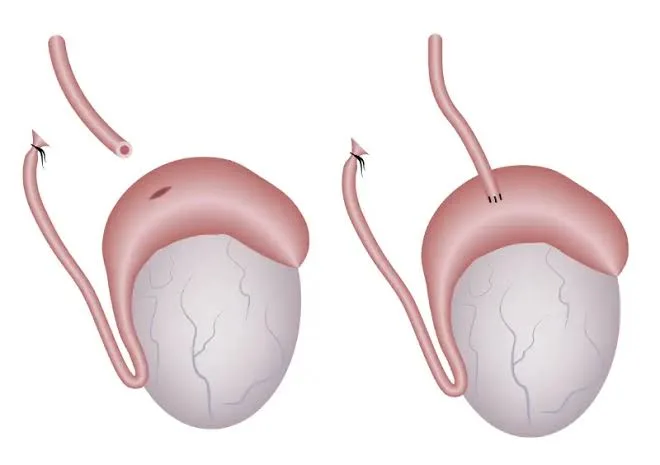
Vasovasostomy is the microsurgical reconstruction of the vas deferens after a vasectomy. Working under an operating microscope, the surgeon removes the blocked segment on each side and rejoins the two cut ends, restoring the channel that carries sperm from the testicle into the ejaculate so that natural conception becomes possible again. It is usually a day-case operation under general or spinal anaesthesia, takes around two to four hours for both sides, and its success depends more on how many years have passed since the vasectomy than on any other single factor.
 ✓ Clinician-reviewed information
- Time since your vasectomy is the strongest predictor of success. Reversed within three years, 97% of men had sperm return to the semen and 76% of couples conceived; at fifteen years or more, this fell to 71% and 30%.
- "Success" is two different numbers, and clinics often quote only the flattering one. Patency means sperm return to your ejaculate. Pregnancy means a baby. Patency rates are always higher — treat any single headline percentage with suspicion until you know which one it refers to.
- Your surgeon must be able to perform a vasoepididymostomy in the same operation. The choice between the two is made under the microscope, after examining the vasal fluid, and cannot be settled beforehand. A surgeon who only offers vasovasostomy may have to abandon the operation.
- Your partner's age matters as much as your surgery. Female partner age is an independent predictor of pregnancy after reversal, which is why the decision between reversal and sperm retrieval with ICSI is a decision for the couple, not the man alone.
- It is a day-case operation with a short stay. Around two to four hours in theatre, usually home the same day, five to seven days in the country, and back to desk work inside two weeks.
About vasovasostomy (vasectomy reversal)
What a vasovasostomy actually does
A vasectomy divides the vas deferens — the tube carrying sperm from each testicle towards the urethra — and seals the cut ends. Sperm production continues normally afterwards; the sperm simply have nowhere to go, and are reabsorbed. A vasovasostomy undoes that block. The surgeon exposes the vas on each side, cuts back to healthy tissue above and below the vasectomy site, and sews the two ends together over a channel narrower than a pencil lead, using suture finer than a human hair.
Because the inner channel of the vas is roughly a third of a millimetre across, this is genuine microsurgery. The anastomosis is made under an operating microscope at high magnification, either as a modified single-layer or a two-layer repair. Both are recognised techniques and the choice is the surgeon's; the evidence has not shown one to be clearly superior to the other.
The decision made under the microscope
The most important thing to understand about this operation is that nobody can tell you in advance exactly which operation you will have.
Once the vas is opened, the surgeon examines the fluid from the testicular side under a microscope. If sperm or sperm parts are present, the vas is clear back to the epididymis and a vasovasostomy will work. If the fluid is thick, pasty and contains no sperm, it usually means a second blockage has developed further back in the epididymis — a common consequence of years of back-pressure after a vasectomy. In that case, joining the vas to the vas achieves nothing, and the correct operation is a vasoepididymostomy: bypassing the blockage by joining the vas directly to the epididymal tubule above it.
This is why the surgeon's range matters more than the label on the procedure. Vasoepididymostomy is substantially harder, and a surgeon without that skill faces a bad choice in theatre — perform a vasovasostomy that is unlikely to work, or close up and send you home. International guidance is explicit that microscopic evaluation of the vasal fluid is the best intraoperative predictor of success, and that surgeons offering reversal should be able to perform both operations.
When you request a quote through us, we confirm that the surgeon performs vasoepididymostomy as well as vasovasostomy, and that the quoted price does not change if the harder operation turns out to be the right one. A quote that prices only the simpler procedure is not a quote for this operation.
Reversal or sperm retrieval with ICSI?
There are two routes back to fatherhood after a vasectomy, and they are genuinely different propositions rather than a better and a worse option.
Vasovasostomy restores your fertility rather than producing a single pregnancy. If it works, you can conceive naturally, at home, more than once, with no further procedures and no intervention for your partner. The cost is borne once.
Sperm retrieval with IVF/ICSI — a PESA, TESA or TESE to collect sperm, then fertilisation in a laboratory — bypasses the blockage entirely rather than repairing it. It sidesteps the obstructive-interval problem completely, but each attempt at pregnancy requires a full IVF cycle, which is expensive, repeatable and physically demanding for your partner.
In broad terms, reversal tends to make more sense when the obstructive interval is shorter, the partner is younger, and more than one child is wanted. Retrieval with ICSI tends to make more sense when the interval is very long, when a previous reversal has failed, when the partner has fertility factors of her own that will require IVF regardless, or when time is short. If your partner is in her late thirties or older, the arithmetic shifts: a reversal takes months to show a result, and those are months you may not have to spend.
We will give you a straight read on which side of that line your case falls, including when the answer is that you should not travel for a reversal at all.
What happens on the day
You are admitted in the morning, having fasted. Anaesthesia is general or spinal, depending on the surgeon and your own preference and health. Two small incisions are made in the scrotum — or occasionally a single midline one — and each vas is delivered, trimmed back to healthy tissue and rejoined under the microscope. Bilateral vasovasostomy typically takes two to four hours; longer if a vasoepididymostomy is needed on one or both sides.
Most men go home the same day, wearing scrotal support and with the scrotum well padded. A single overnight stay is arranged where the surgery ran long or where the surgeon prefers it. You will be reviewed before you fly.
Having a reversal in Türkiye
Vasectomy reversal is one of the procedures where the price gap between Türkiye and the UK, Ireland, Australia and the United States is at its widest, because the operation is almost entirely surgical skill and theatre time — there is no expensive implant in the middle of the cost. That makes it an attractive procedure to travel for, and also one where the market is full of clinics quoting a low headline number.
The things to check are specific:
Does the named surgeon perform vasoepididymostomy, and does the price hold if that is what you need on the day?
Is the operation performed under an operating microscope, and not with surgical loupes?
What happens about the semen analyses you will need at three, six and twelve months, once you are home?
What is offered if the reversal fails — a repeat attempt, a sperm retrieval, or nothing?
Every proposal we send names the surgeon, itemises theatre and hospital separately, and writes down what is excluded. Where we cannot get a straight answer on the four questions above, that surgeon does not go into your proposal.
Who it is for
- •You have had a vasectomy and now want to conceive naturally — after a new relationship, a change of mind, or the loss of a child.
- •Your vasectomy was relatively recent. Under ten years gives the strongest odds, though there is no cut-off beyond which reversal stops working.
- •Your partner has no significant fertility problem of her own and is under roughly 38 to 40.
- •You want the option of more than one child, since a successful reversal allows repeated natural conception at no further cost.
- •You would rather avoid IVF — for its cost, for your partner's sake, or on personal or religious grounds.
- •You fathered children before the vasectomy, which confirms sperm production was normal beforehand.
- •Your testicles are of normal size and consistency on examination, and your epididymis is not obviously indurated.
- •Your partner has a fertility factor that will require IVF regardless. Sperm retrieval with ICSI is then the more direct route, since you would be paying for two treatments to get one result.
- •Your partner's age leaves little time to spend waiting. Sperm can take three to twelve months to return, and longer after a vasoepididymostomy.
- •You have already had two failed reversals. Repeat surgery has meaningfully lower odds, and retrieval with ICSI is usually the better option.
- •Your testicles are small and soft, suggesting impaired sperm production. Reversal reopens the channel but cannot make sperm that are not being produced.
- •You are not certain you want another child. A reversal restores fertility indefinitely, and a further vasectomy later means another operation.
- •You are looking for a guarantee. No surgeon can promise patency, and any clinic that does is telling you something it cannot know.
Preparing for surgery
What recovery looks like
Risks and complications
Common questions
How successful is vasectomy reversal?
Is it too late if my vasectomy was fifteen or twenty years ago?
What is the difference between vasovasostomy and vasoepididymostomy?
Your success figures come from a study published in 1991. Is that still relevant?
How long before sperm come back?
How long do I need to stay in Türkiye?
Should I have sperm frozen at the same time?
What if the reversal doesn't work?
Will a reversal affect my testosterone, my erections or my sex life?
Can I have a reversal if my vasectomy was done abroad, or if I have no records?
Does insurance cover this?
Patient reviews
Been treated? Your honest review of Vasovasostomy (Vasectomy Reversal) helps the next patient.
No one has reviewed this yet. If you have been treated, your experience would help the next person.
Write the first reviewSources
- Belker AM, Thomas AJ Jr, Fuchs EF, Konnak JW, Sharlip ID. Results of 1,469 microsurgical vasectomy reversals by the Vasovasostomy Study Group. J Urol. 1991;145(3):505–11. https://pubmed.ncbi.nlm.nih.gov/1997700/
- American Urological Association. Vasectomy: AUA Guideline (2026) https://www.auanet.org/guidelines-and-quality/guidelines/vasectomy-guideline
- Schlegel PN, Clark JY, Coward RM, et al. Fertility Restoration After Vasectomy: AUA Guideline (2026) Part II. Journal of Urology. https://www.auajournals.org/doi/10.1097/JU.0000000000004862
- Namekawa T, et al. Vasovasostomy and vasoepididymostomy: review of the procedures, outcomes, and predictors of patency and pregnancy over the last decade. Reprod Med Biol. 2018. https://onlinelibrary.wiley.com/doi/10.1002/rmb2.12207
- Herrel L, Hsiao W, et al. Microsurgical vasovasostomy. Asian J Androl. — https://pmc.ncbi.nlm.nih.gov/articles/PMC3739128/
- The Kinetics of Sperm Return and Late Failure Following Vasovasostomy or Vasoepididymostomy: A Systematic Review. Journal of Urology. — https://www.auajournals.org/doi/10.1016/j.juro.2018.07.092
- Seth A, et al. Vasovasostomy: a systematic review and meta-analysis comparing macroscopic, microsurgical, and robot-assisted microsurgical techniques. Andrology. 2024. https://onlinelibrary.wiley.com/doi/10.1111/andr.13543