
Plaque Incision and Grafting Surgery
Plaque incision and grafting is reconstructive penile surgery for selected men with stable Peyronie’s disease and severe or complex penile curvature who have adequate erectile function. The surgeon incises the shortened, scarred side of the tunica albuginea and covers the resulting defect with graft material, allowing the penis to straighten while minimizing the additional shortening associated with plication surgery.
 ✓ Clinician-reviewed information
- Plaque incision and grafting is primarily used for severe or complex Peyronie’s curvature when erectile function is still adequate.
- Unlike penile plication, grafting opens the shortened side of the penis rather than shortening the longer side, helping minimize additional loss of length.
- It is particularly relevant for severe curvature, significant penile shortening, hourglass deformity and hinge instability.
- A systematic review of 1,025 patients reported successful penile straightening in approximately 80.0–96.4% of cases, although outcome definitions varied considerably between studies.
- New or worsened erectile dysfunction is an important risk and should be discussed carefully before surgery.
About plaque incision and grafting surgery
Plaque incision and grafting is a reconstructive operation used to correct significant penile deformity caused by Peyronie’s disease.
Peyronie’s disease produces fibrotic tissue within the tunica albuginea surrounding the erectile bodies of the penis. When the affected side loses elasticity, it cannot expand normally during erection, causing the penis to bend toward the shortened side.
Plaque incision and grafting addresses this shortened side directly.
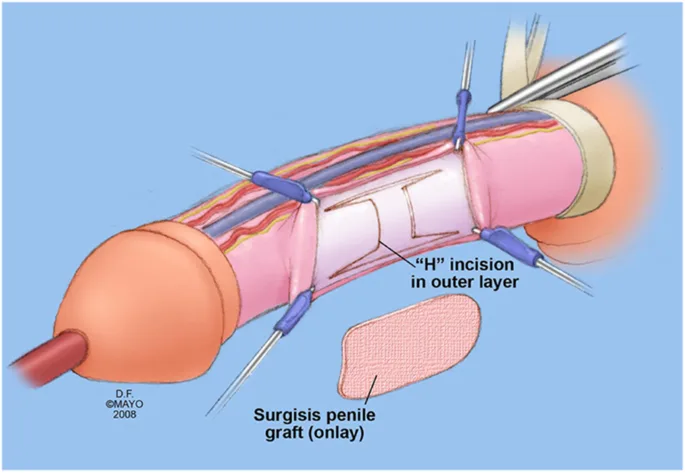
The surgeon makes one or more controlled incisions through the restrictive tunica at the point of maximum curvature. Opening this tissue creates additional space and allows the shortened side to expand.
The resulting tunical defect is then covered with graft material.
The goal is to restore more symmetrical penile dimensions and achieve a functionally straight erection without deliberately shortening the longer side.
Who is plaque incision and grafting designed for?
This procedure is not appropriate for every patient with Peyronie’s disease.
It is generally considered when the patient has:
Significant penile shortening
Severe curvature
Complex deformity
Hourglass deformity
Hinge deformity
Adequate erectile function
Curvature above approximately 60 degrees is often considered severe in clinical practice, although the overall deformity and functional impact are more important than a single angle.
Why must Peyronie’s disease be stable before surgery?
Surgical reconstruction is generally performed during the stable phase of Peyronie’s disease.
Operating while the condition is still actively changing creates a risk that curvature or deformity will continue to progress after reconstruction.
The surgeon therefore evaluates whether:
Curvature has stopped progressing
Deformity has stabilized
Pain associated with the active disease phase has resolved or stabilized
The patient’s sexual difficulty remains significant
The exact duration of stability can vary, so candidacy should be based on clinical assessment rather than a calendar alone.
How is the operation performed?
Before or during surgery, the surgeon evaluates the erect penis to define the direction, degree and complexity of the deformity.
An artificial erection is commonly created during the operation.
The surgeon identifies the concave or shortened side at the point of maximum curvature.
Depending on the location of the deformity, neurovascular structures may need to be carefully mobilized.
One or more incisions are then made through the restrictive tunica albuginea.
Opening the tunica creates a defect and allows the shortened side to expand.
A graft is cut to the required size and fixed over the defect.
Another artificial erection is then performed to assess the correction.
Additional maneuvers, including limited plication, may sometimes be required if meaningful residual curvature remains.
Is the Peyronie’s plaque removed?
Usually, complete plaque removal is not necessary.
Modern surgery commonly involves incision of the restrictive plaque or tunica, rather than total excision.
Complete plaque excision can increase the risk of postoperative erectile dysfunction because it may create a larger defect and greater disturbance of the tunica.
Partial excision may still be considered in selected situations, such as heavily calcified plaques.
What types of graft can be used?
Many graft materials have been used in Peyronie’s reconstruction.
Autografts
Tissue taken from the patient’s own body, such as:
Buccal mucosa
Saphenous vein
Fascia
Tunica vaginalis
Allografts
Human donor-derived tissue, including certain pericardial and fascial grafts.
Xenografts
Biological material derived from another species, such as:
Bovine pericardium
Porcine small intestinal submucosa
Collagen-based materials
Different grafts have different handling characteristics, availability and evidence bases.
There is no single graft that is universally best for every patient.
What about buccal mucosa grafting?
Buccal mucosa is tissue harvested from the inside of the patient’s mouth.
It has become an important graft option in reconstructive Peyronie’s surgery because it is flexible, well vascularized and familiar to reconstructive urologists.
Published studies report high rates of straightening and patient satisfaction, but outcomes should not be generalized to all graft materials or all patients.
Plaque incision and grafting vs penile plication
This is one of the most important comparisons for patients.
Penile Plication Surgery corrects curvature by shortening the longer, convex side.
It is generally simpler and may carry a lower risk of postoperative erectile deterioration, but penile shortening is an important trade-off.
Plaque Incision and Grafting Surgery addresses the shorter, concave side.
It is generally considered when:
Penile shortening is already significant
Curvature is severe
Deformity is complex
Hourglass or hinge deformity is present
Further shortening from plication would be undesirable
The trade-off is that grafting is more extensive surgery and carries a greater risk of postoperative erectile dysfunction.
Does grafting make the penis longer?
It should not be marketed as penile-lengthening surgery.
The purpose of tunical-lengthening surgery is to correct the deformity and reduce additional shortening.
Some patients may regain part of the functional length lost because of curvature, but long-term enlargement beyond the patient’s pre-disease anatomy should not be promised.
Plaque incision and grafting vs penile implant surgery
Erectile function is one of the main factors determining which procedure is appropriate.
A man with severe curvature and good erectile function may be a candidate for incision and grafting.
A man with Peyronie’s disease and severe erectile dysfunction that does not respond adequately to medication is generally better evaluated for penile prosthesis implantation, with additional curvature correction if required.
Why surgeon experience matters
Plaque incision and grafting is more technically demanding than straightforward plication.
The surgeon must manage:
Penile neurovascular structures
Tunical incision
Graft sizing
Graft fixation
Curvature correction
Erectile tissue preservation
Complex three-dimensional deformity
For international patients, surgeon experience in reconstructive penile surgery is particularly important because the operation requires individualized planning rather than a standardized one-size-fits-all approach.
Who it is for
- •You have stable Peyronie’s disease causing curvature that significantly interferes with sexual intercourse.
- •You have severe penile curvature for which plication would potentially cause unacceptable shortening.
- •You have significant penile shortening associated with Peyronie’s disease.
- •Your erectile rigidity is adequate for penetrative intercourse, either naturally or with appropriate medication.
- •Your penile anatomy is suitable for tunical-lengthening reconstruction.
- •You understand that grafting aims to correct deformity and minimize additional shortening but does not guarantee restoration of previous penile length.
- •You understand the risk of new or worsened erectile dysfunction following surgery.
- •You are medically fit for elective reconstructive surgery and anesthesia.
- •Your Peyronie’s disease is still actively progressing.
- •Your penile curvature is still changing significantly.
- •You have severe erectile dysfunction that does not respond adequately to medication.
- •You require penile prosthesis surgery because erectile rigidity is inadequate for intercourse.
- •Your deformity can be effectively corrected with a less extensive plication procedure and additional shortening is acceptable.
- •You expect the operation to enlarge the penis beyond its pre-disease dimensions.
- •You are unwilling to accept the possibility of postoperative erectile dysfunction, altered sensation or residual curvature.
- •You have an untreated urinary, genital or systemic infection.
- •You are medically unfit for elective surgery or anesthesia.
- •Your expectations regarding penile length, straightness or postoperative sexual function are unrealistic.
Preparing for surgery
What recovery looks like
Risks and complications
Common questions
What is plaque incision and grafting surgery?
Who is a good candidate?
How severe does curvature need to be?
Does the surgeon remove the entire Peyronie’s plaque?
What is the success rate?
Can grafting cause erectile dysfunction?
Does grafting preserve penile length?
Will it restore the length I had before Peyronie’s disease?
What is the difference between plication and grafting?
Is grafting better than plication?
What is an hourglass deformity?
What is a hinge deformity?
Which graft is best?
What is buccal mucosa grafting?
Can I have grafting if I have erectile dysfunction?
Can grafting and penile plication be combined?
Can grafting be combined with a penile implant?
How long does surgery take?
How long should I stay in Turkey?
When can I return to work?
When can I have sex?
Is penile traction used after surgery?
Can Peyronie’s curvature come back?
Could I need a penile implant later?
Is this surgery suitable for medical tourism?
Patient reviews
Been treated? Your honest review of Plaque Incision and Grafting Surgery helps the next patient.
No one has reviewed this yet. If you have been treated, your experience would help the next person.
Write the first reviewSources
- EAU Guidelines on Sexual and Reproductive Health — Penile Curvature https://uroweb.org/guidelines/sexual-and-reproductive-health/chapter/penile-curvature
- Twenty Years of Plaque Incision and Grafting for Peyronie's Disease: A Review of Literature https://pubmed.ncbi.nlm.nih.gov/30890446/
- Grafts in Peyronie's Surgery Without the Use of Prostheses: A Systematic Review and Meta-analysis https://pubmed.ncbi.nlm.nih.gov/38265253/
- Surgical Treatment of Peyronie's Disease by Plaque Incision and Buccal Mucosa Graft: Systematic Review and Meta-analysis https://pubmed.ncbi.nlm.nih.gov/41736300/
- Plaque Incision and Grafting for Peyronie's Disease: 15-Year Experience and Functional Outcomes From a High-Volume Andrology Centre https://pubmed.ncbi.nlm.nih.gov/42225958/
- Erectile Dysfunction in Patients With Peyronie's Disease Treated With Different Grafts: A Systematic Review https://pubmed.ncbi.nlm.nih.gov/40966483/