
Vasoepididymostomy — Microsurgical Epididymal Bypass
Vasoepididymostomy is a complex microsurgical fertility procedure that connects the vas deferens directly to an epididymal tubule to bypass an epididymal blockage and restore the passage of sperm into the ejaculate. It is used for selected men with obstructive azoospermia, including some men undergoing vasectomy reversal when secondary epididymal obstruction prevents a standard vasovasostomy.
 ✓ Clinician-reviewed information
- Vasoepididymostomy bypasses an epididymal blockage by connecting the vas deferens directly to a sperm-containing epididymal tubule.
- It aims to restore sperm to the natural ejaculate rather than retrieving sperm solely for IVF/ICSI.
- The procedure may be required during vasectomy reversal when epididymal obstruction has developed and a standard vasovasostomy would not restore sperm flow.
- Vasoepididymostomy is technically more demanding than vasovasostomy and should be performed by a surgeon experienced in male reproductive microsurgery.
- Published microsurgical series report postoperative sperm return to the ejaculate in roughly 70–85% of appropriately selected men, although pregnancy rates are lower and depend on both partners.
About vasoepididymostomy — microsurgical epididymal bypass
Vasoepididymostomy is a microsurgical reconstruction of the male reproductive tract.
It creates a new pathway for sperm when the epididymis is blocked.
Normally, sperm are produced in the testicle, pass through the epididymis and then travel through the vas deferens before entering the ejaculate.
When the epididymis becomes obstructed, sperm may continue to be produced normally but cannot reach the vas deferens.
The result can be obstructive azoospermia.
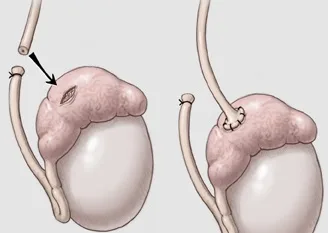
During vasoepididymostomy, the surgeon bypasses the blocked portion by connecting the vas deferens directly to a functioning epididymal tubule above the obstruction.
What is epididymal obstruction?
The epididymis is a long, tightly coiled structure behind the testicle.
Because its tubules are extremely small, inflammation, infection, previous surgery or prolonged obstruction can cause blockage.
Potential causes include:
Previous vasectomy
Long-standing vasal obstruction
Epididymitis
Previous scrotal surgery
Congenital abnormalities
Trauma
Previous reproductive reconstruction
When sperm production remains intact, reconstructing the pathway can potentially return sperm to the semen.
How is vasoepididymostomy performed?
The procedure is performed under high-powered microsurgical magnification.
The surgeon exposes the vas deferens and epididymis through a scrotal incision.
The vas deferens is divided and prepared for reconstruction.
The surgeon then identifies an epididymal tubule above the suspected obstruction.
A tiny opening is created in that tubule.
Fluid emerging from the epididymis is examined for sperm.
If appropriate sperm are identified, the selected epididymal tubule is connected directly to the lumen of the vas deferens using extremely fine microsurgical sutures.
The goal is to create a watertight connection that allows sperm to move from the epididymis into the vas deferens.
Why is this operation technically difficult?
The lumen of an epididymal tubule is microscopic.
The surgeon must create a precise connection between:
A very small epididymal tubule
The much larger vas deferens
The reconstruction must remain open after healing despite postoperative inflammation and scar formation.
For this reason, vasoepididymostomy is considered one of the most technically demanding procedures in male infertility microsurgery.
What is an intussusception vasoepididymostomy?
Modern vasoepididymostomy commonly uses an intussusception technique.
Tiny sutures are passed through the selected epididymal tubule before it is opened.
After the tubule is opened and appropriate fluid is confirmed, the sutures are passed into the vas deferens.
When tied, they draw or "invaginate" the epididymal tubule into the lumen of the vas.
This creates a precise mucosa-to-mucosa connection while minimizing leakage.
On your platform, Two-Suture Longitudinal Intussusception Vasoepididymostomy should belong under Techniques, not as another Procedure.
Vasoepididymostomy vs vasovasostomy
These are different reconstructions.
Vasovasostomy
Vasovasostomy reconnects two divided ends of the vas deferens.
It is the preferred reconstruction when the epididymis remains open and sperm-containing fluid is present at the testicular end of the vas.
Vasoepididymostomy
Vasoepididymostomy bypasses the epididymis by connecting the vas directly to an epididymal tubule.
It is required when a secondary epididymal blockage prevents sperm from reaching the vas.
Vasoepididymostomy is substantially more technically demanding.
Why can vasoepididymostomy be needed during vasectomy reversal?
After vasectomy, sperm production continues.
Pressure can gradually build within the reproductive tract behind the vasectomy site.
In some men, this prolonged obstruction contributes to secondary blockage or rupture within the delicate epididymal tubules.
If this happens, simply reconnecting the vas deferens with vasovasostomy will not restore sperm flow because another blockage remains upstream.
The surgeon must bypass that epididymal obstruction with vasoepididymostomy.
Can the surgeon know before surgery which reconstruction is needed?
Not always.
Clinical factors can estimate the probability of epididymal obstruction, but the definitive decision is often made during surgery.
The surgeon evaluates fluid from the testicular end of the vas deferens.
Important findings include:
Presence or absence of sperm
Sperm fragments
Fluid consistency
Fluid volume
Appearance of the epididymis
If findings suggest that the epididymal pathway is open, vasovasostomy may be performed.
If epididymal obstruction is present, vasoepididymostomy may be necessary.
For patients travelling internationally for vasectomy reversal, this is important: the chosen surgeon should be capable of performing both procedures during the same operation.
Unilateral vs bilateral vasoepididymostomy
Reconstruction may be performed on one or both sides.
Possible combinations include:
Bilateral vasoepididymostomy
Unilateral vasoepididymostomy
Vasoepididymostomy on one side and vasovasostomy on the other
The decision depends on operative findings.
Does vasoepididymostomy restore natural fertility?
Potentially, yes.
Unlike PESA, MESA, TESA or TESE, which retrieve sperm for assisted reproduction, vasoepididymostomy attempts to restore sperm passage into the ejaculate.
If the reconstruction remains open, sperm may return to the semen and natural conception may become possible.
However, restoration of sperm to semen does not guarantee pregnancy.
What does patency mean?
Patency means sperm have returned to the ejaculate after reconstruction.
This is one of the main surgical outcome measures for vasoepididymostomy.
It is different from pregnancy.
A man can have a patent reconstruction and still experience infertility because of:
Low sperm concentration
Poor sperm motility
Female fertility factors
Age-related fertility decline
Other reproductive problems
Therefore, patency and pregnancy rates should always be reported separately.
How long does it take for sperm to return?
Sperm may not immediately appear in the semen.
After vasoepididymostomy, sperm return can take several months because the reconstructed pathway needs time to heal and sperm must travel through the reproductive tract.
Semen analyses are therefore repeated during follow-up.
Some men show sperm relatively early, while others may require six months or longer before patency can be properly assessed.
Can the reconstruction close again?
Yes.
Scar formation can cause secondary obstruction after initially successful reconstruction.
This is called late failure or secondary anastomotic obstruction.
For this reason, some specialists recommend sperm cryopreservation if good sperm concentrations appear after successful surgery, particularly when future fertility may be delayed.
Vasoepididymostomy vs sperm retrieval with ICSI
Both approaches can allow biological fatherhood, but they follow different strategies.
Vasoepididymostomy
Attempts to restore sperm to the ejaculate.
Potential advantages include:
Possibility of natural conception
Potential for multiple pregnancies without repeated IVF
No requirement for ovarian stimulation if natural conception occurs
Surgical sperm retrieval + ICSI
Bypasses the obstruction completely.
Potential advantages include:
Does not require successful reconstruction
May offer a faster assisted-reproduction pathway
Can be preferable when significant female fertility factors already require IVF
The correct decision should consider both partners.
Why female partner age matters
The time available for natural conception is clinically important.
A younger female partner with good ovarian reserve may make reconstruction attractive because the couple has more time to wait for sperm return and natural pregnancy.
When female reproductive age is advanced or ovarian reserve is significantly reduced, waiting months for reconstruction and natural conception may not be the optimal strategy.
In such circumstances, sperm retrieval with IVF/ICSI may sometimes be preferred.
Can sperm retrieval be performed during reconstruction?
Yes.
In selected cases, sperm can be retrieved and cryopreserved during the same operation.
This provides a backup option if:
The reconstruction fails
Sperm never return to the semen
IVF is later required
Fertility plans change
The possibility should be discussed before surgery because embryology and cryopreservation services must be arranged in advance.
Why surgeon experience matters
Vasoepididymostomy requires advanced microsurgical expertise.
Success depends on:
Accurate diagnosis
Appropriate selection of epididymal tubules
Intraoperative fluid interpretation
Microsurgical suturing
Anastomotic precision
Tissue handling
Ability to perform both vasovasostomy and vasoepididymostomy
For international patients, selecting a surgeon capable of switching between reconstructive techniques according to intraoperative findings is particularly important.
Who it is for
- •You have confirmed or strongly suspected obstructive azoospermia caused by epididymal obstruction.
- •Testicular sperm production is preserved but sperm cannot pass through the epididymis.
- •You require vasectomy reversal and intraoperative findings indicate secondary epididymal obstruction.
- •Previous vasovasostomy has failed because of suspected epididymal obstruction.
- •You want to attempt restoration of sperm to the natural ejaculate rather than relying exclusively on IVF/ICSI.
- •Your female partner's fertility status provides a reasonable opportunity for natural conception after reconstruction.
- •You understand that sperm may take several months to return after surgery.
- •You understand that successful patency does not guarantee pregnancy.
- •You are willing to complete postoperative semen analyses.
- •You are medically fit for microsurgery and anesthesia.
- •You have non-obstructive azoospermia caused primarily by severely impaired sperm production rather than reproductive-tract obstruction.
- •You have complete absence of reconstructable epididymal or vasal anatomy.
- •You have untreated genital, urinary or systemic infection.
- •You are medically unfit for elective microsurgery or anesthesia.
- •Female fertility factors make immediate IVF/ICSI clearly more appropriate than waiting for reconstructive success.
- •You expect surgery to guarantee natural pregnancy.
- •You are unwilling to complete postoperative semen analyses.
- •Your infertility has not been adequately evaluated to distinguish obstruction from impaired sperm production.
- •You have a genetic or testicular condition in which sperm production itself is absent.
- •The reproductive team determines that surgical sperm retrieval with ICSI offers a substantially more appropriate pathway for the couple.
Preparing for surgery
What recovery looks like
Risks and complications
Common questions
What is vasoepididymostomy?
What does vasoepididymostomy treat?
Is vasoepididymostomy a type of vasectomy reversal?
What is the difference between vasovasostomy and vasoepididymostomy?
Which operation is more difficult?
Can the surgeon know which operation I need before vasectomy reversal?
What is an intussusception vasoepididymostomy?
What is the success rate?
What does patency mean?
Does 80% patency mean an 80% pregnancy rate?
Can I father a child naturally after vasoepididymostomy?
How long does it take for sperm to return?
Can the reconstruction close again?
Should sperm be frozen if they return?
Can sperm be retrieved during the operation?
Vasoepididymostomy or IVF/ICSI — which is better?
Is vasoepididymostomy appropriate for non-obstructive azoospermia?
Does the procedure affect testosterone?
How long does surgery take?
Do I stay in hospital?
How long should I stay in Turkey?
When can I return to work?
When can I exercise?
When can I have sex?
When will I need a semen analysis?
What happens if surgery fails?
Which doctor should perform vasoepididymostomy?
Patient reviews
Been treated? Your honest review of Vasoepididymostomy — Microsurgical Epididymal Bypass helps the next patient.
No one has reviewed this yet. If you have been treated, your experience would help the next person.
Write the first reviewSources
- EAU Guidelines on Sexual and Reproductive Health — Male Infertility https://uroweb.org/guidelines/sexual-and-reproductive-health/chapter/male-infertility
- Clinical series evaluating modern microsurgical vasoepididymostomy and reporting high postoperative patency. https://pubmed.ncbi.nlm.nih.gov/15936846/
- Evaluation of microsurgical intussusception techniques for epididymal bypass. https://pubmed.ncbi.nlm.nih.gov/11912410/
- Clinical guidance addressing reproductive reconstruction and surgical sperm retrieval for male reproductive-tract obstruction. https://pubmed.ncbi.nlm.nih.gov/31056351/
- Diagnosis and Treatment of Infertility in Men: AUA/ASRM Guideline https://www.auanet.org/guidelines-and-quality/guidelines/male-infertility