
Penile Implant Video Surgery: 8 Things the Footage Never Shows
Penile implant video surgery explained: see what footage misses about sizing, reservoir placement, infection control, fibrosis and surgeon decisions.
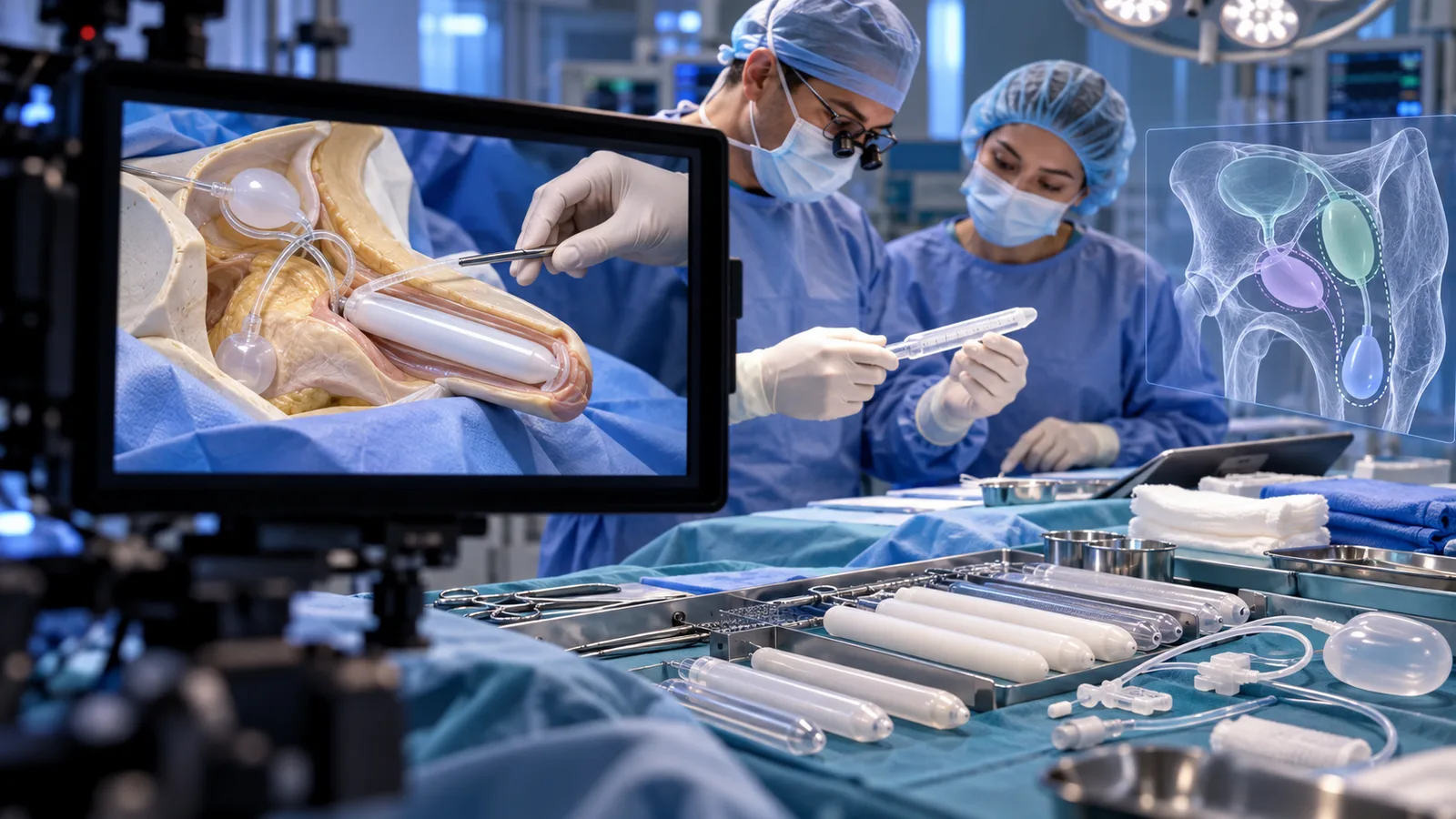
- Penile implant surgery videos show the visible procedure but rarely explain the decisions that determine cylinder size, surgical approach, reservoir position and device configuration.
- Cylinder sizing is based on intraoperative corporal length and dilation, while fibrosis, device design and surgeon experience can change the final implant selection.
- Penoscrotal and infrapubic implantation are both established approaches; systematic reviews and current EAU guidance do not demonstrate one universal safety or effectiveness winner.
- Reservoir position is individualized, particularly after prostate, pelvic or abdominal surgery; contemporary ectopic reservoir techniques can provide alternatives to traditional retropubic placement.
- Much of infection prevention is invisible on video. A 2026 meta-analysis of 102,572 primary implant patients found coated prostheses significantly reduced infection risk compared with uncoated devices.
Penile implant video surgery can show an incision, cylinder placement, a pump and a reservoir, but it cannot show the most important part of the operation: the surgeon’s decision-making. Implant size, corporal measurements, scar tissue, reservoir position, infection-prevention steps, penile curvature and the patient’s long-term needs are judged in real time and can change the procedure.
That is the first thing to understand before watching a penile implant surgery video.
Surgical footage can be useful.
It can help a patient understand that a three-piece inflatable penile prosthesis is not placed externally.
It can show that the cylinders sit inside the corpora cavernosa.
It can demonstrate that the pump is positioned in the scrotum and that the reservoir is placed internally.
It can also make the procedure feel less mysterious.
But a video has a major weakness.
It shows what the surgeon’s hands do.
It rarely shows why the surgeon decides to do it that way.
A 20-minute edited video may make penile prosthesis implantation appear almost mechanical:
make incision;
open corpora;
dilate;
measure;
insert cylinders;
place reservoir;
position pump;
close incision.
That sequence is broadly correct.
But it can give the impression that every patient receives the same operation.
They do not.
A man with uncomplicated erectile dysfunction and no previous pelvic surgery may have a relatively straightforward implantation.
Another patient may have:
severe corporal fibrosis;
Peyronie’s disease;
a previous radical prostatectomy;
previous hernia repair;
a prior infected prosthesis;
previous implant removal;
ischemic priapism;
or unusual pelvic anatomy.
The visible operation can therefore be only the final expression of dozens of decisions made before and during surgery.
Current European Association of Urology guidance recognizes two main penile prosthesis approaches—the penoscrotal and infrapubic approaches—and states that current evidence does not establish one as universally superior. Surgeons need enough experience to tailor the approach to the patient and the complexity of the case.
That idea should frame every surgical video you watch:
there is no single “correct-looking” penile implant operation for every man.
This article walks through the operation in the order it generally happens, but focuses on what the camera does not show.
What a Penile Implant Surgery Video Usually Shows
A typical educational penile prosthesis implant video may show some or all of the following:
the patient positioned on the operating table;
surgical skin preparation;
an incision;
exposure of the corpora cavernosa;
corporotomies, or small openings in the erectile bodies;
dilation of the corporal spaces;
measurement;
insertion of prosthetic cylinders;
reservoir placement for a three-piece system;
pump placement in the scrotum;
connection of the components;
device testing;
closure;
and dressing.
That is the visible anatomy of the procedure.
For patient education, that can be useful.
The Urology Care Foundation explains the operation in similar broad terms: penile prostheses are generally placed under anaesthesia through a small incision above the penis or at the penoscrotal junction, with same-day discharge or one hospital night being common in uncomplicated cases.
But that simplified description intentionally leaves out the technical detail.
Patients do not need a surgical manual.
They do need to understand which decisions affect outcomes.
So rather than focusing on every clamp or suture, it is more useful to ask:
What is the surgeon deciding at each step?
Thing 1 the Video Never Shows: Why This Patient Is Having an Implant at All
The first important decision happens before the operating room.
A surgical video starts after the patient has already been selected.
That can create a false impression that penile implant surgery is simply another option for anyone dissatisfied with erection quality.
It is not.
The EAU recommends penile prosthesis implantation when other erectile dysfunction treatments fail, are unsuitable, or when an appropriately informed patient prefers definitive surgical therapy.
That usually means the patient has already discussed or tried alternatives such as:
PDE5 inhibitors such as sildenafil or tadalafil;
intracavernosal injections;
vacuum erection devices;
or other treatment suited to the cause of ED.
The camera cannot show that clinical history.
Why the reason for ED matters
A man with erectile dysfunction after radical prostatectomy may have different anatomy and expectations from a man with:
long-standing diabetes;
spinal cord injury;
Peyronie’s disease;
severe venous leak;
or priapism-related fibrosis.
That background can influence:
device selection;
reservoir location;
cylinder size;
surgical difficulty;
and counselling about penile dimensions.
Videos also cannot show expectation management
A patient might enter surgery believing:
the implant will enlarge his penis;
the glans will become mechanically rigid;
the prosthesis will restore libido;
or the erection will feel exactly like his natural erection at age 25.
Those expectations can remain unrealistic even when the operation is technically perfect.
A penile prosthesis primarily restores mechanical rigidity.
It does not guarantee increased penile length.
EAU guidance specifically notes that available evidence does not show a simple direct relationship between prosthesis implantation and increased penile length, and perceived shortening can occur even when objective measurements do not significantly decrease.
None of that appears in operating footage.
Yet it can affect satisfaction as much as anything the camera records.
If you are still deciding whether the operation is appropriate, begin with the complete penile implant procedure guide rather than relying only on surgical videos.
Thing 2: The Incision Is a Decision, Not Just a Cut
Most three-piece inflatable implants are placed through one of two main routes:
penoscrotal
or
infrapubic.
A video may show one and make it look like that is simply “how penile implants are done.”
That is incomplete.
Penoscrotal approach
The incision is made where the penis meets the scrotum.
This approach gives direct access to:
the corpora;
the scrotum;
and pump placement.
A 2023 systematic review found the penoscrotal approach remains the most commonly used and is often favored for its surgical exposure, particularly in more complex cases.
Infrapubic approach
The incision is placed above the penis near the pubic region.
It can offer direct access for reservoir placement and may shorten operative time in some series.
Multiple reviews have found broadly similar safety, effectiveness and satisfaction between infrapubic and penoscrotal techniques.
A 2026 multicenter study also reported favorable perioperative and long-term results with the infrapubic approach.
So which approach is better?
Current evidence does not establish one universal winner.
That is exactly what the EAU guideline states.
The choice can depend on:
surgeon experience;
previous surgery;
fibrosis;
reservoir strategy;
need for scrotal access;
and individual anatomy.
This means a patient should not watch one attractive infrapubic video and conclude:
“My surgeon should use this incision.”
Nor should he assume a penoscrotal incision is automatically superior because it appears in more videos.
The important question is:
“Why is my surgeon choosing this approach for me?”
Thing 3: Cylinder Sizing Is One of the Most Important Decisions—and a Video Cannot Show the Judgment Behind It
Cylinder sizing can look almost trivial on camera.
The surgeon inserts a measuring tool.
A number is called out.
Then cylinders are prepared.
But this step is one of the most consequential parts of the operation.
A 2026 review devoted specifically to inflatable prosthesis cylinder selection states that implant choice is based heavily on intraoperative corporal length and dilation measurements, while fibrosis, rear-tip extenders, device characteristics and surgeon experience can all affect the final selection.
The authors summarize the principle clearly:
“A properly sized cylinder ... is the prerequisite for an optimal IPP function and a satisfied patient.”
That is what the camera cannot communicate.
The surgeon is measuring an internal space
The cylinders sit inside the paired corpora cavernosa.
A meaningful portion of each cylinder lies internally toward the pelvis.
So if the surgeon uses, for example, a 20 cm or 22 cm total corporal measurement, that number does not represent the visible external penile length.
This is one of the most common misunderstandings patients have when they watch surgery footage.
They hear:
“22 centimetres.”
Then they think:
“That patient has a 22 cm penis.”
That is not what the measurement means.
The surgeon is measuring the corporal space from the distal tip toward the glans to the proximal corporal crus inside the body.
Too short is a problem
If the cylinders are undersized, possible consequences can include:
poor distal support;
instability;
abnormal cylinder position;
and dissatisfaction.
Too long is also a problem
A surgeon cannot solve penile-length anxiety by simply inserting the longest possible prosthesis.
Oversizing can contribute to:
pain;
buckling;
distal pressure;
erosion;
or abnormal positioning.
The goal is appropriate sizing.
Not maximum sizing.
Different cylinders require different corporal dimensions
The 2026 cylinder-selection review notes that standard inflatable cylinders generally require more corporal dilation than smaller-diameter or narrow-base models.
That matters in men with fibrosis.
If the corporal bodies are scarred and cannot be safely dilated to the diameter needed for a standard cylinder, a narrower implant may be more appropriate.
This decision may not be known with certainty until surgery.
That is why an experienced prosthetic surgeon needs more than one plan.
What Is the Surgeon Actually Measuring?
A useful mental model is to imagine each corpus cavernosum as an internal tunnel.
The surgeon needs to determine:
how long the tunnel is;
how wide it can safely be dilated;
whether both sides are symmetrical;
whether scar tissue blocks the pathway;
and whether the distal and proximal ends are intact.
The measurements then help determine:
cylinder model;
cylinder length;
rear-tip extender length where used;
and sometimes whether a narrow implant is necessary.
A surgical video can show the measuring instrument.
It cannot show years of experience telling the surgeon:
“This resistance is normal.”
versus:
“This is fibrosis.”
or:
“This direction risks perforation.”
That judgment is the surgery.
Thing 4: Corporal Dilation Can Be Easy—or the Hardest Part of the Operation
In routine cases, corporal dilation may look quick.
That can be misleading.
Some men have soft, easily developed corporal spaces.
Others have severe fibrosis.
Fibrosis can result from:
Peyronie’s disease;
previous prosthesis infection;
previous implant removal;
ischemic priapism;
trauma;
or other prior penile surgery.
EAU guidance on priapism specifically notes that severe corporal fibrosis can require:
narrow prostheses;
specialized cavernotomes;
multiple corporotomies;
scar excision;
or reconstructive techniques.
A highly edited surgical video may cut from:
“begin dilation”
to
“cylinders inserted”
in 20 seconds.
In reality, difficult fibrosis can transform the operation.
What the surgeon is trying to avoid
During dilation, recognized risks include:
distal perforation;
proximal perforation;
urethral injury;
and corporal crossover.
Crossover means the instrument passes through the septum and enters the opposite corporal body.
These are not the kinds of events usually included in promotional surgery videos.
But the ability to recognize and manage them is part of prosthetic expertise.
Why surgeon volume matters here
A surgeon who implants prostheses regularly encounters more anatomical variation.
Straightforward cases teach technique.
Difficult cases teach judgment.
That is one reason it is useful to evaluate the operating physician through the Andrology Abroad surgeon directory rather than judging only from a polished video clip.
Thing 5: Reservoir Placement Is Often the Most Underestimated Part of a Three-Piece Implant
Most public videos focus on the cylinders.
Patients naturally think those are the main surgical challenge.
But three-piece inflatable implants also require an internal fluid reservoir.
And reservoir placement can demand significant anatomical judgment.
Traditional reservoir location
The classic location is the space of Retzius, behind the pubic bone.
That location has been used for decades.
For many patients, it remains appropriate.
But the pelvis is not identical in everyone.
Previous pelvic surgery changes the equation
Consider a man who previously underwent:
radical prostatectomy;
bladder surgery;
major abdominal surgery;
or some hernia repairs.
His normal tissue planes may be altered.
A 2024 review of ectopic reservoir placement notes that prior prostatectomy and other pelvic surgical history can lead surgeons to choose an alternative reservoir location rather than the traditional retropubic space.
Another contemporary review emphasizes that technique selection should account for:
previous surgery;
body habitus;
and surgeon experience.
Ectopic reservoir placement
Alternative locations can include various submuscular and extraperitoneal positions.
A large review covering 9,565 patients found no overall increase in safety problems when ectopic reservoir placement was compared with traditional retropubic placement in the studies reviewed.
That does not mean ectopic placement is always better.
It means modern prosthetic surgeons have alternatives.
Why reservoir placement matters
Rare reservoir complications can involve:
bladder;
bowel;
blood vessels;
hernia;
migration;
visibility;
or palpability.
EAU guidance specifically acknowledges that reservoir-related injury to pelvic structures such as the bladder, bowel and blood vessels can occur.
A video may show the surgeon creating a space and inserting the reservoir in a few seconds.
What it does not show is the thinking that happened first:
Has this patient had prostate surgery?
Was the retropubic space disrupted?
Is ectopic placement safer?
Will the reservoir be palpable?
What volume is appropriate?
Is there a hernia history?
Does body habitus matter?
That invisible planning is far more important than how elegant reservoir insertion looks on camera.
Thing 6: Infection Prevention Is Mostly Invisible
A surgical video may show sterile gowns and gloves.
That is only the visible surface of infection prevention.
Penile prosthesis infection is one of the most important complications because bacteria can adhere to prosthetic material and form biofilm.
Modern infection prevention operates across the entire treatment pathway.
A 2026 narrative review highlights:
preoperative optimization;
urine-culture management;
skin antisepsis;
perioperative antibiotics;
no-touch techniques;
antimicrobial-coated devices;
and intraoperative irrigation strategies.
A 2024 review similarly concluded that infection prevention begins before surgery and continues intraoperatively, while evidence for prolonged routine postoperative antibiotics remains less convincing.
The video usually does not show preoperative screening
Before the patient enters the theatre, the team may already have considered:
active urinary infection;
skin infection;
diabetes;
medication;
previous prosthesis infection;
and other risk factors.
The Urology Care Foundation advises postponing implantation if the patient has an active systemic, skin or urinary infection until that infection has been treated.
That step will never appear in an operation video.
But it may matter more than anything shown in the first five minutes.
Coated devices matter
Modern inflatable penile prostheses commonly incorporate infection-reduction technology.
A 2026 meta-analysis included 102,572 primary implant patients and found antibiotic-coated devices associated with a significantly lower infection hazard than non-coated implants:
HR 0.38.
The same analysis found no significant infection difference between the two major manufacturers it compared.
This is an important contemporary result.
A viewer may watch two surgeons implant different brands and assume one has chosen the “safer” prosthesis.
The evidence does not justify that simple conclusion.
The broader infection-control protocol matters.
The no-touch concept
The no-touch technique attempts to minimize contact between the prosthesis and the patient's skin.
A major single-surgeon series reported infection rates falling from 5.3% with uncoated devices to 1.99% with coated devices and to approximately 0.44% after adding the no-touch technique.
Those figures come from a specific practice and should not be treated as universal rates for every surgeon.
But they illustrate why seemingly minor details in the operating room matter.
Why a video cannot prove infection quality
You cannot determine infection safety from whether the operating room looks clean.
You would need to know:
which antibiotics were given;
when they were administered;
which skin preparation was used;
whether the device was coated or dipped;
how long the wound remained open;
how the implant was handled;
and what the hospital's infection protocols are.
The most important infection-prevention steps may happen:
before the camera starts;
outside the frame;
or after editing removes them.
Thing 7: Pump Placement Is About Future Daily Use, Not Just Putting It in the Scrotum
The pump is the part of a three-piece penile implant that the patient will interact with repeatedly.
A surgical video often shows the surgeon creating a scrotal pocket and positioning the pump.
It may take less than a minute on screen.
But pump placement has long-term consequences.
The pump needs to be:
accessible;
stable;
comfortable;
and positioned so the patient can distinguish the inflation bulb and deflation control.
Hand function matters
A man with:
arthritis;
neuropathy;
stroke-related weakness;
spinal cord injury;
or limited dexterity
may have more difficulty manipulating an inflatable pump.
That may influence device choice before surgery.
EAU guidance recognizes malleable prostheses as a possible option for men with limited manual dexterity.
A video of a surgeon easily cycling the device on the operating table tells you almost nothing about whether the patient can operate it at home.
Pump position matters too
During surgery, the pump needs to be placed in a location the patient can later reach.
Postoperative swelling can initially make the pump feel:
high;
large;
or difficult to distinguish.
As swelling falls, the patient learns its position.
A technically successful implant is not only one that inflates.
It needs to be usable.
This is why postoperative education matters just as much as intraoperative placement.
Thing 8: The Surgeon Tests More Than “Does It Inflate?”
Near the end of many penile implant video surgery clips, the surgeon inflates the prosthesis.
The penis becomes rigid.
The footage may then jump directly to closure.
That final test contains more information than the viewer can see.
The surgeon may be assessing:
cylinder position;
distal tip symmetry;
rigidity;
device cycling;
pump function;
connection integrity;
curvature;
and whether additional correction is needed.
Peyronie’s disease changes this step
For a man with Peyronie’s disease, cylinder insertion itself may improve curvature.
EAU guidance states that mild-to-moderate residual curvature may improve with the prosthesis alone.
If more substantial deformity remains, the surgeon may consider additional straightening measures such as:
manual modelling;
plication;
or plaque incision/grafting in selected cases.
A viewer might see the surgeon bend the inflated penis and think:
“This must be part of every implant procedure.”
It is not.
Manual modelling is a specific maneuver for selected deformity.
The same is true of:
plication;
grafting;
or other adjunctive reconstruction.
The video cannot show whether the final result matches the preoperative plan
Suppose the patient expected:
a particular implant model;
a certain size;
or no additional reconstructive procedure.
The surgeon may discover anatomy that requires a change.
Good surgical care involves preparing the patient for those possibilities before anaesthesia.
Consent happens outside the video.
A Written Walkthrough of Penile Implant Surgery
For readers who searched for a video because they want to understand the sequence, here is the operation in patient-level language.
Step 1: Anaesthesia and positioning
The patient receives anaesthesia.
The genital and surrounding areas are prepared according to the surgical team's sterile protocol.
The exact anaesthetic technique may vary.
Step 2: Surgical access
The surgeon makes a penoscrotal or infrapubic incision, depending on the planned approach.
The corpora cavernosa are exposed.
Step 3: Corporotomies
Small openings are made in the outer covering of the corpora.
These provide access to the internal erectile spaces where the prosthetic cylinders will sit.
Step 4: Dilation
The surgeon carefully develops the corporal spaces.
This can be straightforward or technically demanding depending on fibrosis and previous surgery.
Step 5: Measurement
Each corporal body is measured internally.
This determines the appropriate cylinder length and helps identify asymmetry or perforation.
Step 6: Cylinder preparation and insertion
The selected prosthetic cylinders are prepared according to manufacturer instructions and placed inside the corporal bodies.
For three-piece devices, tubing later connects them to the pump and reservoir.
Step 7: Reservoir placement
A three-piece inflatable implant requires an internal fluid reservoir.
It may be placed in the traditional retropubic space or an alternative location depending on anatomy and prior surgery.
Step 8: Pump placement
The pump is positioned inside the scrotum in a location intended to be reachable during everyday use.
Step 9: Component connection
The hydraulic components are connected.
The surgical team checks the system.
Step 10: Device test
The implant is inflated and deflated to assess function, cylinder position and penile geometry.
If significant residual Peyronie’s curvature is present, additional correction may be considered.
Step 11: Closure
The corporal openings and surgical incision are closed.
Dressings and postoperative support are applied according to surgeon protocol.
This is the basic operation.
The complexity lies in every decision within those steps.
What a Surgery Video Cannot Tell You About the Surgeon
A technically beautiful five-minute clip can be misleading.
It may show the surgeon working confidently.
But you still do not know:
how many implants that surgeon performs;
infection rate;
revision experience;
management of complications;
hospital standards;
or whether the video represents an easy case selected specifically for filming.
This is important.
Marketing videos are usually curated.
They are not random samples of all operations.
An uncomplicated video does not prove expertise with complications
Someone can look excellent during:
a thin patient;
normal corpora;
no fibrosis;
no curvature;
and no previous pelvic surgery.
A difficult prosthetic surgeon needs to know what to do when none of those advantages are present.
This is why a patient should evaluate the physician through:
credentials;
case volume;
hospital;
device experience;
and complication-management pathways.
Use the surgeon directory and clinic directory as starting points rather than treating a surgery video as a quality certificate.
Can You Judge Surgical Speed From a Penile Implant Video?
Not reliably.
Edited surgical videos often remove:
waiting;
equipment preparation;
measurements;
irrigation;
device preparation;
discussion between team members;
and difficult portions of the case.
The final clip may compress a 60- or 90-minute operation into ten minutes.
Also, faster does not automatically mean better.
Some comparative research has found the infrapubic approach associated with shorter operative time than penoscrotal implantation in selected series.
But operative speed is only one outcome.
Safe sizing and placement matter more than winning a timer.
A patient should be cautious if a clinic markets:
“15-minute penile implant surgery”
as proof of quality without explaining what the number actually includes.
Can You Tell Which Penile Implant Is Best From a Video?
No.
The device may look impressive on camera.
That does not tell you whether it is appropriate for your anatomy.
The EAU states that current evidence does not demonstrate clear superiority of one penile implant manufacturer over another.
Different devices have different characteristics.
One patient may value:
length-expanding cylinder behavior.
Another may require:
narrow cylinders because of fibrosis.
Another may prioritize:
pump usability.
Another may need:
a malleable implant because of limited hand function.
Brand comparison should therefore happen around:
the patient;
not the video.
Why Videos Often Overemphasize Cylinder Insertion
Cylinder placement is visually satisfying.
It is the moment when the prosthesis becomes obviously real.
For that reason, educational and promotional videos naturally focus on it.
But the less visually dramatic moments may be equally important.
Examples include:
checking urine culture;
selecting antibiotics;
reviewing old operative reports;
deciding reservoir location;
confirming measurements twice;
evaluating distal cylinder support;
or deciding whether scar tissue needs further work.
None of those makes exciting footage.
All can affect the outcome.
What the Camera Does Not Show About Reservoir Risk
Reservoir placement deserves another look because it is one of the least intuitive parts of three-piece implantation.
The traditional retropubic location sits near important pelvic structures.
Contemporary reviews explain that concern about:
bladder;
bowel;
and vascular injury
helped drive development of alternative reservoir positions.
These complications are uncommon.
The point is not to frighten the patient.
It is to understand why:
“The surgeon inserted the reservoir here in my video”
does not mean that same location is appropriate for everyone.
The correct position depends partly on surgical history.
A man who underwent radical prostatectomy may require a different strategy from a man with untouched pelvic anatomy.
The video cannot know your history.
Your surgeon does.
What the Camera Does Not Show About Infection Risk
Patients frequently assume infection prevention is just:
sterile gloves + antibiotics.
It is more complex.
Recent reviews describe a layered approach including:
patient selection;
control of comorbidities;
preoperative urine considerations;
skin antisepsis;
appropriate perioperative antimicrobial prophylaxis;
coated devices;
minimal implant-skin contact;
and careful intraoperative technique.
The 2026 meta-analysis showing reduced infection risk with coated devices is particularly useful because it included more than 100,000 patients.
This evidence should change how a patient interprets surgery videos.
A surgeon does not prove low infection risk by:
wearing two pairs of gloves on camera;
using one particular brand;
or saying “no-touch” in the video title.
The quality lies in the full protocol.
What if the Surgeon Finds Unexpected Fibrosis?
This is one of the most important questions to ask before surgery.
A patient can have more scar tissue than expected.
When that happens, options can include:
careful additional dilation;
specialized instruments;
smaller-diameter cylinders;
or more advanced reconstructive techniques.
The 2026 cylinder-selection review explains that fibrosis can directly affect both corporal dilation and final cylinder choice.
EAU guidance likewise discusses narrow prostheses and specialized techniques in severe fibrosis after priapism.
This is why an operation should not be reduced to:
“I bought model X, therefore model X must be implanted.”
The surgeon needs enough flexibility to respond to the anatomy actually found.
What if the Corpora Measure Different Lengths?
Small differences can occur.
The surgeon evaluates whether the difference reflects:
normal anatomy;
measurement technique;
fibrosis;
crossover;
or perforation.
The final cylinder configuration needs to provide appropriate support on both sides.
This is another example of a detail that might be visible in raw footage but meaningless without surgical context.
Hearing two different measurements does not automatically mean something went wrong.
Why Rear-Tip Extenders Matter
Rear-tip extenders are components used with some penile implant systems to help match the prosthesis to the measured corporal length.
Patients sometimes misunderstand them as inferior or unnecessary because:
“the cylinder should fill everything.”
That is too simple.
The 2026 cylinder-selection review explicitly identifies rear-tip extender use as one factor influencing final cylinder configuration.
The correct configuration depends on:
device model;
measurement;
and surgeon technique.
A video cannot tell you whether a particular rear-tip extender choice is right merely by showing its size.
What if the Surgeon Changes the Implant During Surgery?
This should be discussed during informed consent.
Possible reasons might include:
unexpected fibrosis;
corporal diameter;
availability of appropriate size;
or anatomy better suited to a different cylinder configuration.
A good preoperative discussion should define:
which device is planned;
what alternatives are acceptable;
and what the surgeon may change if clinically necessary.
The patient should not discover after surgery that a completely different implant was used without an agreed clinical reason.
Why Penile Implant Videos Can Mislead About Penile Length
A surgery video usually shows the penis:
under traction;
in a sterile field;
partially inflated;
or fully inflated for testing.
That does not represent the relaxed postoperative penis.
The visual size on the screen can also be distorted by:
camera angle;
magnification;
cropping;
and surgical traction.
It is therefore a poor way to estimate likely postoperative length.
EAU data show that many patients report a subjective perception of shortening after prosthesis surgery even when objective stretched measurements do not significantly decline.
Therefore, a before-and-after surgical frame should not substitute for proper counselling.
Does the Video Show Whether the Glans Will Be Firm?
Not reliably.
The cylinders sit inside the corpora cavernosa.
They do not mechanically inflate the glans.
The glans continues to depend partly on the patient's own vascular filling.
A video may show a visually full glans during surgery because of:
blood flow;
traction;
device inflation;
or the surgical conditions.
It does not guarantee that every patient will have identical glans engorgement during intercourse.
This should be explained before implantation.
Does the Video Show How the Implant Feels?
No.
That is perhaps the biggest limitation of visual content.
A video cannot tell you:
how the pump feels in the scrotum;
how firm the shaft feels during intercourse;
how the penis feels when deflated;
whether the patient finds pumping easy;
whether the partner notices the device;
or whether the patient is satisfied six months later.
Surgical footage can show anatomy.
It cannot show lived experience.
That is why procedural education should be combined with:
clinical counselling;
outcome data;
and patient-reported experience.
What Happens After the Video Ends?
The operation is over.
Recovery is not.
The Urology Care Foundation notes that:
pain commonly lasts during early recovery;
bruising and swelling can persist for several weeks;
physical activity is limited initially;
and sexual use of the implant begins only after adequate healing and device instruction.
The patient still needs to learn:
where the pump is;
how to inflate;
how to deflate;
when cycling starts;
when intercourse is safe;
and what symptoms require urgent review.
None of that appears in a surgical video ending with a clean dressing.
What Does a Good Educational Penile Implant Video Include?
If you use video to research this operation, the most valuable content should explain rather than simply show.
A useful video should identify:
the implant type;
the surgical approach;
why that approach was chosen;
how corporal measurements determine cylinder selection;
where the reservoir is being placed;
how infection risk is being reduced;
how pump position is chosen;
what unusual anatomy is present;
and what postoperative plan follows.
A video is even more useful when the surgeon says:
“This is what I would do differently in another patient.”
That teaches decision-making.
A simple operation recording teaches mostly anatomy.
What Should You Avoid in Penile Implant Surgery Videos?
Be cautious with videos that promise:
“no risk”
“guaranteed length gain”
“best implant in the world”
“zero infection”
or
“permanent lifetime device.”
Those claims go beyond evidence.
EAU guidance recognizes:
infection;
mechanical failure;
erosion;
reservoir complications;
and other adverse outcomes as real risks of prosthesis surgery.
Modern implants are highly effective.
That does not make them risk-free.
Does a Graphic Surgery Video Help Every Patient?
Not necessarily.
Some people learn better by seeing the operation.
Others find graphic surgical footage distressing without gaining meaningful understanding.
There is no medical requirement to watch an operation before having one.
A high-quality illustrated explanation can provide the relevant information without showing blood or surgical tissue.
That is why the best patient education often combines:
medical diagrams;
written explanation;
device models;
and discussion with the surgeon.
For Andrology Abroad, I would favor clean medical illustration over embedding graphic unedited surgery directly into the article.
It better matches patient-level education and can still satisfy search intent when the text answers exactly what users looking for surgery videos want to know.
Penile Implant Surgery Video: 8 Hidden Decisions in One View
What the video shows | What it usually does not show |
|---|---|
Incision | Why penoscrotal or infrapubic was selected |
Dilation | How fibrosis changes risk and technique |
Measurement | How measurements determine cylinder model and size |
Cylinder insertion | Why that exact cylinder was chosen |
Reservoir placement | Previous pelvic surgery and anatomical risk assessment |
Pump placement | Hand dexterity and long-term accessibility |
Sterile field | Full antibiotic, coating and infection-prevention protocol |
Final inflation | Assessment of curvature, symmetry, sizing and future usability |
This is the central message of the article.
The visible operation is only part of penile prosthesis surgery.
12 Questions to Ask After Watching a Penile Implant Surgery Video
If a video makes you interested in a surgeon or procedure, ask:
Why do you use the penoscrotal or infrapubic approach in my case?
How do you determine the cylinder size?
What happens if my corpora are more fibrotic than expected?
Which exact prosthesis are you planning and why?
Would you use a narrow cylinder if standard dilation is not possible?
Where will my reservoir be placed?
Does my prostate, bladder or hernia surgery change reservoir placement?
What infection-prevention protocol do you use?
Is the proposed device infection-retardant coated or hydrophilic?
What happens if significant Peyronie’s curvature remains after cylinder insertion?
How do you decide pump position?
Who teaches me to use the device after surgery?
Those questions reveal much more than asking:
“Can I see your surgical video?”
How Much Does the Surgeon Matter?
The implant is an engineered product.
The operation is not.
The surgeon still determines:
access;
dilation;
measurement;
component position;
reservoir strategy;
and how unexpected anatomy is managed.
The EAU specifically recommends that prosthesis surgeons be familiar with the major surgical approaches and tailor strategy to the individual patient.
This is particularly important in:
revision surgery;
Peyronie’s disease;
corporal fibrosis;
and prior pelvic surgery.
The more complex the anatomy, the less useful a generic surgery video becomes.
Can Robotic or “Minimally Invasive” Marketing Change the Procedure?
Be cautious with labels.
The term minimally invasive may refer to:
incision size;
approach;
or a specific technique.
A penile prosthesis still requires placement of cylinders inside both corpora.
A three-piece system still requires:
pump;
reservoir;
and connections.
A smaller skin incision does not automatically mean the internal operation is simpler.
Clinical outcomes matter more than branding.
Penoscrotal vs Infrapubic: What the Best Evidence Says
Because this comparison appears frequently in penile implant video how it works searches, it deserves a direct answer.
The evidence does not demonstrate an overall complication advantage for either route.
A systematic review of 26 publications found:
penoscrotal implantation was used more commonly;
infrapubic procedures were generally faster in the included evidence;
and there was no convincing overall complication difference.
EAU guidance therefore concludes there is no proven efficacy or safety superiority between surgical approaches overall.
That means:
surgeon competence with the chosen approach matters more than a patient selecting an incision from YouTube.
How Modern Infection Prevention Has Changed the Surgery
Older implant surgery is not identical to modern implant surgery.
Device coatings and operative protocols have changed.
The new 2026 meta-analysis found a strong association between antimicrobial-coated devices and lower infection risk in primary inflatable implantation.
Contemporary reviews also emphasize:
better patient optimization;
skin preparation;
antimicrobial prophylaxis;
minimal prosthesis contact;
and improved understanding of biofilm.
Therefore, a surgery video from 2007 may remain anatomically interesting.
It may not reflect contemporary infection-prevention practice in 2026.
Date matters.
How Reservoir Surgery Has Changed
Reservoir technique has evolved too.
Traditional retropubic placement remains widely used.
But modern prosthetic surgeons increasingly have multiple ectopic techniques available for men with altered pelvic anatomy.
A 2025 state-of-the-art review describes contemporary reservoir options ranging from traditional Retzius placement to multiple alternative anatomical positions.
This is another reason old videos should not automatically be treated as current best practice.
How Device Selection Has Changed
Modern prostheses offer multiple:
diameters;
lengths;
pump configurations;
coating technologies;
and expansion characteristics.
The 2026 cylinder-selection review emphasizes that proper cylinder selection must integrate measurements with patient anatomy and surgeon expertise.
That is much more sophisticated than:
“Measure the penis and insert the matching implant.”
Does Penile Implant Surgery Remove Erectile Tissue?
This common question often arises after watching a graphic video.
The surgeon dilates the corporal spaces so prosthetic cylinders can be inserted.
The procedure permanently changes the corpora.
It does not mean that every piece of erectile tissue is literally cut out and removed.
But prosthesis implantation is considered a definitive and essentially irreversible treatment pathway because the internal anatomy is surgically altered and the underlying severe erectile dysfunction usually remains.
That is why patients should not treat implantation like a temporary device trial.
What a Penile Implant Video Cannot Show About Long-Term Durability
The implant looks perfect at the end of surgery.
That tells you nothing about how it will function ten years later.
EAU guidance cites pooled survival estimates of approximately:
93.3% at 1 year
91.0% at 3 years
87.2% at 5 years
76.8% at 10 years
63.7% at 15 years
and
52.9% at 20 years.
That does not mean half of all devices fail exactly at 20 years.
It summarizes pooled survival estimates from available studies.
The relevant lesson is simpler:
a penile prosthesis is durable, not immortal.
The operating video cannot show that future.
What a Video Cannot Show About Revision
Revision surgery can be substantially harder than primary implantation.
The surgeon may encounter:
scar tissue;
capsules;
old components;
infection;
or corporal narrowing.
That means the beautifully simple first-time operation in a video should not be used to imagine what every future operation would look like.
If your concern is an existing prosthesis, use the penile prosthesis revision surgery resource instead.
What a Video Cannot Show About Patient Satisfaction
A perfect technical result and a satisfied patient are related.
They are not identical.
Satisfaction also depends on:
expectations;
appearance;
pump usability;
length perception;
partner experience;
pain;
and confidence.
The EAU reports very high satisfaction with appropriately counselled penile prosthesis patients, but specifically emphasizes appropriate counselling as part of that outcome.
That is another invisible part of the operation.
Should You Watch a Penile Implant Surgery Video Before Surgery?
You can if it helps you.
But it should be treated as an educational supplement.
Not as evidence that:
a particular surgeon is automatically superior;
one approach is best;
one brand is best;
or your surgery will look identical.
A more useful preoperative understanding comes from combining:
a diagram of the implant;
a written surgical walkthrough;
your surgeon’s explanation;
device demonstration;
and realistic discussion of recovery and complications.
The Bottom Line on Penile Implant Video Surgery
Penile implant video surgery shows the visible mechanics of prosthesis placement, but the most important parts of the operation are often invisible: patient selection, cylinder sizing, corporal fibrosis, reservoir strategy, infection prevention, device selection and the decisions made when anatomy does not match the plan.
That is why an edited operation video can be educational but incomplete.
The visible steps are relatively straightforward to describe.
A surgeon makes an incision.
The corpora cavernosa are opened.
The internal corporal spaces are dilated and measured.
Cylinders are inserted.
In a three-piece system, a reservoir and pump are positioned.
The components are connected.
The implant is tested.
The incision is closed.
The hard part is not memorizing that sequence.
The hard part is making the right decision at every stage.
Current research illustrates this clearly.
A 2026 cylinder-selection review emphasizes that cylinder choice depends on intraoperative length, dilation, fibrosis, device characteristics and surgeon expertise, not one preset implant size.
Modern reservoir research shows the same principle.
The traditional retropubic space remains useful, but patients with previous pelvic surgery may benefit from alternative reservoir locations. A systematic review involving 9,565 patients found contemporary ectopic reservoir approaches generally comparable in safety and effectiveness to traditional placement in the studies reviewed.
Infection prevention is also largely invisible.
A 2026 meta-analysis involving 102,572 primary penile prosthesis patients found coated prostheses associated with significantly lower infection risk than uncoated devices.
The surgeon may also use:
perioperative antibiotics;
skin preparation;
minimal implant-skin contact;
and other sterile protocols that a short public video does not explain.
Surgical approach is another area where the camera can create false certainty.
A video may demonstrate an elegant penoscrotal procedure.
Another may show an infrapubic approach.
Current systematic reviews and the EAU guideline do not establish one universal winner.
What matters is whether the surgeon can use an appropriate technique for the individual anatomy.
That becomes particularly important with:
previous prostate surgery;
severe fibrosis;
Peyronie’s disease;
revision;
or altered pelvic anatomy.
So if you watch a penile implant surgery video, do not ask only:
“What did the surgeon do?”
Ask:
“Why did the surgeon do it that way for this patient?”
That second question is what separates watching surgery from understanding surgery.
For a full patient-level explanation of implantation, use the penile implant procedure guide.
To compare physicians performing prosthetic surgery, use the Andrology Abroad surgeon directory.
To evaluate treatment settings, review the clinic directory.
If you already have a prosthesis and are researching a problem rather than first-time implantation, see penile prosthesis complications or penile prosthesis revision surgery.
And if you need your history, implant options and surgical plan reviewed individually, contact Andrology Abroad.
The operating-room footage lasts minutes.
The implant can remain with you for years.
The decisions behind the video matter far more than how impressive the video looks.
Common questions
What happens during penile implant video surgery?
What does a penile implant surgery video not show?
How does a surgeon choose penile implant cylinder size?
Which is better: penoscrotal or infrapubic penile implant surgery?
Where is the penile implant reservoir placed?
How do surgeons prevent infection during penile implant surgery?
Does a penile implant surgery video show the final penis size accurately?
Can the surgeon change penile implant size during surgery?
What happens if the surgeon finds severe fibrosis?
Should I watch a penile implant surgery video before having the operation?
Sources
- European Association of Urology — EAU Guidelines on Sexual and Reproductive Health: Management of Erectile Dysfunction. 2026.
- Urology Care Foundation — Erectile Dysfunction: Symptoms, Diagnosis & Treatment
- Optimizing cylinder selection in inflatable penile prosthesis surgery: a narrative review. 2026.
- Penoscrotal approach for inflatable penile prosthesis implant: why it should be preferred. Systematic Review.
- Atwater B, Krug A, Gross MS, et al. A review of the safety and efficacy of inflatable penile prosthesis ectopic reservoir placement. Sexual Medicine Reviews. 2024.
- Ivan S, Pryor J, Maffucci F, Simhan J. Reservoir placement options: a state of the art review. International Journal of Impotence Research. 2025.
- Marquardt Filho N, et al. Infection rates in primary inflatable penile prosthesis: a systematic review and meta-analysis of antibiotic-coated versus non-coated devices. International Journal of Impotence Research. 2026.
- Infection prevention strategies in penile prosthesis implantation: a narrative review. 2026.
- Eid JF, Wilson SK, Cleves M, Salem EA. Coated implants and “no touch” surgical technique decreases risk of infection in inflatable penile prosthesis implantation to 0.46%. Urology. 2012.
- European Association of Urology — EAU Guidelines: Penile Curvature. 2026.
This article is for information and is not a substitute for advice from a doctor who knows your history.