
Paraphimosis
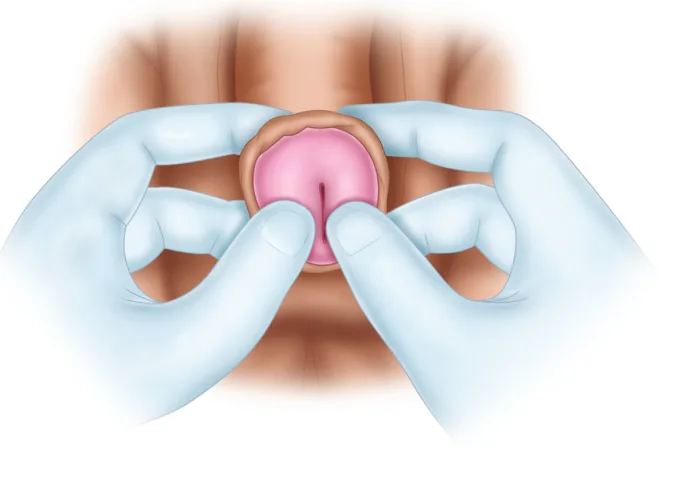
Paraphimosis is a urological emergency in which the foreskin becomes trapped behind the glans penis after being retracted and cannot be returned to its normal position. The constricting foreskin can cause rapid swelling and impaired blood flow to the glans, so prompt reduction and medical treatment are required to prevent tissue injury.
Also known as: Trapped foreskin, Foreskin stuck behind glans, Retracted foreskin stuck, Swollen foreskin behind glans, Tight foreskin behind penis head, Paraphimosis penis, Strangulated foreskin, Foreskin cannot return, Foreskin stuck after retraction, Penile swelling after foreskin retraction
 ✓ Clinician-reviewed information
- Paraphimosis occurs when a retracted foreskin becomes trapped behind the glans and cannot be pulled forward again.
- It is different from phimosis, where the foreskin cannot be retracted over the glans in the first place.
- The trapped foreskin acts like a constricting band, causing swelling and potentially reducing blood flow to the glans.
- Paraphimosis requires urgent medical treatment because prolonged vascular compromise can lead to ischemia and, rarely, tissue necrosis.
- Treatment usually begins with reduction of swelling and manual replacement of the foreskin; difficult cases may require a dorsal slit or later circumcision.
Overview
Paraphimosis occurs when the foreskin of an uncircumcised or partially circumcised penis is pulled behind the glans and becomes stuck there.
Normally, after the foreskin is retracted, it should be returned over the glans.
If it remains trapped behind the corona, the tight ring of foreskin can restrict normal venous and lymphatic drainage.
The glans and distal foreskin then begin to swell.
As swelling increases, the constriction may become tighter, making the foreskin progressively more difficult to return to its normal position.
Without treatment, arterial circulation may eventually become impaired.
This makes paraphimosis a true urological emergency.
Paraphimosis vs phimosis
These conditions are related but fundamentally different.
Phimosis
The foreskin is too tight to retract normally behind the glans.
Paraphimosis
The foreskin has already been retracted behind the glans but becomes trapped and cannot be returned forward.
Phimosis is generally not an immediate emergency unless it causes severe complications.
Paraphimosis, by contrast, requires urgent treatment because prolonged constriction can compromise blood flow.
Why does the penis swell?
Once the foreskin becomes trapped behind the glans, it forms a tight circumferential band.
This initially obstructs:
Venous drainage
Lymphatic drainage
Fluid then accumulates in the glans and foreskin, producing edema.
As swelling increases, the constricting ring becomes even tighter.
In severe or prolonged cases, arterial blood flow can also become compromised.
This can result in:
Ischemia
Tissue injury
Ulceration
Rarely, necrosis of the glans
Prompt reduction breaks this cycle before permanent injury occurs.
How does paraphimosis usually happen?
One of the most common scenarios is failure to replace the foreskin after it has been retracted for:
Cleaning
Physical examination
Urinary catheter placement
Cystoscopy
Another urological procedure
A healthcare professional or caregiver may retract the foreskin and unintentionally leave it behind the glans.
Paraphimosis can also occur after:
Sexual activity
Masturbation
Penile trauma
Forceful foreskin retraction
Men with underlying phimosis are particularly vulnerable because a tight foreskin is more likely to become trapped once retracted.
Types of paraphimosis
Symptoms
Causes
Risk factors
How it is diagnosed
Paraphimosis is usually diagnosed clinically.
Laboratory tests or imaging are generally unnecessary.
Medical history
The doctor will ask:
When the foreskin became trapped
How long swelling has been present
Whether symptoms followed catheterization
Whether the foreskin was retracted for cleaning or examination
Whether there is underlying phimosis
Whether previous episodes have occurred
Whether urination is affected
Whether severe pain or numbness has developed
Physical examination
Diagnosis is usually obvious on examination.
Typical findings include:
Retracted foreskin behind the corona
Tight constricting foreskin band
Swollen glans
Swollen distal foreskin
Inability to manually return the foreskin
The clinician also assesses the color and circulation of the glans.
A pink glans generally suggests preserved blood supply.
Concerning findings include:
Dusky color
Blue discoloration
Pale tissue
Black discoloration
These may indicate significant ischemia or tissue necrosis.
Assessing urinary function
The doctor may determine whether the patient can urinate normally.
Severe swelling can occasionally interfere with urinary flow.
If a urinary catheter is already present, its position and reason for placement should be reviewed.
- Your foreskin is stuck behind the glans and will not move forward.
- The glans is becoming swollen.
- Penile swelling is increasing rapidly.
- There is significant penile pain.
- The foreskin became trapped after catheterization or a medical procedure.
- The glans is becoming blue, purple, pale, dark, or black.
- You are unable to urinate normally.
- Sensation in the glans is decreasing.
- Manual attempts to gently return the foreskin have failed.
Treatment options
- Always return the foreskin to its normal forward position after retracting it.
- Replace the foreskin immediately after cleaning.
- Healthcare professionals should reposition the foreskin after urinary catheter insertion.
- Replace the foreskin after cystoscopy or genital examination.
- Avoid forceful retraction of a tight foreskin.
- Seek treatment for persistent adult phimosis.
- Maintain appropriate foreskin hygiene.
- Educate caregivers responsible for catheter or genital care.
- Seek medical advice for recurrent episodes.
Common questions
What is paraphimosis?
Is paraphimosis an emergency?
What is the difference between phimosis and paraphimosis?
Why is paraphimosis dangerous?
Can paraphimosis cause penile necrosis?
What does paraphimosis look like?
Can paraphimosis happen after a catheter?
Can sex cause paraphimosis?
Can I fix paraphimosis myself?
How is paraphimosis treated?
What is manual reduction?
What if manual reduction does not work?
Does paraphimosis require circumcision?
Can paraphimosis return?
How long can paraphimosis be left untreated?
Can paraphimosis affect erections?
Which doctor treats paraphimosis?
Sources
- Paraphimosis https://www.ncbi.nlm.nih.gov/books/NBK459233/
- Phimosis https://www.ncbi.nlm.nih.gov/books/NBK525972/
- Long-term follow-up of penile glans necrosis due to paraphimosis https://pubmed.ncbi.nlm.nih.gov/32743402/