
MESA — Microsurgical Epididymal Sperm Aspiration
Microsurgical epididymal sperm aspiration (MESA) is a surgical sperm retrieval procedure for men with obstructive azoospermia in whom sperm production is preserved but sperm cannot reach the ejaculate because of a blockage or absent reproductive ducts. The surgeon exposes the epididymis under magnification, opens selected epididymal tubules and aspirates sperm-rich fluid for use with intracytoplasmic sperm injection (ICSI), often obtaining enough sperm for cryopreservation and future treatment cycles.
 ✓ Clinician-reviewed information
- MESA retrieves sperm directly from epididymal tubules using microsurgical magnification.
- It is designed mainly for obstructive azoospermia when testicular sperm production is preserved.
- Compared with PESA, MESA is more invasive but allows more controlled sampling and can often retrieve large quantities of sperm for multiple ICSI cycles and cryopreservation.
- Published series report sperm retrieval rates above 90% in appropriately selected men with obstructive azoospermia.
- MESA sperm are generally used with ICSI, and successful sperm retrieval should not be confused with the probability of pregnancy or live birth.
About mesa — microsurgical epididymal sperm aspiration
MESA stands for Microsurgical Epididymal Sperm Aspiration.
It is a microsurgical sperm retrieval procedure used primarily in men with obstructive azoospermia.
These men may continue producing sperm normally inside the testes, but sperm cannot reach the ejaculate because the reproductive tract is blocked or absent.
Instead of retrieving sperm from the testicle, MESA obtains sperm from the epididymis, where sperm normally mature and are stored after leaving the testis.
The sperm can then be used with ICSI or frozen for future fertility treatment.
What is the epididymis?
The epididymis is a long, tightly coiled structure attached to the back of each testicle.
Sperm produced in the testis move into the epididymis, where they undergo maturation before entering the vas deferens.
When the reproductive tract is blocked downstream, sperm may still be present in significant quantities inside the epididymal tubules.
MESA allows the surgeon to directly identify and aspirate these sperm-rich tubules under magnification.
How is MESA performed?
MESA is performed through a small scrotal incision.
The surgeon carefully exposes the epididymis and uses an operating microscope or high-level magnification to identify suitable epididymal tubules.
A selected tubule is opened and epididymal fluid is aspirated.
The fluid is immediately examined by an embryologist.
If the sample contains adequate numbers of usable sperm, additional fluid may be collected for cryopreservation.
If sperm quality or quantity is insufficient at one location, the surgeon can move to another epididymal segment.
The incision is then closed after sufficient sperm have been obtained.
Why use a microscope?
The epididymal tubules are extremely small.
Microsurgical magnification allows the surgeon to:
Identify dilated sperm-containing tubules
Select the best aspiration sites
Minimize unnecessary tissue injury
Obtain larger amounts of sperm
Preserve surrounding epididymal structures
This controlled approach is one of the main advantages of MESA over blind percutaneous aspiration.
Who usually needs MESA?
MESA is most useful when sperm production is preserved but transport is blocked.
Common situations include:
Congenital bilateral absence of the vas deferens
Men with CBAVD may produce sperm normally but lack the ducts required to transport sperm into the ejaculate.
MESA can retrieve epididymal sperm for ICSI.
Post-vasectomy infertility
Men who wish to father children after vasectomy may choose between:
Vasectomy reversal
Surgical sperm retrieval with IVF/ICSI
MESA is one possible retrieval method when assisted reproduction is chosen.
Epididymal obstruction
Previous infection, inflammation, surgery or congenital abnormalities can block the epididymis.
In some of these patients, MESA may offer better access to viable sperm than percutaneous aspiration.
Non-reconstructable obstructive azoospermia
Some obstructions cannot be realistically repaired or the couple may prefer assisted reproduction.
MESA can provide sperm without restoring natural sperm passage.
MESA vs PESA
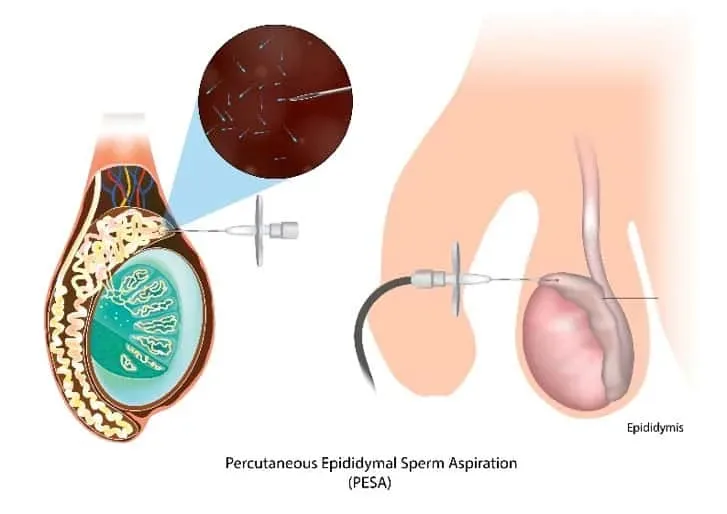
Both procedures retrieve sperm from the epididymis, but they do so differently.
PESA
PESA uses a needle inserted through the scrotal skin.
Advantages include:
Less invasive
Shorter procedure
Faster recovery
No microsurgical incision
However, sperm retrieval is less controlled and the amount available for cryopreservation may be smaller.
MESA
MESA exposes the epididymis surgically and uses magnification to identify and aspirate specific tubules.
Advantages include:
Direct visual control
High sperm yield
Ability to obtain multiple samples
Better opportunity for cryopreservation
Potential usefulness when PESA has failed
Particularly useful in epididymal obstruction
MESA is more invasive and requires microsurgical expertise and an operating room.
MESA vs TESA
MESA retrieves sperm from the epididymis.
TESA retrieves sperm directly from the testicle with a needle.
Because sperm in the epididymis have progressed further through the maturation pathway, some centers prefer epididymal retrieval when it is feasible in men with obstructive azoospermia.
However, both epididymal and testicular sperm can be successfully used with ICSI.
MESA vs TESE
TESE involves removing a small amount of testicular tissue.
MESA avoids direct testicular tissue excision and may retrieve much larger numbers of mature epididymal sperm in appropriately selected obstructive cases.
TESE remains a useful backup if epididymal retrieval fails.
MESA vs Micro-TESE
These procedures are used for very different clinical problems.
MESA is primarily for obstructive azoospermia, where sperm production is expected to be preserved.
Micro-TESE is primarily used for selected men with non-obstructive azoospermia, where sperm production is severely impaired and the surgeon searches the testes microsurgically for small areas of sperm production.
They should remain separate Procedure entities.
Why is MESA considered a high-yield procedure?
Because the surgeon directly opens sperm-containing epididymal tubules under magnification, MESA can retrieve large concentrations of sperm in appropriately selected patients.
A study of 93 consecutive MESA procedures retrieved epididymal sperm in 88 men and produced an average of approximately 7.6 cryopreserved straws per successful procedure.
This can allow one MESA operation to support several future ICSI cycles without repeat surgery.
Can MESA sperm be frozen?
Yes.
One of MESA's major advantages is the ability to obtain enough sperm for cryopreservation.
Sperm can potentially be:
Used fresh during a synchronized ICSI cycle
Frozen for later use
Divided into multiple cryopreserved samples
This can reduce the need for repeated surgical retrieval if further IVF cycles are required.
Are frozen MESA sperm effective?
Yes.
Studies comparing fresh and frozen-thawed epididymal sperm have shown successful fertilization, pregnancies and live births with cryopreserved sperm.
The reproductive outcome depends heavily on female fertility factors and IVF laboratory performance, not simply whether sperm were used fresh or frozen.
Why is ICSI normally used?
MESA-retrieved sperm are generally used with ICSI.
During ICSI, an embryologist injects a single selected sperm directly into an egg.
This avoids the need for sperm to travel naturally through the female reproductive tract or penetrate the egg without assistance.
ICSI is therefore particularly suitable when surgically retrieved sperm are used.
Does MESA restore natural fertility?
No.
MESA retrieves sperm but does not repair the obstruction.
The patient typically remains azoospermic afterward.
If restoration of natural fertility is desired, reconstructive surgery such as:
Vasovasostomy
Vasoepididymostomy
may be more appropriate in selected men.
MESA or reconstructive surgery?
The decision depends on the couple rather than the male patient alone.
Important factors include:
Female partner age
Ovarian reserve
Cause of obstruction
Duration since vasectomy
Possibility of successful reconstruction
Desired number of future children
Need for IVF for female-factor reasons
Couple preference
For some couples, reconstruction offers the possibility of natural conception.
For others, MESA combined with ICSI may provide a more practical reproductive pathway.
Why medical-tourism coordination matters
MESA requires close coordination between:
Reproductive urologist
IVF specialist
Embryologist
Cryopreservation laboratory
Female fertility team
For international patients, the sperm retrieval can either be synchronized with the partner's egg retrieval or performed earlier with planned cryopreservation.
This should be organized before travel rather than after the patient arrives.
Who it is for
- •You have confirmed obstructive azoospermia with preserved sperm production.
- •You have congenital bilateral absence of the vas deferens and require sperm retrieval for ICSI.
- •You have post-vasectomy infertility and have chosen sperm retrieval with IVF/ICSI rather than reconstructive surgery.
- •You have epididymal obstruction and a high-yield microsurgical retrieval approach is preferred.
- •PESA has previously failed or produced insufficient sperm.
- •You want to maximize the amount of sperm available for cryopreservation and future ICSI cycles.
- •Your reproductive team believes sperm are likely to be present within the epididymis.
- •You understand that MESA retrieves sperm but does not repair the underlying obstruction.
- •You understand that ICSI is generally required to use MESA-retrieved sperm.
- •You are medically fit for microsurgery and anesthesia.
- •You have confirmed non-obstructive azoospermia caused by severely impaired sperm production.
- •Evaluation suggests that sperm are unlikely to be present in the epididymis.
- •Your azoospermia has not yet been properly classified as obstructive or non-obstructive.
- •You have an untreated scrotal, urinary or systemic infection.
- •You have an uncontrolled bleeding disorder or anticoagulation that cannot be managed safely.
- •You are medically unfit for surgery or anesthesia.
- •Your goal is restoration of natural sperm passage and reconstructive surgery is more appropriate.
- •Your reproductive plan does not include ICSI or another valid use for the retrieved sperm.
- •You expect MESA to restore sperm to your semen.
- •You are unwilling to accept the possibility that testicular sperm retrieval may be required if epididymal retrieval fails.
Preparing for surgery
What recovery looks like
Risks and complications
Common questions
What is MESA?
Who needs MESA?
How is MESA performed?
Is MESA the same as PESA?
Is MESA better than PESA?
What is the sperm retrieval rate with MESA?
Can MESA be used after a vasectomy?
Can MESA be used for CBAVD?
Can MESA be used for non-obstructive azoospermia?
Why is a microscope needed?
Does MESA require an incision?
Is MESA painful?
How long does MESA take?
Do I need to stay overnight?
Can MESA sperm be frozen?
How much sperm can be collected?
Can frozen MESA sperm be used successfully?
Are fresh sperm better than frozen MESA sperm?
Is ICSI necessary after MESA?
Can MESA sperm be used for natural insemination?
Does MESA cure obstructive azoospermia?
Will sperm appear naturally in my semen after MESA?
Can MESA be repeated?
What happens if MESA fails?
MESA or vasectomy reversal — which is better?
Does MESA affect testosterone?
Can MESA damage fertility?
How long should I stay in Turkey?
When can I return to work?
When can I exercise?
When can I have sex?
Which doctor performs MESA?
Patient reviews
Been treated? Your honest review of MESA — Microsurgical Epididymal Sperm Aspiration helps the next patient.
No one has reviewed this yet. If you have been treated, your experience would help the next person.
Write the first reviewSources
- Review describing MESA as a high-yield microsurgical sperm retrieval option for obstructive azoospermia and its use with ICSI. https://pubmed.ncbi.nlm.nih.gov/23160264/
- Study of 100 men reporting approximately 93% successful sperm retrieval with MESA after insufficient PESA retrieval. https://pubmed.ncbi.nlm.nih.gov/10925551/
- Study of 93 consecutive MESA procedures reporting epididymal sperm retrieval in 88 men and substantial numbers of cryopreserved sperm samples for future ICSI cycles. https://pubmed.ncbi.nlm.nih.gov/11098022/
- Retrospective cohort comparing MESA-ICSI with TESE-ICSI and reporting live birth rates of 39% versus 24%, respectively. https://pubmed.ncbi.nlm.nih.gov/25740877/
- Study showing successful ICSI outcomes with both fresh and frozen-thawed surgically retrieved epididymal sperm. https://pubmed.ncbi.nlm.nih.gov/9740441/
- Clinical series involving CBAVD, failed reconstruction and post-infectious obstruction treated with epididymal or testicular sperm retrieval and ICSI. https://pubmed.ncbi.nlm.nih.gov/9572422/