
Penile Implant Infection: 7 Signs, Rates and Salvage Surgery in 2026
Penile implant infection explained: 7 warning signs, current infection rates, diabetes and revision risks, coated devices and salvage surgery.
- Modern primary penile implant infection rates are commonly around 1–2% with contemporary coated devices and appropriate surgical protocols.
- A 2026 meta-analysis of 102,572 primary implant patients found coated prostheses significantly reduced infection risk versus non-coated devices, with a hazard ratio of 0.38.
- Infection can be obvious or subtle: worsening pain, redness, drainage, fever, increasing swelling, pump fixation and device exposure are important warning signs.
- Diabetes and poorer glycaemic control increase risk; a recent meta-analysis found infection of 9.1% in studies with mean HbA1c ≥8% versus 3.8% in lower-HbA1c groups, although no universal surgical cutoff is established.
- Immediate salvage surgery can remove the infected prosthesis, wash out the prosthetic spaces and replace the device during the same operation; published series have achieved infection-free success above 80% in selected patients.
Penile implant infection is uncommon after a modern first-time prosthesis operation, but it is one of the most important complications because bacteria can form biofilm on the device and antibiotics alone may not eradicate it. Contemporary coated implants have reduced infection risk substantially, while diabetes, revision surgery and certain complex medical conditions can raise risk. Treatment often requires removal of the infected components, sometimes followed by immediate salvage and replacement with a new prosthesis.
For someone considering penile implant surgery, the word infection can be frightening.
That reaction is understandable.
A penile prosthesis is a foreign device placed permanently inside the body. If bacteria establish themselves on its cylinders, pump, reservoir or tubing, the infection behaves differently from an ordinary skin infection.
Modern penile implant surgery has become much safer than older implant eras.
The American Urological Association notes that contemporary infection-retardant prostheses commonly produce infection rates around 1–2% in published primary-implant series. AUA University
The European Association of Urology gives a similar contemporary estimate and states that infection may be reduced to roughly 1–2% when antibiotic-impregnated or hydrophilic-coated prostheses are used with modern surgical protocols. Uroweb
A particularly important update came in July 2026.
A systematic review and meta-analysis examined 11 observational studies involving 102,572 primary penile prosthesis patients.
Antibiotic-coated prostheses were associated with a significantly lower infection hazard than non-coated devices:
HR 0.38, 95% CI 0.28–0.51.
In simple terms, the observational evidence was consistent with a major reduction in infection risk when infection-retardant coatings were used.
The same analysis found no statistically significant difference in infection risk between Boston Scientific and Coloplast prostheses. Nature
That is clinically important.
It supports modern coating technology.
It does not support telling patients that one of the two major inflatable implant manufacturers is universally “safer from infection.”
The patient's health, whether the operation is primary or revision surgery, surgical technique, hospital systems, implant handling and postoperative care all matter.
This guide explains what penile implant infection actually looks like, when it tends to occur, who is at higher risk and what happens if infection is suspected.
What Is a Penile Implant Infection?
A penile implant infection occurs when microorganisms contaminate and establish themselves around a penile prosthesis or on the prosthetic components.
A three-piece inflatable implant contains:
cylinders inside the corpora cavernosa;
a pump inside the scrotum;
a fluid reservoir inside the pelvis or abdominal wall region;
and tubing connecting the system.
Any prosthetic component can theoretically become involved.
Malleable implants contain fewer components, but they are still foreign material and can also become infected.
The fundamental problem is not simply the presence of bacteria.
It is the ability of microorganisms to adhere to prosthetic surfaces and form biofilm.
Why biofilm matters
Biofilm is a structured community of microorganisms embedded in a protective matrix attached to the implant.
Once established, it can make bacteria substantially harder for both:
the immune system;
and antibiotics
to eliminate.
Reviews of penile prosthesis infection emphasize biofilm as one of the main reasons established device infection frequently requires surgery rather than antibiotics alone. ScienceDirect
This explains an otherwise confusing question:
“If antibiotics treat infections elsewhere, why not just give antibiotics for an infected implant?”
Sometimes antibiotics are part of treatment.
But when bacteria are established on a prosthesis, medication may suppress infection without reliably sterilizing every device surface.
That is why confirmed deep prosthetic infection often leads to:
device removal;
or removal combined with immediate replacement through a salvage operation.
Penile Implant Infection Rate: How Common Is It?
There is no single percentage that applies to every patient.
The risk varies according to:
whether this is the first implant;
whether previous implant surgery occurred;
device coating;
patient health;
surgeon and hospital systems;
follow-up duration;
and how infection is defined.
First-time modern implantation
For uncomplicated primary implantation, modern guideline summaries commonly describe infection around 1–2% when contemporary infection-retardant devices and appropriate surgical practices are used. Uroweb
A contemporary review published in 2026 describes infection rates broadly around 1–3% across current penile prosthesis practice. PubMed Central (PMC)
These ranges are more useful than promising a universal 1%.
A healthy first-time implant recipient and a man undergoing his fourth revision are not equivalent.
Coated vs Non-Coated Penile Implants
This is one of the strongest evidence areas in modern infection prevention.
Older penile prostheses did not have the infection-retardant surface technologies commonly used today.
Contemporary inflatable systems use different approaches.
Boston Scientific AMS devices can use InhibiZone, an antibiotic-impregnated surface.
Coloplast inflatable devices use a hydrophilic coating, allowing surgeons to prepare the device according to their antimicrobial protocol.
The 2026 meta-analysis involving 102,572 primary recipients found:
coated vs non-coated HR: 0.38
with a confidence interval of:
0.28–0.51.
That was statistically significant. Nature
This provides much stronger contemporary evidence than relying only on historical individual series.
Does one major brand have a lower infection rate?
The same meta-analysis directly examined studies comparing Boston Scientific and Coloplast.
The result was:
HR 1.02
with no statistically significant difference. Nature
The confidence interval was wide, which means uncertainty remains.
The appropriate interpretation is:
Current evidence does not establish a meaningful infection advantage of one of these major manufacturers over the other.
That is different from saying their devices are identical.
They have different:
materials;
surface technologies;
pumps;
cylinder characteristics;
and surgeon preparation methods.
But infection risk should not be used as a marketing claim favoring one brand without stronger evidence.
When Do Penile Implant Infections Happen?
Many occur early.
The AUA guideline notes that infection typically appears during the first several months after surgery. AUA University
However, prosthesis infection can also present later.
That distinction matters because early and late infections can look different.
Early or acute infection
An acute infection may produce obvious inflammatory symptoms.
These can include:
fever;
increasing redness;
warmth;
significant swelling;
worsening pain;
purulent drainage;
or wound breakdown.
More aggressive organisms can produce systemic illness.
Delayed or indolent infection
Some penile prosthesis infections are much quieter.
A 2024 salvage review explains that indolent infection may present with:
persistent or worsening localized pain;
clear drainage;
localized swelling;
skin changes;
or the prosthesis becoming tethered or fixed to the overlying skin. PubMed Central (PMC)
A patient can therefore have a clinically important prosthetic infection without high fever.
That is one reason postoperative symptoms should be evaluated by a prosthetic urologist rather than diagnosed solely through photographs or internet comparison.
The 7 Warning Signs of Penile Implant Infection
Not every uncomfortable symptom after implant surgery means infection.
During normal recovery, patients commonly have:
swelling;
bruising;
surgical pain;
scrotal tenderness;
and temporary difficulty locating the pump.
The concern rises when symptoms are getting worse instead of better.
Sign 1: Pain That Is Increasing Instead of Improving
Pain after penile implant surgery is expected.
The important question is its trajectory.
Normal postoperative discomfort should generally become easier over time.
Pain that:
becomes progressively stronger;
returns after improving;
or becomes sharply localized around a prosthetic component
deserves assessment.
Indolent prosthesis infection may sometimes present primarily as persistent device-related pain rather than dramatic fever or pus. PubMed Central (PMC)
This does not mean every man with discomfort has an infection.
Pump position, cylinder pressure, nerve sensitivity and ordinary healing can also cause pain.
The diagnosis depends on the overall picture.
Sign 2: Increasing Redness or Warmth
Some early redness around an incision can occur during normal healing.
The more concerning pattern is redness that:
expands;
becomes hotter;
appears after initial improvement;
or accompanies worsening pain and swelling.
Redness directly over:
the pump;
cylinders;
or incision
is particularly important if it is progressing.
A prosthetic infection can involve relatively localized tissue before systemic symptoms develop.
Sign 3: Wound Drainage
Drainage deserves careful attention.
Purulent material is particularly concerning.
But drainage does not need to look like thick pus to matter.
Delayed or indolent prosthesis infection may produce a small draining sinus with clearer fluid. ScienceDirect
A patient should not repeatedly squeeze the surgical wound to “see whether anything comes out.”
The area should be assessed by the medical team.
Sign 4: Fever or Systemic Illness
Fever can occur with acute prosthesis infection.
A patient may also feel:
weak;
chilled;
generally unwell;
or systemically ill.
These symptoms increase concern for a more aggressive infection.
However, the absence of fever does not reliably exclude a penile implant infection.
Indolent infections may remain predominantly local.
That distinction is important because patients sometimes wait for a fever before contacting the surgeon.
Sign 5: The Pump Becomes Fixed to the Scrotal Skin
This is a relatively distinctive prosthetic warning sign.
Normally, the scrotal pump should ultimately remain mobile enough to operate.
With infection, surrounding inflammation and scar response can cause the pump to become progressively tethered or fixed to the scrotal tissues.
Older and contemporary infection reviews describe progressive pump fixation as an important sign of infection. PubMed Central (PMC)
Early after surgery, swelling alone can make the pump difficult to move.
The concern is a progressively abnormal fixation pattern, especially combined with pain, redness or drainage.
Sign 6: Wound Breakdown or Device Exposure
If any part of the prosthesis becomes exposed through the skin, this is a serious problem.
Visible:
pump;
tubing;
cylinder;
or another prosthetic component
should be considered contaminated until assessed appropriately.
Once external organisms have direct access to prosthetic material, infection risk is substantial.
This generally requires urgent specialist evaluation rather than outpatient reassurance.
Sign 7: New Swelling After Recovery Was Improving
Swelling is common immediately after surgery.
New or increasing swelling after initial improvement is more concerning.
Possible explanations include:
haematoma;
seroma;
infection;
or another postoperative complication.
The important point is that these conditions cannot always be distinguished by appearance alone.
A swollen scrotum at postoperative day three and a newly swollen scrotum several weeks after apparent recovery are different clinical scenarios.
Normal Healing vs Possible Penile Implant Infection
Finding | More compatible with routine healing | More concerning for infection |
|---|---|---|
Pain | Gradually improving | Persistent or progressively worsening |
Swelling | Highest early, then falls | Increasing after initial improvement |
Bruising | Common early | Less specific unless worsening with other signs |
Redness | Mild around fresh incision | Expanding, hot or progressive |
Drainage | Minimal expected wound moisture depending on protocol | Purulent or persistent drainage / sinus |
Fever | Usually absent | Can occur, especially acute infection |
Pump | Difficult to identify early from swelling | Progressively tethered to skin |
Device exposure | Never normal | Requires urgent assessment |
General wellbeing | Improving | Chills, weakness, systemic illness |
This table is for orientation.
It is not a diagnostic tool.
A patient with a suspected prosthesis infection should contact the operating surgeon or another urologist experienced in penile prostheses.
Why Infection Can Look Different From Patient to Patient
Not all microorganisms produce the same clinical picture.
Historically, low-grade prosthesis infections were strongly associated with skin organisms such as coagulase-negative Staphylococcus.
More recent microbiology is more diverse.
A large multicenter culture study found that among positive cultures from infected prostheses:
gram-positive organisms were present in 73%;
gram-negative organisms in 39%;
Candida in 11.1%;
anaerobes in 10.5%;
and MRSA in 9.2%.
One-third of cases had no growth on conventional culture, and some infections were polymicrobial. ScienceDirect
A recent review identifies three particularly frequent organisms in contemporary salvage culture datasets as:
Escherichia coli — 18.3%
coagulase-negative Staphylococcus — 15%
and Candida — 11.1%. PubMed Central (PMC)
The clinical implication is not that patients need to memorize bacteria.
It is that penile prosthesis infection microbiology has evolved and can be more diverse than the traditional picture of a simple skin-flora infection.
That is one reason culture-directed management matters.
Who Is at Higher Risk of Penile Implant Infection?
Risk is not binary.
Having diabetes does not mean an implant will become infected.
Having no diabetes does not make infection impossible.
Risk is cumulative and patient-specific.
Several factors deserve particular attention.
Diabetes and Penile Implant Infection
Diabetes is one of the major causes of severe erectile dysfunction.
It is therefore common among penile prosthesis recipients.
The key question is not:
“Can a diabetic patient receive a penile implant?”
Yes, many do.
The better question is:
“How does diabetes and glycaemic control affect infection risk?”
A recent systematic review and meta-analysis included 11 studies and 10,024 subjects.
Overall infection was approximately 4.3% across the selected studies.
Importantly, infection increased with higher baseline HbA1c.
Studies with a mean HbA1c of 8% or higher had an infection rate of:
9.1%
compared with:
3.8%
in the remaining studies.
That is more than a twofold difference in those pooled study groups. PubMed
This is important evidence.
But it should not be misused.
Is HbA1c 8% a universal cutoff?
No.
The EAU explicitly notes that randomized trials have not established one definitive HbA1c threshold that determines whether penile prosthesis surgery is acceptable. Uroweb
Therefore:
HbA1c ≥8% is a risk signal from observational evidence—not an absolute international cancellation rule.
An individual surgeon may use:
8%;
8.5%;
a lower threshold;
or another individualized standard
depending on:
patient health;
institutional policy;
urgency;
and the type of operation.
The safest conclusion is that better diabetes optimization before elective prosthetic surgery is desirable, while the exact threshold remains debated.
Revision Surgery and Infection Risk
Revision is one of the clearest risk factors.
The first penile implant operation occurs in tissue that has not previously contained a prosthesis.
Revision surgery occurs in an already operated field.
There may be:
scar tissue;
a fibrous capsule;
previous biofilm;
altered tissue planes;
or prior infection.
An umbrella review and meta-analysis found that revision/reoperation status was a significant predictor of penile prosthesis infection. In that analysis, primary surgery had an odds ratio of 0.36 relative to revision surgery, indicating substantially greater infection risk in revision cases. PubMed Central (PMC)
That does not mean every revision has a 2.8-times personal risk.
Odds ratios from pooled heterogeneous studies are not patient-specific calculators.
But the direction is clear:
revision operations deserve greater infection-risk attention than uncomplicated primary implantation.
This is one reason penile implant replacement should be performed with the same seriousness as the original operation.
If you already have a prosthesis requiring replacement, the dedicated [penile prosthesis revision surgery](/en/procedures/penile-prosthesis-revision-surgery) page is more relevant than a first-time implant guide.
Does the Number of Previous Implant Operations Matter?
Probably.
Older observational evidence found a stepwise increase in infection as patients underwent repeated prosthetic operations.
One small series cited in a comprehensive review observed increasing infection frequency with each additional previous implant operation. PubMed Central (PMC)
The sample became very small in the highest-surgery groups, so the exact percentages should not be generalized.
The broader lesson is reasonable:
every re-entry into the prosthetic space increases complexity.
That is another reason unnecessary revisions should be avoided.
Spinal Cord Injury and Neurological Patients
Neurogenic erectile dysfunction can sometimes require a penile prosthesis when conservative therapies fail.
These patients may have different risk profiles.
EAU neuro-urology guidance notes that serious prosthesis complications, including infection and perforation, can occur more frequently in some spinal cord injury populations. Uroweb
The general ED guideline also identifies spinal cord injury patients as a higher-risk group in published prosthetic series. Uroweb
Potential contributing issues include:
reduced sensation;
catheterization;
tissue pressure;
and neurological bladder dysfunction.
That does not automatically exclude implantation.
It strengthens the argument for individualized specialist care.
Obesity and Penile Prosthesis Infection
Obesity may affect:
wound healing;
operative exposure;
metabolic health;
and fungal infection patterns.
Contemporary reviews have found fungal prosthesis infection disproportionately represented among men with diabetes and obesity. PubMed Central (PMC)
This does not mean every patient with obesity requires antifungal treatment.
Prophylaxis should be determined by the surgical team.
It does mean that infection prevention is becoming more individualized as microbiology evolves.
Smoking, Immunosuppression and Other Risk Factors
A 2024 salvage review highlights several groups in whom clinicians should maintain increased suspicion for infection, including patients with:
smoking history;
diabetes;
spinal cord injury;
immunosuppression;
and other social or medical factors that impair healing or follow-up. PubMed Central (PMC)
None should be treated as a universal prohibition.
The purpose of identifying risk factors is to modify what can be modified before elective surgery.
How Surgeons Reduce Penile Implant Infection Risk
Modern infection prevention is not one single technique.
It is a chain.
If one link is weak, another link cannot always compensate.
Patient optimization
Before surgery, the team evaluates:
active infection;
diabetes control;
medical conditions;
medications;
and other modifiable risks.
An active urinary, skin or systemic infection generally requires treatment before elective prosthesis implantation.
Perioperative antimicrobial prophylaxis
Antimicrobial therapy is used around the time of implantation according to institutional and specialist protocols.
The ideal regimen remains an area of ongoing research because contemporary prosthesis microbiology includes:
gram-positive organisms;
gram-negative organisms;
anaerobes;
and fungi.
Modern prosthesis coatings
This is now one of the best-supported prevention strategies.
The 2026 meta-analysis showed a significant infection reduction associated with coated devices. Nature
Minimizing implant contact
Techniques designed to reduce direct prosthesis contact with skin have been associated with lower infection rates in observational studies.
The principle is straightforward:
the less opportunity microorganisms have to reach the device, the better.
Surgical efficiency
Unnecessary prolonged wound exposure may increase opportunities for contamination.
EAU guidance specifically identifies coated prostheses and strict surgical protocols that minimize skin contact and prolonged wound exposure as infection-reduction strategies. Uroweb
Does the “No-Touch Technique” Eliminate Infection?
No.
The no-touch concept has been influential.
It aims to prevent the prosthesis from directly contacting skin during implantation.
Historical single-surgeon research reported substantial reductions in infection after combining coated prostheses with a no-touch technique.
But no technique produces zero risk.
Published low infection rates from one high-volume surgeon should not be presented as a universal guarantee for every hospital, patient and surgeon.
The useful lesson is:
infection prevention depends on disciplined handling and operative systems.
Not on a slogan.
Do Postoperative Antibiotics Prevent Infection?
The evidence is less straightforward than many patients assume.
Some surgeons prescribe postoperative antibiotics.
Others use shorter courses.
EAU guidance states that prolonged antibiotics beyond the immediate perioperative period lack definitive evidence for reducing prosthesis infection. Uroweb
That means:
more antibiotics ≠ automatically safer.
Unnecessary prolonged antibiotic exposure can also create:
adverse effects;
resistance;
and altered microbiology.
Patients should follow the operating surgeon's regimen rather than adding antibiotics independently.
Can Penile Implant Infection Be Treated With Antibiotics Alone?
For a superficial skin infection that does not involve the device, antibiotics may sometimes be sufficient.
A true deep prosthetic infection is different.
Once biofilm has established on the implant, antibiotics alone are often unable to sterilize the entire system reliably.
The EAU states:
“Prosthetic infection requires removal of the prosthesis and antibiotic administration.”
It then recognizes immediate salvage with new prosthesis replacement as an alternative strategy in selected patients. Uroweb
This is the central management principle.
Patients should not interpret temporary improvement on antibiotics as proof that a confirmed deep device infection is cured.
What Happens If a Penile Implant Is Infected?
There are two broad surgical pathways.
Option 1: Remove the infected implant and delay replacement
Traditionally, infected prostheses were removed completely.
The patient then received antibiotics and waited for the infection to clear before another implant was placed later.
This can control infection.
But it creates a new problem.
Without cylinders occupying the corpora, significant scar tissue can form.
That fibrosis can lead to:
penile shortening;
narrowing of the corporal space;
and a technically harder future reimplantation.
The later surgery may require:
specialized dilation;
narrower cylinders;
or reconstruction.
This disadvantage led to development of immediate salvage.
Option 2: Immediate Penile Prosthesis Salvage Surgery
Salvage surgery means the infected prosthesis is removed and another device is implanted during the same operation after aggressive cleansing of the prosthetic spaces.
The aim is to:
eradicate infected foreign material;
reduce microbial burden;
preserve the corporal space;
avoid months without a prosthesis;
and reduce severe fibrosis and shortening.
This approach is closely associated with urologist John Mulcahy.
The modern literature often calls it the:
Mulcahy salvage procedure
or
Mulcahy salvage protocol.
For the complete surgical pathway, use Andrology Abroad's dedicated [penile prosthesis salvage surgery](/en/procedures/penile-prosthesis-salvage-surgery) page.
What Was the Original Mulcahy Salvage Protocol?
The classic technique evolved from earlier attempts at immediate prosthesis rescue.
The core concept was:
remove all infected prosthetic components;
debride infected or devitalized tissue as needed;
extensively irrigate all prosthetic spaces;
change contaminated operative materials;
and immediately implant a new prosthesis.
The original protocol used a multi-step sequence of antibiotic and antiseptic irrigating solutions.
It should not be copied from an old paper as though it were a current universal recipe.
Modern knowledge has changed.
Some historical irrigants have concerns related to tissue toxicity, and today's surgeons may use different antimicrobial solutions or simplified protocols.
A 2025 review emphasizes that the principle of meticulous mechanical and antimicrobial washout remains important, but there is still no universally agreed single irrigation formulation. Nature
That distinction matters.
Mulcahy salvage is a surgical strategy, not one immutable bottle recipe.
How Successful Is Salvage Surgery?
The historical results are encouraging.
The initial Mulcahy-related series reported infection-free outcomes in roughly:
82–91%
of patients.
A later long-term series involving more than 100 infected implants reported around 84% remaining infection-free following salvage. Nature
EAU guidance summarizes the broader evidence by stating that immediate removal, washout and replacement have achieved successful salvage in more than 80% of cases. Uroweb
These figures should not be interpreted as:
“salvage has an 84% guaranteed success rate.”
The published series involve:
different patient populations;
different organisms;
different devices;
different antibiotic regimens;
and different definitions of success.
But they demonstrate that immediate salvage can be a viable alternative to removing the device and waiting months for reimplantation.
Modern Salvage Is Broader Than the Original Criteria
Historically, surgeons were very selective.
Early salvage protocols often excluded patients with:
severe purulence;
device erosion;
poorly controlled diabetes;
rapidly developing infection;
or significant tissue compromise.
Modern prosthetic practice has challenged some of those exclusions.
A 2025 review analyzed 13 published salvage studies and concluded that several newer series have successfully extended salvage to patients previously thought unsuitable, including selected patients with:
diabetes;
purulent infection;
and device erosion. Nature
This does not mean everyone with an infected implant should undergo immediate salvage.
Some infections remain poor candidates because of:
severe tissue destruction;
systemic instability;
extensive necrosis;
or other medical factors.
The important update is that the old list of absolute contraindications has become more flexible in experienced hands.
Why Surgeons Sometimes Put in a Malleable Implant During Salvage
Some modern salvage strategies replace an infected inflatable prosthesis with a malleable prosthesis rather than another three-piece inflatable device.
Why?
A malleable implant has:
fewer components;
no reservoir;
no hydraulic tubing;
and a simpler implantation pathway.
It also keeps the corporal spaces open.
That can preserve penile length and make later conversion to an inflatable device easier.
This approach is sometimes called malleable salvage.
The 2025 salvage review describes good infection-free outcomes in modern series using malleable prostheses in selected infected cases. Nature
Some patients ultimately keep the malleable implant.
Others later return for conversion to a three-piece inflatable prosthesis.
The best strategy depends on:
infection severity;
tissue quality;
patient preference;
and surgeon experience.
Why Not Just Remove the Device and Wait?
Delayed reimplantation remains appropriate in some cases.
But waiting has consequences.
The empty corpora can scar.
Fibrosis develops.
The corporal bodies can narrow and shorten.
Later implantation may therefore require:
smaller cylinders;
more aggressive dilation;
specialized instruments;
or reconstructive surgery.
The 2025 salvage review specifically highlights corporal scarring and penile shortening as major disadvantages of traditional explant-and-delay management. Nature
This is the main reason salvage was developed.
Its goal is not simply convenience.
It is preservation of anatomy.
Can an Infected Penile Implant Be Partly Replaced?
Generally, a confirmed infection raises concern about the entire prosthetic system.
Bacteria can travel along:
tubing;
capsules;
and interconnected prosthetic surfaces.
Replacing only the obviously infected component can leave contaminated material behind.
Salvage principles therefore emphasize removal of infected components and thorough treatment of all prosthetic spaces.
The exact approach varies according to:
device type;
clinical presentation;
and operative findings.
A patient should not assume that because redness appears near the pump, only the pump needs treatment.
Does Device Exposure Mean Infection?
Exposed prosthetic material is considered contaminated and usually treated very seriously.
Even if the patient does not have:
fever;
severe pain;
or obvious pus,
a component exposed to the external environment creates a direct route for microorganisms.
This is not a “watch and wait for a week” problem.
It requires specialist assessment.
Can Infection Happen Years After Penile Implant Surgery?
Yes, although most infections occur earlier.
Delayed infections are less common but possible.
Late infection can theoretically follow:
hematogenous bacterial spread;
local tissue erosion;
repeat procedures;
or previously indolent biofilm becoming clinically significant.
Therefore, new:
device pain;
skin changes;
drainage;
or component exposure
years after apparently successful implantation should still be assessed.
A functioning implant is not automatically an uninfected implant if new inflammatory symptoms appear.
Penile Implant Infection vs Mechanical Failure
These problems can sometimes look similar.
A mechanical failure may cause:
poor inflation;
rapid deflation;
pump malfunction;
or loss of rigidity.
It should not normally cause:
fever;
redness;
purulent drainage;
or inflammatory skin changes.
Infection can also affect device usability through:
pain;
swelling;
or component fixation.
The distinction matters because a purely mechanical revision and an infected revision require different planning.
If your implant is failing without obvious infection signs, see [penile prosthesis revision surgery](/en/procedures/penile-prosthesis-revision-surgery).
For the broader differential, use [penile prosthesis complications](/en/conditions/penile-prosthesis-complications).
How Is a Penile Implant Infection Diagnosed?
Diagnosis starts clinically.
The surgeon considers:
when symptoms began;
pain pattern;
wound appearance;
redness;
swelling;
drainage;
device exposure;
pump mobility;
and systemic symptoms.
Blood tests may be useful in some patients.
Urine testing may also be relevant.
Cultures can be obtained when appropriate.
In difficult cases, imaging may help evaluate:
collections;
device position;
or other complications.
But there is no single blood test that definitively says:
“the penile prosthesis is infected.”
Indolent infections can sometimes occur with relatively normal systemic laboratory results. MDPI
This is why prosthetic-urology experience matters.
What Happens to the Implant Culture During Salvage?
During salvage or explantation, surgeons often obtain cultures from:
fluid;
tissue;
or prosthetic surfaces.
Those results can help guide postoperative antimicrobial therapy.
However, conventional cultures are imperfect.
In the large multicenter microbiology study, 33% of clinically infected cases had no growth. ScienceDirect
Therefore:
negative culture ≠ proof that infection was absent.
Diagnosis remains clinical and surgical.
Why Candida Has Become More Important
Older discussions of penile implant infection focused heavily on skin bacteria.
Modern studies identify fungal organisms more frequently than many patients expect.
Candida accounted for about 11.1% of positive cultures in the major multicenter study. ScienceDirect
Recent reviews also note fungal infection particularly among patients with:
diabetes;
and obesity. PubMed Central (PMC)
This changing microbiology is one reason prosthetic surgeons continue to reconsider:
antimicrobial prophylaxis;
implant dipping solutions;
and salvage protocols.
It also shows why infection prevention cannot remain frozen in protocols developed decades ago.
Does Hospital or Surgeon Experience Affect Infection?
Available observational evidence suggests experience and systems matter.
A specialist who performs penile prostheses regularly is more likely to have standardized pathways for:
patient screening;
device preparation;
operative flow;
revision;
and salvage.
That does not mean a particular case-volume number guarantees a low infection rate.
It means infection prevention is partly a system skill.
For patients choosing surgery abroad, this is more useful than asking only:
“Which implant brand do you use?”
Ask:
How many implants does the surgeon perform?
How many revisions?
Does the surgeon perform salvage surgery?
Which hospital is used?
What is the infection protocol?
What happens if infection develops after I return home?
Those questions reveal the actual pathway.
What Should International Patients Know About Penile Implant Infection?
Medical travel creates one additional problem:
distance.
An infection may develop after the patient has already returned home.
Before travelling for prosthesis surgery, know:
who will review photographs;
how quickly you can speak with the surgeon;
whether a local urologist can assess you;
whether you would need to return to the original center;
and what the financial policy is for revision or salvage.
A claim such as:
“lifetime warranty”
does not automatically mean:
free hospital care;
free surgeon fees;
free salvage;
or free international travel.
Device warranty and complication management are separate subjects.
The infection pathway should be explained in writing whenever possible.
Can a Patient Prevent Penile Implant Infection After Surgery?
The patient cannot reduce risk to zero.
But recovery instructions matter.
General principles include:
keeping the wound managed according to the surgeon's instructions;
taking prescribed medication correctly;
avoiding unapproved manipulation of the device;
not returning to sexual activity too early;
reporting worsening symptoms;
and attending postoperative reviews.
The patient should not independently:
start leftover antibiotics;
apply antiseptic chemicals into a wound;
drain a swelling;
or aggressively manipulate the pump because he thinks infection fluid needs to be released.
Those actions can delay correct diagnosis or worsen tissue injury.
Penile Implant Infection and Regret
Patients searching penile implant regrets frequently encounter infection stories.
Those stories are important.
They show what a serious complication can feel like.
But they should not be used as infection-rate statistics.
People with major complications are much more likely to post long accounts online than men whose implant healed uneventfully.
Population data are more useful for frequency.
Individual patient stories are more useful for understanding lived experience.
Both have value.
They answer different questions.
Does Infection Mean the Penile Implant Surgery Was Done Wrong?
Not automatically.
Infection can occur even when:
the patient was appropriately selected;
a modern coated implant was used;
the surgeon followed recognized prevention protocols;
and the hospital maintained high standards.
Surgery cannot eliminate all microbial risk.
A complication is not automatically evidence of negligence.
At the same time, preventable infection risk matters.
Appropriate protocols, patient optimization and modern infection-control strategies should be part of good prosthetic care.
The proper question after an infection is:
“What likely contributed, and what should change before any future implantation?”
Can You Get Another Penile Implant After an Infection?
Often, yes.
The timing and difficulty depend on how the infection was managed.
After successful immediate salvage
The patient already leaves surgery with a new prosthesis.
If the salvage remains infection-free, another staged operation may not be necessary.
After complete explantation
Reimplantation can be performed later after the infection has resolved.
The challenge is fibrosis.
The longer the corporal spaces remain without cylinders, the more difficult later implantation can become in some patients.
That is one reason salvage is attractive when clinically appropriate.
After repeated infection
Every new operation needs individualized reassessment.
Repeated infection can compromise:
tissue quality;
corporal dimensions;
and future surgical options.
These cases are best evaluated by surgeons experienced in complex prosthetic reconstruction.
What Happens to Penile Length After an Infected Implant Is Removed?
This question matters enormously to patients.
Explantation followed by delayed reimplantation can produce:
corporal fibrosis;
contracture;
and loss of available corporal space.
Published salvage literature repeatedly describes penile shortening as one of the major disadvantages of removing an infected implant without immediate replacement. Nature
This does not mean every explanted patient loses the same amount of length.
There is no single predictable number.
But anatomical preservation is one of the main reasons immediate salvage is considered.
What Is the Difference Between Salvage and Revision Surgery?
The words are sometimes confused.
Revision surgery
Revision broadly means operating again on an existing prosthesis.
Reasons include:
mechanical failure;
malposition;
erosion;
pain;
component problems;
or infection.
Salvage surgery
Salvage is specifically an infection-management strategy.
The infected device is removed, the prosthetic spaces are aggressively cleaned, and another prosthesis is placed immediately during the same operation.
Therefore:
all salvage operations are revisions, but not all revisions are salvage operations.
Your website appropriately separates them:
[penile prosthesis revision surgery](/en/procedures/penile-prosthesis-revision-surgery)
and
[penile prosthesis salvage surgery](/en/procedures/penile-prosthesis-salvage-surgery).
Penile Implant Infection: Primary vs Revision Risk
Situation | General infection context |
|---|---|
Modern primary implant | Often ~1–2% in contemporary coated-device series |
Coated primary implant | Lower infection hazard than non-coated devices in 2026 meta-analysis |
Revision surgery | Higher risk than first-time implantation |
Poorer glycaemic control | Infection risk rises as HbA1c rises in pooled observational data |
Spinal cord injury / complex neuro-urology | Higher complication and infection rates in some published series |
Previous implant infection | More complex tissue and reinfection concerns |
Repeated prosthetic surgery | Risk tends to increase with cumulative procedures |
These are population-level patterns.
They cannot replace individualized risk assessment.
What Does the 2026 Evidence Say About Infection Prevention?
The most important new evidence is straightforward.
The 2026 Marquardt Filho meta-analysis involved:
102,572 primary implant patients
across 11 observational studies.
The authors found:
HR 0.38 for coated versus non-coated prostheses.
They also found:
no significant infection difference between Boston Scientific and Coloplast. Nature
That gives patients two useful conclusions.
First:
Modern infection-retardant coatings matter.
Second:
brand rivalry should not replace evidence-based infection prevention.
The best infection strategy is broader than a logo on the implant package.
What Does the New Diabetes Evidence Say?
The recent diabetes meta-analysis adds another useful numerical finding.
Across 10,024 patients, studies with mean HbA1c of at least 8% had infection around:
9.1%
versus:
3.8%
in lower-HbA1c study groups. PubMed
This supports preoperative metabolic optimization.
But because much of the evidence is retrospective and study-level, it does not establish that:
HbA1c 7.9% = safe
while
HbA1c 8.0% = unsafe.
Medicine rarely behaves that neatly.
What Does the New Salvage Evidence Say?
The 2025 review by Mahdi, Campos and Yafi examined the evolution of immediate salvage across 13 studies spanning roughly three decades.
Its conclusions are important.
Immediate salvage has:
preserved corporal space;
reduced the fibrosis associated with delayed reimplantation;
achieved high infection-free success in multiple series;
and expanded beyond the very restrictive patient criteria used originally.
The authors note that modern experience has successfully salvaged selected cases involving:
diabetes;
purulent infection;
and erosion
that would previously have been excluded. Nature
This makes contemporary salvage surgery more nuanced than the original 1990s algorithm.
Questions to Ask Before Penile Implant Surgery About Infection
Before surgery, a good consultation should answer questions such as these:
What is the center's infection rate for primary implants?
Is that rate separate from revision cases?
Which exact prosthesis is being used?
Is it infection-retardant coated?
How is diabetes optimized before surgery?
Does the surgeon use a specific HbA1c threshold?
How are active urine or skin infections handled?
What perioperative antimicrobial protocol is used?
Does the surgeon perform penile prosthesis salvage surgery?
What happens if infection occurs after I return home?
Would the entire device need removal?
Is immediate salvage available?
Would salvage use another inflatable implant or a malleable device?
What costs are covered if early infection occurs?
How quickly can I reach the medical team if symptoms develop?
A clinic should be comfortable discussing infection before the patient pays.
Complication planning is part of responsible prosthetic surgery.
When Should You Contact the Surgeon Urgently?
After penile implant surgery, contact the medical team promptly for:
rapidly worsening pain;
progressively increasing swelling;
expanding redness;
significant warmth;
fever or chills;
purulent or persistent drainage;
wound separation;
skin breakdown;
a pump becoming increasingly fixed to the scrotal wall;
or any prosthetic component becoming visible.
A patient should not wait for all seven signs to appear.
One significant warning sign can be enough to justify assessment.
Penile Implant Infection Does Not Always Mean an Emergency Department Is Enough
An emergency physician can:
evaluate systemic illness;
order tests;
treat sepsis;
and begin appropriate urgent care.
But prosthesis-specific decisions often require urology.
Questions such as:
Is this superficial infection or device infection?
Can salvage be attempted?
Which components are involved?
Does erosion exist?
Should an inflatable or malleable device be placed?
require prosthetic expertise.
For an international patient, this is why maintaining contact with the original surgical team can be useful even if local emergency assessment is needed.
Can Infection Be Prevented Completely?
No.
That is one of the most important consent points.
Modern surgery can reduce infection risk substantially.
It cannot make the risk zero.
Coated devices help.
Optimizing diabetes helps.
Appropriate antimicrobial prophylaxis helps.
Good sterile technique helps.
Minimizing skin-device contact helps.
Experienced teams help.
None produces absolute immunity.
The goal is therefore:
risk reduction + early recognition + an effective rescue plan.
That is a much more realistic definition of safe prosthetic surgery.
The Bottom Line on Penile Implant Infection
Penile implant infection is uncommon after contemporary first-time prosthesis surgery, but it remains one of the most important complications because an infected device often cannot be reliably sterilized with antibiotics alone.
Modern infection rates are far lower than those seen in older prosthesis eras.
AUA and EAU guidance commonly place infection around 1–2% in contemporary primary coated-device series. Uroweb
The strongest new evidence comes from a 2026 meta-analysis involving 102,572 primary penile prosthesis patients.
Antibiotic-coated devices were associated with a markedly lower infection hazard than non-coated devices:
HR 0.38.
The analysis did not find a significant infection-rate difference between Boston Scientific and Coloplast prostheses. Nature
That means prevention should focus on the entire prosthetic pathway rather than marketing one manufacturer as universally safer.
The warning signs can be dramatic:
fever;
redness;
purulent drainage;
wound breakdown;
or prosthesis exposure.
But penile implant infection can also be subtle.
An indolent infection may appear mainly as:
persistent pain;
clear drainage;
localized swelling;
or progressive fixation of the pump to the scrotal skin. PubMed Central (PMC)
Diabetes deserves special attention.
A recent systematic review involving 10,024 patients found that study populations with a mean HbA1c of at least 8% had infection rates of 9.1% compared with 3.8% in the lower-HbA1c groups. PubMed
That supports better glycaemic control before elective implantation.
It does not create a universal 8% cancellation threshold; EAU guidance still notes the absence of randomized evidence defining one ideal HbA1c cutoff. Uroweb
Revision surgery also carries greater risk than primary implantation.
An umbrella meta-analysis identified reoperation as a significant infection predictor, reinforcing the importance of treating revision as a more complex prosthetic procedure rather than simply “changing the old implant.” PubMed Central (PMC)
If infection does occur, treatment may involve complete explantation followed by delayed reimplantation.
That can cure infection but risks corporal fibrosis and penile shortening.
The alternative in selected patients is immediate penile prosthesis salvage surgery.
The infected device is removed.
The prosthetic spaces are thoroughly decontaminated.
A new prosthesis is implanted during the same operation.
The original Mulcahy experience reported infection-free success in approximately 82–91% of cases, and contemporary literature continues to report strong results with evolving techniques. Nature
The EAU summarizes salvage success as greater than 80% in published series. Uroweb
More recent evidence has also expanded salvage beyond the narrow patient selection criteria used in the early era.
Selected men with:
diabetes;
purulent infection;
and even some forms of erosion
have undergone successful salvage in experienced centers. Nature
That does not make salvage appropriate for everyone.
The decision depends on:
patient stability;
infection severity;
organism;
tissue viability;
erosion;
device exposure;
and surgeon experience.
The most useful way to think about penile implant infection is therefore not:
“Can my infection risk be zero?”
It cannot.
The better questions are:
“How is my risk being reduced, how quickly would infection be recognized, and does my surgical team have a clear plan if it occurs?”
For the overall complication picture, see [penile prosthesis complications](/en/conditions/penile-prosthesis-complications).
If an infected device may be removed and replaced during the same operation, review [penile prosthesis salvage surgery](/en/procedures/penile-prosthesis-salvage-surgery).
If the prosthesis requires another operation for infection, mechanical failure or another problem, use [penile prosthesis revision surgery](/en/procedures/penile-prosthesis-revision-surgery).
For first-time surgery, start with the [penile implant procedure guide](/en/procedures/penile-implant).
And if you need your medical history, diabetes control, previous implant operations or current symptoms reviewed individually, [contact Andrology Abroad](/en/contact).
Early recognition matters.
But prevention, surgeon experience and a realistic salvage plan matter long before infection ever happens.
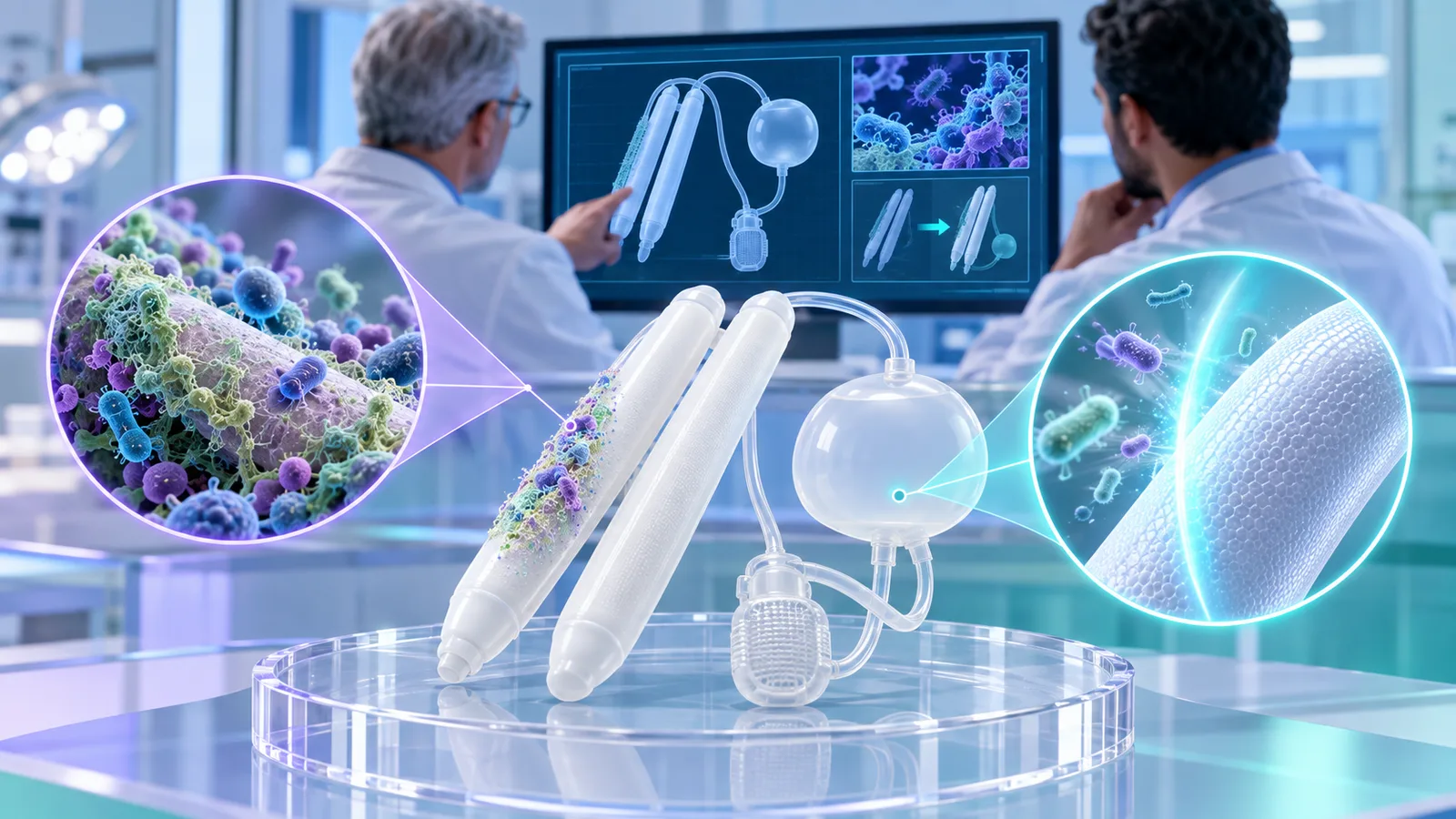
Hero Image
For this article, I would avoid graphic infection imagery.
The strongest concept is a realistic medical microbiology + implant safety image.
Create a premium clinical scene showing a three-piece inflatable penile prosthesis suspended inside a transparent sterile laboratory chamber.
On one side of the device, show a subtle microscopic visualization of bacterial biofilm beginning to form on an implant surface.
On the opposite side, show a clean protected implant surface with a subtle antimicrobial shield effect.
In the background, two urology specialists should be reviewing a medical screen displaying:
a sterile implant diagram;
microbiology imagery;
and a salvage/replacement concept.
Keep everything professional and non-graphic.
Use the Andrology Abroad brand palette:
periwinkle;
teal;
mint green;
soft lavender;
medical white.
No explicit genital anatomy.
No blood or pus.
No fear-based imagery.
No brand logos.
No text embedded in the image.
The image should immediately communicate:
“penile prosthesis + infection + biofilm + medical management.”
Common questions
How common is penile implant infection?
What are the first signs of a penile implant infection?
Can a penile implant infection occur without fever?
Can penile implant infection be treated with antibiotics alone?
Do coated penile implants have a lower infection rate?
Does diabetes increase penile implant infection risk?
What is Mulcahy penile implant salvage surgery?
How successful is penile prosthesis salvage surgery?
Is infection more common after penile implant revision?
Can I get another penile implant after an infected one is removed?
Sources
- Source: Marquardt Filho N, et al. Infection rates in primary inflatable penile prosthesis: a systematic review and meta-analysis of antibiotic-coated versus non-coated devices. International Journal of Impotence Research. 2026.
- European Association of Urology — EAU Guidelines on Sexual and Reproductive Health: Management of Erectile Dysfunction. 2026.
- American Urological Association — Erectile Dysfunction: AUA Guideline.
- Penile prosthesis infection and diabetes mellitus: a systematic review and meta-analysis.
- Mahdi M, Campos LR, Yafi FA. Immediate salvage procedure for infected penile prostheses: A review of the advances in surgical technique and antimicrobial strategies. International Journal of Impotence Research. 2025.
- Risk factors for penile prosthesis infection: An umbrella review and meta-analysis.
- Narrative review of immediate salvage for penile prosthesis infection. Translational Andrology and Urology. 2024.
- Gross MS, et al. Multicenter Investigation of the Micro-Organisms Involved in Penile Prosthesis Infection. Journal of Sexual Medicine.
- Swanton AR, Gross MS, Munarriz RM, et al. Penile prosthesis salvage: a historical look at the Mulcahy technique and a review of the latest literature. International Journal of Impotence Research.
- An update on penile prostheses: a narrative review. 2026.
Last reviewed 26 September 2026. We re-review this article by 24 July 2027. This article is for information and is not a substitute for advice from a doctor who knows your history.