
Selective Dorsal Cryoablation (SDC)
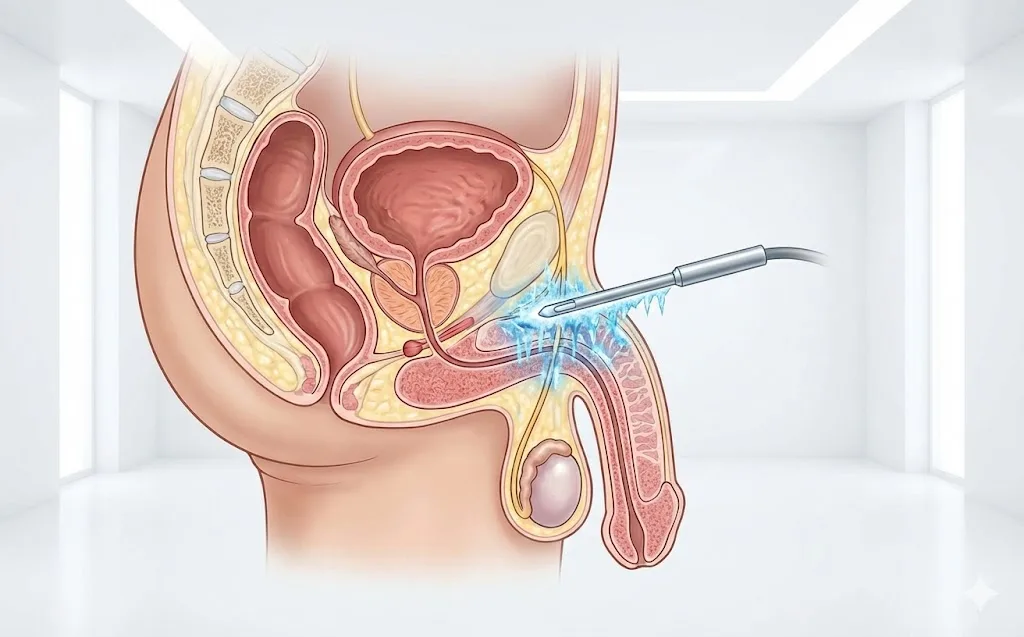
Selective dorsal cryoablation is a minimally invasive procedure that freezes part of the dorsal penile nerve to reduce glans sensitivity and delay ejaculation, used for men with lifelong premature ejaculation caused by penile hypersensitivity. It's a genuinely newer, less-invasive alternative to surgical dorsal neurotomy, but the human evidence behind it currently comes from only a small number of very small pilot studies — this is one of the least-studied procedures on this site, and that needs to be understood clearly before anything else.
 ✓ Clinician-reviewed information
- Selective dorsal cryoablation freezes part of the dorsal penile nerve — the nerve that carries sensation from the glans — to reduce hypersensitivity and delay ejaculation, without requiring a surgical incision.
- It's a newer, minimally invasive alternative to selective dorsal neurotomy (SDN), the older surgical technique that achieves a similar effect by microsurgically cutting a portion of the same nerve branches.
- This is genuinely one of the least-studied procedures discussed on this site: the human evidence for cryoablation specifically comes from a small number of pilot studies with 24 to 29 patients each, not the larger trials or established guideline endorsement seen for many other treatments here.
- The single largest published cryoablation study found a statistically significant increase in ejaculation time that was sustained at one year, though with some decline from its peak — a genuinely encouraging but still preliminary signal, not settled proof.
- Because the nerve being treated sits close to the blood vessels responsible for erections, safety relative to erectile function is a real, actively studied concern, and researchers themselves have called for larger trials before this can be considered a well-established option.
About selective dorsal cryoablation (sdc)
Selective dorsal cryoablation is a minimally invasive procedure developed to treat lifelong premature ejaculation caused specifically by penile hypersensitivity — a recognised subtype in which the glans is unusually sensitive to stimulation, contributing to a very short time to ejaculation that a man has experienced since his first sexual encounters. The procedure works by using a thin, needle-like cryoprobe, inserted through the skin at the base of the penis, to deliver controlled freezing temperatures (commonly described in the literature as ranging from around -40°C to -78°C, depending on the specific protocol) to selected branches of the dorsal penile nerve — the nerve responsible for carrying tactile sensation from the glans to the spinal cord. This freezing disrupts the nerve's ability to transmit signals as intensely as before, reducing hypersensitivity and, in principle, delaying the ejaculation reflex, without requiring a surgical incision.
To understand this procedure properly, it helps to know where it sits relative to its older, more established relative. Selective dorsal neurotomy (SDN) is the original, surgical version of this same underlying idea: rather than freezing the nerve, a surgeon microsurgically identifies and partially cuts (transects) a portion of the dorsal penile nerve branches — typically described as targeting roughly 50% of the nerve supply to the glans, cutting every other identified branch — through a small incision near the base of the penis, usually under spinal or local anaesthesia. SDN has a longer track record and a somewhat larger body of published research behind it, including a randomized controlled trial that found men with lifelong premature ejaculation genuinely do have more numerous and thicker dorsal penile nerve branches than men without the condition, and that surgically reducing this nerve supply meaningfully prolonged ejaculation time and improved ejaculatory control, with relatively few postoperative complications reported in that specific trial. Even so, it's worth being honest that a formal systematic review protocol registered to evaluate SDN specifically noted, in its own background section, that there "still lacks adequate evidence to demonstrate the effectiveness of SDN is better than others" — meaning even the more established surgical version of this approach hasn't been conclusively shown to outperform standard treatments like SSRIs or topical anaesthetics in a fully settled, comparative way.
Cryoablation was developed specifically as a less invasive alternative to this surgical approach — the appeal being obvious: achieving a similar reduction in nerve sensitivity using a needle and freezing probe, rather than an incision, sutures, and the recovery that goes with surgical nerve dissection. This is a genuinely reasonable, logical idea, and it draws on cryoablation's established use in other areas of medicine (including, for example, palliative treatment of certain nerve-related pain conditions) for safely and precisely disrupting nerve function without cutting tissue. But it's important to be very direct about where the actual clinical evidence for this specific application currently stands, because it's considerably thinner than for almost any other procedure discussed on this site.
The most substantial published human study of dorsal penile nerve cryoablation specifically for premature ejaculation is a prospective study of 24 men, using CT-guided percutaneous cryoablation, published in the Journal of Vascular and Interventional Radiology. The technical success rate — meaning the procedure was successfully performed as planned — was 100%. Baseline average intravaginal ejaculatory latency time (IELT) was 54.7 seconds; this increased to a peak average of 256 seconds by day 7 (though this very early result didn't reach statistical significance, likely reflecting the small number of men with data at that specific time point), settling to a statistically significant 182.5 seconds by day 90, remaining at essentially the same level (182.5 seconds) at day 180, and then declining somewhat to 140.9 seconds by one year — still a statistically significant, meaningful improvement over baseline at every measured time point from day 90 onward, but with a clear pattern of some benefit fading over the course of the first year, plausibly reflecting gradual nerve regeneration after the initial freezing effect. A separate, smaller pilot study from a different research group, involving 29 men aged 22 to 35, described selective minimally invasive cryoablation as "a promising treatment for premature ejaculation," while explicitly concluding that "additional studies with a larger number of participants are needed" — a genuinely honest, appropriately cautious note from the researchers themselves, not a confident, settled endorsement.
It's worth understanding why researchers in this specific field have been notably cautious, beyond simply wanting larger sample sizes. The dorsal penile nerve runs in close anatomical proximity to the dorsal penile arteries — the blood vessels critical to achieving an erection — and a cryoprobe delivering temperatures well below freezing in this tight anatomical space carries a genuine, actively discussed theoretical risk of affecting these vessels alongside the intended nerve target. This concern was significant enough that a separate research group specifically conducted an animal model safety study before proceeding further with human application, explicitly stating that the proximity of the cavernous bodies and dorsal arteries to the cold cryoprobe "led to lot of discussions" within the field — an honest acknowledgment that this isn't a settled, risk-free technical question, but one still being actively investigated.
There's also a related complication worth knowing about from the surgical (non-cryoablation) SDN literature, since it illustrates a genuine risk category relevant to any procedure targeting these nerves: a documented case report describes a man who developed a traumatic neuroma — a nodular, reactive regrowth of injured nerve tissue — on his penis two years after undergoing SDN, requiring surgical removal and histopathological confirmation. The case report's authors specifically noted this hadn't previously been reported as a recognised complication of this type of nerve procedure, illustrating that even well-established techniques targeting these specific nerves can still produce novel, previously undocumented complications over longer follow-up — a genuinely relevant, honest data point when weighing a newer technique like cryoablation, where comparably long-term follow-up simply doesn't yet exist.
Taken together, and stated as plainly as possible: selective dorsal cryoablation for premature ejaculation is a technically feasible, minimally invasive procedure with a genuinely interesting rationale and some encouraging, statistically significant preliminary human data — but it remains, honestly, an emerging, still-evolving technique studied so far only in small pilot studies (24 and 29 patients respectively, in the two human studies identified for this page), without the larger trials, longer-term safety data, or established guideline endorsement that exists for many of the other procedures covered on this site. This isn't a reason to dismiss it outright — the field is actively, visibly working towards better evidence, including dedicated animal safety studies and calls from researchers themselves for larger human trials — but it is a genuine, important reason for any man considering this procedure to go in with realistic, well-informed expectations about how early-stage this specific evidence base still is.
Who it is for
- •Men with lifelong (primary) premature ejaculation, specifically linked to confirmed or strongly suspected penile hypersensitivity, rather than acquired PE with a different underlying cause
- •Men who have tried, and found insufficient benefit from, standard first-line treatments such as SSRIs, topical anaesthetics, or behavioural techniques
- •Men without erectile dysfunction, since some clinical sources specifically caution that aggressive nerve reduction can worsen erectile function in certain cases
- •Men who understand and accept that they are considering a genuinely early-stage procedure with a limited evidence base, not an established, guideline-endorsed standard treatment
- •Men with acquired premature ejaculation linked to anxiety, relationship factors, or coexisting erectile dysfunction, where the underlying cause is different from the hypersensitivity mechanism this procedure specifically targets
- •Men who haven't yet properly trialled well-established first-line treatments
- •Men with any bleeding disorder or vascular condition that might increase the theoretical risk to the nearby dorsal arteries during the freezing process
- •Men seeking a fully proven, guideline-endorsed option rather than one still actively being studied
Preparing for surgery
What recovery looks like
Risks and complications
Common questions
How is cryoablation different from the surgical version of this procedure (SDN)?
Is this a well-established, guideline-recommended treatment?
Does the improvement actually last?
Will this affect my erections?
Will I lose all sensation in the glans?
Why would I choose this over a well-established treatment like SSRIs or topical anaesthetics?
Is imaging guidance necessary for this procedure?
Can this procedure be repeated if the benefit fades?
How do I know if my premature ejaculation is actually caused by hypersensitivity, rather than something else?
Is this the same as circumcision, which is sometimes mentioned as reducing PE-related sensitivity?
Should I get a second opinion before considering this procedure?
Is this procedure widely available, or offered at only a few specialised clinics?
Patient reviews
Been treated? Your honest review of Selective Dorsal Cryoablation (SDC) helps the next patient.
No one has reviewed this yet. If you have been treated, your experience would help the next person.
Write the first reviewSources
- "Percutaneous CT-guided Cryoablation of the Dorsal Penile Nerve for Treatment of Symptomatic Premature Ejaculation." J Vasc Interv Radiol. https://www.jvir.org/article/S1051-0443(12)00962-1/pdf ;
- "Selective cryoablacion of penile nerves as a treatment for premature ejaculation." https://www.researchgate.net/publication/367293141_Selective_cryoablacion_of_penile_nerves_as_a_treatment_for_premature_ejaculation
- "Evaluation of the safety of premature ejaculation treatment with selective minimally invasive cryoablation of the penile nerves in an animal model." 2025. https://www.researchgate.net/publication/391674099_Evaluation_of_the_safety_of_premature_ejaculation_treatment_with_selective_minimally_invasive_cryoablation_of_the_penile_nerves_in_an_animal_model
- "Anatomic Basis and Clinical Effect of Selective Dorsal Neurectomy for Patients with Lifelong Premature Ejaculation: A Randomized Controlled Trial." https://pubmed.ncbi.nlm.nih.gov/30935469/
- "Selective dorsal neurotomy in the treatment of premature ejaculation: A protocol for systematic review and meta-analysis." https://www.ncbi.nlm.nih.gov/pmc/articles/PMC7447451/
- "Penile Traumatic Neuroma: A Late Complication of Penile Dorsal Neurotomy to Treat Premature Ejaculation." (case report, cited within cryoablation safety literature)
- "A Comparative Study of Selective Dorsal Neurectomy, Pulsed Radiofrequency Neuromodulation, and Intragranular Hyaluronic Acid Injection for Premature Ejaculation." ClinicalTrials.gov, NCT06777199. https://clinicaltrials.gov/study/NCT06777199