
Adult Orchidopexy for Undescended Testicle
Adult orchidopexy is surgery that moves an undescended testicle into the scrotum and fixes it in a stable position. In adults, the decision to preserve an undescended testicle with orchidopexy rather than remove it with orchiectomy must be individualized because a testicle that remained undescended after puberty may have reduced fertility potential and an increased long-term risk of testicular cancer.
 ✓ Clinician-reviewed information
- Adult orchidopexy moves an undescended testicle into the scrotum and fixes it there, making the testicle easier to examine and monitor.
- Treatment in adults differs significantly from childhood orchidopexy because long-standing cryptorchid testes may already have substantial impairment of sperm production.
- Orchidopexy after puberty does not eliminate the increased risk of testicular cancer, so long-term awareness and surveillance remain important.
- Orchiectomy may be preferred for a small or abnormal unilateral undescended testicle when the opposite testicle is healthy.
- Testis-preserving orchidopexy may be considered in selected men with bilateral cryptorchidism, a solitary testicle, impaired hormonal function or fertility considerations.
About adult orchidopexy for undescended testicle
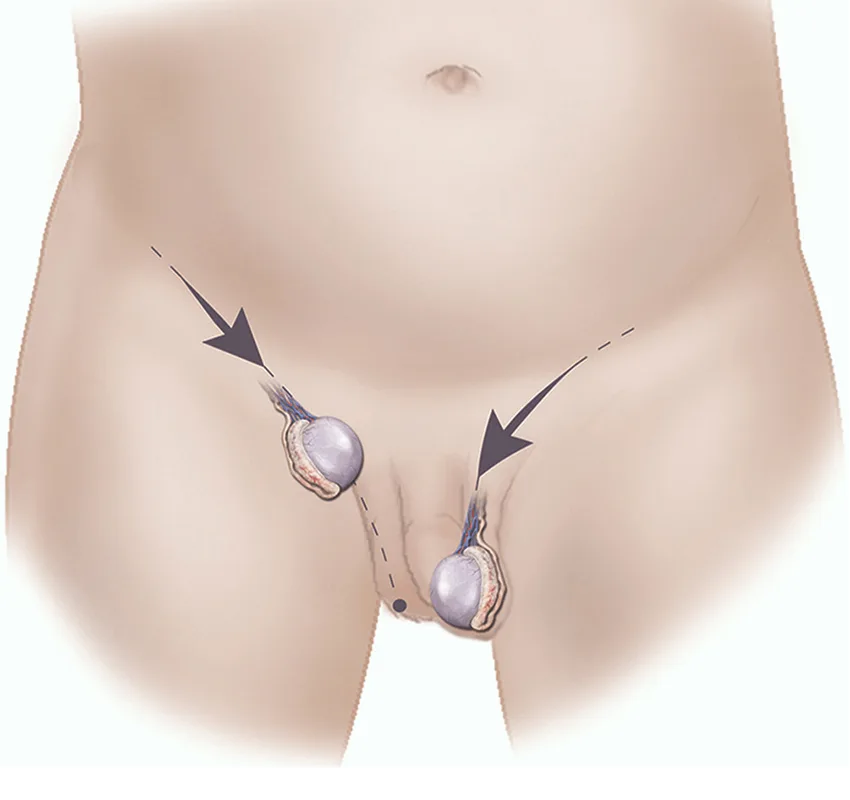
Orchidopexy, also called orchiopexy, is surgery that moves an undescended testicle into the scrotum and fixes it in place.
Normally, the testicles descend into the scrotum before birth.
When one or both remain outside the scrotum, the condition is called:
Cryptorchidism
Undescended testicle
Undescended testis
Most cases are diagnosed and treated during infancy.
A testicle that remains undescended until adulthood requires a different treatment strategy because years of abnormal temperature exposure can affect sperm production and increase malignancy risk.
Where can an undescended testicle be located?
An undescended testicle may be located:
Near the upper scrotum
In the inguinal canal
Near the internal inguinal ring
Inside the abdomen
Some testes are palpable during physical examination.
Others are non-palpable and may require laparoscopic exploration to determine whether the testicle is:
Intra-abdominal
Severely atrophic
Absent
Associated with abnormal anatomy
The location strongly influences the surgical approach.
Why treat an undescended testicle in adulthood?
Several issues must be considered.
These include:
Testicular cancer risk
Fertility
Testosterone production
Testicular pain
Torsion risk
Trauma
Associated inguinal hernia
Cosmetic appearance
Ability to examine the testicle
Treatment therefore requires more than simply moving the testicle into the scrotum.
The surgeon must first decide whether preserving the testicle is appropriate.
Why is adult cryptorchidism different from childhood cryptorchidism?
In children, orchidopexy is ideally performed early because bringing the testicle into the scrotum can help protect future testicular function and facilitate examination.
By adulthood, an undescended testicle may have spent decades at an abnormally high temperature.
Long-standing cryptorchidism can result in:
Germ-cell loss
Reduced spermatogenesis
Testicular atrophy
Fibrosis
Reduced fertility potential
The risk-benefit calculation is therefore different in adults.
Orchidopexy vs orchiectomy in adults
This is one of the most important parts of the page.
Adult patients should not be told that orchidopexy is automatically preferable because it “saves” the testicle.
Orchidopexy
Orchidopexy preserves the testicle.
It may be considered when:
Both testes are undescended
The patient has only one functioning testicle
Hormonal function could benefit from preservation
Fertility preservation is important
Spermatogenic failure is already present
The testicle appears potentially viable
The patient strongly prefers preservation after counselling
Orchiectomy
Orchiectomy removes the undescended testicle.
It may be recommended when:
Cryptorchidism is unilateral
The opposite testicle is healthy
The undescended testicle is severely atrophic
The testicle appears abnormal
Fertility benefit from preservation is unlikely
Cancer-risk considerations favor removal
The decision should be individualized by an experienced urologist or andrologist.
What do current European guidelines say?
European guidance recognizes the important distinction between adult patients with preserved reproductive function and those with impaired testicular function.
For adult men with a unilateral undescended testicle and normal hormonal function or spermatogenesis, orchiectomy should be offered.
For selected adults with unilateral or bilateral undescended testes accompanied by hypogonadism or spermatogenic failure, orchidopexy may be offered when technically feasible.
This distinction is especially important for Andrology Abroad because presenting orchidopexy as the standard adult treatment without mentioning orchiectomy would be medically incomplete.
How is adult orchidopexy performed?
The exact operation depends on where the testicle is located.
For a palpable inguinal testicle, an incision is usually made in the groin.
The surgeon:
Identifies the testicle and spermatic cord.
Releases surrounding attachments.
Carefully mobilizes the spermatic vessels and vas deferens.
Creates sufficient length for the testicle to reach the scrotum without excessive tension.
Creates a pocket within the scrotum.
Positions the testicle inside that pocket.
Fixes it to reduce the chance of re-ascent or torsion.
The wounds are then closed.
What if the testicle is inside the abdomen?
A non-palpable testicle may require laparoscopy.
A small camera is inserted into the abdomen to locate the testicle and evaluate:
Testicular size
Blood supply
Vas deferens
Spermatic vessels
Distance from the internal inguinal ring
Depending on these findings, the surgeon may perform:
Standard laparoscopic orchidopexy
Fowler-Stephens orchidopexy
Staged orchidopexy
Orchiectomy
What is Fowler-Stephens orchidopexy?
A high intra-abdominal testicle may not have enough vascular length to reach the scrotum safely using conventional mobilization.
Fowler-Stephens orchidopexy relies on collateral blood supply to obtain additional mobility.
It can be performed as:
One-stage surgery
Two-stage surgery
A staged approach allows collateral circulation to develop before the testicle is moved into the scrotum.
This should sit under your Techniques category rather than being another primary Procedure.
Is a testicular biopsy performed?
In adults undergoing orchidopexy, biopsy may be considered because of the increased risk of germ-cell neoplasia.
Current European guidance recommends simultaneous testicular biopsy for detection of germ cell neoplasia in situ (GCNIS) when undescended testes are corrected in adulthood.
This is an important difference between pediatric and adult orchidopexy.
Does orchidopexy reduce cancer risk?
Early childhood orchidopexy is associated with a lower cancer risk than correction after puberty.
However, adult orchidopexy should not be described as eliminating testicular cancer risk.
Moving the testicle into the scrotum makes it substantially easier to:
Examine
Monitor
Ultrasound
Investigate if a mass develops
The patient must therefore understand that repositioning the testicle does not reset cancer risk to that of a man who never had cryptorchidism.
How high is the cancer risk?
Cryptorchidism is an established risk factor for testicular germ-cell cancer.
Large cohort data have shown that men corrected after puberty have a substantially higher cancer risk than men corrected earlier.
This is one reason adult management may favor orchiectomy rather than preservation when the affected testicle is unilateral, abnormal or unlikely to contribute meaningfully to fertility or hormonal function.
Can adult orchidopexy restore fertility?
This requires careful wording.
Adult orchidopexy does not reliably restore fertility.
Long-standing exposure of the testicle to higher temperatures may already have caused irreversible damage to sperm-producing tissue.
However, isolated reports and small series demonstrate that spermatogenesis can sometimes persist or improve after post-pubertal orchidopexy.
Fertility assessment should therefore be individualized rather than assuming the testicle has either no function or normal function.
What if both testicles are undescended?
Bilateral adult cryptorchidism deserves particular attention.
Removing both testes would eliminate natural testosterone production and require lifelong testosterone replacement.
It would also eliminate any remaining potential for biological sperm production from those testes.
Testis-preserving strategies may therefore be considerably more important in bilateral disease.
Evaluation may include:
Semen analysis
Testosterone
LH
FSH
Testicular imaging
Fertility counselling
Orchidopexy may be considered if technically feasible.
What if only one testicle is undescended?
If the opposite testicle is normal and functioning, preserving a severely atrophic post-pubertal undescended testicle may offer limited reproductive or hormonal benefit.
In these circumstances, orchiectomy may be recommended.
The patient's:
Age
Testicular appearance
Location
Contralateral testicular function
Fertility goals
Hormonal status
Cancer risk
Personal preference
should all be considered.
Does orchidopexy improve testosterone?
Not necessarily.
An adult cryptorchid testicle may already have impaired Leydig-cell function.
Recent post-pubertal outcome data suggest that moving the testicle into the scrotum does not necessarily produce a substantial short-term improvement in testosterone, LH or FSH.
The main goals in selected adult patients may therefore be preservation, accessibility for examination and possible reproductive value rather than guaranteed hormonal improvement.
Can the testicle shrink after orchidopexy?
Yes.
The blood supply to the testicle must be carefully preserved.
If vascular supply is inadequate, postoperative testicular atrophy can occur.
This risk is particularly relevant for:
High intra-abdominal testes
Short spermatic vessels
Fowler-Stephens procedures
Previously operated testes
Why surgeon experience matters
Adult orchidopexy can be significantly more complex than routine pediatric orchidopexy.
Long-standing undescended testes may have:
Short spermatic vessels
Dense adhesions
Abnormal anatomy
Significant atrophy
Associated hernia
Increased oncologic concerns
The surgeon should therefore have experience in:
Adult andrology
Testicular surgery
Laparoscopic urology
Male infertility
Testicular oncology assessment
Who it is for
- •You have an undescended testicle that has persisted into adulthood.
- •Preservation of the testicle is clinically appropriate after specialist assessment.
- •You have bilateral undescended testes and preservation of endocrine or reproductive function is important.
- •You have a solitary undescended testicle or the opposite testicle has impaired function.
- •You have spermatogenic failure or hypogonadism and preservation may provide clinical benefit.
- •The undescended testicle appears viable and can technically be brought into the scrotum.
- •Fertility preservation is an important consideration.
- •You understand that adult orchidopexy does not guarantee recovery of sperm production.
- •You understand that orchidopexy does not eliminate the increased testicular-cancer risk.
- •You agree to appropriate long-term testicular awareness and follow-up.
- •You are medically fit for surgery and anesthesia.
- •You have a severely atrophic unilateral undescended testicle and a healthy normally functioning opposite testicle where orchiectomy is considered more appropriate.
- •Imaging or surgical findings strongly suggest testicular malignancy requiring oncological management.
- •The testicle is non-viable.
- •Adequate vascular length cannot be achieved safely and preservation would carry an unacceptable risk.
- •You have an untreated active infection.
- •You are medically unfit for elective surgery.
- •You expect adult orchidopexy to restore normal fertility with certainty.
- •You expect repositioning the testicle to eliminate its future cancer risk.
- •The risks of preservation outweigh its endocrine, reproductive or psychological benefits.
- •You are unwilling to follow recommendations for long-term testicular monitoring.
Preparing for surgery
What recovery looks like
Risks and complications
Common questions
What is adult orchidopexy?
Is orchidopexy the same as orchiopexy?
Can an undescended testicle be treated in adulthood?
Why wasn't my testicle in the scrotum?
Should every adult undescended testicle be preserved?
Why would a surgeon remove the testicle instead?
When is orchidopexy preferred?
Can adult orchidopexy improve fertility?
Can I have children after orchidopexy?
Should I have a semen analysis before surgery?
Can sperm be retrieved from an undescended testicle?
Does orchidopexy prevent testicular cancer?
Why move the testicle into the scrotum if cancer risk remains?
Do adults need a testicular biopsy during orchidopexy?
What if the testicle is inside my abdomen?
What is Fowler-Stephens orchidopexy?
Can orchidopexy be performed laparoscopically?
Can the testicle shrink after surgery?
How long does surgery take?
Do I need to stay in hospital?
How long should I stay in Turkey?
When can I return to work?
When can I exercise?
When can I have sex?
Will my testicle look normal afterward?
Do I need follow-up after surgery?
Which doctor performs adult orchidopexy?
Patient reviews
Been treated? Your honest review of Adult Orchidopexy for Undescended Testicle helps the next patient.
No one has reviewed this yet. If you have been treated, your experience would help the next person.
Write the first reviewSources
- Guideline recommendations addressing post-pubertal cryptorchidism, orchiectomy, orchidopexy, fertility implications and testicular biopsy when adult correction is performed. https://uroweb.org/guidelines/sexual-and-reproductive-health/chapter/male-infertility
- Contemporary 2026 discussion of adult cryptorchidism, fertility considerations, malignancy risk and the limitations of post-pubertal orchidopexy. https://pubmed.ncbi.nlm.nih.gov/42545896/
- Recent adult/post-pubertal cohort evaluating histology, spermatogenesis, endocrine outcomes and malignancy after orchidopexy. https://pmc.ncbi.nlm.nih.gov/articles/PMC13432487/
- Clinical review discussing orchidopexy, orchiectomy and observation according to fertility, endocrine function, age, testicular position and malignancy risk. https://pmc.ncbi.nlm.nih.gov/articles/PMC4709431/
- Systematic review examining post-pubertal orchidopexy versus orchiectomy and emphasizing individualized treatment based on fertility, contralateral testicular function, age and malignancy risk. https://pmc.ncbi.nlm.nih.gov/articles/PMC11470230/