
Adult Circumcision
Adult circumcision is a surgical procedure that removes part or all of the foreskin covering the glans penis. It is commonly performed to treat adult phimosis, recurrent paraphimosis, chronic foreskin inflammation or scarring, and can relieve pain, improve hygiene and prevent recurrent foreskin-related complications.
 ✓ Clinician-reviewed information
- Adult circumcision permanently removes the tight, scarred or repeatedly problematic foreskin and is a definitive surgical treatment for many cases of adult phimosis.
- It can also prevent recurrent paraphimosis after the acute episode has been reduced and inflammation has settled.
- The operation is usually performed as day surgery and often takes less than one hour.
- Most men can return to light work within several days to about one week, while intercourse and masturbation are usually avoided for approximately four to six weeks.
- Circumcision changes foreskin anatomy permanently, so conservative alternatives and foreskin-preserving surgery should be discussed when appropriate.
About adult circumcision
Adult circumcision is an operation that removes the foreskin, the fold of skin covering the glans penis.
After surgery, the glans remains permanently exposed.
Circumcision can be performed for:
Medical reasons
Recurrent foreskin problems
Reconstructive reasons
Personal or cultural reasons
Within Andrology Abroad, the procedure page should primarily focus on medical adult circumcision, especially treatment of phimosis and recurrent paraphimosis.
Why is circumcision performed for adult phimosis?
Phimosis means the foreskin cannot be comfortably retracted behind the glans.
Adult phimosis can cause:
Pain during erections
Pain during intercourse
Foreskin tearing
Bleeding
Difficulty cleaning beneath the foreskin
Recurrent inflammation
Recurrent infection
Painful urination
Difficulty exposing the glans
Paraphimosis after forced retraction
When the foreskin is severely scarred or symptoms persist despite appropriate conservative treatment, circumcision provides a definitive solution by removing the constricting foreskin.
Is circumcision always necessary for phimosis?
No.
Treatment depends on:
Severity
Cause
Degree of scarring
Presence of lichen sclerosus
Previous treatment
Patient preference
Selected mild cases may respond to:
Topical corticosteroid therapy
Gentle stretching
Other conservative approaches
Foreskin-preserving surgery such as preputioplasty may also be possible in selected patients.
Circumcision remains an established definitive surgical treatment, particularly for scarred or recurrent adult phimosis.
Circumcision for paraphimosis
Paraphimosis occurs when a retracted foreskin becomes trapped behind the glans and cannot be returned to its normal position.
The acute episode is treated urgently by reduction of the foreskin or surgical decompression when necessary.
Circumcision is generally not the first step during every acute episode.
After swelling and inflammation have resolved, circumcision may be recommended to prevent recurrence, particularly when underlying phimosis is present.
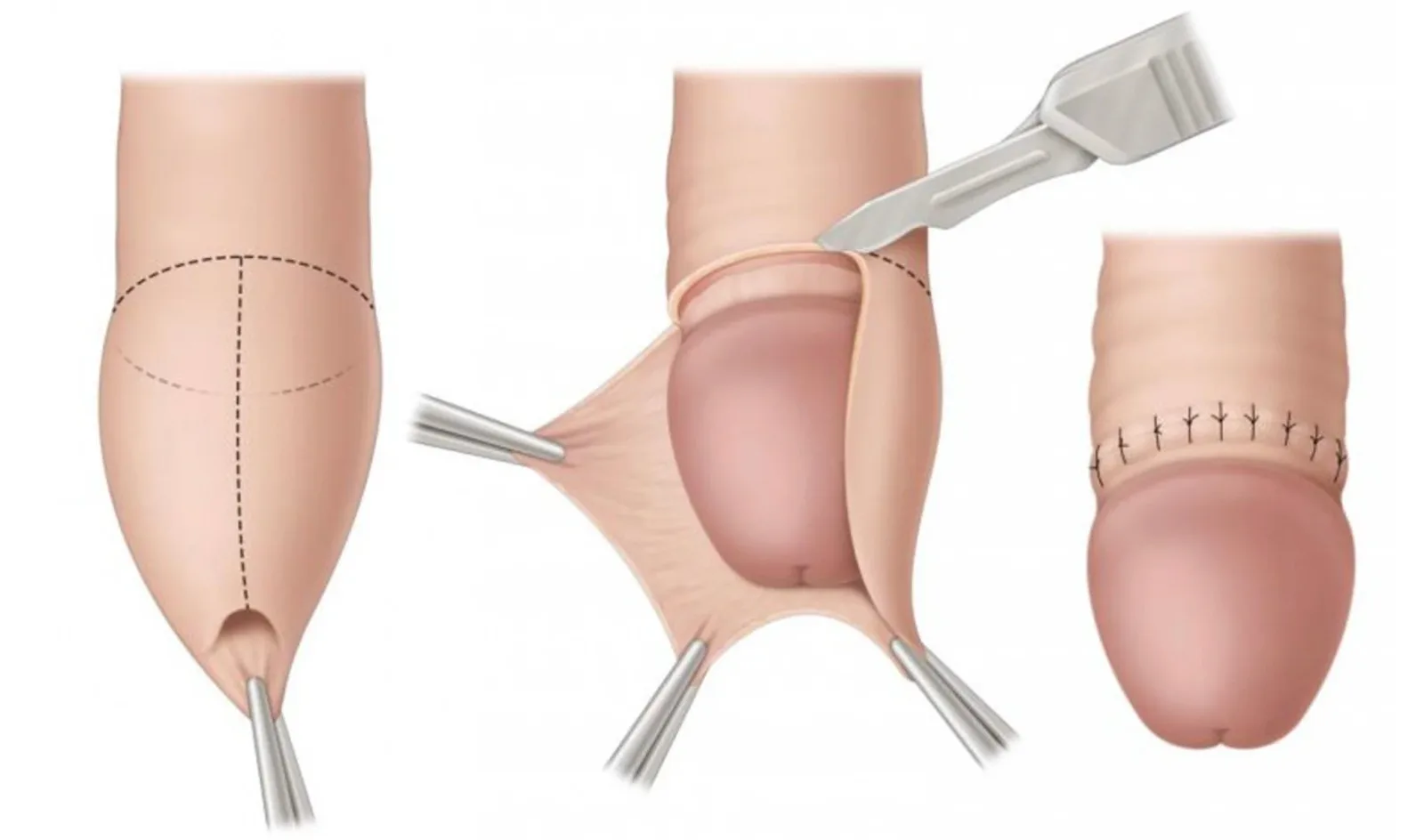
What happens during adult circumcision?
The penis is cleaned and anesthetized.
The surgeon marks how much foreskin will be removed.
The foreskin is then carefully separated and excised while preserving appropriate shaft skin.
Bleeding points are controlled.
The remaining penile skin is joined just behind the glans.
Absorbable sutures are commonly used.
A light dressing may then be applied around the penis.
How much foreskin is removed?
The amount varies according to:
Foreskin anatomy
Scarring
Surgical technique
Patient preference
Medical indication
Terms such as:
High circumcision
Low circumcision
Tight circumcision
Loose circumcision
describe variations in scar position and the amount of retained inner and outer foreskin.
These are better treated as Techniques or surgical-design variations, not separate Procedure pages.
What is sleeve circumcision?
Sleeve circumcision is a conventional surgical technique in which circumferential incisions are made around the foreskin and a sleeve of tissue is removed.
It allows the surgeon to carefully control:
Amount of skin removed
Position of the final scar
Hemostasis
Symmetry
It is one of several established adult circumcision techniques.
What is dorsal slit circumcision?
A dorsal slit opens the tight foreskin along its upper surface.
A dorsal slit can be used:
As an emergency decompression procedure
As part of circumcision
In severe phimosis where foreskin retraction is initially impossible
A dorsal slit alone does not necessarily remove the entire foreskin.
For recurrent adult phimosis, definitive circumcision may still be recommended.
What is stapler circumcision?
Disposable circumcision staplers simultaneously cut the foreskin and apply staples around the surgical margin.
Potential advantages may include:
Shorter operative time
Consistent circumferential incision
Reduced suturing
Less intraoperative bleeding in some studies
However, conventional surgery remains effective, and device-assisted techniques are not necessarily superior for every patient.
On your platform, Stapler Circumcision should be a Technique rather than a separate Procedure.
What is laser circumcision?
Laser-assisted circumcision uses laser energy to cut tissue and control bleeding.
Some studies report shorter operative times and reduced early postoperative complications compared with traditional approaches.
However, the fundamental procedure remains circumcision.
Therefore, Laser Circumcision should also sit under Techniques.
Circumcision and frenulum breve
Some patients with phimosis also have a short frenulum.
If necessary, circumcision can be combined with:
Frenuloplasty
Frenulectomy
Frenular release
However, isolated frenulum breve does not always require circumcision.
This is why Frenuloplasty deserves its own Procedure page.
Circumcision and lichen sclerosus
Lichen sclerosus can cause:
Severe foreskin scarring
White fibrotic foreskin
Progressive phimosis
Cracking
Pain
Meatal narrowing
Urethral disease
Circumcision can be an important treatment when disease primarily affects the foreskin.
However, patients with urinary-stream changes may require further assessment because lichen sclerosus can also involve the urethral opening or urethra.
Does circumcision affect sexual function?
Men often worry that circumcision will cause erectile dysfunction or major loss of sexual function.
Research has produced variable subjective findings, but circumcision performed appropriately for symptomatic phimosis does not appear to routinely impair erectile function.
In men who previously had painful phimosis, sexual comfort and satisfaction may improve because:
Erections are no longer restricted
Painful tearing stops
Inflammation resolves
Penetration becomes easier
Individual changes in sensation are possible and should be discussed before surgery.
Does circumcision reduce penile sensitivity?
The sensation of the penis can feel different because the foreskin is removed and the glans remains exposed.
Some men report:
Less sensitivity
Different sensitivity
No meaningful change
Improved sexual comfort
A specific sensory outcome cannot be guaranteed.
Circumcision should therefore be performed for a clear indication after informed discussion rather than with promises about sexual enhancement.
Does circumcision increase penis size?
No.
Circumcision removes foreskin and does not increase the length or girth of the erectile bodies.
Temporary swelling after surgery should not be interpreted as enlargement.
Can circumcision prevent phimosis from returning?
Yes.
Complete circumcision removes the foreskin responsible for phimosis, making recurrent foreskin narrowing impossible.
However, separate inflammatory or urethral conditions can still require treatment.
Why surgeon experience matters
Adult circumcision is generally less complex than many reconstructive andrology procedures, but poor technique can still cause problems such as:
Excessive skin removal
Insufficient skin removal
Asymmetric scar
Bleeding
Frenular injury
Cosmetic dissatisfaction
An experienced urologist should balance adequate removal of diseased tissue with preservation of enough shaft skin for comfortable erections.
Who it is for
- •You have persistent or severe adult phimosis causing pain, tearing, hygiene problems or sexual difficulty.
- •Your foreskin is significantly scarred and unlikely to respond adequately to conservative treatment.
- •Topical steroid treatment or gentle stretching has failed or is inappropriate.
- •You experience recurrent balanitis or balanoposthitis associated with foreskin disease.
- •You previously experienced paraphimosis and definitive surgery has been recommended after the acute episode resolved.
- •You have lichen sclerosus primarily affecting the foreskin and circumcision is considered appropriate.
- •Recurrent foreskin cracking or bleeding interferes with erections or intercourse.
- •You prefer definitive circumcision after discussing foreskin-preserving alternatives.
- •You understand that foreskin removal is permanent.
- •You are medically fit for the planned anesthesia and procedure.
- •You have an untreated acute penile, urinary or systemic infection that should first be controlled.
- •You currently have severe acute paraphimosis requiring urgent reduction rather than routine elective circumcision.
- •Your symptoms are mild and may reasonably be managed with conservative treatment.
- •You want to preserve the foreskin and are a suitable candidate for preputioplasty or another conservative option.
- •Your main problem is isolated frenulum breve that can be treated with frenuloplasty without foreskin removal.
- •You have significant uncontrolled bleeding risk.
- •You are medically unsuitable for elective surgery.
- •You expect circumcision to increase penile length or girth.
- •You expect guaranteed improvement in erection quality, orgasm or sexual performance.
- •You have unrealistic expectations about the final scar or exact cosmetic appearance.
Preparing for surgery
What recovery looks like
Risks and complications
Common questions
What is adult circumcision?
Why do adults need circumcision?
Is circumcision the best treatment for adult phimosis?
Can phimosis return after circumcision?
Do I need circumcision after paraphimosis?
Is paraphimosis an emergency?
Does circumcision hurt?
How long does adult circumcision take?
Do I need general anesthesia?
Do I need to stay overnight?
How long should I stay in Turkey?
When can I return to work?
When can I exercise?
When can I have sex after circumcision?
When do the stitches dissolve?
Will erections hurt after circumcision?
Will circumcision affect erections?
Will circumcision reduce sensitivity?
Can circumcision improve my sex life?
Does circumcision enlarge the penis?
What is stapler circumcision?
Is stapler circumcision better than conventional circumcision?
What is laser circumcision?
What if I want to keep my foreskin?
Can circumcision and frenuloplasty be done together?
Which doctor performs adult circumcision?
Patient reviews
Been treated? Your honest review of Adult Circumcision helps the next patient.
No one has reviewed this yet. If you have been treated, your experience would help the next person.
Write the first reviewSources
- Prospective adult phimosis study demonstrating that conservative treatment can be effective in selected mild cases and supporting individualized treatment rather than automatic circumcision. https://pubmed.ncbi.nlm.nih.gov/34984181/
- Comprehensive review of adult phimosis treatment describing circumcision as the standard definitive surgical approach while also reviewing conservative therapy, preputioplasty and newer circumcision techniques. https://pubmed.ncbi.nlm.nih.gov/38391414/
- Prospective patient-reported outcomes study involving 148 adults. At six months, 85.8% reported improved sexual life and 83.8% reported satisfaction with penile appearance. https://pubmed.ncbi.nlm.nih.gov/42123232/
- Prospective study assessing pain, sexual function and genital self-image before and after circumcision for adult phimosis. https://pubmed.ncbi.nlm.nih.gov/33545503/
- Network meta-analysis of 18 randomized trials and 6,179 participants comparing conventional circumcision, disposable circumcision suture devices and Shang Ring techniques. https://pubmed.ncbi.nlm.nih.gov/28522221/
- Study evaluating erectile function, sensitivity, sexual activity and satisfaction in men circumcised during adulthood. https://pubmed.ncbi.nlm.nih.gov/11956453/