
Ejaculatory Duct Obstruction (EDO)
Ejaculatory duct obstruction (EDO) is a blockage of one or both ejaculatory ducts, the small channels that carry sperm-containing fluid into the urethra during ejaculation. It can cause low semen volume, very low sperm count or azoospermia, painful ejaculation, blood in the semen, and male infertility, and some forms can be treated surgically.
Also known as: Ejaculatory duct blockage, Blocked ejaculatory duct, Ejaculatory duct obstruction, EDO, Blocked sperm duct, Seminal duct obstruction, Distal reproductive tract obstruction, Distal seminal tract obstruction, Ejaculatory canal obstruction, Obstructive male infertility
 ✓ Clinician-reviewed information
- Ejaculatory duct obstruction blocks the normal passage of sperm and seminal-vesicle fluid into the urethra.
- Complete bilateral obstruction can cause low-volume obstructive azoospermia, while partial obstruction may cause severe oligozoospermia and poor sperm motility.
- Low semen volume and acidic semen can be important clues, particularly when testosterone and testicular function appear normal.
- TRUS and, in selected cases, pelvic MRI can help identify dilated seminal vesicles, ejaculatory ducts, cysts, calcification, or other signs of obstruction.
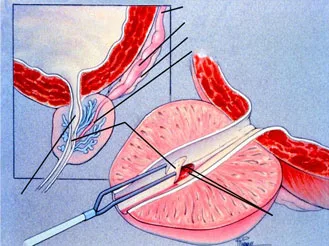
- Some men can be treated with transurethral resection of the ejaculatory ducts (TURED), while sperm retrieval with IVF/ICSI is an alternative in selected cases.
Overview
The ejaculatory ducts are two small ducts located within the prostate.
Each is formed where the vas deferens joins the duct of the seminal vesicle.
During ejaculation, sperm travel from the testes and epididymides through the vas deferens. Seminal-vesicle secretions join this pathway before the ejaculatory ducts empty into the prostatic urethra.
If one or both ejaculatory ducts become blocked, sperm and seminal fluid may not enter the urethra normally.
This is called ejaculatory duct obstruction (EDO).
Why does EDO affect fertility?
The seminal vesicles contribute a substantial proportion of normal ejaculate volume.
When both ejaculatory ducts are completely obstructed, sperm may be produced normally inside the testes but cannot reach the ejaculate.
This can result in:
Low semen volume
Azoospermia
Acidic semen
Reduced or absent seminal-vesicle secretions
This is a form of obstructive azoospermia.
Partial obstruction may produce a different pattern, including:
Oligozoospermia
Very poor sperm motility
Reduced ejaculate volume
Painful ejaculation
Haematospermia
Complete vs partial obstruction
EDO does not always completely block sperm passage.
Complete bilateral EDO
Both ducts are fully obstructed.
The classic semen-analysis pattern can include:
Azoospermia
Low ejaculate volume
Acidic semen
Normal testicular size
Normal testosterone
Normal or relatively preserved sperm production
Partial EDO
Some seminal fluid and sperm can still pass through the ducts.
Semen analysis may show:
Severe oligozoospermia
Reduced motility
Low or sometimes near-normal semen volume
Abnormal semen parameters
Partial EDO can therefore be more difficult to recognize.
Is EDO the same as retrograde ejaculation?
No.
In ejaculatory duct obstruction, semen cannot move normally through the ejaculatory ducts.
In retrograde ejaculation, semen reaches the urethra but travels backward into the bladder instead of exiting through the penis.
These conditions require different diagnostic approaches and treatments.
Is EDO the same as vas deferens obstruction?
No.
The vas deferens carries sperm from the epididymis toward the prostate.
The ejaculatory ducts are farther downstream and pass through the prostate before opening into the urethra.
Identifying the location of an obstruction is important because treatment differs according to where the reproductive tract is blocked.
Types of ejaculatory duct obstruction (edo)
Symptoms
Causes
Risk factors
How it is diagnosed
EDO is diagnosed using a combination of semen analysis, medical history, physical examination, hormonal evaluation, and targeted imaging.
Semen analysis
Semen analysis is one of the most important initial tests.
Classic findings suggesting complete EDO can include:
Low semen volume
Azoospermia
Acidic semen
Partial obstruction may instead cause:
Severe oligozoospermia
Very low sperm motility
Reduced semen volume
AUA/ASRM guidance advises considering distal genital tract obstruction when semen volume is low and acidic, particularly when azoospermia or severe oligozoospermia is present.
Hormonal testing
Hormonal tests may include:
FSH
LH
Total testosterone
Men with purely obstructive infertility may have relatively preserved testicular function and hormone levels.
This can help differentiate obstruction from severe testicular sperm-production failure.
Physical examination
An andrologist or reproductive urologist may assess:
Testicular size
Epididymides
Presence of the vas deferens
Secondary sexual characteristics
Other reproductive tract abnormalities
Transrectal ultrasound (TRUS)
TRUS is an important imaging investigation when EDO is suspected.
It can evaluate:
Seminal vesicles
Ejaculatory ducts
Prostate
Midline prostatic cysts
Calcifications
Dilated reproductive structures
The EAU recommends TRUS in infertile men with low seminal volume, acidic pH, and severe oligozoospermia or azoospermia when ejaculatory duct obstruction is suspected.
Pelvic MRI
Pelvic MRI may be useful in selected patients when anatomy remains unclear.
It can provide detailed visualization of:
Ejaculatory ducts
Seminal vesicles
Prostate
Midline cysts
Duct dilation
MRI is generally complementary rather than necessary for every patient.
Additional diagnostic procedures
Selected specialist centers may use procedures such as:
Seminal vesicle aspiration
Seminal vesiculography
Chromotubation
Seminal vesiculoscopy
These are not routine tests for every infertile man but may help confirm obstruction in difficult cases.
- You and your partner have difficulty conceiving.
- Semen analysis shows azoospermia.
- Semen volume is persistently very low.
- Semen analysis shows severe oligozoospermia with very poor motility.
- You experience painful ejaculation.
- You repeatedly notice blood in the semen.
- Hormone levels appear normal despite azoospermia.
- Your testes are normal in size but no sperm are found in the ejaculate.
- Imaging identifies a midline prostatic cyst or dilated seminal vesicles.
- You have previously been diagnosed with unexplained obstructive azoospermia.
- You want to compare surgical correction with sperm retrieval and IVF/ICSI.
Treatment options
- Seek appropriate treatment for genitourinary infections.
- Obtain medical evaluation for persistent painful ejaculation.
- Seek assessment for recurrent haematospermia.
- Follow appropriate care after prostate or pelvic procedures.
- Avoid delaying evaluation of persistent male infertility.
- Investigate unexplained low semen volume rather than assuming it is normal.
- Seek specialist evaluation when azoospermia occurs despite apparently normal testicular function.
Common questions
What is ejaculatory duct obstruction?
Can blocked ejaculatory ducts cause infertility?
Can you still ejaculate with blocked ejaculatory ducts?
Does EDO cause azoospermia?
Can EDO cause low semen volume?
Can EDO cause painful ejaculation?
Can EDO cause blood in semen?
How is EDO diagnosed?
Can ultrasound detect blocked ejaculatory ducts?
Is MRI used for EDO?
What is TURED?
Can EDO be cured?
Does sperm count improve after TURED?
Can natural pregnancy occur after TURED?
What are the risks of TURED?
Is IVF necessary if I have EDO?
Can sperm be retrieved if EDO cannot be corrected?
Which doctor treats ejaculatory duct obstruction?
Sources
- EAU Guidelines on Sexual and Reproductive Health — Male Infertility https://uroweb.org/guidelines/sexual-and-reproductive-health/chapter/male-infertility
- Diagnosis and Treatment of Infertility in Men: AUA/ASRM Guideline https://www.auanet.org/guidelines-and-quality/guidelines/male-infertility
- Ejaculatory duct obstruction: current diagnosis and treatment https://pubmed.ncbi.nlm.nih.gov/23733548/
- An update on the diagnosis and management of ejaculatory duct obstruction ttps://pubmed.ncbi.nlm.nih.gov/26620608/
- Diagnosis and management of infertility due to ejaculatory duct obstruction: summary evidence https://pubmed.ncbi.nlm.nih.gov/33566474/