
Varicocele Embolisation
Varicocele embolisation is a non-surgical treatment for varicocele performed through a pinhole in a vein, usually in the groin or the neck. An interventional radiologist threads a fine catheter up into the faulty testicular vein under X-ray guidance and blocks it from the inside using tiny metal coils, a sclerosant liquid, or both, so that blood is rerouted through healthy veins and the pooling around the testicle stops. There is no incision, no stitches, no general anaesthetic and no scrotal wound, and most men are back at a desk within two to five days.
 ✓ Clinician-reviewed information
- No incision and no general anaesthetic. The whole procedure is done through a pinhole in a vein under local anaesthetic with light sedation, takes roughly 45 to 90 minutes, and you go home the same day.
- It works, and it is well documented. In a fifteen-year series of 225 patients, the procedure was technically successful in 96% of cases and clinically successful in 94%, with a complication rate of 1.78% and no major events.
- For fertility, microsurgical varicocelectomy is still the first-line operation. Embolisation is a legitimate and effective alternative rather than a straight equal — the evidence base for pregnancy rates is stronger for microsurgery, and recurrence is generally reported as higher after embolisation. We say so plainly rather than selling you the less invasive option because it sounds nicer.
- It is the better choice in specific situations — a varicocele that has come back after previous surgery, a man who wants both sides treated in a single sitting, someone who cannot have a general anaesthetic, or a patient whose main complaint is pain rather than fertility.
- It involves X-ray exposure. The procedure is guided by fluoroscopy, close to the testicles, in men who are usually trying to conceive. Doses are low and operators work to minimise them, but this is a real trade-off against surgery and you deserve to hear it from us rather than find it later.
About varicocele embolisation
What a varicocele embolisation does
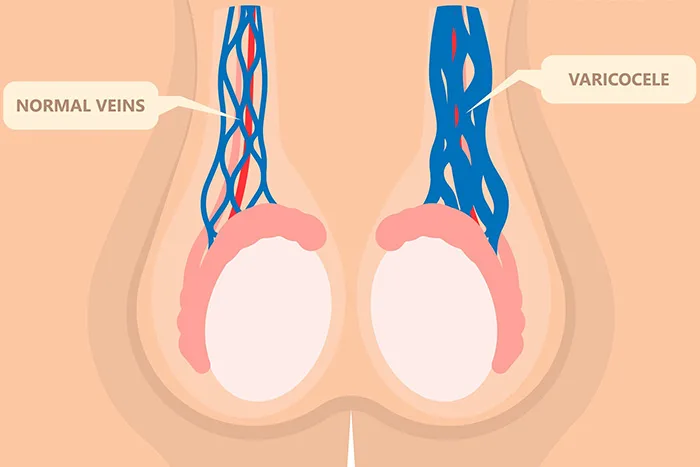
A varicocele is a tangle of swollen veins above the testicle, caused by valves in the testicular vein failing so that blood flows backwards and pools. That pooling raises the temperature around the testicle and is associated with impaired sperm production, a persistent dragging ache, and in some men reduced testosterone.
Surgery treats this from the outside: an incision, and the faulty veins tied off. Embolisation treats it from the inside. A needle puncture is made in a vein — usually at the top of the right thigh, sometimes in the neck — and a catheter thinner than a piece of spaghetti is steered up through the vein system to the testicular vein under X-ray guidance. Contrast dye confirms exactly which veins are refluxing. The radiologist then blocks the vein from within, using small metal coils, a sclerosant that scars the vein closed, or a combination of the two. Blood immediately reroutes through healthy veins; the blocked vein is not needed.
The puncture site is closed with pressure and a dressing. There are no stitches to remove, no scrotal wound, and nothing that can be seen afterwards.
How well it works
In a fifteen-year series from two tertiary centres covering 225 patients, embolisation was technically successful — the vein reached and successfully blocked — in 96% of cases, with clinical success in 94% and a complication rate of 1.78%, none of them major.
That series produced one finding worth knowing before you travel. When patients were contacted afterwards, a quarter believed their varicocele had come back. When those men were scanned, the true, ultrasound-confirmed recurrence rate was 6.25%. Most men who thought the procedure had failed were wrong. Residual fullness in the scrotum is common and does not mean the vein is refluxing again — which is exactly why we insist any proposal includes a defined route back for a follow-up scan rather than leaving you to interpret your own scrotum from three thousand kilometres away.
Technical success rates in the wider literature vary with how the operator defines them, ranging from the high eighties to essentially 100% in selected series. The most common reason for failure is not skill but anatomy: sometimes the testicular vein cannot be catheterised, particularly on the right, and the procedure has to be abandoned. This is uncommon, but it is a possibility your consent conversation should cover.
Embolisation or surgery? An honest comparison
We publish a varicocelectomy page as well, and we are not going to pretend the two procedures are interchangeable just because we offer both.
For a man whose primary goal is fertility, microsurgical subinguinal varicocelectomy remains the reference standard. Network meta-analyses consistently rank it first for pregnancy rates and lowest for recurrence, with recurrence rates under 4% in good series. A systematic review comparing sclero-embolisation with surgical ligation across thirty studies found a statistically higher recurrence rate after embolisation. If you are choosing purely on the strength of the fertility evidence, microsurgery is the better-supported option, and any site telling you otherwise is either behind the literature or selling you something.
That does not make embolisation the wrong choice. A prospective head-to-head study comparing subinguinal microsurgical ligation with percutaneous embolisation in infertile men found no significant difference in sperm quality, pregnancy rate or overall satisfaction between the two, with an overall spontaneous pregnancy rate of 35.5% at a median four years of follow-up. Patients who had embolisation recovered faster and reported less post-procedure pain.
So the honest summary is this: surgery has the stronger fertility evidence base and the lower recurrence rate; embolisation is meaningfully gentler and, in direct comparison, produced comparable results. Where the two diverge most is not in outcome but in what you are willing to undergo to get it.
Embolisation moves ahead of surgery when:
The varicocele has recurred after previous surgery, where scarring makes a repeat operation harder and embolisation can map and block the collateral veins that caused the recurrence.
Both sides need treating, which embolisation can do through a single puncture in one sitting.
General or spinal anaesthesia is undesirable or risky for you.
Your dominant complaint is pain rather than infertility.
Recovery time genuinely matters — a self-employed patient who cannot afford three weeks of restricted activity is making a rational choice, not a squeamish one.
Surgery moves ahead when:
Fertility is the sole objective, the semen parameters are significantly abnormal, and you want the option with the strongest evidence behind it.
Radiation exposure is a concern you would rather avoid altogether.
Previous embolisation has failed.
If you tell us your situation, we will tell you which of these two your case sits closer to — including when the answer is that neither procedure is likely to help you enough to be worth the flight.
The radiation question
Embolisation is guided by live X-ray, and the field is close to the testicles in men who are usually trying to conceive. This deserves a straight answer rather than a footnote.
Fluoroscopy times in published series typically run around twenty minutes, and reported doses are low. Interventional radiologists working in this area are acutely aware that their patients are young, healthy and fertile, and dose reduction is an explicit priority in the literature. There is no evidence that varicocele embolisation impairs subsequent fertility — the head-to-head comparisons show sperm parameters improving, not declining.
But "low" is not "none", and surgery involves no radiation at all. If that trade-off matters to you, it is a legitimate reason to choose varicocelectomy, and we would rather you weighed it now than discovered it in a forum afterwards.
Who performs it, and why that changes what we verify
This is the one procedure on our site not performed by an andrology surgeon. Embolisation is done by an interventional radiologist, and the operator's experience with gonadal vein anatomy — which is highly variable, especially on the right — is the main determinant of technical success.
Our verification for this procedure therefore runs on two tracks: the interventional radiologist who performs the embolisation, checked against their medical registration in the same way as every surgeon on this site, and the andrologist who assessed you and will interpret your follow-up semen analyses. A varicocele should not be treated by someone who never examined it. If a clinic offers you embolisation without an andrological assessment first, that is a reason to walk away, and we will not put that clinic in your proposal.
What happens on the day
You attend fasted, though this is a lighter fast than for a general anaesthetic. Local anaesthetic is injected at the puncture site, usually at the top of the right thigh, and sedation is given to keep you comfortable and still. You are awake but drowsy throughout.
The catheter is advanced under X-ray guidance and contrast is injected to map the refluxing veins. Coils, sclerosant or both are deployed. You may feel a brief cramping ache in the groin or flank when the sclerosant goes in; this is expected and short-lived. The catheter is removed and pressure held over the puncture site.
You lie flat for two to four hours afterwards to let the vein seal, then you go home. There is no wound to dress beyond a small plaster.
Who it is for
- •You have a clinical varicocele confirmed on examination and Doppler ultrasound, with reflux demonstrated on Valsalva.
- •Your varicocele has recurred after previous surgery, where embolisation can map and block the collateral veins that caused the recurrence.
- •You have varicoceles on both sides and would rather have both treated through a single puncture in one sitting.
- •Your main complaint is a dragging scrotal ache rather than infertility.
- •You cannot safely have, or strongly wish to avoid, a general or spinal anaesthetic.
- •A fast return to work matters to you and a week of restricted activity is materially easier than three.
- •You have abnormal semen parameters attributable to the varicocele and have understood that microsurgery has the stronger fertility evidence and have chosen this route anyway.
- •Your varicocele is subclinical — visible only on ultrasound, not palpable on examination. Treating subclinical varicocele is not recommended, and we will tell you so rather than take the booking.
- •You have a significant allergy to iodinated contrast, or kidney impairment that makes contrast unsafe.
- •Your semen parameters are normal and you have no pain. A varicocele that is causing nothing does not need treating.
- •Fertility is your sole objective, your parameters are markedly abnormal, and you want the option with the strongest published evidence — microsurgical varicocelectomy is then the better recommendation.
- •Any radiation exposure is unacceptable to you. This is a reasonable position and it points to surgery.
- •Your infertility has a cause the varicocele does not explain, such as non-obstructive azoospermia with small, soft testes. Blocking a vein will not fix that.
- •You are looking for a guaranteed improvement in sperm count. No varicocele treatment can promise that, whichever route you take.
Preparing for surgery
What recovery looks like
Risks and complications
Common questions
Is embolisation as good as surgery for fertility?
Then why would I choose embolisation?
Does the X-ray exposure affect my fertility?
Will I feel the coils, or set off airport scanners?
How soon will my sperm count improve?
My varicocele came back after surgery. Can this fix it?
Can both sides be done at once?
I have a right-sided varicocele. Is that different?
Will it help my testosterone?
Does my varicocele need treating at all?
Will insurance cover it?
Patient reviews
Been treated? Your honest review of Varicocele Embolisation helps the next patient.
No one has reviewed this yet. If you have been treated, your experience would help the next person.
Write the first reviewSources
- A fifteen-year retrospective analysis of varicocele embolization: evaluating success, recurrence rates and embolic agents. CVIR Endovascular. 2025. https://pmc.ncbi.nlm.nih.gov/articles/PMC12283497/
- Bou Nasr E, et al. Subinguinal microsurgical varicocelectomy vs. percutaneous embolization in infertile men: prospective comparison of reproductive and functional outcomes. Basic Clin Androl. 2017. — https://www.ncbi.nlm.nih.gov/pmc/articles/PMC5463394/
- Comparison of sclero-embolization and surgical ligation for varicocele treatment: a systematic review and meta-analysis. 2025. https://pubmed.ncbi.nlm.nih.gov/41137990/
- Surgical approaches to varicocele: a systematic review and network meta-analysis. — https://pmc.ncbi.nlm.nih.gov/articles/PMC12637882/
- Comparing endovascular and surgical treatments for varicocele: a systematic review and meta-analysis. 2022. https://www.sciencedirect.com/science/article/abs/pii/S1051044322001269
- Percutaneous embolization for painful varicocele: an 8-year tertiary centre experience. J Belg Soc Radiol. 2025. https://jbsr.be/articles/10.5334/jbsr.3769
- Liquid and solid embolic agents in gonadal veins. J Clin Med. 2021. — https://www.ncbi.nlm.nih.gov/pmc/articles/PMC8069975/