
Preputioplasty for Adult Phimosis
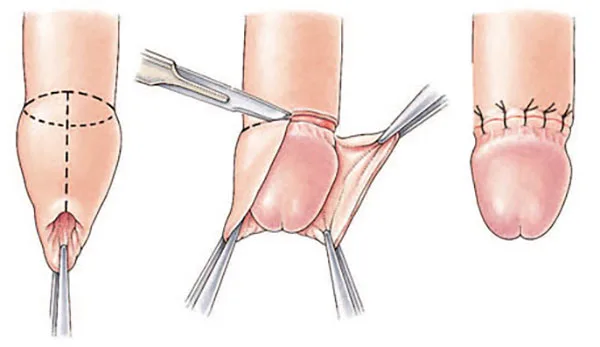
Preputioplasty is a foreskin-preserving surgical procedure used to widen a tight preputial opening in selected adults with phimosis. Instead of removing the foreskin as in circumcision, the surgeon makes one or more controlled incisions in the constricted foreskin and closes them in a way that increases its circumference, allowing easier and less painful retraction.
 ✓ Clinician-reviewed information
- Preputioplasty widens a tight foreskin without routinely removing it.
- It can be an alternative to circumcision for selected adults who want to preserve their foreskin.
- The procedure is most appropriate when phimosis is localized and the foreskin is otherwise sufficiently healthy.
- Severe scarring, extensive lichen sclerosus or recurrent inflammatory disease may make circumcision more appropriate.
- Recovery is generally short, but the foreskin must heal fully before intercourse or forceful retraction.
About preputioplasty for adult phimosis
Preputioplasty is reconstructive surgery of the foreskin.
Its purpose is to enlarge the narrow opening responsible for phimosis while preserving most or all of the foreskin.
Instead of circumferentially removing foreskin tissue, the surgeon releases the tight ring through carefully positioned incisions.
Those incisions are reconstructed in a different orientation so that the opening becomes wider.
What is adult phimosis?
Phimosis occurs when the foreskin cannot be comfortably retracted behind the glans.
Adults may experience:
Pain during erection
Pain during intercourse
Difficulty cleaning beneath the foreskin
Cracking
Bleeding
Recurrent inflammation
Painful retraction
Difficulty exposing the glans
Paraphimosis after forced retraction
Treatment depends on the cause and severity.
Is circumcision always necessary for adult phimosis?
No.
Selected adults can be managed with:
Topical corticosteroids
Gentle stretching
Treatment of underlying inflammation
Preputioplasty
Circumcision
Circumcision remains an established definitive treatment, particularly when the foreskin is extensively scarred or diseased.
Preputioplasty provides an additional option for appropriately selected patients who want to preserve the foreskin.
How does preputioplasty work?
A tight foreskin behaves like a narrow ring.
The surgeon makes one or more longitudinal incisions through this constricted area.
Instead of closing the incision in the same direction, it can be closed transversely.
This converts length into additional circumference.
The result is a wider foreskin opening without circumferential removal of the prepuce.
What happens during surgery?
The penis is examined and anesthetized.
The surgeon identifies the narrowest part of the foreskin.
One or more incisions are made through the tight ring.
The opening is widened until the foreskin can retract comfortably without excessive tension.
The incisions are then reconstructed using fine absorbable sutures.
The foreskin remains present after surgery.
What is the main advantage over circumcision?
The primary advantage is foreskin preservation.
This may matter to men because of:
Personal preference
Body image
Cultural preference
Sexual preference
Desire to maintain normal foreskin coverage
Desire to avoid permanent circumcision
Preputioplasty therefore offers a middle ground between conservative therapy and complete foreskin removal.
Preputioplasty vs circumcision
Preputioplasty
Preserves the foreskin and widens the tight area.
Advantages may include:
Foreskin preservation
Less tissue removal
Maintenance of glans coverage
Potentially shorter procedure
Reversible escalation pathway because circumcision remains possible later
Disadvantages include:
Possibility of recurrent narrowing
Visible foreskin scars
Need for postoperative retraction care in some patients
Unsuitability for extensively diseased foreskin
Circumcision
Removes the foreskin.
Advantages include:
Definitive elimination of foreskin phimosis
No recurrence of the phimotic foreskin ring
Removal of extensively scarred tissue
Disadvantages include:
Permanent loss of foreskin
Permanent exposure of the glans
Circumferential scar
Irreversible anatomical change
Neither procedure is universally better.
The correct choice depends on anatomy, disease and patient preference.
Who is a particularly good candidate?
Preputioplasty is most attractive when:
The tight ring is localized
The remaining foreskin is healthy
Scarring is limited
The patient wants to preserve the foreskin
Conservative therapy has failed or is undesirable
The surgeon must confirm that preserving the tissue is medically reasonable.
What if the foreskin is severely scarred?
Extensive fibrosis makes foreskin-preserving surgery less predictable.
A severely scarred ring may:
Recontract
Heal poorly
Remain painful
Continue inflammatory disease
Circumcision may therefore provide a more reliable treatment when significant pathological scarring is present.
What about lichen sclerosus?
This is an important selection issue.
Male genital lichen sclerosus can cause:
White scarred foreskin
Progressive phimosis
Cracking
Pain
Meatal narrowing
Urethral involvement
When lichen sclerosus extensively affects the foreskin, preserving diseased tissue may not be appropriate.
Circumcision is commonly preferred when disease is primarily preputial.
Patients with urinary-stream abnormalities may also require assessment of the meatus and urethra.
Can steroid cream be tried first?
Yes, in appropriate cases.
Topical corticosteroids combined with careful stretching can improve some cases of phimosis.
The likelihood of success depends on:
Severity
Cause
Degree of fibrosis
Compliance
Underlying skin disease
Preputioplasty becomes relevant when conservative management is unsuccessful, unsuitable or not preferred.
What if the frenulum is also short?
Phimosis and frenulum breve can coexist.
If the foreskin opening is widened but the frenulum remains restrictive, retraction can still be painful.
The surgeon may therefore combine preputioplasty with Frenuloplasty when both problems are present.
These should remain separate Procedure entities in your CMS because they treat different anatomical abnormalities.
Does preputioplasty change penile sensation?
The foreskin and glans remain largely anatomically preserved.
Temporary sensitivity around the incision is expected during healing.
Major predictable changes in sexual sensation should not be promised in either direction.
Does preputioplasty improve erections?
It does not directly treat erectile dysfunction.
However, men whose erections are painful because the tight foreskin stretches or tears may experience improved comfort once the mechanical restriction has been corrected.
Does it treat premature ejaculation?
No.
Preputioplasty should not be marketed as treatment for premature ejaculation.
Does preputioplasty increase penis size?
No.
It widens the foreskin opening.
It does not increase:
Penile length
Penile girth
Erectile-tissue volume
Can phimosis return?
Yes.
Unlike complete circumcision, preputioplasty retains the foreskin.
Scar contraction or recurrent inflammatory disease can therefore produce recurrent narrowing.
Good patient selection is important.
Can I still have circumcision later?
Yes.
One useful feature of preputioplasty is that circumcision remains possible if:
Phimosis recurs
Scarring progresses
The cosmetic result is unacceptable
Recurrent inflammation develops
The patient later prefers definitive foreskin removal
Why surgeon experience matters
Successful preputioplasty requires more than simply cutting the foreskin.
The surgeon must determine:
Whether the foreskin is healthy enough to preserve
Where the constricting ring is located
How much widening is required
Which incision pattern best suits the anatomy
Whether frenuloplasty is also required
Whether circumcision would actually provide the better long-term result
Proper selection is therefore central to success.
Who it is for
- •You have adult phimosis causing painful or difficult foreskin retraction.
- •The constriction is localized rather than involving extensive diseased foreskin.
- •Your foreskin is sufficiently healthy to preserve.
- •Conservative treatment has failed, is unsuitable or is not preferred.
- •You want to preserve your foreskin.
- •You understand that circumcision provides a more definitive elimination of foreskin narrowing.
- •You accept that recurrent phimosis can occur after foreskin-preserving surgery.
- •You are willing to follow postoperative foreskin-care instructions.
- •You understand that circumcision may still become necessary later.
- •You are medically fit for minor elective surgery.
- •You have extensive foreskin scarring or fibrosis that makes preservation unreliable.
- •You have significant active lichen sclerosus affecting tissue that should be removed.
- •You have an untreated penile, urinary or systemic infection.
- •You have acute paraphimosis requiring urgent reduction.
- •Your symptoms are primarily caused by isolated frenulum breve rather than foreskin narrowing.
- •Circumcision is considered substantially more appropriate because of recurrent severe foreskin disease.
- •You have uncontrolled bleeding risk.
- •You have uncontrolled bleeding risk.
- •You expect the procedure to increase penis size.
- •You expect it to treat erectile dysfunction or premature ejaculation.
- •You expect zero possibility of recurrent phimosis.
Preparing for surgery
What recovery looks like
Risks and complications
Common questions
What is preputioplasty?
Is preputioplasty the same as circumcision?
Can adults have preputioplasty?
Who is a good candidate?
Can all phimosis be treated with preputioplasty?
Can steroid cream work instead?
What if steroid treatment fails?
Is preputioplasty permanent?
Can phimosis come back?
Can I have circumcision later?
Does preputioplasty preserve the entire foreskin?
What is Y-V preputioplasty?
What is Z-plasty preputioplasty?
What if I also have a short frenulum?
Does preputioplasty improve erections?
Does it affect sensitivity?
Does preputioplasty treat premature ejaculation?
Does it make the penis larger?
How long does surgery take?
What anesthesia is used?
Do I need to stay overnight?
How long should I stay in Turkey?
When can I return to work?
When can I exercise?
When can I have sex?
Do I need to stretch the foreskin after surgery?
What happens if the foreskin becomes tight again?
Which doctor performs preputioplasty?
Patient reviews
Been treated? Your honest review of Preputioplasty for Adult Phimosis helps the next patient.
No one has reviewed this yet. If you have been treated, your experience would help the next person.
Write the first reviewSources
- Adult series evaluating Y-V preputioplasty as a foreskin-preserving treatment for phimosis, including patient satisfaction and subsequent circumcision. https://pubmed.ncbi.nlm.nih.gov/18701144/
- Contemporary review of adult phimosis covering topical corticosteroids, circumcision and foreskin-preserving surgical approaches. https://pubmed.ncbi.nlm.nih.gov/38391414/
- Prospective evidence supporting conservative foreskin-preserving management in appropriately selected adults and emphasizing that circumcision is not automatically necessary for every case of adult phimosis. https://pubmed.ncbi.nlm.nih.gov/34984181/
- European urological guidance relevant to evaluation of adult penile and foreskin abnormalities and appropriate specialist assessment. https://uroweb.org/guidelines