
Varicocele
Enlarged veins within the scrotum, associated with impaired sperm production and testicular discomfort.
 ✓ Clinician-reviewed information
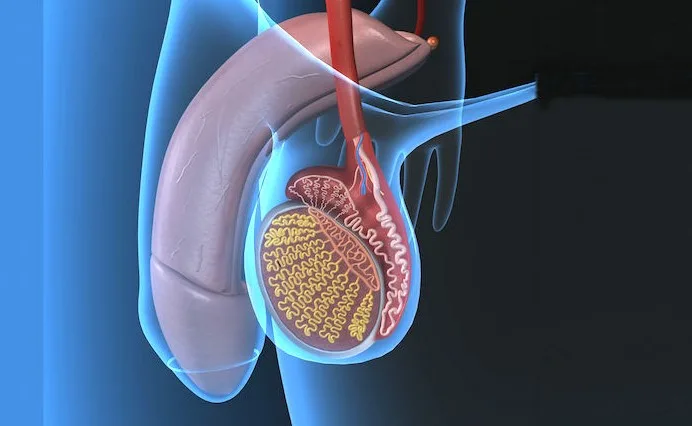
- A varicocele is an enlargement of the pampiniform plexus, the network of veins that drains blood from the testicle, caused by malfunctioning valves that let blood pool rather than flow normally.
- It's genuinely common — found in roughly 10–20% of adult men — and the large majority never cause pain, fertility problems, or any symptoms at all.
- It occurs on the left side in the substantial majority of cases, due to a straightforward anatomical difference in how the left and right testicular veins drain.
- It's the most common identifiable, surgically correctable cause of male infertility, found in a much higher proportion of men being investigated for infertility than in the general population.
- Not every varicocele needs treatment — the decision depends on symptoms, size, and fertility goals, not simply on whether one is present.
Overview
A varicocele is an abnormal enlargement of the veins within the scrotum that drain blood away from the testicle — specifically a network of small veins called the pampiniform plexus. It's often described, not inaccurately, as the scrotal equivalent of varicose veins in the legs. In both cases, the underlying mechanism is similar: small one-way valves inside the veins, whose job is to keep blood flowing in one direction against gravity, stop working properly. Blood that should be moving steadily out of the area instead pools and backs up, and the affected veins gradually stretch, widen, and become engorged.
The anatomy of the testicular veins explains one of the more consistent and clinically useful facts about varicocele: it happens on the left side far more often than the right. The right testicular vein drains directly into a large vessel called the inferior vena cava, at a relatively favourable angle. The left testicular vein, by contrast, drains into the left renal vein — the vein carrying blood away from the left kidney — at something close to a right angle, and has to travel a longer route to get there. This less favourable drainage path puts more pressure on the venous valves on the left side, making them more prone to failure over time. This is why a left-sided varicocele is by far the most common presentation, and why a right-sided varicocele occurring on its own is more likely to prompt a doctor to look for another explanation, discussed further in the FAQs below.
Varicoceles are formally graded by physical examination, and this grading is genuinely useful clinical shorthand rather than an arbitrary label. A subclinical varicocele can't be felt or seen and is only detected on ultrasound. Grade I is felt only when a man performs a Valsalva manoeuvre (bearing down, as if straining) while standing. Grade II is palpable without needing to strain, but isn't visible just by looking. Grade III is large enough to be visible through the skin without any examination technique needed at all, often described, somewhat memorably, as looking or feeling like a "bag of worms." This grading matters clinically because it correlates, imperfectly but usefully, with the likelihood of a varicocele causing symptoms or measurably affecting fertility.
The exact mechanism by which a varicocele can affect fertility isn't fully settled, but several plausible and reasonably well-supported explanations exist, and they likely act together rather than in isolation. Pooled blood around the testicle raises local temperature slightly, and sperm production is known to be sensitive to even small increases in scrotal temperature. Reduced blood flow efficiency may also cause relative hypoxia — lower oxygen levels — in testicular tissue. There's also a proposed mechanism involving the reflux of metabolic waste products from the adrenal gland or kidney travelling backward down the affected vein toward the testicle. None of these mechanisms has been proven as the single definitive cause, and it's worth being honest that the relationship between varicocele and infertility, while well documented statistically, isn't fully mechanistically understood — a point some recent literature reviews explicitly flag as still under investigation.
It's important to be clear-eyed about something that's easy to overstate: having a varicocele does not mean a man is infertile, and most men with a varicocele conceive without any difficulty whatsoever. The vast majority of varicoceles are entirely asymptomatic and are often found incidentally, during a routine physical exam or an unrelated scan, rather than because they're causing a problem. What makes varicocele clinically significant as a topic in andrology is a different fact: among men who are already experiencing fertility difficulty, varicocele shows up far more often than it does in the general population, and its surgical correction is one of the relatively few well-established, structurally reversible interventions available for male infertility. This dual reality — common and usually harmless, but disproportionately present in infertility populations and genuinely treatable when relevant — is the reason varicocele occupies such a central place in andrology despite rarely being an emergency or even, for most men, a symptomatic problem at all.
There also appears to be a real hereditary component to who develops a varicocele, particularly more significant ones. Studies looking at the first-degree relatives — fathers, brothers — of men with grade II or III varicocele have found notably elevated rates of varicocele within those families, well above the general population baseline. This doesn't mean varicocele is simply inherited in a predictable pattern, but it does suggest that genetic factors, likely related to vein wall and valve structure, play a meaningful role alongside anatomy.
Types of varicocele
Symptoms
Causes
Risk factors
How it is diagnosed
Diagnosis usually starts with a physical examination, performed with the man standing, since a varicocele can shrink or become undetectable when lying down as gravity no longer works against venous drainage. The doctor will look and feel for swelling, and may ask the man to perform a Valsalva manoeuvre to help detect smaller (grade I) varicoceles that aren't obvious at rest.
Scrotal Doppler ultrasound is the standard way to confirm a varicocele, assess its grade more objectively, measure testicular size, and rule out other causes of scrotal swelling. For men being assessed specifically for fertility concerns, a semen analysis is typically also performed, since varicocele's clinical significance in this context is judged partly by its measurable effect on sperm parameters, not by its grade alone. Hormone testing, including testosterone, is sometimes included as part of a broader fertility work-up.
One diagnostic point worth flagging directly: a varicocele that appears suddenly, particularly on the right side alone, or one that doesn't reduce in size when lying down, is treated differently by clinicians than a typical, gradually developing left-sided varicocele. This pattern can occasionally indicate a mass or blockage elsewhere along the vein's drainage path — for example, in the kidney or retroperitoneum — rather than a straightforward primary varicocele, and it's a recognised reason for further imaging.
- You notice scrotal swelling, a lump, or a "bag of worms" texture
- You have persistent aching or heaviness in the scrotum, especially after standing
- You notice a difference in size between your testicles
- You and a partner are having difficulty conceiving
- A varicocele appears suddenly, is only on the right side, or doesn't reduce when lying down — this combination is a reasonable prompt for further investigation rather than assumption
Treatment options
- Adolescent boys and young men with a known varicocele are sometimes followed with periodic examination to monitor testicular growth and size, since this is one of the more actionable markers in this age group
- Men noticing new scrotal swelling, discomfort, or asymmetry are generally better served by prompt assessment than by waiting, given how straightforward the diagnostic process is
Common questions
Is a varicocele dangerous?
Why do varicoceles almost always happen on the left side?
Should I worry if I have a varicocele only on the right side?
Does every varicocele need to be treated?
Can a varicocele shrink or go away on its own?
Does having a varicocele mean I'm infertile?
How does a varicocele actually affect fertility?
Does the grade of the varicocele predict how much it affects fertility?
Can treating a varicocele improve fertility?
Is varicocele surgery the only treatment option?
Is varicocele repair a guarantee of getting a partner pregnant?
Can a varicocele cause low testosterone?
Do varicoceles run in families?
Can a varicocele affect testicle size?
Is varicocele repair recommended for teenagers?
Does a varicocele cause pain, and if so, what does it feel like?
Can varicocele come back after surgery?
Is varicocele the same thing as a hydrocele?
Should I get a varicocele checked even if it doesn't hurt and I'm not trying to conceive?
Sources
- Recent Guidelines and Perspectives for Varicocele: A Clinical Consensus and Recommendations from the Korean Society for Sexual Medicine and Andrology." World J Mens Health. 2025 Oct. https://pmc.ncbi.nlm.nih.gov/articles/PMC12505475/
- Global Andrology Forum (GAF), "Clinical Guidelines on the Management of Infertile Men with Varicocele." World J Mens Health. 2025. https://wjmh.org/DOIx.php?id=10.5534%2Fwjmh.250004
- Recent Trends in the Management of Varicocele." PMC. 2025 Aug. https://pmc.ncbi.nlm.nih.gov/articles/PMC12347406/
- Hsiao W, Rosoff JS, Pale JR, Powell JL, Goldstein M. "Does Varicocele Repair Improve Conventional Semen Parameters? A Meta-Analytic Study of Before-After Data." World J Mens Health. 2024;42(1):92-132. https://pmc.ncbi.nlm.nih.gov/articles/PMC10782123/
- Clavijo RI, Carrasquillo R, Ramasamy R. "Varicoceles: prevalence and pathogenesis in adult men." Fertil Steril. 2017;108(3):364-9.
- NHS, "Varicocele" https://www.nhs.uk/conditions/varicocele/