
Penile Corporal Reconstruction for Severe Fibrosis
Penile corporal reconstruction is complex reconstructive surgery used when severe fibrosis has replaced or contracted the erectile tissue inside the corpora cavernosa, making conventional penile prosthesis implantation difficult or impossible. The procedure releases or removes obstructive scar tissue, recreates adequate corporal space and, in most severe erectile-dysfunction cases, is performed together with placement of a penile prosthesis.
 ✓ Clinician-reviewed information
- Severe corporal fibrosis can make ordinary penile prosthesis placement technically difficult or occasionally impossible without additional reconstruction.
- Common causes include prolonged ischemic priapism, previous infected implant removal, erosion, repeated prosthesis surgery, penile trauma and some intracavernosal injection complications.
- Reconstruction may involve specialized dilation, scar incision or excision, corporal excavation, grafting or use of narrow prosthesis cylinders.
- In contemporary specialist series, many fibrotic corpora can still be successfully implanted without extensive open reconstruction.
- These cases have higher technical complexity than primary penile implant surgery and are best managed by high-volume prosthetic and reconstructive surgeons.
About penile corporal reconstruction for severe fibrosis
The penis contains two cylindrical erectile bodies called the corpora cavernosa.
Normally, these contain expandable sinusoidal tissue that fills with blood during an erection.
Corporal fibrosis occurs when healthy erectile tissue is replaced by dense scar tissue.
This can cause:
Severe erectile dysfunction
Loss of penile elasticity
Penile shortening
Narrowing of the corporal space
Difficulty dilating the penis during implant surgery
Deformity
Pain or contracture in selected cases
Mild fibrosis and severe diffuse fibrosis are very different surgical problems.
This Procedure page should focus on the severe end of the spectrum.
What causes severe penile fibrosis?
Important causes include:
Prolonged ischemic priapism
Previous penile prosthesis infection
Removal of an infected prosthesis
Prosthesis erosion
Multiple implant revisions
Penile trauma
Previous penile surgery
Repeated intracavernosal injections
Severe inflammatory or scar-forming processes
Prior implant infection and prolonged priapism are among the most important causes of difficult corporal fibrosis encountered by prosthetic surgeons.
What happens after prolonged ischemic priapism?
Ischemic priapism traps poorly oxygenated blood inside the corpora cavernosa.
If ischemia continues for a prolonged period, smooth muscle begins to suffer irreversible injury.
This can progress to:
Necrosis
Organization of tissue
Collagen deposition
Dense fibrosis
The longer severe ischemia persists, the greater the risk of permanent erectile dysfunction and corporal scarring.
Once extensive fibrosis has developed, tablets, injections or regenerative therapies cannot simply recreate normal cavernous architecture.
Why can an infected penile implant cause fibrosis?
When an infected prosthesis is removed, inflammation and healing occur within the corporal spaces.
If the space is left without an implant, scar tissue can progressively contract.
This can make later reimplantation significantly more difficult.
Potential consequences include:
Narrow corporal channels
Penile shortening
Dense adhesions
Difficulty passing standard dilators
Increased perforation risk during reimplantation
This is one reason immediate salvage is considered in selected prosthesis infections rather than delayed reimplantation.
Is penile fibrosis the same as Peyronie’s disease?
No.
They can overlap, but they are not identical.
Peyronie’s disease
Usually involves localized fibrosis of the tunica albuginea and may cause:
Curvature
Hourglass deformity
Hinge deformity
Plaque
Corporal fibrosis
Can involve the deeper erectile tissue inside the corpora cavernosa.
Severe corporal fibrosis may obstruct the channels needed for prosthesis cylinders.
Patients may have both conditions, but they require different surgical planning.
What is penile corporal reconstruction?
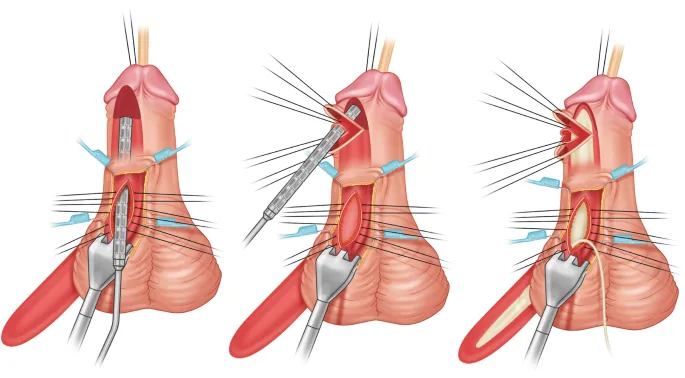
Corporal reconstruction describes surgical techniques used to recreate adequate space inside severely scarred corpora.
The surgeon may need to:
Open the corpora
Identify the fibrotic segment
Dilate through scar tissue
Incise fibrosis
Excise selected scar
Create new corporal channels
Reconstruct tunical defects
Insert appropriately sized prosthesis cylinders
There is no single universal reconstruction technique.
The procedure must be tailored to the individual fibrosis pattern.
Is reconstruction always necessary when fibrosis is present?
No.
This is an important distinction.
Many patients with corporal fibrosis can still undergo prosthesis implantation using:
Careful sequential dilation
Specialized cavernotomes
Narrow cylinders
More extensive open reconstruction should generally be reserved for cases in which simpler techniques cannot safely establish adequate corporal space.
A modern multicenter series found that most fibrotic cases could be implanted using standard dilators or cavernotomes, while major sharp excision was rarely required.
What are cavernotomes?
Cavernotomes are specialized instruments designed to create a channel through dense corporal scar tissue.
Unlike ordinary blunt dilators, some cavernotomes incorporate cutting surfaces that gradually remove or divide fibrosis.
Examples include:
Carrion-Rossello cavernotomes
Mooreville / Uramix cavernotomes
They are particularly useful when standard dilation cannot pass through dense fibrosis.
Cavernotome dilation should be modeled as a Technique.
What is corporal excavation?
Corporal excavation is a more extensive reconstructive technique used in selected severe fibrosis cases.
The surgeon opens the corpora and removes obstructive scar tissue to recreate sufficient space for implant cylinders.
It can allow prosthesis placement in cases where routine dilation is impossible.
However, it is more invasive and carries greater technical complexity.
It therefore belongs under Techniques within this Procedure.
What is sharp scar excision?
Dense fibrosis can occasionally require controlled sharp dissection.
The surgeon removes or releases enough scar to create a safe path for the prosthesis.
Excessive excision should be avoided because it can:
Damage corporal tissue
Create tunical defects
Increase bleeding
Increase perforation risk
Require graft reconstruction
Contemporary practice generally favors the least invasive technique that safely allows implantation.
When is grafting necessary?
Extensive corporotomy or scar excision can leave a tunical defect that cannot be closed directly.
A graft may then be used to reconstruct the corporal wall.
Potential graft materials vary between centers.
The graft itself and graft material should belong in your Techniques/material relationships rather than becoming separate Procedure entities.
Does every patient receive an implant?
Severe diffuse corporal fibrosis is frequently associated with irreversible erectile dysfunction.
For that reason, definitive surgical reconstruction is commonly performed together with penile prosthesis implantation.
Standalone scar removal without addressing severe erectile dysfunction is generally not the goal.
This is why this Procedure should be positioned as a complex reconstructive pathway closely linked to your existing Penile Implant Surgery entity.
Why not simply use the standard Penile Implant Surgery page?
Your standard Penile Implant Surgery page represents routine primary implantation.
This page exists for a distinct complex scenario in which severe scarring requires substantial additional reconstruction.
The distinction is useful because these patients have different:
Operative complexity
Surgical techniques
Implant-selection issues
Complication risks
Counseling requirements
Recovery expectations
However, minor fibrosis encountered during routine implantation should not automatically trigger this Procedure relationship.
Can narrow cylinders be used?
Yes.
When the corporal space remains narrow despite careful dilation, narrower prosthesis cylinders can sometimes be used.
This may avoid more aggressive reconstruction.
In selected patients, later tissue expansion may permit replacement or upsizing.
The specific prosthesis model belongs under Devices.
Can a malleable implant be used?
Yes.
A malleable prosthesis can be useful in selected severely fibrotic cases because:
Cylinder diameter may be easier to accommodate
Implantation may require less space
It can act as a tissue expander in staged strategies
The choice between inflatable and malleable prostheses should depend on anatomy, goals, infection history and surgeon judgment.
Can an inflatable implant still be placed?
Often, yes.
Severe fibrosis does not automatically mean that only a malleable prosthesis is possible.
Specialized dilation, narrow cylinders and reconstructive techniques can allow inflatable prosthesis placement in many patients.
The final choice must be determined intraoperatively in some complex cases.
Does surgery restore the penis to its original length?
Not necessarily.
Severe fibrosis can permanently shorten the penis.
Surgery primarily aims to:
Restore functional rigidity
Create adequate implant space
Correct severe contracture where possible
Patients should be counseled that their pre-fibrosis length may not be recoverable.
Length restoration should never be guaranteed.
Can the surgeon increase cylinder size later?
Sometimes.
A narrow prosthesis may initially be used when scar tissue prevents placement of a larger cylinder.
Over time, tissue expansion may permit:
Cylinder upsizing
Prosthesis exchange
This is highly individualized and should not be presented as guaranteed.
How is the severity of fibrosis assessed?
Evaluation can include:
Surgical history
Priapism history
Previous prosthesis infection
Previous implant removal
Physical examination
Penile ultrasound
Erectile-function assessment
Ultrasound can help identify and estimate fibrosis, but the true degree of obstruction may only become fully apparent during surgery.
What does penile ultrasound show?
Ultrasound may identify:
Echogenic scar tissue
Calcification
Abnormal corporal architecture
Reduced cavernous tissue
In patients with previous prosthesis infection or severe priapism, preoperative ultrasound may help the surgeon anticipate complex dilation.
Why surgeon experience matters
Severe corporal fibrosis is one of the more difficult scenarios in penile prosthetic surgery.
Potential intraoperative problems include:
Corporal perforation
Urethral injury
Crossover between corpora
Inability to dilate
Cylinder malposition
Tunical defects
Bleeding
Need to change implant type
Complex cases should therefore be treated by surgeons experienced in:
Penile prosthesis surgery
Revision implants
Salvage surgery
Cavernotome use
Corporal reconstruction
Grafting
Severe post-priapism fibrosis
High-volume referral centers are particularly appropriate.
Who it is for
- •You have severe corporal fibrosis causing significant erectile dysfunction.
- •Previous standard penile implant placement is expected to be difficult because of dense scar tissue.
- •You developed fibrosis after prolonged ischemic priapism.
- •You developed severe fibrosis after infected penile prosthesis removal.
- •You developed scarring after prosthesis erosion, revision or multiple penile procedures.
- •Your corpora cannot be adequately dilated using ordinary techniques.
- •Penile prosthesis implantation remains clinically appropriate.
- •You understand that a narrower prosthesis may need to be used.
- •You understand that extensive reconstruction or grafting may become necessary during surgery.
- •You understand that original penile length cannot be guaranteed.
- •You accept the higher technical complexity compared with routine primary implant surgery.
- •You are medically fit for major reconstructive surgery and anesthesia.
- •Your fibrosis is mild and standard penile prosthesis implantation can be performed without major reconstruction.
- •You have active untreated penile prosthesis infection requiring an infection-specific salvage or explant pathway.
- •You have uncontrolled systemic infection.
- •Your erectile dysfunction can still be satisfactorily treated with appropriate less-invasive therapy and reconstruction is unnecessary.
- •Your main problem is localized Peyronie’s curvature without diffuse corporal fibrosis.
- •Your main goal is cosmetic penile enlargement.
- •You expect surgery to restore the exact penile dimensions you had before fibrosis.
- •Severe tissue loss makes safe reconstruction impossible.
- •Your medical condition makes complex surgery or anesthesia unacceptably risky.
- •You are unwilling to accept the possibility that implant type or cylinder size may need to change during surgery.
Preparing for surgery
What recovery looks like
Risks and complications
Common questions
What is penile corporal fibrosis?
What causes severe corporal fibrosis?
Is corporal fibrosis the same as Peyronie’s disease?
Can severe penile fibrosis cause erectile dysfunction?
Can tablets reverse severe fibrosis?
Can PRP or shockwave therapy remove severe corporal fibrosis?
Why does fibrosis make penile implant surgery difficult?
Does every fibrotic penis need reconstruction?
What is a cavernotome?
Is cavernotome use a separate procedure?
What is corporal excavation?
Will I need a graft?
Is the penile implant placed during the same surgery?
Can I get a three-piece inflatable implant?
Can a malleable implant be used?
What are narrow penile implant cylinders?
Can the cylinders be made larger later?
Can surgery restore my original penis length?
Why does priapism cause fibrosis?
Why can implant infection cause fibrosis?
Can fibrosis be prevented after an infected implant?
How is fibrosis diagnosed?
How long does reconstruction take?
How long will I stay in hospital?
How long should I stay in Turkey?
When can I return to work?
When can I have sex?
Is this surgery riskier than normal penile implant surgery?
Should this surgery be performed by any urologist?
Patient reviews
Been treated? Your honest review of Penile Corporal Reconstruction for Severe Fibrosis helps the next patient.
No one has reviewed this yet. If you have been treated, your experience would help the next person.
Write the first reviewSources
- Multicenter series of 42 men describing contemporary techniques used to implant fibrotic corpora, including standard dilation, cavernotomes, limited scar excision and narrow cylinders. https://pubmed.ncbi.nlm.nih.gov/33204006/
- Detailed review of scar incision, fibrosis excision, corporotomy, grafting, cavernotomes, downsized implants and other strategies used in severe corporal fibrosis. https://pubmed.ncbi.nlm.nih.gov/21492405/
- Review of corporal excavation and alternative strategies including specialized dilation, counter-incisions, graft reconstruction and scar excision. https://pubmed.ncbi.nlm.nih.gov/26565574/
- Review covering conservative approaches and surgical treatment of corporal fibrosis, including corporal reconstruction and penile prosthesis implantation in severe disease. https://pubmed.ncbi.nlm.nih.gov/26558095/
- Contemporary review of evaluation and management of penile fibrosis, including ultrasound, vacuum therapy, narrow implants, cavernotomes and complex reconstructive approaches. https://pubmed.ncbi.nlm.nih.gov/38404545/
- 2026 review of contemporary open and closed approaches to prosthesis implantation in severely fibrotic corpora, emphasizing tailored cylinder selection and specialist surgical techniques. https://pubmed.ncbi.nlm.nih.gov/42477171/
- Clinical series describing extensive corporal reconstruction combined with prosthesis implantation for severe penile contracture and fibrosis. https://pubmed.ncbi.nlm.nih.gov/22672346/