
Hyaluronic Acid Injection
Hyaluronic acid (HA) injection increases the volume of the glans penis, aiming to reduce sensitivity and delay ejaculation. This is a genuinely conflicted area of evidence: several meta-analyses of uncontrolled, before-after studies report dramatic improvements in ejaculation time, but the only meta-analysis to specifically pool the placebo-controlled trials found the effect over placebo was small and not statistically significant — a gap worth understanding honestly before considering this treatment.
 ✓ Clinician-reviewed information
- Hyaluronic acid injection works by increasing the volume and circumference of the glans penis, which is thought to create a partial barrier over the nerve endings responsible for heightened sensitivity, thereby delaying the ejaculation reflex.
- The evidence picture here is genuinely split in a way worth understanding clearly: uncontrolled, before-after studies consistently report large, statistically significant increases in ejaculation time, but the one meta-analysis that specifically pooled the placebo-controlled trials found the effect over placebo was small and not statistically significant.
- At least one individual, well-designed randomized crossover trial did find HA meaningfully outperformed a saline placebo — so the picture isn't uniformly negative either; it's genuinely mixed, not settled in either direction.
- Injection location appears to matter considerably for safety: one study found a complication rate of 25.8% when HA was injected directly into the glans, compared with just 1.9% when injected around the coronal sulcus (the base of the glans) instead.
- No severe adverse events, including glans necrosis, have been reported specifically with HA gel injection technique, which is a genuinely reassuring safety signal even amid the efficacy uncertainty.
About hyaluronic acid injection
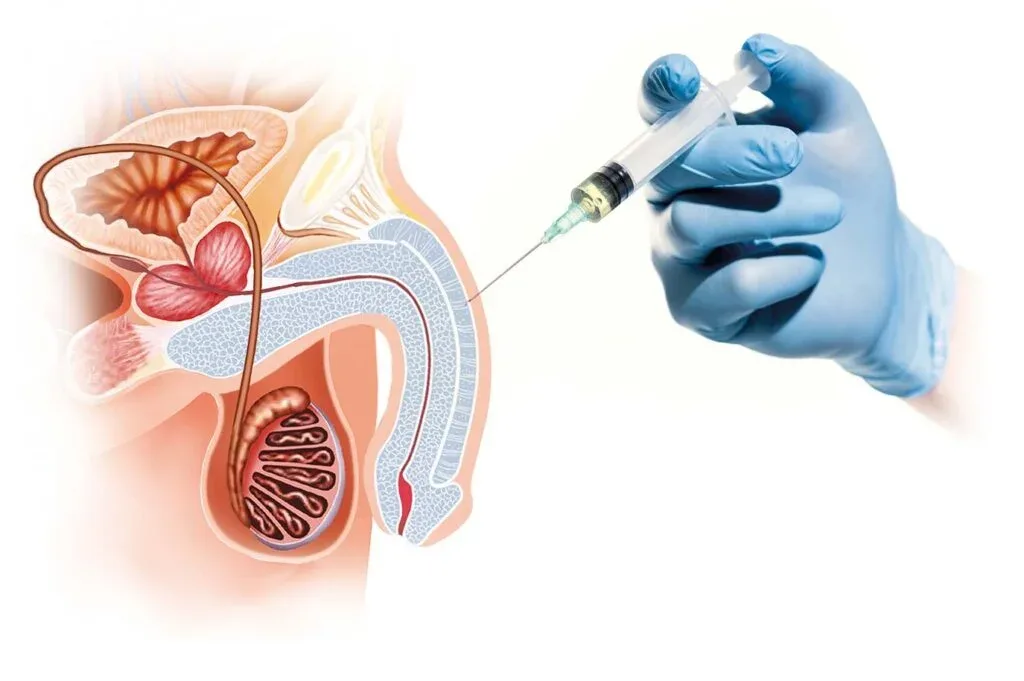
Hyaluronic acid (HA) injection for premature ejaculation, sometimes described as glans penis augmentation (GPA), involves injecting a gel form of hyaluronic acid — a naturally occurring substance in the body, widely used in dermal filler and joint injections elsewhere in medicine — into the deep dermis of the glans penis. The stated aim is to increase the volume and circumference of the glans, which is proposed to work through two related mechanisms: physically increasing the distance between the skin surface and the underlying dorsal nerve branches responsible for tactile sensation, and creating a degree of general desensitisation of the glans. Together, these are thought to raise the threshold of stimulation needed to trigger ejaculation, extending the time to climax.
This is one of the more actively studied procedural approaches to premature ejaculation discussed on this site, with a genuinely larger body of published research — including several randomized and placebo-controlled trials — than exists for some other procedures, such as penile nerve cryoablation. But a larger body of research doesn't automatically mean a settled, unambiguous answer, and this is exactly the case here: the evidence for HA injection is honestly one of the more internally conflicted pictures in this entire area of andrology, and it's worth understanding that conflict directly rather than being shown only the most favourable-looking numbers.
On one side, uncontrolled, single-arm (before-and-after) studies consistently report large, statistically significant increases in intravaginal ejaculatory latency time (IELT) following HA injection. A pilot study using a "five-puncture" injection technique in 30 men found IELT rising from a baseline of roughly 38 seconds to over 320 seconds at one month, settling at around 235 seconds by 12 months — still a more than sixfold increase over baseline, sustained a full year later. A larger study of 110 men found IELT rising from a baseline of about 88 seconds to nearly 300 seconds at six months, alongside a genuine, measured increase in glans circumference and high patient-reported satisfaction. A more recent study introducing a refined, three-session injection protocol in 80 men found IELT rising from roughly 94 seconds at baseline to a stable, sustained 197–201 seconds across the 3, 6, and 12-month follow-up points — notably flat and durable, rather than declining over time, which its authors specifically highlighted as reducing the likely future need for repeat injections. Pooling this kind of uncontrolled study data, a systematic review and single-arm meta-analysis covering 616 participants across nine studies found HA injection significantly increased IELT by roughly 240 seconds at one month, 203 seconds at three months, 165 seconds at six months, and 189 seconds at twelve months or beyond — genuinely large, consistent, statistically significant numbers.
On the other side — and this is the part that deserves equal, honest weight — a separate systematic review and meta-analysis specifically set out to pool only the studies that included a proper placebo control group, rather than relying on before-and-after comparisons alone. Its findings were considerably more cautious: pooling one placebo-controlled study, HA injection showed an improvement in IELT at one and three months, but the overall effect size was described as low and not statistically significant. When two placebo-controlled studies were pooled specifically for the six-month outcome, the improvement in IELT was actually numerically more pronounced in the control (placebo) group than in the group that had received HA injection — though this difference, too, was small and not statistically significant either way. This is a genuinely important, sobering finding, and it illustrates something worth understanding about premature ejaculation research specifically: PE outcomes are measured almost entirely by self-report (how long a man believes intercourse lasted, and how he rates his own control and satisfaction), and this kind of subjective, expectation-sensitive outcome is particularly prone to large placebo effects — meaning dramatic before-and-after improvement in an uncontrolled study can reflect genuine treatment effect, placebo response, natural fluctuation, and the psychological impact of undergoing a procedure at all, all mixed together, in a way that only a proper control group can meaningfully separate out. This is precisely the pattern also seen with PRP injection for erectile dysfunction, discussed on our dedicated P-Shot page, and it's a recurring, important theme across several of the newer, procedure-based treatments in this field.
It would be inaccurate, though, to summarise this simply as "the controlled evidence says no" — because at least one well-designed individual trial found a genuine benefit over placebo. A randomized, controlled, crossover study of 30 men, comparing HA injection against a saline injection control, with each man eventually receiving both treatments in sequence, found statistically significant improvement after HA compared with saline across follow-up: IELT increased by a median of 2.6-fold after HA injection, compared with only a 1.1-fold increase after saline — a real, meaningful, statistically confirmed difference, not just a numerically larger before-after change. This particular trial's authors, whose broader systematic review is one of the more recent and rigorous available on this topic, have themselves described the overall efficacy question for this treatment as "quite controversial" — a genuinely honest characterisation from researchers actively working in this specific area, and one this page adopts directly rather than presenting a falsely confident verdict in either direction.
Technique also appears to matter meaningfully, both for effect and for safety. Two main injection approaches are described in the literature — a "Fanning" technique, spreading the gel across a broader area with fewer puncture points, and multiple-puncture techniques (including the five-puncture protocol described above), aiming for more even distribution of the gel through the glans tissue. Injection location specifically has also been shown to affect safety outcomes directly: one retrospective study comparing injection directly into the glans penis against injection around the coronal sulcus (the ridge at the base of the glans) found a complication rate of 25.8% with direct glans injection, compared with just 1.9% when the coronal sulcus was used instead — a genuinely large, clinically important difference in a single study, worth asking any provider about directly.
It's worth being clear, finally, about what this procedure is not. Historically, some approaches to glans augmentation used surgical dermofat grafts or scaffold implants placed between the corpus spongiosum and the tip of the corpus cavernosum — techniques that carried a genuine, serious risk of glans necrosis (tissue death) from compromised blood supply. HA gel injection into the deep dermis, without any surgical dissection, has not been associated with this severe complication in the published literature, which is a meaningfully more reassuring safety profile than these older, more invasive glans-augmentation approaches, even amid the genuine uncertainty about how much benefit it actually provides beyond placebo.
Who it is for
- •Men with lifelong or refractory premature ejaculation, particularly where reduced glans sensitivity is suspected to be a contributing factor
- •Men who have tried, and found insufficient or unsustainable benefit from, standard first-line treatments such as SSRIs or topical anaesthetics
- •Men specifically interested in avoiding ongoing daily or on-demand medication, and willing to accept the current uncertainty in the procedural evidence as a trade-off
- •Men without erectile dysfunction or significant psychiatric conditions, which were exclusion criteria in several of the published studies
- •Men with acquired PE linked primarily to anxiety, relationship factors, or coexisting erectile dysfunction, where the underlying driver isn't glans sensitivity and a nerve- or volume-based intervention is less likely to be the right target
- •Men who haven't yet properly trialled well-established first-line treatments
- •Men seeking a guaranteed or even reliably probable improvement, given the directly conflicting controlled-trial evidence discussed throughout this page
- •Men considering direct glans injection specifically without discussing the meaningfully different complication rate found with coronal sulcus injection in at least one comparative study
Preparing for surgery
What recovery looks like
Risks and complications
Common questions
Does hyaluronic acid injection actually work for premature ejaculation?
Why would placebo-controlled results differ so much from before-after studies?
Is the injection painful?
Does it matter exactly where on the penis the injection is given?
Will this permanently change the size or shape of my glans?
How many treatment sessions do I actually need?
Will this affect my ability to feel pleasure during sex, not just delay ejaculation?
Is this safer than older penis-enlargement-style procedures I've read about?
Should I try this before or after well-established treatments like SSRIs?
Can I have this done alongside other PE treatments, like SSRIs or behavioural techniques?
Is there a registered clinical trial comparing this directly against standard medication?
Why isn't there a clearer, more settled answer given how many studies exist?
Patient reviews
Been treated? Your honest review of Hyaluronic Acid Injection helps the next patient.
No one has reviewed this yet. If you have been treated, your experience would help the next person.
Write the first reviewSources
- Atmoko W, Savira M. "Hyaluronic Acid Injection of Penis for Management of Premature Ejaculation: A Systematic Review with Single-Arm Meta-Analysis." J Sex Med. 2024;21(Suppl 2):qdae002.069. https://academic.oup.com/jsm/article/21/Supplement_2/qdae002.069/7618370
- "The techniques, efficacy and safety of penile glans augmentation using hyaluronic acid for the treatment of premature ejaculation: a systematic review and meta-analysis." Afr J Urol. 2024;30:63 https://link.springer.com/article/10.1186/s12301-024-00464-9
- Culha MG, Baran C, Erkoc M. "Clinical efficacy and safety of hyaluronic acid gel injection in the glans penis for treatment of premature ejaculation: systematic review and meta-analysis." J Sex Med. 2024;21(10):878-888 https://academic.oup.com/jsm/article-abstract/21/10/878/7730561
- Culha MG, et al. "Hyaluronic acid injection in glans penis for treatment of premature ejaculation: a randomized controlled cross-over study." https://pubmed.ncbi.nlm.nih.gov/30610210/
- "The efficacy of hyaluronic acid in treating premature ejaculation: A systematic review and single-armed meta-analysis." https://www.sciencedirect.com/org/science/article/pii/S042802962300080X
- Sakr A, Elgalaly H, Seleem MM, et al. "Outcome of hyaluronic acid gel injection in glans penis for treatment of lifelong premature ejaculation: A pilot study." 2022. https://www.ncbi.nlm.nih.gov/pmc/articles/PMC9930752/
- Eldib H, Farag M, Noah I. "Efficacy of hyaluronic acid local injection in treatment of lifelong premature ejaculation: A new protocol." 2025. https://www.tandfonline.com/doi/full/10.1080/20905998.2025.2457922
- Chen K, Li Q, Xu T, Zhang X. "Hyaluronic acid injection to coronal sulcus of the penis for the treatment of premature ejaculation: a retrospective observational study." BMC Urol. 2023;23(1):55 https://link.springer.com/article/10.1186/s12894-023-01214-9
- "A clinical study to assess the effectiveness of a hyaluronic acid-based procedure for treatment of premature ejaculation." https://www.ncbi.nlm.nih.gov/pmc/articles/PMC3655259/
- "Hyaluronic Acid Injection in the Glans Penis Versus Selective Serotonin Reuptake Inhibitors for Lifelong Premature Ejaculation." ClinicalTrials.gov, NCT06451406. https://clinicaltrials.gov/study/NCT06451406