Skip to content
Procedure

Priapism Shunt Surgery

Priapism shunt surgery is an emergency procedure used to drain trapped, oxygen-deprived blood from the corpora cavernosa when acute ischemic priapism does not resolve with aspiration, irrigation and intracavernosal medication. The surgeon creates a controlled passage between the corpora cavernosa and another drainage structure, usually the glans penis, to relieve pressure, restore blood flow and limit further damage to erectile tissue.

AnaesthesiaGeneral
Operating time30–120 min
Hospital stay1–2 nights
Days in Türkiye3–7 days
Back to work1–2 weeks
Priapism Shunt Surgery✓ Clinician-reviewed information
Key takeaways
  • Ischemic priapism lasting more than four hours is a urological emergency because prolonged oxygen deprivation can permanently damage erectile tissue.
  • Shunt surgery is generally considered only after aspiration, irrigation and intracavernosal sympathomimetic treatment fail.
  • Distal corporoglanular shunts are usually preferred before more invasive proximal procedures.
  • The chance of preserving erectile function depends strongly on how long the priapism lasted before successful decompression.
  • After approximately 36–48 hours of continuous ischemia, permanent erectile dysfunction becomes increasingly likely even when the erection is successfully relieved.

About priapism shunt surgery

Priapism is a prolonged penile erection that persists without normal sexual stimulation or continues after stimulation has ended.

The most important clinical distinction is between:

  • Ischemic priapism

  • Non-ischemic priapism

  • Stuttering priapism

Shunt surgery is primarily used for ischemic priapism.

What is ischemic priapism?

Ischemic priapism occurs when blood becomes trapped inside the corpora cavernosa.

Fresh arterial blood cannot circulate normally through the erectile tissue.

As time passes, trapped blood becomes progressively:

  • Hypoxic

  • Acidic

  • Hypercapnic

  • Glucose depleted

This creates a compartment-like ischemic injury inside the penis.

The corpora are usually:

  • Rigid

  • Painful

while the glans may remain comparatively soft.

Why is ischemic priapism an emergency?

The erectile tissue depends on adequate oxygen supply.

After several hours of ischemia, cavernous smooth muscle begins to suffer metabolic injury.

With prolonged duration, this can progress to:

  • Smooth-muscle necrosis

  • Fibrosis

  • Penile shortening

  • Permanent erectile dysfunction

Treatment should therefore begin urgently.

An erection lasting four hours or longer without resolving requires emergency medical assessment.

What is the first treatment?

Shunt surgery is not normally the first treatment.

Initial management generally includes:

  • Corporal blood aspiration

  • Saline irrigation

  • Intracavernosal phenylephrine or another appropriate sympathomimetic agent

  • Monitoring of cardiovascular status during medication administration

If the penis detumesces with these measures, surgery may be avoided.

When is shunt surgery considered?

Surgery becomes relevant when ischemic priapism remains rigid despite appropriate nonsurgical treatment.

Indicators of persistent ischemia may include:

  • Continuing corporal rigidity

  • Persistent severe pain

  • Ischemic cavernosal blood gases

  • Failure of aspiration and irrigation

  • Failure of intracavernosal phenylephrine

  • Persistently elevated intracavernosal pressure

The decision to escalate should take duration of priapism into account.

What does a shunt do?

A shunt creates a controlled passage that allows trapped blood to leave the corpora cavernosa.

The opening may connect the corpora with:

  • Glans penis

  • Corpus spongiosum

  • Venous circulation

Distal corporoglanular shunts are generally attempted first because they are less invasive.

What is a distal shunt?

A distal shunt creates an opening near the tip of the penis between the corpora cavernosa and the glans.

The goal is to allow stagnant blood to escape and fresh circulation to return.

Examples include:

  • Winter shunt

  • Ebbehoj shunt

  • T-shunt

  • Al-Ghorab shunt

These should be modeled as Techniques.

Why are distal shunts preferred first?

Distal shunts are generally:

  • Less invasive

  • Easier to perform

  • Associated with lower erectile-dysfunction risk than more invasive proximal shunts

Current European guidance recommends distal shunting as the first surgical shunt approach when nonsurgical treatment has failed.

What is a T-shunt?

A T-shunt is a distal corporoglanular shunt.

The surgeon inserts a scalpel through the glans into the distal corpus cavernosum and creates a controlled T-shaped opening.

This permits stagnant blood to drain.

The technique can be performed:

  • Unilaterally

  • Bilaterally

depending on the situation.

What is tunneling?

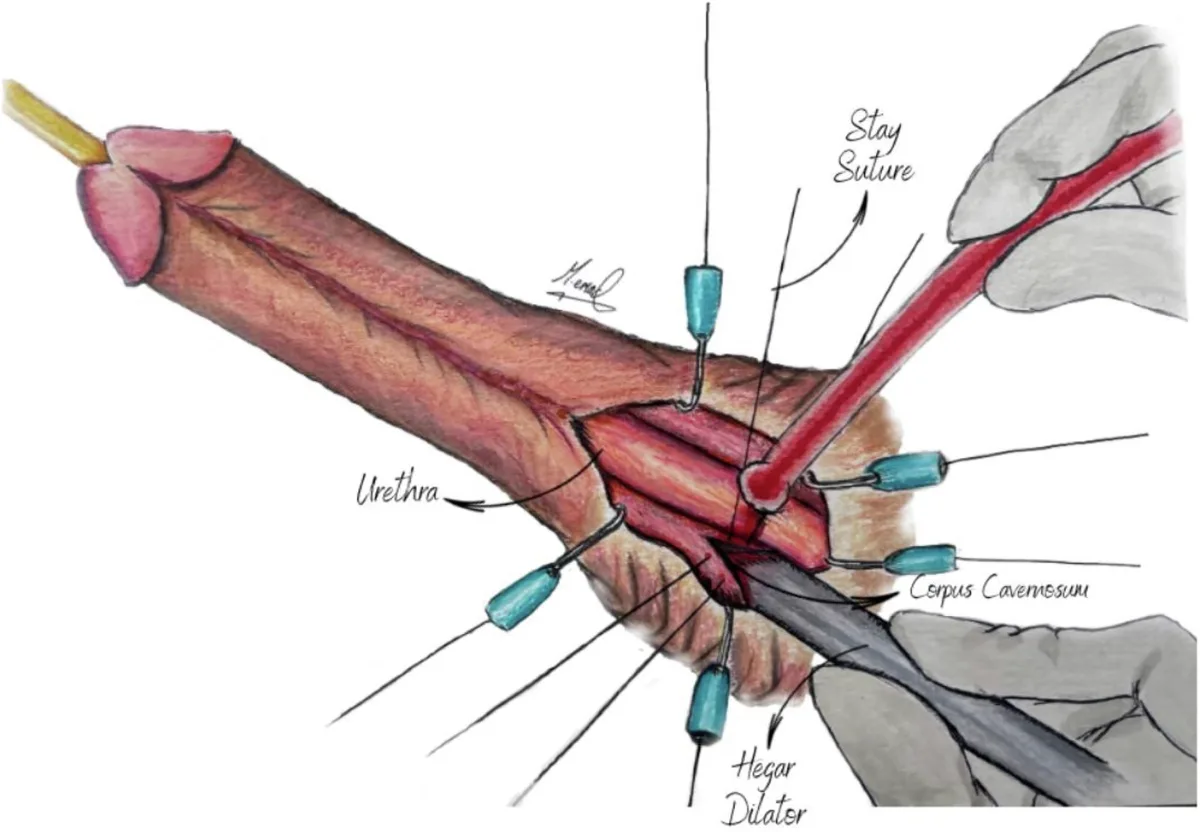
If a distal opening alone does not sufficiently decompress the penis, the surgeon may extend the drainage pathway through the corpus cavernosum.

This is called:

  • Corporal tunneling

  • Snaking

  • Burnett snake maneuver

A dilator or similar instrument is passed proximally through the corporal tissue to facilitate drainage of stagnant blood from deeper portions of the penis.

Is tunneling more effective?

In some severe cases, yes.

Clinical series suggest that distal shunting combined with tunneling can produce higher immediate detumescence rates than a distal shunt alone.

However, tunneling involves greater corporal manipulation.

It may therefore carry greater risk to erectile function.

It should be used according to clinical necessity rather than routinely.

What is the Burnett snake maneuver?

The Burnett snake maneuver is a form of corporal tunneling used with a distal shunt.

After the distal shunt is created, an instrument is passed proximally through the corpus cavernosum to evacuate stagnant blood and facilitate reperfusion.

This should be a Technique under Priapism Shunt Surgery.

What is an Al-Ghorab shunt?

Al-Ghorab is an open distal corporoglanular shunt.

A small portion of distal tunica albuginea is excised to create a wider communication between the corpora and glans.

It can be used when less invasive distal shunting is inadequate or according to surgeon preference.

What is peno-scrotal decompression?

Peno-scrotal decompression is a newer decompression strategy performed through a penoscrotal approach.

The proximal corpus cavernosum is opened and tunneling can be performed in both directions.

Contemporary studies report promising detumescence rates.

However, evidence remains more limited than for established distal shunting, and it should currently be presented as an alternative specialist Technique rather than the universal standard.

What are proximal shunts?

Proximal shunts create drainage closer to the base of the penis.

Examples include:

  • Quackels shunt

  • Sacher shunt

These procedures are more invasive.

Modern practice usually favors distal procedures first.

What is a Grayhack shunt?

A Grayhack shunt uses a vein, traditionally the saphenous vein, to create venous drainage from the corpus cavernosum.

It is considerably more invasive than contemporary distal shunts.

Potential complications include thrombosis and pulmonary embolism.

It is now rarely used.

How do doctors know whether the shunt worked?

The most immediate sign is loss of corporal rigidity.

The surgeon may also assess:

  • Color and flow of corporal blood

  • Cavernosal blood gases

  • Intracavernosal pressure

  • Clinical penile examination

Penile Doppler immediately after decompression may be difficult to interpret because temporary reactive hyperemia can occur.

Does detumescence mean erectile function will recover?

Not necessarily.

Successful decompression and preservation of erectile function are two different outcomes.

A shunt can successfully relieve the erection but the erectile tissue may already have suffered irreversible ischemic damage.

The strongest predictor is the duration of ischemia before treatment.

How does duration affect erectile function?

When ischemic priapism is treated relatively early, erectile recovery can be good.

As duration increases, smooth-muscle injury and fibrosis become progressively more likely.

European guidance reports that when ischemic priapism resolves within approximately 24 hours, published series have described spontaneous functional erection recovery in roughly 78–100% of patients, sometimes with PDE5 inhibitor support.

Once duration exceeds approximately 36–48 hours, erectile dysfunction becomes much more common and may exceed 90% in some series.

These figures reflect tissue damage from the priapism itself, not simply damage from shunt surgery.

Why is this distinction important?

A patient may believe:

“My erection worked before the shunt, so the surgery caused my ED.”

But the persistent erection during ischemic priapism is not a healthy erection.

It represents trapped, oxygen-deprived blood.

The longer that state continues, the greater the likelihood that the smooth muscle responsible for future erections has already been permanently damaged.

What happens after 48 hours?

Very prolonged ischemic priapism can cause extensive corporal necrosis.

In these cases:

  • Phenylephrine becomes much less likely to work

  • Shunting can still relieve pressure and pain

  • Erectile-function preservation becomes much less likely

  • Severe fibrosis and penile shortening may follow

Early penile prosthesis implantation may therefore be discussed in selected refractory or delayed cases.

When might penile implant surgery be considered instead?

Penile prosthesis implantation can be considered when there is a high likelihood of irreversible erectile-tissue damage.

Situations may include:

  • Ischemia lasting more than approximately 48 hours

  • Failure of aspiration and medication in a delayed presentation

  • MRI or biopsy evidence of smooth-muscle necrosis

  • Failed shunt surgery

  • Severe refractory priapism

  • Anticipated complete erectile dysfunction

This decision belongs under your separate Penile Implant Surgery Procedure.

Why implant early after prolonged priapism?

Waiting months after extensive ischemic damage can allow severe corporal fibrosis to develop.

That can lead to:

  • Penile shortening

  • Narrow corporal channels

  • Much harder implant surgery

  • Need for cavernotomes

  • Need for corporal reconstruction

  • Increased complication risk

Early prosthesis placement may preserve corporal space in carefully selected patients.

Is priapism caused by erectile-dysfunction injections?

It can be.

Intracavernosal drugs such as:

  • Alprostadil

  • Papaverine

  • Phentolamine combinations

can occasionally produce prolonged ischemic erections.

A patient using injection therapy should receive clear instructions about when an erection becomes an emergency.

Can medications cause priapism?

Yes.

Potential medication associations include selected:

  • Erectile-dysfunction drugs

  • Antipsychotics

  • Antidepressants

  • Alpha blockers

  • Recreational substances

Not every case has an identifiable cause.

What about sickle cell disease?

Sickle cell disease is an important cause of recurrent and acute ischemic priapism.

The penile emergency must still be treated promptly.

Systemic sickle-cell management should occur alongside urological treatment but should not delay decompression of the corpora.

Is high-flow priapism treated with a shunt?

Usually not.

Non-ischemic or high-flow priapism commonly occurs after trauma causing an abnormal arterial fistula.

The penis is usually:

  • Less rigid

  • Less painful

Because tissue ischemia is not the central problem, management differs.

Selective arterial embolization is a more typical interventional treatment when conservative management fails.

Why correct classification matters

Performing the wrong treatment for the wrong type of priapism can expose the patient to unnecessary risk.

Evaluation may include:

  • History

  • Physical examination

  • Cavernosal blood gas

  • Penile Doppler ultrasound

Cavernosal blood gases are particularly valuable when the diagnosis is uncertain.

Why surgeon experience matters

Emergency priapism surgery requires the surgeon to make rapid decisions about:

  • When nonsurgical therapy has failed

  • Which distal shunt to use

  • Whether bilateral shunting is needed

  • Whether tunneling is required

  • Whether more invasive decompression is appropriate

  • Whether the episode is so prolonged that penile prosthesis should be discussed instead

Complex delayed cases are particularly appropriate for prosthetic and reconstructive urology expertise.

Outcomes
“In a contemporary series, distal corporoglanular shunting combined with the Burnett snake maneuver achieved resolution after a single surgical intervention in 92.3% of patients, compared with 53.6% after distal shunting alone.”

Implant types and devices

There are three types of penile implant. They differ in how natural they feel, how they are used, and what they cost. Below each type are the specific device models a surgeon may propose — every proposal we send names the exact make and model.

Ebbehoj distal shunt

The Ebbehoj distal shunt is a percutaneous corporoglanular surgical technique used to decompress refractory acute ischemic priapism after aspiration and intracavernosal sympathomimetic therapy have failed. A scalpel is passed through the glans into the distal corpus cavernosum to create a drainage incision that allows trapped ischemic blood to escape into the glanular circulation. The technique is less invasive than open distal shunts such as Al-Ghorab but generally creates a larger channel than a needle-based Winter shunt.

Advantages
  • +Less invasive than an open distal shunt : The procedure can be performed percutaneously without formal exposure and excision of distal tunica albuginea.
  • +Creates a larger tract than a needle puncture : The scalpel incision may provide more drainage than the small channel created by a Winter shunt.
  • +Technically straightforward : The basic principle involves a limited distal scalpel incision rather than extensive penile or perineal dissection.
  • +Can be performed unilaterally : A single corpus can be treated first and the response assessed before additional surgery is considered.
  • +Can be performed bilaterally : A second distal tract can be created when drainage from one side is insufficient.
  • +Avoids proximal dissection : Successful distal decompression can avoid the need for more invasive proximal shunts.
  • +No permanent implant required : The technique uses native tissue and does not leave a synthetic shunt device.
Trade-offs
  • More traumatic than a needle-based Winter shunt : Use of a scalpel creates a larger tissue incision than a biopsy needle puncture.
  • Smaller drainage pathway than some open distal techniques : The tract may still be insufficient in severe cases with extensive clot or prolonged ischemia.
  • Risk of glanular injury : Bleeding, edema, bruising, hematoma, infection, and wound-related complications can occur.
  • Risk of urethral injury : Incorrect blade placement can injure the adjacent urethra or corpus spongiosum.
  • The tract can close or thrombose : Clot and tissue swelling may obstruct the drainage pathway.
  • May not decompress the proximal corpora adequately : A patent distal tract cannot guarantee that thick or coagulated blood from the proximal penis will reach the opening.
  • May require escalation : Persistent ischemia can require bilateral shunting, a larger distal shunt, or corporal tunneling.
  • Erectile dysfunction may persist : The procedure cannot reverse irreversible cavernosal smooth-muscle damage caused by prolonged ischemia.

Proximal corporospongiosal shunt

A proximal corporospongiosal shunt is a surgical decompression technique used historically for refractory ischemic priapism after less invasive treatments have failed. It creates a communication between the proximal corpus cavernosum and the corpus spongiosum, allowing trapped, deoxygenated cavernosal blood to drain through the spongiosal circulation. The Quackels shunt is the best-known named proximal corporospongiosal technique, but this approach is now rarely used because distal shunting, corporal tunneling, and other contemporary strategies are generally preferred.

Advantages
  • +Provides an alternative proximal drainage pathway : The technique can decompress the corpora through the proximal penile anatomy when conventional drainage has been unsuccessful.
  • +Direct corporospongiosal communication : The shunt allows blood trapped within the corpus cavernosum to drain into the comparatively lower-pressure spongiosal circulation.
  • +Historically useful for refractory cases : Proximal corporospongiosal shunting provided an additional surgical option when medical treatment and distal shunting failed.
  • +Does not require vein harvesting : Unlike the Grayhack technique, a proximal corporospongiosal shunt does not require mobilization of the great saphenous vein.
  • +No permanent synthetic implant : The drainage pathway is constructed using the patient's existing corporal and spongiosal tissues.
Trade-offs
  • More invasive than distal shunting : The technique requires proximal surgical exposure and deeper dissection than most distal corporoglanular procedures.
  • Risk of urethral injury : Because the urethra runs within the corpus spongiosum, it can potentially be injured during creation of the shunt.
  • Risk of urethrocavernous fistula : Damage involving the urethra can create an abnormal communication between the urinary tract and corpus cavernosum.
  • Risk of infection and cavernositis : Extensive tissue manipulation and proximity to the urinary tract can increase the potential for serious infection.
  • Bleeding and hematoma : Dissection involving vascular erectile tissues can result in operative or postoperative bleeding and hematoma formation.
  • Technically demanding : The anatomy and proximity of the urethra require careful surgical exposure and controlled dissection.
  • Erectile dysfunction may persist : Patients requiring proximal shunting frequently have prolonged ischemic injury and may remain at substantial risk of erectile dysfunction despite successful detumescence.
  • Rarely used in contemporary practice : Distal shunting, corporal tunneling, other decompression approaches, and penile prosthesis strategies have substantially reduced the need for traditional proximal corporospongiosal shunting.

Winter distal shunt

Winter distal shunt is a minimally invasive percutaneous surgical technique used to relieve acute ischemic priapism when aspiration, irrigation, and intracavernosal medication have failed. The technique creates one or more small channels between the corpora cavernosa and the glans penis using a large-bore biopsy needle, allowing trapped, deoxygenated blood to drain and reducing pressure within the erectile tissue.

Advantages
  • +Minimally invasive : The shunt can be created percutaneously through the glans without the larger surgical exposure required for an open distal shunt.
  • +Technically straightforward : The basic technique is comparatively simple and can be performed rapidly by an appropriately trained urologist.
  • +Provides direct corporal : drainage When successful, the newly created corporoglanular channel allows stagnant ischemic blood to leave the corpora cavernosa and reduces intracavernosal pressure.
  • +Can be performed bilaterally : Drainage channels can be created into both corpora cavernosa when clinically required.
  • +Preserves further treatment options : Failure of a Winter shunt does not necessarily prevent subsequent treatment using a larger distal shunt, corporal tunneling, or another appropriate intervention.
Trade-offs
  • Small drainage channel : The biopsy needle creates a relatively narrow fistula compared with scalpel-based distal shunting techniques.
  • Risk of inadequate drainage : The small opening may not provide sufficient outflow, particularly when blood flow increases following decompression of the ischemic corpora.
  • Risk of premature shunt closure : The needle-created communication can close or become functionally inadequate, potentially resulting in persistent or recurrent rigidity.
  • Lower reported success than some alternative distal shunts : Needle-based Winter shunting may produce less reliable detumescence than larger scalpel-based distal shunting techniques.
  • May require additional surgery : Persistent ischemic priapism can require another distal shunt, corporal tunneling, or another escalation strategy.
  • Cannot reverse established ischemic damage : Successful drainage cannot reverse smooth-muscle necrosis or fibrosis that has already developed during prolonged ischemia.
  • Erectile dysfunction may still occur : Patients with prolonged ischemic priapism remain at significant risk of subsequent erectile dysfunction despite successful decompression.

Grayhack venous shunt

The Grayhack venous shunt is a surgical cavernosaphenous shunting technique used in selected cases of refractory ischemic priapism. It creates a drainage pathway between the corpus cavernosum and the great saphenous vein, allowing trapped ischemic blood to bypass obstructed penile venous outflow. Because the procedure is more invasive and technically demanding than modern distal shunting techniques, it is now rarely used and is generally reserved for exceptional refractory cases.

Advantages
  • +Provides an alternative venous outflow pathway : The technique creates direct drainage from the congested corpus cavernosum into the systemic venous circulation.
  • +Can decompress refractory priapism : Historically, the Grayhack technique has provided an additional surgical option when conventional medical treatment and less invasive shunting have failed.
  • +Creates a relatively substantial drainage pathway : A venous anastomosis can provide a larger outflow route than the small channels created by some percutaneous needle-based shunts.
  • +Uses autologous vascular tissue : The patient's own saphenous vein functions as the conduit rather than requiring a permanent synthetic shunt implant.
  • +May remain an option in exceptional cases : Although rarely performed today, cavernosaphenous shunting remains a possible salvage technique in carefully selected patients with otherwise refractory ischemic priapism.
Trade-offs
  • Highly invasive compared with distal shunting : The procedure requires surgical exposure of both the saphenous vein and corpus cavernosum rather than a simple percutaneous penile approach.
  • Technically demanding : Mobilizing the vein and creating a reliable vascular anastomosis require greater operative expertise than most distal shunting procedures.
  • Additional surgical incision : Saphenous vein mobilization creates a second operative field and introduces additional risks of pain, infection, hematoma, scarring, and wound complications.
  • Risk of thrombosis : Thrombus formation can obstruct the shunt or involve the saphenous and saphenofemoral venous system.
  • Risk of pulmonary embolism : Pulmonary embolism has been reported as a serious complication of Grayhack venous shunting.
  • Potential effect on erectile function : A persistently patent shunt may interfere with normal corporal veno-occlusion, while the prolonged ischemic priapism that usually precedes this procedure itself carries a high risk of erectile dysfunction.
  • Sacrifices or alters a potentially useful vein : Use of the great saphenous vein may affect its availability as a conduit for future vascular procedures, including selected coronary or peripheral vascular bypass operations.
  • Rarely required in modern practice : Modern distal shunts, corporal tunneling, penoscrotal decompression techniques, and penile prosthesis strategies have substantially reduced the circumstances in which a Grayhack shunt is considered.

Quackels shunt

The Quackels shunt is a proximal corporospongiosal surgical technique used historically for refractory ischemic priapism when medical treatment and distal shunting have failed. It creates a communication between the proximal corpus cavernosum and corpus spongiosum, allowing trapped ischemic blood to drain through the spongiosal circulation. Because it is more invasive and carries risks including urethral injury, cavernositis, fistula formation, and erectile dysfunction, it is rarely used in contemporary priapism management.

Advantages
  • +Provides proximal corporal decompression : The technique creates an alternative drainage pathway at the proximal corpora when other methods have failed to achieve adequate detumescence.
  • +Creates direct corporospongiosal drainage : Stagnant blood can move from the high-pressure corpus cavernosum into the better-drained corpus spongiosum.
  • +Historically useful after failed distal shunting : The Quackels procedure provided an additional surgical option for severe cases that remained refractory after less invasive interventions.
  • +Does not require a vascular graft : Unlike a Grayhack cavernosaphenous shunt, the technique does not require mobilization of the great saphenous vein.
  • +No permanent implant is required :The drainage pathway is created using the patient's existing corporal and spongiosal tissues rather than a synthetic shunt device.
Trade-offs
  • More invasive than distal shunting : The Quackels procedure requires proximal surgical exposure and substantially more tissue dissection than percutaneous distal techniques.
  • Risk of urethral injury : The urethra lies within the corpus spongiosum and can be damaged during creation of the corporospongiosal communication.
  • Risk of urethrocavernous fistula : An abnormal communication involving the urethra and corpus cavernosum can occur following injury or breakdown of tissues surrounding the shunt.
  • Risk of infection and cavernositis : More extensive surgical dissection can increase the potential for infection involving the operative site or erectile tissues.
  • Potential bleeding and hematoma : Dissection of highly vascular penile and perineal tissues can result in postoperative bleeding or hematoma.
  • Erectile dysfunction may persist : Patients requiring proximal shunting often have prolonged ischemia and significant cavernosal damage, placing them at substantial risk of subsequent erectile dysfunction.
  • Technically more demanding : Proximal anatomy, urethral proximity, and the need for surgical exposure make the technique more complex than most distal shunts.
  • Rarely used in contemporary practice : Modern distal shunting, corporal tunneling, other decompression techniques, and penile prosthesis strategies have substantially reduced the need for Quackels shunting.

Penoscrotal Decompression

Penoscrotal decompression is a surgical technique used for refractory acute ischemic priapism when aspiration, intracavernosal medication, or other decompression methods have failed. Through a penoscrotal incision, the surgeon directly accesses the corpora cavernosa, creates corporotomies, evacuates stagnant deoxygenated blood, and irrigates the erectile tissue to restore circulation. The technique provides extensive corporal decompression without creating a traditional distal or proximal shunt and has emerged as a contemporary surgical option for selected difficult cases.

Advantages
  • +Direct access to both corpora cavernosa : The penoscrotal approach provides broad surgical access to the paired erectile bodies through a single operative region.
  • +Extensive corporal decompression : Direct corporotomies permit evacuation of stagnant blood without relying on a small distal shunt opening.
  • +Allows thorough corporal irrigation : The surgeon can irrigate the erectile tissue directly to remove deoxygenated blood, clot, and ischemic debris.
  • +Avoids a glanular shunt incision : The technique does not require creation of a corporoglanular fistula through the glans.
  • +Avoids vein harvesting : Unlike the Grayhack shunt, penoscrotal decompression does not require mobilization of the great saphenous vein.
  • +Avoids a proximal corporospongiosal fistula : The technique does not require surgical connection of the corpus cavernosum to the corpus spongiosum near the urethra.
  • +Provides direct assessment of corporal tissue : Open exposure allows the surgeon to observe the corpora and the character of blood flow during decompression.
  • +Useful in selected refractory cases : It provides an additional surgical strategy when aspiration, medication, or conventional decompression techniques have failed or are insufficient.
Trade-offs
  • Requires open surgery : The technique involves a formal penoscrotal incision and direct corporal exposure, making it more invasive than aspiration or percutaneous shunting.
  • Risk of bleeding : Corporotomies involve highly vascular erectile tissue and can produce significant operative or postoperative bleeding.
  • Risk of hematoma : Blood can collect within penile or scrotal tissues following surgery, causing swelling and discomfort.
  • Risk of infection : Open exposure of the corpora introduces the possibility of wound infection, cavernositis, or deeper tissue infection.
  • Risk of corporal scarring : Surgical opening and closure of the tunica albuginea can contribute to local scar formation.
  • Postoperative pain and swelling : Penoscrotal surgery may cause temporary penile and scrotal discomfort, edema, and bruising.
  • Erectile dysfunction may persist : Successful decompression cannot reverse irreversible cavernosal smooth-muscle injury caused by prolonged ischemia.
  • Requires specialist surgical experience : Appropriate exposure, bilateral corporal decompression, irrigation, hemostasis, and reconstruction require familiarity with penile surgical anatomy.

Corporal tunneling

Corporal tunneling is a surgical decompression technique used for persistent acute ischemic priapism after a distal corporoglanular shunt has failed to achieve adequate detumescence. A dilator or similar instrument is passed proximally through the corpus cavernosum from an existing distal shunt opening to disrupt stagnant clot, create a drainage tract, and allow ischemic blood from the proximal corpora to evacuate. The technique is also known as tunneling, snaking, or the corporal snake maneuver and is used as an adjunct to distal shunting rather than as a separate vascular shunt.

Advantages
  • +Improves drainage from the proximal corpora : Tunneling extends decompression beyond the distal shunt and helps evacuate blood retained in the proximal erectile tissue.
  • +Useful after distal shunt failure : The technique provides an established escalation option when a distal corporoglanular shunt alone does not achieve adequate detumescence.
  • +Disrupts stagnant blood and clot : Mechanical passage of a dilator can break up ischemic coagulum that may otherwise prevent effective drainage.
  • +Avoids a traditional proximal vascular shunt : Proximal decompression can be achieved without creating a Quackels corporospongiosal or Grayhack cavernosaphenous shunt.
  • +Can be performed bilaterally : Both corpora cavernosa can be tunneled when required to obtain adequate decompression.
  • +Compatible with established distal techniques : Tunneling can be combined with T-shunt or Al-Ghorab-type distal procedures.
  • +Provides extensive corporal decompression :The longitudinal tract can connect proximal areas of stagnant blood with the distal exit pathway.
Trade-offs
  • Requires surgical distal access : Tunneling is usually performed through an existing distal corporoglanular shunt and therefore requires operative access through the glans.
  • Risk of urethral injury : Incorrect advancement of the dilator can potentially damage the adjacent urethra.
  • Risk of corporal perforation : The instrument can leave the corporal body if it is advanced in an incorrect direction.
  • Bleeding and hematoma : Mechanical disruption of vascular erectile tissue can cause bleeding, bruising, and postoperative hematoma.
  • Risk of tissue trauma and fibrosis : Passing a dilator through the corpora can injure erectile tissue and may contribute to subsequent scarring.
  • Shunt-related complications remain possible : Because tunneling is usually combined with a distal shunt, complications such as infection, glanular injury, necrosis, or fistula formation can still occur.
  • Erectile dysfunction may persist : Tunneling cannot reverse irreversible cavernosal smooth-muscle necrosis caused by prolonged ischemia.
  • Evidence remains limited : Most published evidence consists of retrospective or observational series rather than randomized comparative trials.

Burnett Snake Maneuver

The Burnett snake maneuver is a surgical corporal tunneling technique used for refractory acute ischemic priapism when distal shunting alone does not provide adequate decompression. Through a distal corporoglanular opening, a blunt dilator is advanced proximally through the corpus cavernosum to disrupt stagnant blood and clot, create a longitudinal drainage tract, and improve evacuation through the distal shunt. It is most closely associated with a modification of the Al-Ghorab shunt and is also described as corporal tunneling or snaking.

Advantages
  • +Extends distal shunt drainage proximally : The technique creates a longitudinal tract that connects stagnant proximal cavernosal blood with the distal shunt opening.
  • +Useful after inadequate distal shunting : It provides an escalation option when a distal corporoglanular shunt alone does not produce sufficient detumescence.
  • +Disrupts stagnant blood and clot : Mechanical passage of the dilator helps break up thickened or partially coagulated blood within the corpora.
  • +Can achieve extensive corporal decompression : The maneuver addresses more of the corporal length than a distal opening alone.
  • +May avoid traditional proximal shunting : Proximal drainage can be improved without creating a Quackels or Grayhack shunt.
  • +Can be performed bilaterally : Both corpora can be tunneled when clinically necessary.
  • +No permanent implant required : The drainage tract is created through the patient's own erectile tissue without a synthetic shunt device.
Trade-offs
  • Requires surgical distal access : The maneuver is typically performed through an existing distal shunt and therefore requires an operative opening through or near the glans.
  • Risk of urethral injury : Incorrect instrument direction can damage the urethra or corpus spongiosum.
  • Risk of corporal perforation : The dilator can exit the corpus cavernosum if advanced along an incorrect plane.
  • Bleeding and hematoma : Mechanical tunneling and distal shunting can cause significant bleeding, bruising, or hematoma.
  • Risk of infection : The distal incision and internal corporal manipulation introduce a risk of wound or cavernosal infection.
  • Potential corporal trauma and fibrosis : Passing a dilator through erectile tissue intentionally disrupts the corporal spaces and may contribute to scarring.
  • Shunt-related complications remain possible : Complications associated with the underlying distal shunt, including glanular injury, necrosis, fistula formation, and wound problems, can still occur.
  • Erectile dysfunction may persist : The maneuver cannot reverse irreversible smooth-muscle damage caused by prolonged ischemia.

Bilateral distal shunt

A bilateral distal shunt is a surgical decompression strategy for refractory acute ischemic priapism in which distal drainage pathways are created on both sides of the penis, connecting each corpus cavernosum with the glans. It may be performed using techniques such as bilateral T-shunts or other distal corporoglanular shunts when unilateral drainage does not achieve adequate detumescence. Bilateral shunting can improve evacuation from both corpora but is more invasive than unilateral treatment and may increase local tissue trauma and glanular complications.

Advantages
  • +Provides drainage from both corpora : Separate distal pathways allow direct decompression of the right and left corpora cavernosa.
  • +Useful when unilateral shunting is insufficient : A contralateral shunt can improve drainage when persistent rigidity remains after treatment of one corpus.
  • +Can be performed using established distal techniques : Bilateral decompression can be achieved with T-shunt, Winter, Ebbehoj, or selected open distal approaches.
  • +Can be combined with corporal tunneling :Tunneling can extend drainage proximally when bilateral distal openings alone are insufficient.
  • +Avoids traditional proximal vascular shunting : Effective bilateral distal decompression may eliminate the need for more invasive Quackels or Grayhack procedures.
  • +No permanent implant required : The technique uses surgically created communications between the corpora and glans without placing a permanent drainage device.
Trade-offs
  • Greater tissue trauma than unilateral shunting : Creating operative pathways on both sides produces more glanular and corporal manipulation than a successful unilateral procedure.
  • Risk of glanular injury : Bilateral distal access can cause edema, bleeding, hematoma, tissue damage, or wound-healing problems involving the glans.
  • Risk of urethral injury : Incorrectly positioned incisions or instruments can damage the nearby urethra, particularly when tunneling is also performed.
  • Risk of bleeding and hematoma : Two operative sites may increase local bleeding compared with a single distal shunt.
  • Risk of infection : Additional surgical openings increase tissue exposure and can contribute to wound or corporal infection.
  • Shunts can thrombose or close : Distal communications may become obstructed by clot or edema, resulting in recurrent or persistent ischemia.
  • May still require corporal tunneling : Bilateral openings cannot guarantee adequate evacuation of stagnant blood from the proximal corpora.
  • Erectile dysfunction may persist : Successful bilateral decompression cannot reverse irreversible cavernosal damage caused by prolonged ischemia.
  • Additional surgery can be unnecessary if ischemia has resolved : Post-treatment edema and hyperemia can resemble persistent rigidity, so continued ischemia should be confirmed before further surgical escalation.

T-shunt with tunneling

T-shunt with tunneling is a surgical decompression technique used for refractory acute ischemic priapism when aspiration, intracavernosal medication, or a distal shunt alone does not provide adequate detumescence. A T-shaped corporoglanular opening is created between the glans and corpus cavernosum, after which a blunt dilator is advanced proximally through the corpus to create a longitudinal drainage tract. The combination provides both a distal exit for ischemic blood and improved drainage from the proximal corpora and is an established escalation technique for persistent ischemic priapism.

Advantages
  • +Combines distal and proximal corporal drainage : The T-shunt provides a distal exit while tunneling creates a pathway from the proximal corpus toward that opening.
  • +Provides more extensive decompression than T-shunt alone : Tunneling can evacuate stagnant blood that cannot adequately reach a distal opening.
  • +Useful after inadequate distal shunting : The technique provides an established escalation option when a distal shunt alone fails to produce adequate detumescence.
  • +Can disrupt stagnant blood and clot : Mechanical tunneling helps break up thickened or partially coagulated cavernosal blood.
  • +Can be performed unilaterally or bilaterally : Treatment can be extended to the contralateral corpus when additional drainage is necessary.
  • +May avoid traditional proximal shunts : Extensive corporal drainage can potentially be achieved without a Quackels or Grayhack procedure.
  • +No permanent implant is required : The procedure creates drainage through surgically modified native tissues without leaving a synthetic shunt device.
Trade-offs
  • More invasive than T-shunt alone : Adding tunneling increases the amount of corporal manipulation and tissue disruption.
  • Risk of urethral injury : Incorrect advancement of the tunneling instrument can damage the nearby urethra.
  • Risk of corporal perforation :The dilator can perforate the tunica albuginea if it leaves the intended intracavernosal path.
  • Risk of glanular injury : Creation of the T-shunt can cause bleeding, edema, hematoma, infection, or other glanular complications.
  • Bleeding and hematoma : Both the distal incision and corporal tunneling can produce bleeding and postoperative hematoma.
  • Potential corporal fibrosis : Mechanical disruption of cavernosal tissue may contribute to postoperative scarring.
  • Risk of infection : Surgical access through the glans and manipulation of the corpora introduce a risk of wound or cavernosal infection.
  • Erectile dysfunction may persist : The procedure cannot reverse irreversible cavernosal smooth-muscle necrosis caused by prolonged ischemia.
  • May still fail to achieve adequate decompression : Severe edema, extensive clot, shunt closure, or advanced tissue injury can result in persistent ischemia despite tunneling.

Al-Ghorab shunt

The Al-Ghorab shunt is an open distal corporoglanular surgical technique used to decompress refractory acute ischemic priapism when aspiration, intracavernosal sympathomimetic treatment, or less invasive measures have failed. Through an incision in the glans, the surgeon exposes the distal corpus cavernosum and excises a small portion of the tunica albuginea to create a relatively large drainage window between the corpus cavernosum and glanular circulation. The technique can provide more substantial drainage than needle-based distal shunts but is more invasive and carries risks including bleeding, infection, glanular injury, fistula formation, and erectile dysfunction.

Advantages
  • +Creates a relatively large drainage window : Excision of distal tunica albuginea provides a larger corporoglanular communication than small needle-created distal shunts.
  • +Provides direct corporal decompression : The open distal window allows stagnant ischemic blood to drain directly from the corpus cavernosum.
  • +Useful when less invasive drainage is inadequate : The technique can provide more substantial decompression when smaller distal channels fail or are considered insufficient.
  • +Can be performed bilaterally : Both corpora can be directly decompressed when clinically necessary.
  • +Can be combined with corporal tunneling : The distal opening provides access for a Hegar dilator or similar instrument when proximal tunneling is required.
  • +May avoid proximal shunting : Successful distal decompression can eliminate the need for more invasive historical Quackels or Grayhack procedures.
  • +No permanent implant required : The shunt is created entirely using native tissues without a synthetic drainage device.
Trade-offs
  • More invasive than percutaneous distal shunts : The technique requires open glanular exposure and excision of distal tunica albuginea.
  • Risk of glanular injury : Surgery through the glans can cause edema, bleeding, hematoma, wound complications, or tissue damage.
  • Risk of glanular necrosis : Rare severe vascular or wound complications can compromise glanular tissue, particularly after extensive or repeated distal surgery.
  • Risk of urethral injury : Incorrectly positioned dissection can damage the nearby urethra.
  • Bleeding and hematoma : Open manipulation of highly vascular corporal and glanular tissues can produce significant bleeding.
  • Risk of infection : The open incision introduces the possibility of wound infection, cavernositis, or deeper penile infection.
  • The shunt can fail or become obstructed : Persistent clot, edema, or inadequate proximal drainage can result in continued ischemia despite creation of the distal window.
  • May require corporal tunneling : A patent distal window may still be insufficient when stagnant proximal cavernosal blood cannot reach it.
  • Erectile dysfunction may persist : Successful decompression cannot reverse irreversible smooth-muscle necrosis and fibrosis caused by prolonged ischemia.

T-shunt

The T-shunt is a distal corporoglanular surgical technique used to decompress refractory acute ischemic priapism after aspiration and intracavernosal sympathomimetic therapy have failed. A scalpel is passed through the glans into the distal corpus cavernosum and rotated to create a T-shaped communication that allows trapped ischemic blood to drain into the glanular circulation. The procedure may be performed unilaterally or bilaterally and can be extended with corporal tunneling when the distal shunt alone does not provide adequate decompression.

Advantages
  • +Creates a substantial distal drainage pathway : The T-shaped incision can provide greater drainage than a small needle-created tract.
  • +Less extensive than an open Al-Ghorab shun : The technique does not require formal open exposure and excision of a segment of distal tunica albuginea.
  • +Can be performed unilaterally : Treatment can initially be limited to one corpus when that provides adequate decompression.
  • +Can be extended bilaterally : A contralateral T-shunt can be created when unilateral drainage remains insufficient.
  • +Can be combined with corporal tunneling : The T-shunt provides direct access for proximal tunneling when stagnant blood cannot adequately reach the distal opening.
  • +May avoid proximal shunting : Successful distal decompression, with tunneling when necessary, may eliminate the need for more invasive historical proximal shunts.
  • +No permanent implant required : The procedure uses surgically created native-tissue drainage rather than a synthetic shunt device.
Trade-offs
  • Requires glanular surgical access : The procedure involves passing a scalpel through the glans into the distal corpus cavernosum.
  • Risk of bleeding and hematoma : Opening highly vascular glanular and corporal tissue can result in bleeding, bruising, or hematoma.
  • Risk of glanular injury : Edema, wound problems, infection, tissue injury, and rare severe glanular complications can occur.
  • Risk of urethral injury : Incorrectly positioned scalpel access can damage the adjacent urethra or corpus spongiosum.
  • The shunt can thrombose or close : Clot and tissue swelling may obstruct the drainage pathway and cause persistent or recurrent ischemia.
  • May provide inadequate proximal drainage ; A patent distal shunt may not sufficiently evacuate stagnant blood from the proximal corpus.
  • May require additional tunneling : Persistent ischemia can require advancement to T-shunt with corporal tunneling.
  • Erectile dysfunction may persist : Successful shunting cannot reverse irreversible cavernosal smooth-muscle damage caused by prolonged ischemia.

Distal corporoglanular shunt

A distal corporoglanular shunt is a surgical decompression technique used for refractory acute ischemic priapism after aspiration and intracavernosal sympathomimetic therapy have failed. The procedure creates a communication between the distal corpus cavernosum and the vascular tissue of the glans, allowing trapped deoxygenated blood to drain and reducing intracavernosal pressure. Distal corporoglanular shunting includes several named techniques, such as Winter, Ebbehoj, T-shunt, and Al-Ghorab, which differ mainly in the size and method of creating the distal drainage pathway.

Advantages
  • +Established surgical approach for refractory ischemic priapism : Distal corporoglanular shunting is a recognized escalation strategy when aspiration and intracavernosal therapy fail.
  • +Uses a favorable anatomical drainage pathway : The procedure connects the ischemic corpora to the relatively well-drained glans.
  • +Multiple technical options are available : Winter, Ebbehoj, T-shunt, and Al-Ghorab techniques allow the size and invasiveness of the opening to be tailored to the clinical situation.
  • +Can be performed unilaterally or bilaterally : Treatment can be expanded if one-sided drainage is insufficient.
  • +Can be combined with corporal tunneling : A distal opening can serve as access for proximal corporal tunneling when additional drainage is necessary.
  • +Generally less invasive than proximal shunting : Distal procedures avoid the perineal or vascular dissection required for Quackels and Grayhack shunts.
  • +No permanent implant is usually required : The drainage pathway is created using native penile tissue.
Trade-offs
  • Requires glanular penetration or surgical exposure : All distal corporoglanular shunts involve manipulation of the glans and distal corpora.
  • Small shunts may close or thrombose : Needle-based and limited-incision tracts can become obstructed by clot or edema.
  • May provide inadequate proximal drainage : A distal opening does not guarantee that stagnant blood from the proximal corpora can reach it.
  • Risk of glanular injury : Bleeding, edema, hematoma, infection, wound complications, and rare tissue necrosis can occur.
  • Risk of urethral injury : Incorrect placement of the surgical tract can damage the adjacent urethra or corpus spongiosum.
  • Bleeding and hematoma : The procedure deliberately opens highly vascular tissue and may cause postoperative hematoma.
  • Risk of infection : The surgical tract can introduce infection into the glans or corpora cavernosa.
  • May require additional tunneling or decompression : Persistent ischemia may continue despite a patent distal shunt.
  • Erectile dysfunction may persist : Successful decompression cannot reverse irreversible cavernosal smooth-muscle necrosis and fibrosis caused by prolonged ischemia.

Who it is for

✓ May be suitable if
  • You have confirmed acute ischemic priapism.
  • The erection has persisted despite corporal aspiration and irrigation.
  • Intracavernosal phenylephrine or appropriate sympathomimetic treatment has failed.
  • The corpora remain rigid and painful.
  • Cavernosal blood gases continue to show ischemia.
  • Emergency decompression is required to restore circulation.
  • A distal shunt is considered appropriate by the treating urologist.
  • You understand that successful detumescence does not guarantee preservation of erectile function.
  • You understand that prolonged ischemia itself can cause permanent erectile dysfunction.
  • You understand that additional tunneling or more extensive surgery may become necessary.
✕ Not suitable if
  • Your condition has not been confirmed as ischemic priapism.
  • You have non-ischemic/high-flow priapism that is more appropriately managed with observation or arterial embolization.
  • Aspiration and intracavernosal medication have not yet been appropriately attempted in an ordinary acute ischemic case.
  • The erection has already completely resolved.
  • Your primary problem is recurrent stuttering priapism between acute episodes rather than an unresolved emergency episode.
  • Severe prolonged ischemia makes immediate penile prosthesis implantation more appropriate after specialist evaluation.
  • You are considering traveling abroad while an acute four-hour-plus painful erection remains untreated.

Preparing for surgery

Record when the erection began as accurately as possible.
Tell the doctor whether the penis has remained completely rigid continuously.
Report the degree of pain.
Report any erectile-dysfunction injections used before the episode.
Provide the exact medication and dose when known.
Report PDE5 inhibitor use.
Report recreational drug use when relevant.
Provide all prescription medications.
Report sickle cell disease or other hematological disorders.
Report previous episodes of priapism.
Report previous priapism shunt procedures.
Report previous penile surgery.
Tell the team about anticoagulant or antiplatelet medications.
Do not delay treatment while waiting for routine medical-tourism documentation.
Cavernosal blood gas testing may be required.
Penile Doppler may be performed when the diagnosis is unclear.
Complete urgent blood tests according to clinical need.
Follow anesthesia instructions once surgery is planned.
Discuss the high risk of erectile dysfunction when priapism has been prolonged.
In very delayed cases, discuss whether penile prosthesis implantation should be considered.

What recovery looks like

Day 0 — Emergency shunt surgery
After nonsurgical decompression has failed, the surgeon creates a shunt between the corpora cavernosa and the glans or another drainage structure. Dark ischemic blood is evacuated until improved drainage and detumescence are achieved. If distal drainage is inadequate, bilateral shunting or corporal tunneling may be necessary. The penis is repeatedly examined to confirm that pathologic rigidity has resolved.
First 24 hours — Monitoring for recurrent rigidity
The penis can remain swollen and partially firm even after successful treatment because of edema and reactive hyperemia. This should not automatically be interpreted as recurrent ischemic priapism. The treating team monitors pain, corporal rigidity, wound bleeding and evidence of renewed ischemia.
Days 2–3 — Early recovery
Penile swelling, tenderness and bruising remain common. The glans can be particularly sensitive after distal shunt procedures. Gentle walking is usually possible. Strenuous exercise, sexual activity and unnecessary manipulation of the penis should be avoided.
Days 4–7 — Wound recovery
Pain and swelling should gradually improve. The shunt incision begins to heal, although temporary irregularity or swelling around the glans may remain. Persistent severe rigidity, increasing pain, fever, wound discharge or darkening of penile skin requires urgent reassessment.
Months 2–6 — Fibrosis and ED follow-up
Patients with prolonged priapism may develop progressive corporal fibrosis, penile shortening or persistent erectile dysfunction. Severe cases should be reviewed by an andrologist or prosthetic urologist because delayed prosthesis implantation becomes technically more difficult as fibrosis advances.

Risks and complications

Persistent priapism
The initial shunt may fail to provide adequate drainage.
Recurrent priapism
The shunt can close prematurely and ischemic rigidity can return.
Need for additional shunting
A second distal shunt or bilateral procedure may be necessary.
Need for tunneling
Persistent corporal congestion may require proximal corporal tunneling.
Erectile dysfunction
ED is an important long-term outcome, particularly after prolonged ischemia. Much of this risk results from the duration of priapism itself rather than the operation alone.
Corporal fibrosis
Ischemic smooth-muscle damage can heal with dense scar formation.
Bleeding
Shunt incisions can bleed.
Hematoma
Blood may collect within penile tissues.
Infection
Surgical wound or corporal infection is possible.
Cavernositis
Inflammation or infection of the corpora can occur.
Urethral injury
Tunneling or more extensive procedures can rarely injure the urethra.
Urethro-cavernous fistula
An abnormal communication with the urethra can rarely develop.
Persistent shunt fistula
The drainage pathway may remain open longer than intended.
Glans injury
Distal shunts involve surgery through or near the glans.
Glans necrosis
Severe vascular compromise and complex surgery can rarely damage glans tissue.
Penile skin necrosis
Rare tissue ischemia can cause skin loss.
Sensory changes
Temporary or persistent altered glans sensation may occur.
Need for penile prosthesis
Patients with irreversible post-priapism ED may ultimately require penile implant surgery.

Common questions

What is priapism?
Priapism is a prolonged erection that persists without normal sexual stimulation or fails to resolve after stimulation ends.
When is an erection an emergency?
A persistent erection lasting approximately four hours or longer should be treated as a medical emergency, particularly when the penis is painful and fully rigid.
What type of priapism needs shunt surgery?
Shunt surgery is primarily used for ischemic or low-flow priapism.
Is ischemic priapism dangerous?
Yes. It deprives penile erectile tissue of oxygen and can cause irreversible damage.
Is shunt surgery the first treatment?
No. Aspiration, irrigation and intracavernosal sympathomimetic medication are generally attempted first.
When is surgery necessary?
Surgery is considered when appropriate nonsurgical treatment fails to resolve ischemic priapism.
What does the shunt do?
It creates a drainage pathway that allows trapped blood to leave the corpora cavernosa.
What is a distal shunt?
A distal shunt connects the distal corpora cavernosa with the glans to allow drainage.
What is a T-shunt?
It is a distal corporoglanular shunt created with a controlled incision through the glans into the corpus cavernosum.
What is an Al-Ghorab shunt?
It is an open distal shunt involving removal of a small window of distal tunica albuginea.
What is the Burnett snake maneuver?
It is corporal tunneling performed through a distal shunt to improve evacuation of stagnant blood.
Is tunneling always necessary?
No. It is generally used when a distal shunt alone does not provide adequate decompression.
How successful is shunt surgery?
Success in relieving the ischemic erection can be high, but results differ according to technique and priapism duration.
Does successful surgery mean my erections will remain normal?
No. Erectile recovery depends mainly on how long the penis remained ischemic before circulation was restored.
Can I develop erectile dysfunction?
Yes. The risk rises sharply as ischemic duration increases.
What happens if priapism lasts more than 24 hours?
The risk of smooth-muscle injury increases substantially, although erectile recovery can still occur.
What happens after 36–48 hours?
Permanent erectile damage becomes increasingly likely, and published series report very high ED rates after such prolonged episodes.
Can priapism permanently shorten the penis?
Yes. Severe ischemia can cause fibrosis and subsequent penile shortening.
Can I need a penile implant afterward?
Yes. Men with irreversible ED after prolonged ischemic priapism may ultimately need penile prosthesis surgery.
Why might an implant be placed early?
Early implantation can sometimes prevent severe corporal contraction and make prosthesis placement easier before dense fibrosis develops.
Can erectile-dysfunction injections cause priapism?
Yes. Intracavernosal injection medications are a recognized cause.
What should I do if an injection gives me a four-hour erection?
Seek emergency medical care immediately rather than attempting to travel to another country.
Can Viagra cause priapism?
It is possible but uncommon. Many priapism episodes have other causes or multiple contributing factors.
Is priapism common in sickle cell disease?
Sickle cell disease is an important cause of both acute and recurrent ischemic priapism.
Is high-flow priapism also an emergency?
It generally does not cause the same immediate ischemic injury, although it still requires specialist assessment.
How is high-flow priapism treated?
Selective arterial embolization is commonly used when intervention is necessary.
How do doctors determine which type I have?
History, examination, cavernosal blood gases and penile Doppler ultrasound can distinguish ischemic from non-ischemic priapism.
How long does shunt surgery take?
Approximately 30–120 minutes, depending on the required procedure.
How long will I stay in hospital?
Often approximately 1–2 nights, although hospitalization depends on the clinical situation.
Can I fly to Turkey for shunt surgery?
You should not delay treatment to travel internationally during acute ischemic priapism. A painful erection lasting four hours or longer requires immediate local emergency care.
When can I return to work?
After an uncomplicated procedure, light work may be possible within approximately one to two weeks, but recovery varies significantly.
When can I have sex?
Sexual activity should wait until the surgical wound has healed and the treating urologist has assessed recovery.
Which doctor performs priapism shunt surgery?
An emergency urologist or andrologist experienced in priapism, penile surgery and complex prosthetic reconstruction should manage refractory cases.

Patient reviews

Been treated? Your honest review of Priapism Shunt Surgery helps the next patient.

Write a review
No reviews yet

Be the first to share your experience of this procedure. We read and verify every review before it is published.

Write the first review

Sources

  1. Current European guidance covering emergency management of ischemic priapism, aspiration, sympathomimetic injection, distal shunting, tunneling, peno-scrotal decompression and early penile prosthesis implantation. https://uroweb.org/guidelines/sexual-and-reproductive-health/chapter/priapism
  2. Guideline recommending distal corporoglanular shunting, with or without tunneling, after aspiration and intracavernosal phenylephrine fail in acute ischemic priapism. https://www.auanet.org/guidelines-and-quality/guidelines/priapism-guideline
  3. Contemporary comparative series reporting higher single-intervention resolution after distal shunting combined with the Burnett snake maneuver than distal shunting alone. https://pubmed.ncbi.nlm.nih.gov/38971576/
  4. Contemporary study assessing surgical and nonsurgical pathways in prolonged ischemic priapism and complications including fibrosis and penile deformity. https://pubmed.ncbi.nlm.nih.gov/41439680/