
P-Shot for erectile dysfunction
The P-Shot is a trademarked platelet-rich plasma (PRP) injection marketed for erectile dysfunction and penile enhancement. This is genuinely one of the least settled treatments covered on this site: pooled meta-analyses of generic PRP show a modest positive signal over placebo, but a well-designed, double-blind, placebo-controlled trial found no benefit at all, the branded P-Shot protocol itself has no independent peer-reviewed trial testing it directly, and the European Association of Urology currently classifies PRP as experimental, to be used only within clinical trials.
 ✓ Clinician-reviewed information
- The P-Shot is a specific, trademarked commercial protocol for injecting platelet-rich plasma (PRP) — a concentrate prepared from a man's own blood — into the penis, marketed to improve erectile function, sensitivity, and size.
- This is genuinely one of the more evidence-contested treatments in andrology: several meta-analyses pooling multiple trials of generic intracavernosal PRP report statistically significant improvement over placebo, while a separate, well-designed double-blind, randomized, placebo-controlled trial found PRP was not more effective than placebo at all.
- The branded "P-Shot" protocol specifically has no independent, peer-reviewed clinical trial testing the exact commercial method — nearly all published research is on generic PRP injection technique, not verified to match the proprietary preparation and injection process sold under this trademark.
- The European Association of Urology currently classifies PRP as an experimental therapy and recommends its use be restricted to clinical trials, not offered as a standard, evidence-based clinical treatment.
- Because PRP uses a man's own blood, the direct physical risk is low — but given how unsettled the efficacy evidence is, the most significant honest risk for most men is financial and time cost for a benefit that current rigorous evidence cannot yet confirm.
About p-shot for erectile dysfunction
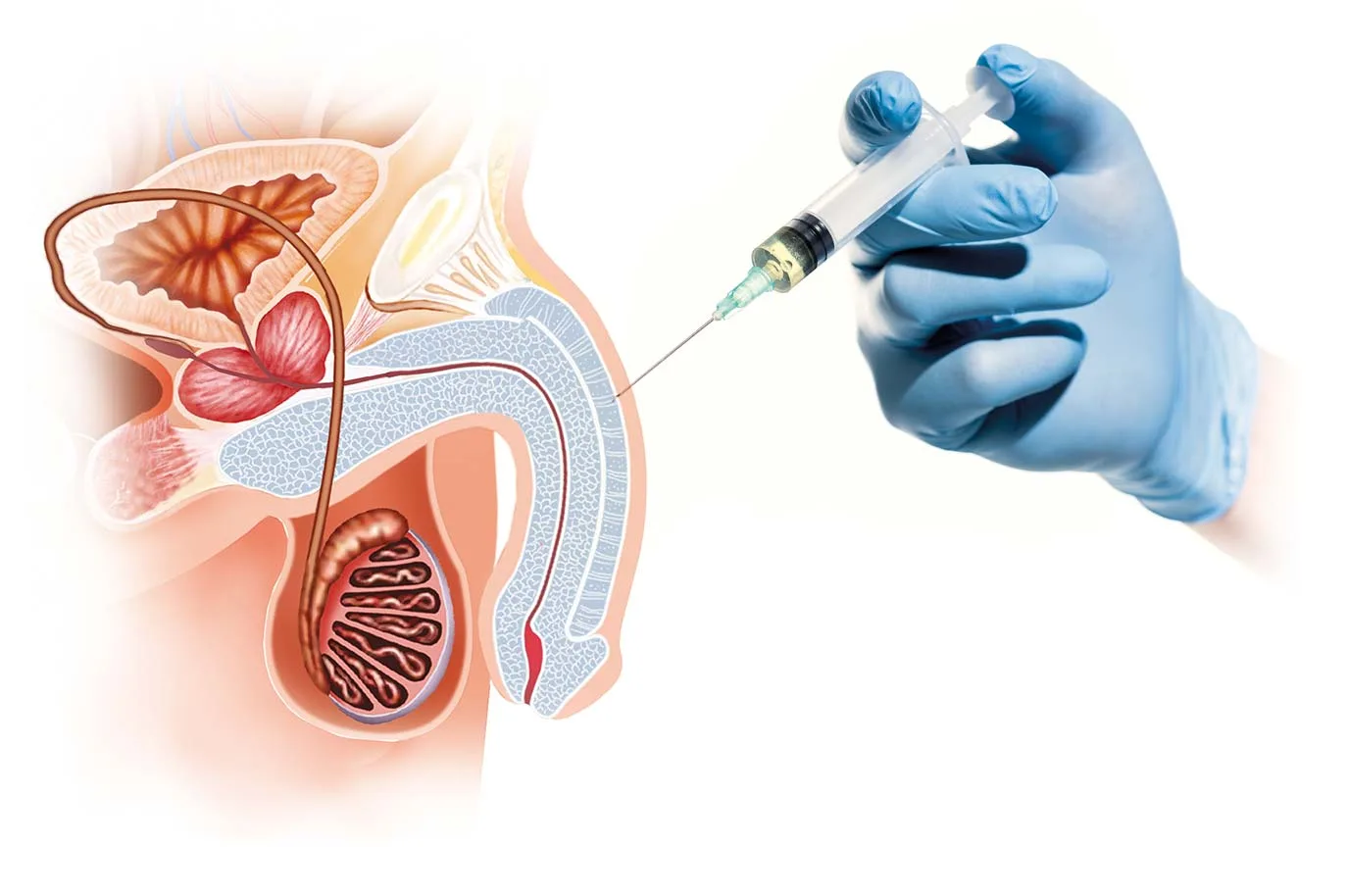
The P-Shot, formally trademarked as the Priapus Shot, is a specific, proprietary commercial protocol for injecting platelet-rich plasma (PRP) into the penis, marketed to men seeking improvement in erectile function, sensitivity, or overall sexual performance. PRP itself is not unique to this product — it's prepared by drawing a small amount of a man's own blood, spinning it in a centrifuge to concentrate the platelets (which contain numerous growth factors involved in tissue repair and, in laboratory studies, blood vessel formation), and then injecting this concentrated plasma into specific areas of the penis. The P-Shot is one particular, branded version of this broader technique, with its own specific, trademarked preparation, activation, and injection process, developed and marketed by a specific physician and company.
Understanding this distinction — between "PRP for ED" as a general medical concept being studied in research, and "the P-Shot" as a specific, trademarked commercial product — is genuinely important, and it's one of the more unusual aspects of writing honestly about this particular treatment. Nearly all of the published, peer-reviewed research discussed below studies generic intracavernosal (or subcutaneous) PRP injection using various preparation methods described in each specific study, not the exact, proprietary P-Shot protocol itself. When PRP research has shown disappointing results, the P-Shot's own trademark holder has specifically argued, in response, that the branded protocol differs meaningfully in its preparation, activation, and injection technique from what was studied — which may or may not be true, but which also means, taken to its logical conclusion, that the specific commercial product being sold under this trademark has essentially no independent, peer-reviewed verification of its own. This is worth understanding clearly before anything else on this page, because it shapes how much weight the research below can actually be given when applied specifically to a P-Shot treatment, as opposed to PRP injection in general.
Turning to the broader body of PRP-for-ED research itself, the picture is genuinely, unusually mixed — more so than for most other treatments covered on this site, including even low-intensity shockwave therapy, which has its own significant evidence-quality caveats. On one side, several recent meta-analyses, pooling data from multiple randomized and single-arm trials, report a statistically significant benefit. A November 2024 meta-analysis combining 12 controlled trials (991 patients) and 11 single-arm trials (377 patients) found the PRP group showed better outcomes on the International Index of Erectile Function (IIEF) score and a measure called the Minimal Clinically Important Difference, concluding that PRP "appears effective" while explicitly calling for further high-quality, larger trials with longer follow-up. A separate systematic review and meta-analysis of randomized controlled trials, published in mid-2024, similarly concluded that PRP "shows more effectiveness in treating ED compared to placebo." A third analysis, using meta-regression across six studies, found PRP intracavernous injection associated with a statistically significant increase in IIEF erectile function domain scores at both one and three months compared with control groups.
On the other side — and this is genuinely important, not a minor footnote — one of the more methodologically rigorous individual studies conducted specifically to test this question directly found the opposite result. A prospective, double-blind, randomized, placebo-controlled trial, presented at the American Urological Association's 2023 Annual Meeting and reported as winning a "best abstract" award at that meeting, concluded plainly that PRP "was not more efficacious than placebo." The study's lead researcher was direct in his framing of this finding, noting that PRP injections for ED are "really popular, but, objectively speaking, so far, we don't have any evidence showing that it actually works" using a properly blinded, placebo-controlled design of this kind. This is a genuinely important, sobering counterpoint to the more positive pooled meta-analyses discussed above, and it's worth understanding why these findings might diverge: the meta-analyses combine studies using considerably varied PRP preparation methods, dosing, activation techniques, and follow-up periods — described in a 2025 narrative review as showing "significant variability" that "hindered" the ability to draw firm, unified conclusions — meaning the pooled positive signal may partly reflect this methodological heterogeneity and the inclusion of weaker, less rigorously controlled studies, rather than a single, dependable, reproducible clinical effect.
Reflecting this genuine, unresolved uncertainty, the European Association of Urology's current guideline position — discussed specifically in the context of Peyronie's disease, but reflecting the same underlying evidence base and general caution that extends to PRP's use in erectile dysfunction — explicitly classifies PRP as an experimental therapy, recommending that its use be restricted to formal clinical trials rather than offered as a standard, evidence-supported clinical treatment outside of that research context. This is a meaningfully more cautious position than exists for, say, low-intensity shockwave therapy, where major guideline bodies at least describe it as an emerging or investigational option worth discussing, rather than something that should currently be restricted to trials only.
It's worth being honest about the proposed mechanism too, separate from the clinical trial evidence. The theoretical rationale for PRP in erectile dysfunction draws on its use in other areas of regenerative medicine, where concentrated platelets are thought to release growth factors that can, in laboratory and some animal studies, promote new blood vessel formation (angiogenesis) and tissue repair — a mechanism with some genuine biological plausibility, not dissimilar in principle to the mechanotransduction theory behind shockwave therapy. But biological plausibility in laboratory settings is a different thing from confirmed, reproducible clinical benefit in men, and this is precisely the gap that the conflicting human trial evidence described above hasn't yet closed.
None of this means PRP or the P-Shot specifically is dangerous, or that no man has ever experienced genuine improvement after having it — some men do report satisfaction with the treatment, and because it uses a man's own blood, the direct physical risk profile is genuinely low, discussed further below. What it does mean, and what this page aims to convey honestly rather than soften, is that this is currently one of the least settled treatments discussed on this site, sitting somewhere between the encouraging-but-uncertain evidence picture for low-intensity shockwave therapy and the more directly discouraged, professional-body-skeptical territory of standalone girth enhancement procedures — closer, if anything, to the latter, given the existence of a directly contradicting, well-designed placebo-controlled trial and an explicit guideline recommendation restricting use to clinical trials only.
Who it is for
- •Men who have already tried and properly assessed first-line treatments (PDE5 inhibitors, and where appropriate, other options such as low-intensity shockwave therapy) and are specifically interested in exploring additional, low-physical-risk options
- •Men specifically interested in participating in a genuine, registered clinical trial studying PRP for ED, where the treatment is being properly evaluated under research conditions
- •Men who understand and accept, going in, that current rigorous evidence — including a directly contradicting placebo-controlled trial and an explicit guideline classification as experimental — means benefit is genuinely uncertain, not modestly likely
- •Men who haven't yet properly trialled well-established, strongly evidence-supported first-line treatments
- •Men seeking a guaranteed or even reliably probable improvement, given how directly the evidence conflicts on whether this treatment outperforms placebo at all
- •Men with bleeding disorders or who are on blood-thinning medication, where any injection procedure carries somewhat elevated risk
- •Men considering this specifically because of confident marketing claims from a provider, without that provider disclosing the genuine uncertainty and conflicting evidence discussed on this page
Preparing for surgery
What recovery looks like
Risks and complications
Common questions
Is the P-Shot the same thing as PRP, or something different?
Does the research actually show this works?
Why do the meta-analyses and the placebo-controlled trial disagree?
If a clinic shows me a study proving PRP works, does that mean the P-Shot specifically works?
Is this treatment approved or regulated the way medications are?
Is it safe, even if we're not sure it works?
Should I try this before or after PDE5 inhibitor tablets like Viagra or Cialis?
How is this different from low-intensity shockwave therapy, which is also described as having uncertain evidence on this site?
Can I ask to see the specific research my clinic is basing their recommendation on?
Is there a way to access this treatment within an actual, monitored clinical trial rather than as a standard paid clinic visit?
Does the P-Shot affect penis size, not just erectile function?
If I've already had this treatment and I'm not sure it helped, what should I do?
Patient reviews
Been treated? Your honest review of P-Shot for erectile dysfunction helps the next patient.
No one has reviewed this yet. If you have been treated, your experience would help the next person.
Write the first reviewSources
- Du S, Sun S, Guo F, Liu H. "Efficacy of platelet-rich plasma in the treatment of erectile dysfunction: A meta-analysis of controlled and single-arm trials." PLOS ONE. 2024. https://www.ncbi.nlm.nih.gov/pmc/articles/PMC11563399/
- "The efficacy of platelet rich plasma in the treatment of erectile dysfunction: a systematic review and meta-analysis of randomized controlled trials." 2024. https://www.tandfonline.com/doi/full/10.1080/13685538.2024.2358944
- Huang H, Qin J, Wen Z, et al. "Efficacy and safety of platelet-rich plasma (PRP) in erectile dysfunction (ED): a systematic review and meta-analysis." Transl Androl Urol. https://tau.amegroups.org/article/view/125002/html
- "Efficacy and safety of platelet-rich plasma intracavernous injection for patients with erectile dysfunction: A systematic review, meta-analysis, and meta-regression." https://www.sciencedirect.com/science/article/pii/S2214388224000018
- Ragheb A, et al. "Intracavernosal platelet-rich plasma therapy for erectile dysfunction: Current evidence and future directions." UroPrecision. 2025. https://onlinelibrary.wiley.com/doi/10.1002/uro2.70004
- "Mixed Results on Two Treatments for Erectile Dysfunction" (reporting on Ledesma et al., AUA 2023 Annual Meeting double-blind placebo-controlled trial). Medscape. https://www.medscape.com/viewarticle/991447
- "Intralesional Platelet-Rich Plasma for Treating Chronic Peyronie's Disease: A Single-Center Retrospective Cohort Study" (discusses EAU guideline classification of PRP as experimental) https://www.ncbi.nlm.nih.gov/pmc/articles/PMC12844030/
- Cleveland Clinic, "Priapus Shot (P-Shot): PRP, How It Works, Benefits & Risks." https://my.clevelandclinic.org/health/treatments/p-shot