
Skip to content
Procedure

Peyronie's disease surgery

Peyronie's disease surgery corrects penile curvature caused by scar tissue, using one of two main approaches — plication (shortening the longer, unscarred side) for milder curvature, or plaque incision or excision with grafting for more severe curvature and hourglass deformity. Both are effective, with published satisfaction rates of 67% for plication and 87–90%+ for grafting, though each carries a genuinely different, honest trade-off between simplicity, length preservation, and erectile function risk.
AnaesthesiaGeneral
Operating time60–180 min
Hospital stay0–1 nights
Days in Türkiye5–10 days
Back to work1-2 Weeks
Peyronie's Disease (Penile Curvature)✓ Clinician-reviewed information
Key takeaways
  • Peyronie's disease surgery isn't one procedure — it's a choice between two fundamentally different techniques with different trade-offs: plication, which shortens the longer side of the penis to match the curved, scarred side, and plaque incision or excision with grafting, which lengthens the shorter, scarred side using a tissue graft.
  • Surgery is only appropriate once the disease has reached its stable phase — typically after curvature has stopped changing and pain has resolved, usually 6 to 12 months after onset — not during the active, still-evolving phase.
  • Plication is simpler and preserves erectile function more reliably (published de novo erectile dysfunction rate of 16% in one large series), but it shortens the penis and isn't suitable for more severe curvature or hourglass deformity.
  • Plaque incision or excision with grafting can correct more severe curvature (typically over 60°) and hourglass deformity without significant additional shortening, but carries a meaningfully higher risk of worsening erectile function (commonly cited at 20–30% in older literature, though more recent specialised-centre series report considerably lower rates).
  • For men with coexisting significant erectile dysfunction, combining curvature correction with a penile implant in the same operation is often the recommended approach, rather than correcting curvature alone and hoping erectile function holds up afterward.

About peyronie's disease surgery

Peyronie's disease surgery refers to a group of surgical techniques used to correct the penile curvature caused by the scar tissue (plaque) that defines the condition. Unlike medical or device-based treatments discussed elsewhere on this site — injections, traction therapy — surgery works by directly and mechanically restoring a straighter shaft, and it's generally considered once the disease has moved past its active phase and either hasn't responded to, or isn't considered appropriate for, non-surgical approaches. Current European Association of Urology guidance, updated in 2025, reflects this staged approach: conservative and minimally invasive treatments first, with surgery reserved for stable, sufficiently bothersome curvature.

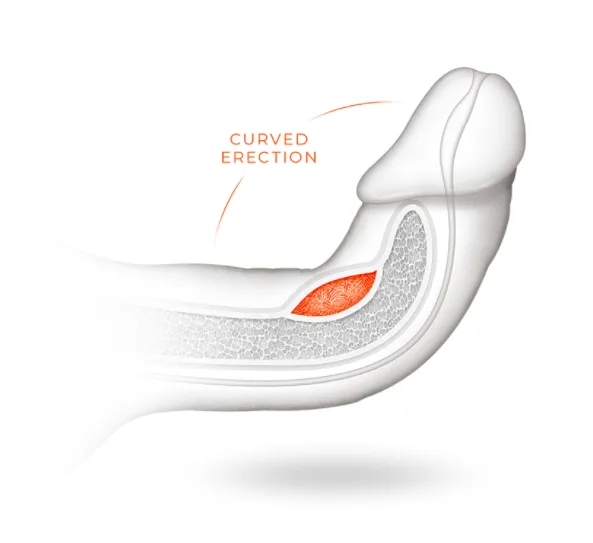
There are two fundamentally different surgical strategies, and understanding the logic behind each is genuinely useful before considering either. Peyronie's disease curves the penis because scar tissue on one side of the shaft (most commonly the top, or dorsal, surface) doesn't stretch the way healthy tissue does during erection, while the opposite side continues to expand normally — the mismatch in expansion is what produces the curve. There are only two ways to correct this mismatch: shorten the longer, unaffected side to match the shorter, scarred side, or lengthen the shorter, scarred side to match the longer one. These two approaches correspond directly to the two surgical techniques used today.

Plication (sometimes called the Nesbit procedure, or tunica albuginea plication) takes the first approach. The surgeon places a series of stitches on the convex (longer, unaffected) side of the penis, opposite the scar tissue, gathering and shortening that side until the two sides are balanced and the penis straightens. This is a comparatively simpler operation that doesn't involve directly touching or grafting over the diseased tissue itself. It's generally reserved for men with mild-to-moderate curvature (commonly under 60–70°), a relatively simple curve pattern (rather than complex, multi-directional curvature), no significant hourglass narrowing, and reasonably preserved erectile function beforehand. The clear, honest trade-off with this technique is length: because it works by shortening the already-longer side, plication further reduces overall penile length — on top of whatever length the disease itself has already taken — which is the single most consistent, most important thing for a man to understand and accept before choosing this option. A recent bicentric retrospective study of 80 men undergoing plication found an overall patient satisfaction rate of 67%, with erectile dysfunction developing in 16% of men afterward and reoperation needed in 12% of cases — genuinely solid, if not universally excellent, figures, and notably, the study found that greater preoperative curvature was actually associated with higher satisfaction after plication, suggesting that men with more visually dramatic curves may feel a proportionally greater sense of improvement once straightened, even accounting for the length trade-off.

Plaque incision or excision with grafting takes the opposite approach. The surgeon makes an incision into (or removes a portion of) the scarred plaque itself on the shorter, concave side of the penis, then covers the resulting defect with a graft — a patch of tissue, either taken from elsewhere in the man's own body (such as a vein, or tissue from inside the cheek, called buccal mucosa) or a processed tissue substitute (such as bovine pericardium or porcine dermal matrix) — which allows that side of the shaft to stretch and lengthen to match the other side. This is a more technically involved operation, but it offers two genuine advantages over plication: it can correct considerably more severe curvature (plaque excision and grafting is generally recommended for curvature greater than 60°, where plication's shortening effect would be too extreme), and it can address hourglass deformity (narrowing of the shaft), which plication cannot correct at all. It's also, when performed well, associated with maintaining rather than further reducing penile length — one of its most genuinely attractive features compared with plication. The honest trade-off here is a meaningfully higher risk to erectile function: because this technique involves opening or removing part of the tunica albuginea (the fibrous sheath that gives the erectile chambers their structural integrity) and grafting over the defect, there's a real risk of the graft not integrating perfectly, of scarring within the graft itself, or of changes to blood flow within the erectile tissue, any of which can worsen erectile function. Older literature commonly cites a 20–30% risk of new or worsened erectile dysfunction with plaque excision and grafting, which is precisely why this procedure has traditionally been offered specifically to men with strong, reliable erections beforehand, and why some surgeons are cautious about recommending it in men whose pre-operative erectile function is already borderline.

It's genuinely encouraging that more recent, specialised-centre data on grafting techniques looks considerably better than these older, more cautious historical figures. A prospective study using buccal mucosa graft (tissue taken from inside the cheek, chosen partly because it's naturally moist, elastic, and well-tolerated by the body) in 22 men with stable-phase Peyronie's disease and significant curvature (median 45°) found a 95% success rate at 3 months and 90% at 24 months, with no cases of new erectile dysfunction at all, and — notably — actual improvement in IIEF-5 erectile function scores over the follow-up period, alongside no significant penile shortening. A large, 15-year experience series from a high-volume andrology centre, following 293 men who underwent plaque incision and grafting, found an overall satisfaction rate of 87.0%, with 90.1% of men successfully resuming penetrative intercourse afterward; perceived length reduction was reported by 29.4% of men (a subjective, not necessarily objectively measured, finding) and hypoaesthesia (reduced sensation) by 15.4%. These are genuinely strong, real-world results from experienced centres, and they illustrate something worth understanding honestly: outcomes for this specific surgery are meaningfully tied to surgeon and centre experience, graft material choice, and precise patient selection, more so than for some more standardised procedures.

A newer, related technique worth knowing about is the "grid incision" approach, where multiple small, shallow incisions are made across the plaque (rather than one larger incision or full excision) and then sealed with a collagen fleece material, aiming to correct curvature while minimising the size of the tunical defect that needs to heal or be grafted over — a 3-year prospective study of 34 men using this modified technique reported encouraging outcomes, reflecting ongoing refinement in this specific area of surgical technique.

A critical, separate scenario deserves its own honest discussion: men who have both significant curvature and significant, coexisting erectile dysfunction that isn't likely to respond well to curvature correction alone. In this situation, current expert guidance and published research both point towards combining curvature correction with penile implant placement in the same operation, rather than correcting the curvature first and hoping erectile function holds up afterward, or worse, correcting curvature only to discover erectile function isn't adequate and needing a second, separate operation later. Research specifically notes that plaque excision and grafting is generally recommended for men with curvature over 60° and strong preoperative erections, while placement of an inflatable penile implant is recommended when erectile rigidity is already suboptimal — though it's honestly noted in the literature that some men, when counselled towards an implant, decline and choose plaque excision and grafting alone regardless, out of personal preference or a wish to avoid an implant, a choice that deserves to be respected once the relevant risks and trade-offs have been thoroughly and honestly explained.

Timing matters considerably for any Peyronie's disease surgery, and this is a point worth being genuinely firm about. Surgery is only appropriate once the disease has reached its stable phase — meaning curvature has stopped changing and any pain has resolved, generally taking somewhere between six months and a year from the onset of symptoms. Operating during the active, still-evolving phase risks correcting a curve that hasn't finished changing, potentially requiring a second operation once the disease truly stabilises. This is why most specialists recommend a defined period of watchful waiting, often alongside non-surgical treatments such as traction therapy or intralesional injections, before surgery is even considered.

Outcomes
In a 15-year experience series from a high-volume andrology centre following 293 men who underwent plaque incision and grafting for Peyronie's disease, overall satisfaction was 87.0%, with 90.1% of men successfully resuming penetrative intercourse afterward.
Source: nature.com

Implant types and devices

There are three types of penile implant. They differ in how natural they feel, how they are used, and what they cost. Below each type are the specific device models a surgeon may propose — every proposal we send names the exact make and model.

Nesbit procedure

Excision of a wedge on the convex side to straighten the curve.

Advantages
  • +Durable, well-studied result
Trade-offs
  • Shortens the penis
  • Not suitable for severe curvature

Plication

Sutures placed on the convex side to counteract the curve.

Advantages
  • +Simpler than grafting
  • +Preserves erectile function
Trade-offs
  • Shortens the penis
  • Sutures can be palpable

Grafting

Plaque incision with a graft placed to fill the defect.

Advantages
  • +Preserves length
  • +Handles severe curvature
Trade-offs
  • Higher risk of erectile dysfunction
  • Longer recovery

Who it is for

✓ May be suitable if
  • Men with mild-to-moderate curvature (commonly under 60–70°) and a simple, single-direction curve pattern
  • Men with reasonably preserved, reliable erectile function beforehand
  • Men without significant hourglass narrowing
  • Men who understand and accept that this technique will further reduce penile length, on top of any length already lost to the disease
  • Men with more severe curvature (typically over 60°) or complex, multi-directional curvature
  • Men with hourglass deformity (narrowing) alongside curvature
  • Men with strong, reliable preoperative erectile function, given the higher risk to erectile function with this technique
  • Men who specifically want to avoid further length reduction and are willing to accept the somewhat higher risk to erectile function as a trade-off
✕ Not suitable if
  • Men still in the active (unstable) phase of Peyronie's disease, where curvature or pain is still changing
  • Men who haven't yet properly trialled or been assessed for non-surgical options (traction therapy, intralesional injections), where appropriate for their specific severity and phase

Preparing for surgery

Confirm your Peyronie's disease has genuinely reached the stable phase (curvature and pain no longer changing), typically requiring at least six to twelve months since onset, before proceeding with surgery
Have a thorough discussion with your surgeon about which technique — plication or grafting — is being recommended and why, based specifically on your curvature severity, pattern, and preoperative erectile function
If erectile function is already a significant concern, discuss directly whether combining curvature correction with a penile implant in the same operation is more appropriate than correcting curvature alone
Have your erectile function properly assessed beforehand (including, where relevant, vascular testing), since this is one of the strongest predictors of how well you'll tolerate either surgical approach
Take clear, well-lit photographs of your erect curvature beforehand if not already done, since this is often part of standard pre-operative documentation and planning
Arrange appropriate time off work and abstain from sexual activity and strenuous exercise for the recommended post-operative period

What recovery looks like

Day of surgery – Day 1
Most men go home the same day or after one night. Swelling, bruising, and discomfort in the surgical area are expected and managed with pain relief.
Week 1
Rest and limited activity are advised. A follow-up wound check is typically scheduled during this period.
Weeks 1–2
Gradual return to desk-based work and light daily activity for most men, with continued swelling settling over this time.
Weeks 2–6
Continued healing of the surgical repair. Strenuous activity, heavy lifting, and sexual activity remain restricted during this period, since premature mechanical stress on a healing plication or graft can genuinely compromise the result.
Weeks 6–8
Most surgeons permit a gradual return to sexual activity around this point, once healing is confirmed at follow-up, though this timeline should always be individually confirmed rather than assumed.
Months 3–24
Published outcome data, including the large 15-year series and buccal mucosa graft study cited above, formally assesses satisfaction, curvature correction, and erectile function at these longer intervals, reflecting that final, settled results and any late complications are best judged over this extended window, not just in the first few weeks.

Risks and complications

General risks:
Infection Haematoma Persistent or new penile pain Recurrence of curvature over time General risks associated with anaesthesia and surgery
More specific to plication:
Further reduction in penile length, beyond any already caused by the disease itself — the most consistent, expected trade-off of this technique, not an unusual complication Palpable suture knots beneath the skin, sometimes requiring reassurance or, rarely, further attention New or worsened erectile dysfunction (reported at 16% in one recent series)
New or worsened erectile dysfunction
historically cited at 20–30% in older literature, though more recent specialised-centre and buccal mucosa graft series report considerably lower rates
Reduced penile sensation (hypoaesthesia)
, reported at around 15% in one large series Perceived penile length reduction, reported by around 29% of men in one large series, despite the technique being designed to preserve length

Common questions

How do I know which technique — plication or grafting — is right for me?
This depends primarily on your curvature severity and pattern, whether hourglass narrowing is present, and how strong and reliable your erections are beforehand. As a general guide, milder, simple curvature with good erectile function favours plication; more severe curvature, hourglass deformity, or a strong wish to avoid further shortening favours grafting — but this is ultimately a specific, individual decision to make with your surgeon based on a full assessment.
Will I definitely lose length with plication?
Yes, this should be understood as an expected, near-certain outcome of the technique itself, not a possible complication — plication works specifically by shortening the longer side of the penis to match the shorter, scarred side, so some additional length reduction is inherent to how the procedure achieves straightening.
Does grafting really avoid the length loss that plication causes?
Generally, yes, and this is one of grafting's genuine advantages — published data specifically notes no significant additional shortening with plaque excision and grafting when performed well, since the technique lengthens the shorter side rather than shortening the longer one. Some men still report a perceived reduction in length afterward, though this is thought to relate to overall changes from the disease and psychological perception rather than the surgical technique itself removing length.
Is my risk of erectile dysfunction really that different between the two techniques?
Published data does suggest a meaningfully lower rate of new erectile dysfunction with plication (around 16% in one recent series) compared with plaque excision and grafting (historically 20–30%, though more recent series report lower rates with modern technique and careful patient selection). This is a genuine, important difference to weigh honestly against the length-preservation advantage of grafting.
How long do I need to wait after my Peyronie's disease starts before surgery is even an option?
Surgery is generally only considered once the disease reaches its stable phase, meaning curvature and pain have stopped changing — typically six to twelve months from the onset of symptoms. Operating earlier, during the active phase, risks correcting a curve that hasn't finished evolving.
What happens if I also have erectile dysfunction — do I need two separate operations?
Not necessarily, and in fact combining curvature correction with penile implant placement in the same operation is generally the recommended approach for men with significant coexisting erectile dysfunction, rather than treating the curvature first and addressing erectile function separately later. This is a specific conversation to have directly with your surgeon if this applies to you.
Can I choose plaque excision and grafting even if my surgeon recommends an implant instead?
This is a genuine, documented pattern in the literature — some men counselled towards an implant, due to suboptimal preoperative erectile function, decline and choose to proceed with plaque excision and grafting alone regardless, out of personal preference. This is your decision to make once you've been given a full, honest explanation of the relevant risks, though it's worth understanding that outcomes in this specific situation may be less predictable than in men with strong preoperative erections.
What graft material is used, and does it matter which one?
Graft options include the man's own tissue (such as buccal mucosa, taken from inside the cheek, or vein) or processed tissue substitutes (such as bovine pericardium or porcine dermal matrix), and comparative studies have looked at differences in long-term outcomes between graft types. This is a reasonable, specific question to ask your surgeon about their preferred material and why, based on your particular case.
Will the curvature come back after surgery?
Recurrence is a recognised possibility with either technique, though it's not the most commonly reported outcome in published series — most men who achieve successful correction maintain it over the following years. Persistent or new curvature after surgery deserves its own proper evaluation rather than being assumed to be a typical or expected outcome.
Is surgery painful, and how long does recovery really take?
Some discomfort, swelling, and bruising are expected in the first one to two weeks, generally well managed with standard pain relief, with most men returning to light activity within this window. Full healing sufficient for a return to sexual activity typically takes six to eight weeks, and this should always be confirmed individually with your surgeon rather than assumed.
Can I have non-surgical treatment first and still have surgery later if it doesn't work?
Yes — this is, in fact, the generally recommended approach. Non-surgical options such as intralesional injections or traction therapy are typically tried first, particularly during or shortly after the active phase, with surgery reserved for men whose curvature remains significant and bothersome once the disease has stabilised and non-surgical options haven't been sufficient.
Does the surgeon's experience really make a big difference to my outcome?
Yes, genuinely — the strongest published outcome data (including the 87% satisfaction, 90% intercourse-resumption 15-year series, and the encouraging buccal mucosa graft results) comes from high-volume, specialised andrology centres with surgeons experienced specifically in this procedure. This is a reasonable, important factor to ask about directly when choosing where to have this surgery.
Will my erect penis look completely straight and normal afterward?
Most men achieve a substantial, often near-complete correction of curvature sufficient for comfortable, functional intercourse, and this is reflected in the high rates of resumed penetrative intercourse in published series. A small degree of residual curvature or asymmetry is possible and, in many cases, not functionally significant, though this is worth discussing as part of realistic expectation-setting before surgery.
Is hourglass deformity treatable with surgery, or only the curvature?
Plaque excision or incision with grafting can directly address hourglass narrowing alongside curvature, which is one of its specific advantages — plication, by contrast, only corrects curvature and does not address narrowing at all. If hourglass deformity is a significant part of your presentation, this is an important factor pointing towards grafting rather than plication.
How soon after surgery will I know if it's been successful?
Initial straightening is usually apparent once healing is sufficiently advanced, generally within the first several weeks, but formal functional assessment — including resumption of intercourse and any impact on erectile function — is typically evaluated over a longer window, with published studies commonly reporting outcomes at 3, 12, and 24 months to capture both early and more durable results.

Patient reviews

Been treated? Your honest review of Peyronie's disease surgery helps the next patient.

Write a review
No reviews yet

Be the first to share your experience of this procedure. We read and verify every review before it is published.

Write the first review

Sources

  1. "Plaque incision and buccal mucosa graft hits high success rate in Peyronie's disease." Urology Times, reporting on a study in J Sex Med. https://www.urologytimes.com/view/plaque-incision-and-buccal-mucosa-graft-hits-high-success-rate-in-peyronie-s-disease
  2. "Plaque incision and grafting for peyronie's disease: 15-year experience and functional outcomes from a high-volume andrology centre." Int J Impot Res. 2026. https://www.nature.com/articles/s41443-026-01296-7
  3. Navratil P, Chalupnik J, Tranova MN, et al. "Clinical outcomes of the tunica albuginea plication for patients with Peyronie's disease: a bicentric retrospective analysis." Basic Clin Androl. 2025;35(1). https://doi.org/10.1186/s12610-025-00264-3
  4. Langbo WA, Wang V, Bajic P, Levine L. "Long-term outcomes after plaque excision grafting for Peyronie's disease and subanalysis of patients who undergo the procedure despite preoperative counseling against it." J Sex Med. 2024;21(2):163-168. https://academic.oup.com/jsm/article/21/2/163/7469892
  5. Salonia A, Capogrosso P, Boeri L, et al. "European Association of Urology guidelines on male sexual and reproductive health: 2025 update on male hypogonadism, erectile dysfunction, premature ejaculation, and Peyronie's disease." Eur Urol. 2025;88:76-102.
  6. "Postoperative Progress of Deep Grid Incision and Sealing with Collagen Fleece for Treatment of Peyronie's Disease: Prospective Observational Study for 3 Years." World J Mens Health. 2025. https://wjmh.org/DOIx.php?id=10.5534%2Fwjmh.240201
  7. "Outcomes of surgical correction of Peyronie's disease with plaque excision and grafting: Comparison of testicular tunica vaginalis graft versus bovine pericardium graft." https://www.sciencedirect.com/science/article/pii/S2214388223000760