
Adult Acquired Buried Penis
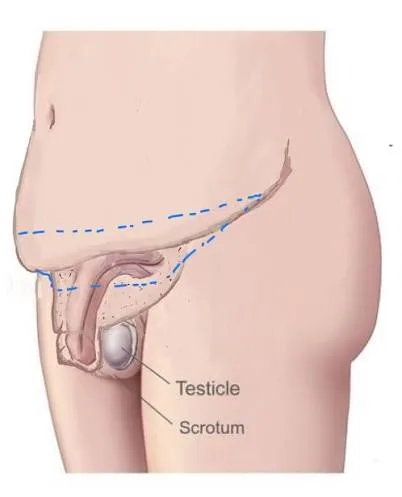
Adult acquired buried penis is a condition in which a normally sized penis becomes partially or completely hidden beneath surrounding suprapubic skin, fat, scar tissue, or swollen genital tissue. It is most often associated with obesity but can also result from lichen sclerosus, genital lymphedema, previous surgery, chronic inflammation, trauma, or complications of penile procedures, and it can interfere with urination, hygiene, sexual activity, and quality of life.
Also known as: Buried penis, Adult buried penis, Adult acquired buried penis, AABP, Hidden penis, Concealed penis, Retracted penis, Penis buried in fat, Buried penis obesity, Hidden penis from obesity, Acquired concealed penis, Penis hidden by suprapubic fat, Penis buried after weight gain
 ✓ Clinician-reviewed information
- Adult acquired buried penis occurs when a normally sized penis becomes hidden beneath surrounding skin, fat, scar tissue, or genital swelling.
- Obesity is the most common cause, but lichen sclerosus, genital lymphedema, previous surgery, chronic inflammation, and trauma can also contribute.
- The condition can cause difficulty urinating while standing, urine trapping, infections, hygiene problems, sexual dysfunction, and apparent loss of penile length.
- Weight loss may improve some obesity-related cases but does not always correct excess suprapubic tissue, scarring, or diseased penile skin.
- Moderate or severe cases may require reconstructive surgery to expose the penis, remove diseased or excess tissue, restore penile fixation, and sometimes replace damaged penile skin with a skin graft.
Overview
Adult acquired buried penis is a reconstructive urological condition in which the penile shaft becomes partially or completely concealed by surrounding tissues.
Importantly, the penis itself is usually normal in anatomical length.
The problem is that the visible and functionally usable portion of the penis becomes reduced because surrounding:
Suprapubic fat
Excess skin
Scar tissue
Lymphedematous tissue
Inflamed genital tissue
covers or traps the penile shaft.
For this reason, buried penis should not be confused with true micropenis or ordinary concerns about penile length.
Is the penis actually shorter?
Usually, no.
Buried penis can create the appearance of a dramatically shortened penis because part or nearly all of the shaft is hidden within surrounding tissue.
When the surrounding tissue is compressed, a greater portion of the normal penile shaft may become visible.
This is why buried penis is sometimes categorized as a cause of false penile shortness.
However, chronic inflammation and scarring can eventually produce genuine functional shortening or contracture in severe cases.
How does adult buried penis develop?
There are several mechanisms.
In obesity, excessive suprapubic fat and descent of the fat pad over the genital region can cover the base of the penis.
Over time, the penis may become progressively trapped beneath this tissue.
The concealed penis creates a warm, moist environment where:
Urine can accumulate
Skin becomes macerated
Bacterial or fungal infections can develop
Chronic inflammation occurs
Scar tissue forms
Inflammation and scarring can then further trap the penis, creating a self-perpetuating cycle.
Buried penis and obesity
Obesity is one of the most important causes of adult acquired buried penis.
The suprapubic fat pad — sometimes called the escutcheon — can enlarge and descend over the penis.
In severe obesity, an abdominal pannus may further cover the genital region.
However, weight alone is not always the entire problem.
Men may also develop:
Skin laxity
Scar formation
Lymphedema
Chronic inflammation
Penile skin deficiency
This explains why substantial weight loss does not always completely expose the penis.
Buried penis and lichen sclerosus
Lichen sclerosus is an important inflammatory skin disease associated with adult acquired buried penis.
It can cause:
Whitening of penile skin
Scarring
Phimosis
Constriction around the penis
Meatal narrowing
Urethral stricture disease
A scarred ring of tissue may progressively push or trap the penis inward.
Because lichen sclerosus can also affect the urethra, men with buried penis and urinary symptoms may require evaluation for urethral stricture disease.
Buried penis and genital lymphedema
Severe genital or scrotal lymphedema can produce enough swelling to completely surround and conceal the penis.
This can occur with:
Morbid obesity
Previous lymph-node surgery
Lymphatic obstruction
Chronic inflammatory disease
Hidradenitis suppurativa
Other causes of genital lymphedema
These cases can require particularly complex reconstructive surgery.
Buried penis after penile procedures
Buried penis may occasionally develop after:
Circumcision complications
Penile enlargement procedures
Penile filler or foreign-material injections
Trauma
Reconstructive genital surgery
Removal of genital skin
Severe infection such as Fournier's gangrene
Scar tissue or a deficiency of healthy penile skin can pull the penis inward or prevent normal shaft exposure.
Types of adult acquired buried penis
Symptoms
Causes
Risk factors
How it is diagnosed
Adult acquired buried penis is primarily diagnosed through a detailed medical history and physical examination.
The specialist first determines why the penis has become concealed and whether additional penile, skin, urinary, or urethral disease is present.
Medical history
The doctor may ask:
When the penis first began to appear buried
Whether symptoms followed weight gain
Whether major weight loss has occurred
Whether urination has changed
Whether the patient must sit to urinate
Whether urine sprays or dribbles
Whether recurrent infections occur
Whether genital hygiene is difficult
Whether erections are painful
Whether intercourse is possible
Whether erectile dysfunction is present
Whether penile length appears to have decreased
Whether previous genital surgery was performed
Whether circumcision was performed
Whether penile fillers or injections were previously used
Whether lichen sclerosus has been diagnosed
Whether genital lymphedema is present
Physical examination
Examination should assess the penis, scrotum, suprapubic area, and surrounding skin.
The specialist evaluates:
Amount of suprapubic fat
Presence of an abdominal pannus
Quality of penile skin
Amount of available healthy penile skin
Scar tissue
Phimosis
Lichen sclerosus
Genital lymphedema
Hidradenitis
Penile fixation
Position of the penopubic junction
Urinary meatus
The clinician may compress the surrounding fat and skin in an attempt to deliver or expose the penile shaft.
This helps estimate the true penile length and determine how much healthy skin is available for reconstruction.
Evaluating the urethra
Buried penis, especially when associated with lichen sclerosus, can coexist with:
Meatal stenosis
Urethral stricture
When urinary symptoms suggest urethral disease, evaluation may include:
Urethral calibration
Cystoscopy
Retrograde urethrogram
Voiding cystourethrogram in selected cases
Severe burial can sometimes prevent complete urethral evaluation until surgery.
Imaging
Imaging is not routinely required for straightforward buried penis.
It may be helpful in complex cases involving:
Massive genital lymphedema
Large scrotal masses
Suspected hernia
Deep soft-tissue abnormalities
CT or other imaging may be used according to the clinical situation.
- The penis has progressively become hidden beneath surrounding tissue.
- You cannot fully expose the penile shaft or glans.
- You have difficulty urinating while standing.
- Urine sprays unpredictably.
- Urine becomes trapped around the penis.
- You develop repeated genital skin infections.
- Genital hygiene has become difficult.
- Sexual penetration has become difficult or impossible.
- Erections are painful because of surrounding scar tissue.
- Penile concealment persists despite substantial weight loss.
- You notice white, thickened, or scarred penile skin suggestive of lichen sclerosus.
- You have urinary symptoms suggesting urethral narrowing.
- Burial developed after circumcision or another genital procedure.
- Symptoms developed after penile fillers or enhancement injections.
- Severe genital or scrotal swelling is progressively burying the penis.
Treatment options
- Maintain a healthy body weight.
- Seek medical support for significant obesity.
- Treat chronic genital skin disease appropriately.
- Seek specialist care for lichen sclerosus.
- Maintain good genital hygiene.
- Treat genital infections promptly.
- Manage diabetes appropriately.
- Seek treatment for genital lymphedema.
- Avoid unregulated penile injections or foreign materials.
- Choose appropriately qualified specialists for penile procedures.
- Seek reconstructive-urology assessment when progressive penile concealment develops.
- Do not repeatedly force scarred penile skin or attempt aggressive self-correction.
Common questions
What is a buried penis?
Is buried penis the same as micropenis?
Does buried penis mean my penis has become shorter?
Is obesity the main cause of adult buried penis?
Can losing weight fix a buried penis?
Can buried penis cause urinary problems?
Can buried penis cause infections?
Can buried penis affect sex?
Can you still have an erection with buried penis?
Is buried penis related to erectile dysfunction?
What is the treatment for adult buried penis?
What is buried penis surgery?
What is an escutcheonectomy?
What is a panniculectomy?
Does buried penis surgery increase penis length?
Is skin grafting always necessary?
Where does the skin graft come from?
Can buried penis return after surgery?
What are the risks of buried penis reconstruction?
Can lichen sclerosus cause buried penis?
Can penile injections or fillers cause buried penis?
Which doctor treats adult acquired buried penis?
Sources
- EAU Guidelines on Sexual and Reproductive Health — Penile Size Abnormalities and Dysmorphophobia https://uroweb.org/guidelines/sexual-and-reproductive-health/chapter/penile-size-abnormalities-and-dysmorphophobia
- Evaluation and management of adult acquired buried penis https://pmc.ncbi.nlm.nih.gov/articles/PMC6127540/
- Outcomes of adult acquired buried penis reconstruction: a multicentre cohort study https://pubmed.ncbi.nlm.nih.gov/42026175/
- Buried Penis: A Comprehensive Review on Aetiology, Classification and Plastic-Surgical Reconstruction https://pubmed.ncbi.nlm.nih.gov/28561167/
- Adult Acquired Buried Penis: A Hidden Problem in Obese Men https://pubmed.ncbi.nlm.nih.gov/33680609/
- Plastic surgery reconstruction of the adult buried penis: Option or obligation? https://pubmed.ncbi.nlm.nih.gov/28801716/