
Coloplast Titan Penile Implant: 6 Differences That Matter in 2026
Coloplast Titan penile implant explained in 6 differences: Titan Touch pump, Bioflex cylinders, HydroVANTAGE coating, sizing, girth and 2026 evidence.
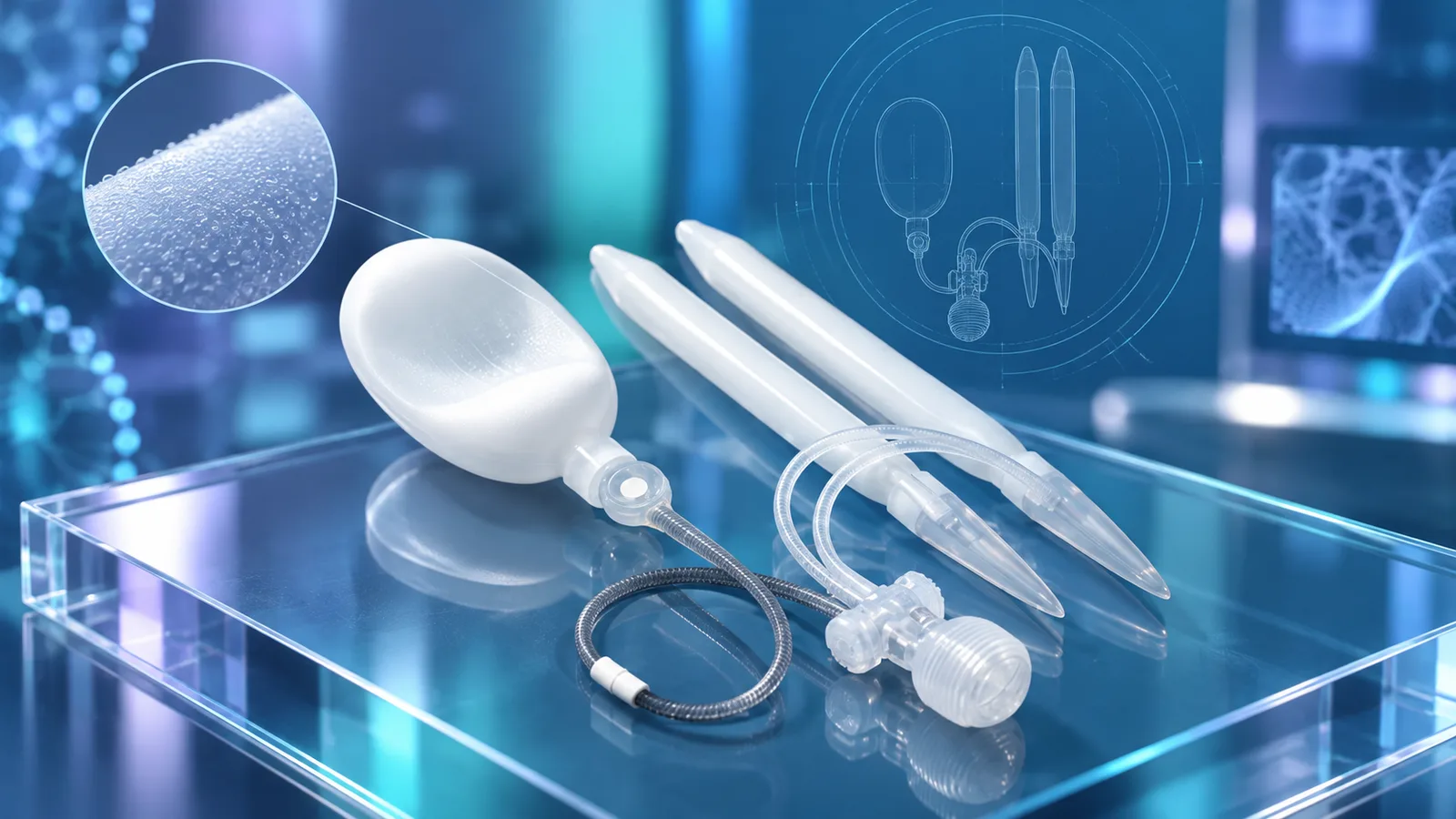
- The Coloplast Titan penile implant is a three-piece inflatable prosthesis using Bioflex cylinders, an internal reservoir and a scrotal pump to create controllable penile rigidity.
- Titan's HydroVANTAGE hydrophilic coating can absorb an aqueous antimicrobial solution selected by the surgical team; this differs from implants using a fixed factory antibiotic combination.
- Titan Touch refers mainly to the One Touch Release pump configuration, while “Zero Degree” refers to the angle of the proximal cylinder tubing—it is not a separate “Zero Step” implant.
- Titan cylinders prioritize girth expansion and rigidity and are available in standard, Narrow Base and XL configurations, but those features do not make the device a cosmetic penis-enlargement procedure.
- Clinical studies report high satisfaction and good reliability with Titan, but comparative evidence and current EAU guidance do not establish Titan—or any other manufacturer—as universally superior for every patient.
The Coloplast Titan penile implant is a three-piece inflatable penile prosthesis made for men who need a reliable surgical treatment for erectile dysfunction. Its main distinguishing features include Bioflex cylinders, strong girth expansion, HydroVANTAGE hydrophilic coating, a lock-out reservoir valve, standard or narrow-base cylinder options, and the Titan Touch pump with one-touch deflation.
Those features sound straightforward.
The more difficult question is what they actually mean for a patient.
Does Bioflex make Titan objectively better than another implant?
Does “more girth” mean penile enlargement?
Is Titan Touch a completely different prosthesis from Titan?
What does “Zero Degree” mean?
Can a man with severe penile fibrosis still receive a Titan?
How reliable is the pump?
And what does the Titan penile implant cost compared with the rest of the operation?
Those questions matter because device marketing often turns engineering characteristics into claims about clinical superiority.
That is not how the evidence should be interpreted.
The European Association of Urology states that modern inflatable and malleable penile prostheses are established treatment options, but there are no definitive head-to-head data demonstrating universal superiority of one manufacturer over another. Device selection should therefore consider anatomy, patient priorities, surgeon experience and the characteristics of the available implant rather than brand loyalty alone.
Titan is nevertheless an important device family to understand.
It is one of the best-established three-piece inflatable prostheses internationally and competes directly with systems such as the Boston Scientific AMS 700.
Its cylinders use a different material.
Its infection-control strategy is different.
Its pump mechanics are different.
Its sizing architecture is different.
And its expansion characteristics can make it attractive in particular anatomical situations.
This guide explains the six differences that matter most—without turning manufacturer specifications into promises that the clinical literature does not support.
What Is the Coloplast Titan Penile Implant?
The Coloplast Titan penile implant is a three-piece inflatable penile prosthesis.
It consists of:
two inflatable cylinders placed inside the corpora cavernosa;
a pump positioned inside the scrotum;
and a fluid reservoir placed internally in the pelvic or lower abdominal region.
The components are connected by tubing.
All major components remain inside the body.
Nothing is attached externally before sex.
There is no battery.
There is no charger.
And the patient does not inject fluid into the prosthesis.
The hydraulic fluid remains permanently inside a closed system.
When the patient wants an erection, he squeezes the pump in the scrotum.
Fluid moves from the reservoir into the two cylinders.
As the cylinders fill, the shaft becomes firm enough for penetration.
When intercourse is finished, the patient activates the deflation mechanism.
Fluid returns to the reservoir and the shaft becomes softer.
That basic principle is similar to other three-piece inflatable penile implants.
The differences lie in how Titan is built and how those components behave.
Coloplast describes the current Titan family as using Bioflex and silicone, with standard and narrow-base cylinder options and configurations suitable for penoscrotal or infrapubic implantation. Current product literature lists Titan-family lengths extending up to 28 cm depending on configuration and market.
For the broader operation rather than this specific device, see the penile implant procedure guide.
Coloplast Titan in One Table
Feature | Coloplast Titan |
|---|---|
Device class | Three-piece inflatable penile prosthesis |
Cylinders | Two Bioflex cylinders |
Pump | Titan pump or Titan Touch configuration depending on product/market |
Reservoir | Internal fluid reservoir |
Coating | HydroVANTAGE hydrophilic coating |
Auto-inflation protection | Lock-out valve |
Cylinder options | Standard, Narrow Base and larger/XL configurations |
Maximum family length | Up to 28 cm in current documented configurations |
Deflation | Titan Touch uses One Touch Release |
Length-expanding design | No AMS-LGX-style longitudinal expansion system |
Main expansion emphasis | Girth and rigidity within corporal anatomy |
MRI status | MRI conditional according to manufacturer instructions |
Latex | Manufacturer describes Titan as latex-free |
The table makes Titan sound like a collection of specifications.
The next six sections explain which specifications actually matter clinically.
Difference 1: Titan Uses Bioflex Cylinders Rather Than the Silicone-Fabric Design Used in Some Competitors
One of the defining features of the Titan penile implant is Bioflex.
Bioflex is Coloplast's proprietary polyurethane-based biopolymer used in the inflatable cylinders.
Current clinical reviews describe Titan cylinders as being constructed from a stronger Bioflex material rather than the silicone-fabric architecture used in some other contemporary inflatable systems.
That material choice affects several characteristics.
It influences:
rigidity;
girth expansion;
fatigue resistance;
cylinder wall behavior;
and how the implant tolerates pressures during inflation.
Coloplast markets Bioflex heavily around strength and rigidity.
Those are real engineering characteristics.
But manufacturer bench-testing claims need to be interpreted differently from randomized clinical evidence.
For example, Coloplast currently reports comparative bench data suggesting Titan cylinders have greater girth, rigidity and durability than specified competing cylinders. These figures come largely from manufacturer data and laboratory testing—not from trials demonstrating that every Titan patient has better sex, greater satisfaction or longer device survival than every patient receiving another brand.
That distinction is essential.
What does greater cylinder rigidity mean?
A penile prosthesis must resist bending during intercourse.
This is called axial rigidity.
If an inflated cylinder buckles too easily under pressure, penetration may be less stable.
Bioflex is designed to create a firm internal support structure when Titan is fully inflated.
That can be useful in men who require substantial rigidity, including some patients with fibrotic tissues or penile curvature.
But erection quality is not determined by cylinder material alone.
It also depends on:
correct sizing;
cylinder positioning;
corporal anatomy;
degree of inflation;
Peyronie's deformity;
and glans support.
A technically poor implantation of a very rigid device is not better than a well-performed implantation using another appropriate prosthesis.
Is Titan “harder” than a natural erection?
It can feel very firm when fully inflated.
But patients do not necessarily need maximal inflation for every sexual encounter.
After healing and device training, a man learns how much inflation provides comfortable, stable penetration.
The purpose of rigidity is function, not achieving the highest possible mechanical pressure.
Does Bioflex make Titan last longer?
Bioflex has strong fatigue properties in bench testing.
But device longevity depends on the complete system.
A three-piece implant can fail through:
cylinder leakage;
pump malfunction;
reservoir problems;
or tubing damage.
A device is only as durable as its entire hydraulic pathway.
This matters because a very recent 2026 study of Titan Touch devices found that tubing-related failures were a major source of mechanical revision, despite the cylinders themselves being highly durable.
So “strong cylinders” does not mean “no mechanical failure.”
What Do Current Titan Failure Data Show?
A 2026 analysis examined a large single-surgeon experience involving Titan Touch prostheses placed between 2013 and 2025.
Among 1,907 Titan Touch implants, researchers identified 149 cases of mechanical failure requiring revision in the cohort they analyzed. The median time to reoperation was approximately 59 months.
Tubing malfunction was the leading failure mechanism, particularly near the connection between kink-resistant tubing and the strain-relief area near the scrotal pump.
This study is valuable because it describes where failures occurred rather than simply reporting overall implant survival.
It also has limitations.
It was:
retrospective;
performed in one high-volume surgical setting;
and represented one surgeon's technique and patient population.
So it should not be interpreted as:
“Titan fails after five years.”
That would be incorrect.
The more appropriate conclusion is:
Modern Titan cylinders are mechanically strong, but the implant remains a multicomponent hydraulic device and mechanical revision can arise from tubing, pump, reservoir or cylinder problems over time.
Difference 2: Titan Uses HydroVANTAGE Hydrophilic Coating Rather Than a Factory-Fixed Antibiotic Combination
The second major difference is infection-control strategy.
Penile prosthesis infection is one of the complications patients fear most because a significant infection can require implant removal or salvage surgery.
Modern manufacturers therefore use surface technologies intended to reduce bacterial adherence and infection risk.
Titan uses a hydrophilic coating, now marketed as HydroVANTAGE.
Coloplast states that the coating covers the external surfaces of the implant and can absorb an aqueous solution selected by the surgeon before implantation. It also increases surface lubricity, which may make insertion easier.
This differs from Boston Scientific's InhibiZone approach, where rifampin and minocycline are incorporated into the device by the manufacturer.
Titan instead gives the surgeon flexibility in choosing the solution used to soak or “dip” the hydrophilic surface.
How does the hydrophilic coating work?
The surface attracts fluid.
Before implantation, the surgeon can immerse the prosthesis in an antimicrobial solution.
The coating absorbs the selected aqueous solution.
The intent is twofold:
reduce bacterial attachment;
and deliver antimicrobial activity around the device at implantation.
The coating also makes the device surface more slippery, which may aid placement.
The concept has been studied for more than two decades.
An early large database analysis compared 2,357 hydrophilic-coated Titan prostheses with 482 non-coated predecessor implants.
Reported infection rates were:
1.06% in the coated Titan group
versus
2.07% in the non-coated comparison group
during the studied period.
The study was not a randomized trial and relied on manufacturer-linked post-market data.
But it provided early evidence supporting the hydrophilic strategy.
Does HydroVANTAGE itself contain a specific antibiotic?
Not in the same way InhibiZone does.
That is a useful distinction.
Titan's hydrophilic surface is designed to absorb a solution chosen at implantation.
The antibiotic or antiseptic regimen therefore depends partly on surgical protocol.
Research has explored different dipping combinations.
For example, published laboratory work evaluated various antibiotic solutions against organisms associated with prosthesis infection.
A multicentre analysis of diabetic men receiving primary Titan implants also examined outcomes associated with different antimicrobial dipping solutions, illustrating that the surgeon's choice of dip can be clinically relevant.
Does hydrophilic coating prevent every infection?
No.
No prosthesis technology does.
The 2026 EAU guideline states that modern antibiotic-impregnated or hydrophilic-coated implants can reduce infection rates to roughly 1–2% in appropriate primary cases, but infection remains a recognized complication.
Risk also depends on:
primary versus revision surgery;
previous infection;
diabetes;
tissue quality;
operative technique;
duration of surgery;
skin contamination;
and surgeon protocols.
An infection-resistant surface does not compensate for poor sterile technique.
Is Titan's coating better than AMS InhibiZone?
There is no high-quality universal answer.
One approach gives a surgeon flexible antimicrobial dipping.
The other supplies a pre-impregnated antibiotic combination.
Both have clinical evidence.
The EAU explicitly states that available manufacturer systems have not been conclusively proven universally superior.
A website stating:
“HydroVANTAGE is definitely safer than InhibiZone”
or
“InhibiZone is always better than Titan coating”
would be going beyond the evidence.
Difference 3: Titan Touch Uses a One Touch Release Pump
The pump is where patients interact with the implant every time they use it.
That makes pump design more than a technical detail.
The Titan Touch configuration uses Coloplast's One Touch Release system.
Coloplast describes it as allowing the patient to initiate deflation with momentary compression of the deflation control, allowing fluid to transfer from the cylinders back toward the reservoir.
This is different from pump systems that require the patient to hold or repeatedly manipulate a deflation control throughout the process.
Is Titan Touch a different penile implant from Titan?
Not in the way LGX and CXR are different cylinder designs within the AMS family.
The name Titan Touch primarily refers to the Titan system paired with the Touch/One Touch Release pump configuration.
The fundamental device is still a three-piece Titan prosthesis using Bioflex cylinders, a reservoir and pump.
Current Coloplast product literature states that both Titan and Titan Touch use two Bioflex cylinders, a pump and reservoir, with two pump options available across the family.
So patients should not interpret:
Titan
and
Titan Touch
as two completely unrelated prostheses.
The most obvious patient-facing difference is pump operation.
What Does the Titan Touch Pump Do?
To inflate the implant, the patient repeatedly compresses the pump bulb in the scrotum.
Each squeeze transfers fluid toward the cylinders.
To deflate, the patient finds the deflation control and activates the One Touch Release mechanism.
Fluid then moves away from the cylinders so that the penis becomes softer.
Patients are usually taught device operation after postoperative swelling has settled sufficiently.
The first attempt can be frustrating.
The pump may be difficult to identify through swollen scrotal tissues.
The patient may not yet know:
where the bulb ends;
where the deflation pads are;
or how much pressure is required.
This is a normal learning issue rather than evidence of device malfunction.
What Did Clinical Studies Find About the One Touch Release Pump?
A prospective multicentre international study enrolled 113 men receiving the Titan One Touch Release implant.
The research specifically examined ease of device operation, patient training and satisfaction.
Earlier comparative work involving 100 Titan cases found that the OTR pump was considered easier to deflate than the previous Genesis pump and reduced the number of postoperative training sessions required for correct device use. No pump malfunctions were observed during the short follow-up of that study.
Another clinical series of 33 Titan OTR patients reported:
85% patient satisfaction
and
92% saying they would recommend a penile implant to another man with a similar condition.
Seventy-six percent felt the process of achieving an erection with the implant was natural. The study also recorded revisions for problems including auto-inflation, deflation and reservoir displacement.
These numbers are useful.
But they are not promises.
Small clinical series can produce satisfaction rates that differ from larger populations.
Satisfaction is also heavily affected by preoperative expectations.
One Titan study found that more realistic expectations before surgery were associated with better satisfaction afterward.
That lesson probably matters more than the precise shape of the pump.
Difference 4: “Zero Degree” Is a Tubing Design—Not a Separate “Zero Step” Penile Implant
This needs correcting because your original strategy brief calls for:
“Titan versus Titan Touch versus Zero Step.”
Current Coloplast documentation does not describe a major Titan product called “Zero Step.”
The relevant term is Zero Degree.
Coloplast describes a zero-degree angle proximal base input tubing design intended to make surgical placement easier.
The technical literature explains why this was developed.
Earlier tubing could leave the cylinder at approximately a 45-degree angle.
Coloplast later introduced zero-degree cylinder tubing so that the tubing exits in line with the proximal cylinder rather than protruding at a wider angle.
A 2021 review of penile implant technology explains that the zero-degree configuration was introduced to reduce issues associated with tubing wear and improve placement around the corporotomy.
What does this mean for the patient?
Usually very little in day-to-day operation.
The patient does not manipulate the zero-degree tubing.
He does not choose an erection mode called “Zero Degree.”
It is primarily a surgical-design characteristic.
It can influence:
how the cylinder sits proximally;
how tubing exits the cylinder;
how the surgeon positions components;
and potentially how much tissue dilation is required around the cylinder base.
Is Titan Zero Degree a separate prosthesis?
Some regional ordering catalogues have historically listed products described as Titan Zero Degree cylinder/pump sets.
That describes a component/configuration within the Titan family—not a fundamentally separate class of penile implant.
Therefore, the more accurate 2026 explanation is:
Titan = the overall three-piece device family.
Titan Touch = Titan paired with the Touch/One Touch Release pump configuration.
Zero Degree = proximal tubing geometry used in Titan cylinder configurations.
That distinction is more useful than treating all three terms as competing prostheses.
Difference 5: Titan Prioritizes Girth Expansion and Offers Standard, Narrow-Base and XL Sizing
The fifth major difference is cylinder architecture.
Titan is often associated with girth and rigidity.
That statement needs care.
It does not mean the prosthesis is a cosmetic girth-enhancement procedure.
It means the Bioflex cylinders can expand radially within the corporal space during inflation.
A current 2026 review of inflatable cylinder selection reports approximately:
15–17 mm deflated cylinder diameter
and
20–22 mm inflated diameter
for standard Titan configurations.
The narrower Titan NB configuration has more restricted expansion, approximately 17 mm, and is intended for smaller or more fibrotic corporal spaces.
Coloplast's own product information describes maximum cylinder expansion around 21 mm per cylinder in its current Titan Touch materials.
Again, these are cylinder measurements.
They are not the same thing as final penile girth.
The penis includes:
the cylinders;
the tunica albuginea;
remaining corporal tissue;
skin;
corpus spongiosum;
and glans.
Does Titan make the penis thicker?
It can produce substantial fullness when inflated, particularly compared with years of weak erections.
But the surgeon cannot safely force the cylinders beyond the limits of the corpora.
The patient's tissue determines how much expansion can occur.
A patient with:
severe fibrosis;
Peyronie's plaques;
previous implant surgery;
or priapism-related scarring
may obtain less expansion than a man with supple corporal tissue.
Titan's girth capacity should therefore not be marketed as:
“guaranteed penile enlargement.”
It is an engineering characteristic of the prosthesis.
Titan Standard vs Titan Narrow Base
Most routine patients who have adequate corporal diameter can receive standard cylinders.
Some cannot.
Titan Narrow Base, sometimes abbreviated Titan NB, uses narrower dimensions.
A narrow-base prosthesis can be valuable when fibrosis or anatomy makes a standard cylinder unsafe or technically difficult.
The 2026 cylinder-selection review lists Titan NB among the options designed for restricted corporal spaces.
The purpose is not to give the patient a smaller erection.
It is to create a prosthetic erection in anatomy where a wider cylinder might not fit.
This is particularly relevant after:
prolonged ischemic priapism;
previous infected prosthesis removal;
severe corporal fibrosis;
or multiple penile operations.
For patients with significant scarring, our penile fibrosis page explains the underlying condition in more detail.
How Long Can Titan Cylinders Be?
Current Coloplast materials show a broad range.
The Titan family includes configurations extending from smaller narrow-base sizes to XL cylinders of 24, 26 and 28 cm.
The number is often misunderstood.
A 28 cm implant does not produce a 28 cm visible penis.
Part of the corpora cavernosa extends deep inside the pelvis.
The prosthesis fills both:
the visible penile shaft;
and the proximal corporal roots inside the body.
This is why two men can receive very different cylinder lengths while having similar visible penile length.
Cylinder size is a surgical fitting measurement.
It is not a cosmetic ranking.
Does Titan Expand in Length Like AMS 700 LGX?
Not in the same way.
Titan is generally considered a girth-expanding and rigidity-focused design rather than a dedicated longitudinal expansion cylinder comparable with the AMS 700 LGX.
That does not mean penile length cannot be preserved or optimized with Titan.
Sizing technique and postoperative cycling matter.
A prospective rehabilitation study followed men receiving Titan implants and a structured postoperative inflation programme.
At two years:
96.5% were satisfied with overall implant function;
67.8% were satisfied with penile length;
and
77% perceived their length as either longer or unchanged compared with before surgery.
The study involved a specific surgical sizing method and aggressive rehabilitation protocol.
It should not be translated into:
“Titan grows the penis.”
A more responsible interpretation is:
careful sizing and structured cycling may help optimize postoperative dimensions in selected Titan patients.
Difference 6: Titan Has Strong Clinical Outcomes, but the Evidence Does Not Prove It Is Universally “Best”
The final difference matters most because this is where marketing and evidence often separate.
Titan is well established.
It has published:
patient-satisfaction data;
infection data;
pump studies;
comparative studies;
Peyronie's data;
mechanical-failure research;
and long-term clinical experience.
That is valuable.
But it does not support declaring Titan the best penile implant for every patient.
What Do Titan Penile Implant Reviews in the Medical Literature Show?
Published Titan studies generally report high satisfaction.
One 33-patient series using the Titan OTR pump reported 85% patient satisfaction.
A multicentre study evaluating Titan against AMS 700 CX in 248 men found high overall satisfaction with both devices. Both implants were considered reliable for intercourse and most patients learned to use their devices within six months.
A separate long-term comparison found almost identical average EDITS satisfaction scores:
77.2 for AMS 700 CX
versus
77.5 for Titan
with no statistically significant difference in overall satisfaction.
That study is important precisely because it did not identify a clear winner.
What about mechanical survival?
A 2025 systematic review examined removal and mechanical-failure data across major inflatable penile prostheses.
Across the included Titan literature, reported removal rates ranged from 0% to 6.2%, while reported mechanical-failure rates ranged from 0% to 9.1%.
However, follow-up durations differed substantially between studies.
The authors explicitly cautioned that stronger long-term comparative evidence is still needed.
This is the right way to discuss penile implant reliability.
Not:
“Titan has a 9.1% failure rate.”
And not:
“Titan has a 0% failure rate.”
Both would misuse the review.
The data represent different studies, populations and follow-up periods.
Titan in Peyronie’s Disease
Titan's cylinder rigidity can also be useful in men who have both severe erectile dysfunction and Peyronie's disease.
An older comparative study evaluated 138 men with Peyronie's disease who received either AMS 700 CX or Titan.
Five-year estimated mechanical survival was 91% for AMS 700 CX and 87% for Titan, but the difference was not statistically significant.
Both devices achieved effective penile straightening, and overall satisfaction was high.
Again, no universal winner emerged.
Current EAU guidance similarly advises against assuming one manufacturer's implant is superior for every case.
Titan vs Titan Touch: What Exactly Is the Difference?
Because this is one of the highest-intent searches around the device, it deserves a clear answer.
Titan refers broadly to Coloplast's three-piece inflatable prosthesis family.
Titan Touch refers to a Titan configuration using the Touch pump and its One Touch Release deflation mechanism.
Both use:
Bioflex cylinders;
a reservoir;
a scrotal pump;
HydroVANTAGE coating;
and internal hydraulic operation.
The main patient-facing distinction is pump design.
Depending on country and hospital procurement, availability can differ.
That means a patient should not assume an advertisement saying:
“Coloplast Titan included”
automatically means Titan Touch.
Ask for the exact product configuration in writing.
Titan Touch vs Zero Degree: They Are Not Competing Options
This is another area where online terminology can become confusing.
Titan Touch describes a pump configuration.
Zero Degree describes the orientation of proximal cylinder tubing.
A Titan Touch prosthesis can incorporate zero-degree tubing.
The patient is not choosing:
“Touch or Zero Degree”
as though they solve the same problem.
They describe different components of the same device architecture.
This is why the Day 10 planning phrase “Titan versus Titan Touch versus Zero Step” needed correction before publication.
What Is the Lock-Out Valve?
Auto-inflation is an unwanted movement of fluid from the reservoir toward the cylinders.
In practical terms, the penis can become firmer without the patient intentionally pumping the device.
Modern systems incorporate mechanisms intended to prevent this.
Titan uses a patented Lock-out valve associated with the reservoir system.
Coloplast describes it as designed to reduce unwanted auto-inflation.
This does not mean auto-inflation can never occur.
Earlier Titan OTR clinical studies still documented occasional problems requiring review or revision.
If a healed prosthesis repeatedly becomes firm without pump activation, the patient should speak to the implant surgeon.
What Does the Coloplast Titan Feel Like When Deflated?
A three-piece inflatable prosthesis allows fluid to leave the cylinders and return to the reservoir.
This provides a softer resting state than a malleable implant.
However, the cylinders remain physically inside the corpora.
The penis therefore does not return to a state in which no prosthesis exists.
Some patients describe inflatable cylinders as giving the resting penis:
more internal structure;
slightly greater fullness;
or a different feel.
The important difference is that Titan does not remain rigid continuously.
That generally makes concealment easier than with a malleable implant.
What Does Titan Feel Like When Inflated?
When sufficiently filled, Titan produces substantial rigidity and girth within the anatomical limits of the penis.
Because Bioflex is relatively stiff when pressurized, patients and surgeons often describe Titan as a particularly rigid prosthesis.
But perception varies.
The glans also matters.
The prosthetic cylinders stop beneath the head of the penis.
They do not directly inflate the glans.
Therefore, the shaft can be extremely firm while the glans remains softer.
That is not automatically implant failure.
Glans engorgement continues to depend largely on the patient's remaining vascular response.
Does Titan Affect Penile Sensation?
The prosthesis is not designed to remove sensation from the skin of the penis.
The major sensory nerves lie outside the cylinders.
A patient whose penile sensation was normal before uncomplicated surgery would usually expect to retain it.
However, many men considering implants have medical conditions that can affect sensation independently.
These include:
diabetic neuropathy;
spinal cord injury;
pelvic surgery;
and other neurological conditions.
The prosthesis cannot restore sensation already lost because of nerve damage.
Can You Still Have an Orgasm With a Titan Penile Implant?
Usually, if orgasm was possible beforehand.
The implant solves a mechanical problem:
rigidity.
Orgasm involves neurological and muscular processes that are different from cylinder inflation.
Titan does not create an orgasm.
It also does not normally prevent one.
A patient whose orgasm has been affected by prostate surgery, medication or neurological disease may continue to experience those difficulties after implantation.
Can You Ejaculate With a Titan Penile Implant?
The prosthesis cylinders do not normally block the urethra.
A man who ejaculated normally before surgery can generally still ejaculate.
But radical prostatectomy is common among men who later receive penile implants.
A man whose prostate and seminal vesicles have been removed will normally no longer produce a typical semen-containing ejaculation.
Titan cannot reverse that.
Is Coloplast Titan Good After Radical Prostatectomy?
It can be.
Many penile implant patients developed severe ED after prostate cancer surgery.
The main additional surgical issue is the reservoir.
Radical prostatectomy can alter the normal pelvic space where a reservoir might traditionally be positioned.
Experienced prosthetic surgeons can use alternative reservoir positions when required.
The implant cylinder itself is still placed in the corpora cavernosa.
Therefore, previous prostatectomy is not automatically a reason a man cannot receive Titan.
Is Titan Good for Severe Penile Fibrosis?
Sometimes, but this is highly anatomy-dependent.
Standard Titan cylinders require adequate corporal diameter.
When severe fibrosis restricts that space, Titan Narrow Base may be considered.
The 2026 cylinder-selection literature specifically discusses Titan NB as a smaller-diameter option for constrained corpora.
If fibrosis is extreme, the surgeon may need:
specialized cavernotomes;
additional reconstruction;
or another implant strategy.
No brand can overcome anatomy by force.
Andrology Abroad has dedicated information on penile corporal fibrosis reconstruction for patients with severe scar tissue.
Is Titan Better for Peyronie’s Disease?
Titan's rigidity can make it attractive in some Peyronie's cases, particularly where modelling of the penis is required.
Coloplast materials state that Titan has regulatory clearance for manual modelling in the setting of Peyronie's disease, and the clinical literature documents good straightening results.
That does not mean every Peyronie's patient should receive Titan.
Curvature severity, fibrosis, penile length, surgeon experience and reconstructive plan all matter.
Some men require only cylinder placement and modelling.
Others require:
plication;
plaque incision;
grafting;
or another reconstructive technique.
Our penile prosthesis with Peyronie's correction page covers that combined operation separately.
How Is the Coloplast Titan Implanted?
The operation follows the standard principles of three-piece penile prosthesis surgery.
The surgeon:
accesses the corpora cavernosa;
creates openings in the tunica albuginea;
dilates the corporal spaces;
measures each corpus;
selects appropriate cylinders;
places the cylinders;
creates a scrotal pump pocket;
places the reservoir;
connects the hydraulic components;
tests the implant;
and closes the incisions.
Titan can be placed using either a:
penoscrotal
or
infrapubic
approach.
Coloplast supplies configurations compatible with both approaches.
The incision choice is usually determined by surgeon preference, anatomy and prior surgery rather than the brand name itself.
How Long Does Titan Surgery Take?
A routine primary three-piece penile implant procedure often takes roughly an hour to ninety minutes in experienced hands, although complex cases can take longer.
Examples that increase complexity include:
severe fibrosis;
previous prosthesis infection;
revision surgery;
Peyronie's reconstruction;
or unusual reservoir anatomy.
Operating time is not a measure of quality.
A difficult operation taking two hours is not necessarily worse than a routine operation taking 50 minutes.
How Long Before You Can Use the Titan Implant?
The device may function mechanically during surgery, but the body needs to heal.
Patients commonly begin full device training and sexual use several weeks later, often around four to six weeks after uncomplicated surgery.
The exact timing belongs to the operating surgeon.
The incision must heal.
Scrotal swelling must reduce enough for the patient to find the pump.
Pain should be manageable.
And the surgeon should be satisfied with the early result.
Using the implant for intercourse too early simply because it can inflate is not appropriate.
What Is Titan Cycling?
Cycling means repeatedly inflating and deflating the prosthesis after the surgeon allows it.
It has two purposes.
First, the patient learns to use the device.
Second, regular inflation allows the cylinders and surrounding tissues to adapt to their intended operating dimensions.
A structured rehabilitation protocol was used in the Titan study that reported improved penile measurements and high functional satisfaction at two years.
That study should not be converted into an unsupervised instruction to inflate aggressively for hours immediately after surgery.
The protocol began under clinical guidance.
Different surgeons use different schedules.
Coloplast Titan Penile Implant Cost
There is no single global Titan penile implant cost.
A patient is usually paying for an entire treatment episode rather than buying the device as a consumer product.
The total cost can contain:
device;
surgeon;
anaesthetist;
operating theatre;
hospital stay;
medications;
preoperative tests;
postoperative care;
and, for international patients, hotel and transport.
This is why two “Titan prices” can differ by thousands even if the device itself is identical.
Is Titan more expensive than other implants?
Possibly, but not universally.
Device procurement varies between:
countries;
distributors;
hospitals;
and purchasing contracts.
One hospital may obtain Titan at a favorable negotiated price.
Another may price AMS similarly.
A third may offer another manufacturer at a lower acquisition cost.
The final patient quote can also reflect far more than device price.
For the current treatment structure rather than a stale number embedded in an evergreen blog article, use the live penile implant surgery cost in Turkey page.
That page can be refreshed independently as hospital and device pricing changes.
Does Titan Touch cost more than Titan?
There is no universal international pricing rule.
Availability and procurement arrangements vary.
A provider should tell you exactly which pump and cylinder configuration is included.
If two prices differ, ask whether the difference reflects:
implant configuration;
hospital;
surgeon;
stay;
tests;
or aftercare.
Do not assume the price difference is caused only by the pump.
What Should a Titan Quote Actually Say?
A proper proposal should identify the device precisely.
A good description is closer to:
Coloplast Titan Touch three-piece inflatable penile prosthesis, with specified cylinder configuration.
Not:
premium American implant.
Not:
Coloplast implant.
And ideally not even simply:
Titan.
The patient should understand whether the proposed system includes:
Titan Touch pump;
standard or Narrow Base cylinders;
and any other relevant configuration.
After surgery, the patient should keep the device documentation.
Does Titan Come With a Lifetime Warranty?
Warranty terms can differ by country and contract.
Patients should request written manufacturer and provider information rather than relying on the phrase “lifetime warranty.”
A manufacturer warranty on the implant component does not automatically mean:
free surgeon;
free hospital;
free anaesthesia;
free travel;
or free revision surgery
for the rest of the patient's life.
That distinction is especially important in medical tourism.
What Happens if a Titan Implant Eventually Fails?
Mechanical failure generally leads to evaluation by a prosthetic urologist.
Depending on the problem, revision may involve:
replacement of one component;
replacement of several components;
or complete device replacement.
Infection is a different situation and can require removal or salvage.
A man receiving an implant at age 45 has more lifetime exposure to possible revision than someone receiving the same device at age 78.
That does not mean younger men should avoid implantation.
It means future revision should be part of informed consent.
Is the Coloplast Titan Safe for MRI?
Coloplast lists Titan as MRI conditional.
That means scanning is permitted only under the conditions specified in the device's instructions.
It does not mean a patient should enter any MRI scanner without telling staff he has an implant.
The patient should keep his implant documentation and inform radiology personnel about the device before imaging.
Is the Coloplast Titan Latex-Free?
Current Coloplast information describes Titan as latex-free.
This can matter to patients with latex allergy, although all allergies and previous implant reactions still need to be discussed with the surgical team.
Titan Penile Implant Reviews: What Should You Trust?
Online reviews can be useful for understanding experience.
They are weak evidence for comparing devices.
A man may love Titan because his operation was uncomplicated and his expectations were realistic.
Another may dislike the exact same implant because:
he expected more length;
his glans remained soft;
he developed pain;
he struggled with the pump;
or he had a surgical complication.
The implant brand is only one variable.
Published evidence provides better information on patterns.
Current research suggests that Titan generally achieves high satisfaction, while direct comparative studies do not consistently demonstrate an overwhelming advantage over other established three-piece systems.
That is more useful than choosing a prosthesis because one anonymous review calls it “the best.”
What About Searches for “Coloplast Penile Implant in Greensboro”?
Your original keyword export includes “coloplast penile implant in Greensboro.”
I would not optimize this article for that phrase.
Your own SEO strategy explicitly excludes most U.S. local-intent queries because searches tied to a specific American city primarily resolve to local providers and map results rather than international medical travel.
Forcing “Greensboro” repeatedly into an international Titan guide would weaken topical relevance.
The better strategy is to rank this page for device-level research while the user compares brands, then route appropriate international patients toward surgeons, hospitals and pricing.
So I have deliberately left that phrase out of the Supporting Keywords field below.
Is Titan Better Than AMS 700?
That deserves a separate article rather than a one-line answer.
And that is exactly what Day 11 in your strategy does.
The evidence we already have shows why.
Some comparative studies found differences in individual satisfaction questions or pump deflation.
Others found no significant overall satisfaction difference.
Peyronie's studies also found both devices effective without establishing a clear universal winner.
The EAU specifically states that the available evidence does not demonstrate one manufacturer's penile implant as superior for every patient.
So Day 11 should compare them properly on:
coating;
pump;
cylinder expansion;
sizes;
fibrosis;
Peyronie's disease;
mechanical evidence;
and cost.
For Day 10, the important point is simply this:
Titan should be evaluated on its own characteristics—not declared the universal winner before the comparison has even been made.
Who May Be a Good Candidate for the Coloplast Titan?
A Titan may be considered when the patient has erectile dysfunction severe enough to justify penile prosthesis surgery and his anatomy is appropriate for the device.
Potential scenarios include men with:
severe vascular erectile dysfunction;
diabetes-associated ED;
post-prostatectomy ED;
Peyronie's disease with ED;
neurological ED;
or failed conservative treatments.
But there is no diagnosis called:
“Titan candidate.”
The patient is first a candidate for penile prosthesis surgery.
Only then does the surgeon decide which implant configuration makes sense.
Who Might Need a Different Device?
A patient might reasonably receive another implant if:
his corpora are better suited to another cylinder design;
he strongly values length-expansion characteristics;
he cannot operate the Titan pump comfortably;
a two-piece prosthesis better suits previous pelvic surgery;
a malleable implant better suits poor hand dexterity;
or the surgeon has substantially greater experience with another established device.
Device choice is a clinical decision, not brand allegiance.
6 Coloplast Titan Differences That Actually Matter
The six differences can now be summarized clearly.
1. Bioflex cylinders
Titan uses Bioflex cylinders designed for substantial rigidity, girth expansion and fatigue resistance.
2. HydroVANTAGE coating
The hydrophilic surface can absorb an antimicrobial solution chosen by the surgical team rather than relying solely on a factory-fixed antibiotic combination.
3. Titan Touch pump
The Touch configuration uses One Touch Release to simplify initiation of device deflation.
4. Zero Degree tubing
This is a proximal tubing geometry intended to aid implantation—not a separate “Zero Step” penile implant.
5. Standard, Narrow Base and XL cylinder architecture
Titan provides a broad sizing range, including narrow options for selected fibrotic corpora and large configurations extending up to 28 cm.
6. Strong evidence without proof of universal superiority
Titan has substantial published clinical experience, but high-quality evidence does not justify saying it is the best implant for every patient.
Those are much more meaningful differences than advertising terms.
Questions to Ask Before Choosing a Coloplast Titan
Before surgery, a useful consultation should establish:
Why is Titan being recommended for my anatomy?
Is the proposed implant Titan or Titan Touch?
Which pump will I receive?
Do I need standard or Narrow Base cylinders?
Do I have corporal fibrosis?
How will my corpora be measured?
Does Peyronie's disease change the plan?
Which antimicrobial dip will the surgeon use with the hydrophilic coating?
Where will my reservoir be positioned?
Does previous pelvic surgery affect reservoir placement?
What should I realistically expect regarding penile length?
What should I expect regarding glans firmness?
What is included in the quoted price?
What does the warranty cover?
Who will manage me if the implant needs revision years later?
A strong implant consultation should answer those questions without turning into a sales pitch.
Expert Perspective: What Matters More Than the Brand?
The current European Association of Urology guideline gives the most useful answer.
Modern inflatable prostheses are effective.
Three-piece devices often provide the most natural transition between resting and erect states.
Coated devices can reduce infection risk.
But current evidence does not show that one manufacturer is universally superior.
That principle should anchor every device article on Andrology Abroad.
Patients deserve device-level information.
They also deserve protection from device-level hype.
The Bottom Line
The Coloplast Titan penile implant is a well-established three-piece inflatable penile prosthesis with six characteristics that genuinely distinguish it: Bioflex cylinders, HydroVANTAGE hydrophilic coating, the Titan Touch One Touch Release pump, Zero Degree proximal tubing, a broad range of standard/Narrow Base/XL cylinder configurations, and a substantial published clinical evidence base.
The device uses two Bioflex cylinders, a scrotal pump and an internal reservoir.
The patient inflates the cylinders when he wants an erection and deflates them afterward.
Its Bioflex cylinders are designed for substantial radial expansion and axial rigidity.
That does not mean Titan should be marketed as a penile enlargement device.
The corpora cavernosa still determine the maximum dimensions that can safely be achieved.
The HydroVANTAGE coating is another meaningful feature.
Unlike factory-fixed antibiotic impregnation, Titan's hydrophilic surface allows the surgical team to absorb a selected aqueous antimicrobial solution before implantation.
Historical studies found lower infection rates with hydrophilic-coated Titan compared with earlier uncoated implants, while modern guidelines recognize hydrophilic coatings as part of the strategy that has reduced prosthesis infection rates.
Titan Touch mainly refers to the pump configuration.
It uses One Touch Release, allowing the patient to initiate deflation with momentary activation of the deflation mechanism.
Published clinical studies have reported good ease of use and high satisfaction with this pump.
And the term in the original strategy should be corrected:
it is Zero Degree, not Zero Step.
Zero Degree describes the angle at which tubing leaves the proximal cylinder.
It is an engineering and surgical-placement feature, not a separate implant competing against Titan Touch.
Current Titan sizing also gives surgeons considerable flexibility.
Standard cylinders, narrow-base options and XL configurations allow prosthetic selection across a wide range of corporal anatomy, with documented Titan-family sizes extending up to 28 cm depending on configuration.
But none of those features proves that Titan is automatically the best penile implant.
Comparative studies between Titan and AMS 700 have produced mixed findings.
Some differences appear in particular questions, while other studies found nearly identical overall satisfaction. Current EAU guidance therefore does not identify one manufacturer as universally superior.
The appropriate sequence remains:
first decide whether a penile implant is medically appropriate.
Then:
measure the anatomy.
Then:
choose the device and configuration that best fit the patient.
Then compare:
surgeon, hospital, cost and follow-up.
If you are beginning that process, start with Andrology Abroad's penile implant procedure guide.
Patients with severe scarring can also review penile fibrosis and penile corporal fibrosis reconstruction.
For men with Peyronie's disease and severe ED, see penile prosthesis with Peyronie's correction.
For current self-pay planning in Türkiye, use the live penile implant surgery cost in Turkey page.
And before choosing a device, compare the doctors in the andrology surgeon directory.
The question to ask is not:
“Is Titan the best implant?”
It is:
“Does Titan's cylinder design, sizing, pump and coating make it the right implant for my anatomy—and is my surgeon experienced enough to explain why?”
That is a much better basis for a permanent surgical decision.
Common questions
What is the Coloplast Titan penile implant?
What is the difference between Titan and Titan Touch?
What is a Titan Zero Degree penile implant?
Does the Coloplast Titan penile implant increase girth?
What is HydroVANTAGE coating on the Titan implant?
How reliable is the Coloplast Titan penile implant?
How much does a Titan penile implant cost?
Is Coloplast Titan better than AMS 700?
Can Coloplast Titan be used in severe penile fibrosis?
Can Coloplast Titan be used for Peyronie's disease?
Sources
- Coloplast — Titan® Penile Implant
- Coloplast — Titan® Touch Inflatable Penile Implant
- European Association of Urology — EAU Guidelines on Sexual and Reproductive Health: Management of Erectile Dysfunction
- Ohl DA, Brock G, Ralph D, et al. Prospective Evaluation of Patient Satisfaction, and Surgeon and Patient Trainer Assessment of the Coloplast Titan One Touch Release Three-Piece Inflatable Penile Prosthesis. Journal of Sexual Medicine. 2012.
- The hydrophilic-coated inflatable penile prosthesis: 1-year experience. Journal of Sexual Medicine.
- Köhler TS / Chung E et al. Optimizing cylinder selection in inflatable penile prosthesis surgery: a narrative review. International Journal of Impotence Research. 2026.
- Feng D, Elshafei A, Yi B, et al. Patterns of mechanical failure in the Coloplast Titan Touch inflatable penile prosthesis: a 12-year single-surgeon experience. Journal of Sexual Medicine. 2026.
- Pryor MB, Carrion R, Wang R, Henry G. Patient satisfaction and penile morphology changes with postoperative penile rehabilitation 2 years after Coloplast Titan prosthesis. Asian Journal of Andrology.
- Romero Otero J, Rojas Cruz C, García Gómez B, et al. Comparison of the patient and partner satisfaction with 700CX and Titan penile prostheses. Asian Journal of Andrology.
Last reviewed 14 September 2026. We re-review this article by 31 January 2027. This article is for information and is not a substitute for advice from a doctor who knows your history.