
Boston Scientific Penile Implant vs Coloplast Titan: 7 Honest Differences in 2026
Boston Scientific penile implant vs Coloplast Titan compared in 7 areas: cylinders, pumps, coating, rigidity, durability, cost and surgeon choice.
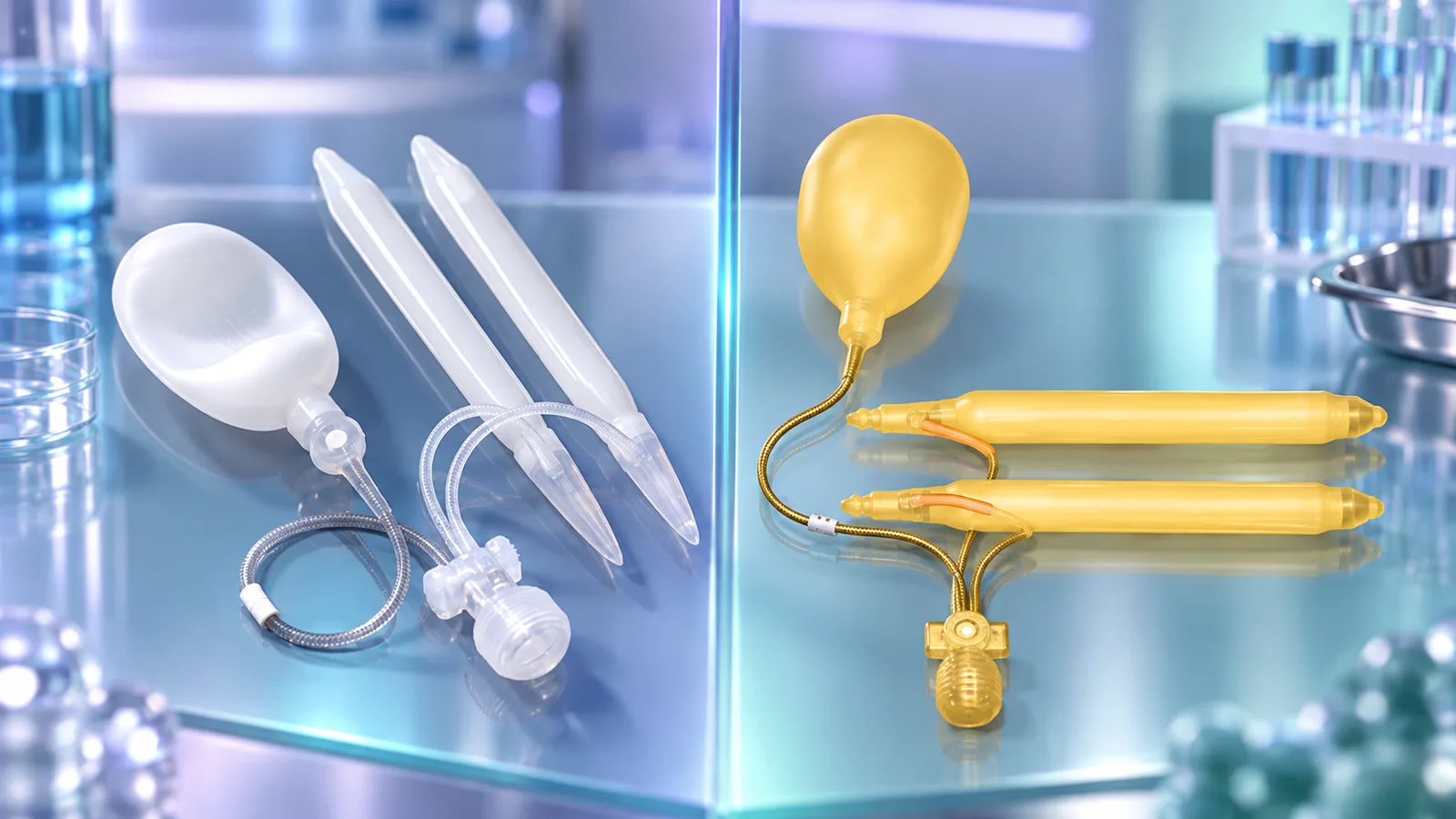
- A Boston Scientific penile implant and Coloplast Titan are both established three-piece inflatable prostheses, and current guidelines do not identify either manufacturer as universally superior.
- AMS 700 offers LGX, CX and CXR cylinders; LGX uniquely provides longitudinal expansion characteristics, while Titan Bioflex cylinders generally emphasize girth expansion and axial rigidity.
- AMS uses InhibiZone rifampin/minocycline antibiotic treatment, while Titan uses HydroVANTAGE hydrophilic coating that absorbs an aqueous antimicrobial solution selected by the surgical team.
- Comparative studies report high satisfaction with both implants, and systematic reviews find the available evidence insufficient to declare a clear winner on durability or overall clinical outcomes.
- Surgeon experience may matter more than brand: a 2025 Medicare analysis found lower adjusted one-year reoperation odds among patients treated by higher-volume penile prosthesis surgeons.
A Boston Scientific penile implant and a Coloplast Titan are both established three-piece inflatable penile prostheses, and current evidence does not prove that one is universally better. AMS 700 offers LGX, CX and CXR cylinders plus InhibiZone antibiotic treatment; Titan uses Bioflex cylinders and HydroVANTAGE hydrophilic coating. The better choice depends mainly on anatomy, priorities and surgeon experience.
That answer may be less satisfying than being told:
“Brand A is the best penile implant.”
But it is much closer to what the evidence actually shows.
Both systems have been used extensively.
Both can provide reliable erections.
Both have high patient-satisfaction data.
Both can eventually develop mechanical problems.
Both have infection-reduction technologies.
And both contain enough different configurations that comparing simply “AMS versus Titan” can hide important differences within each product family.
For example, the AMS 700 LGX behaves differently from the AMS 700 CX.
The AMS 700 CXR solves a different anatomical problem again.
Likewise, a standard Coloplast Titan cylinder should not be treated as identical to Titan Narrow Base, and pump configuration also matters.
That is why the clinically useful question is not:
“Which company wins?”
It is:
“Which cylinder, pump and reservoir configuration is most appropriate for my anatomy, my priorities and the surgeon who will actually implant it?”
A systematic literature review specifically comparing AMS 700 and Coloplast Titan concluded that durability and survival were broadly similar, patient-satisfaction comparisons were inconsistent and the available evidence was insufficient to establish a superior device. Current European Association of Urology guidance likewise states that evidence does not demonstrate universal superiority of one manufacturer over another.
This article compares the two systems directly on the points that actually matter.
Boston Scientific Penile Implant vs Coloplast Titan: Quick Verdict
If you want the entire comparison in one table, start here.
Question | Boston Scientific AMS 700 | Coloplast Titan |
|---|---|---|
Device class | Three-piece inflatable penile prosthesis | Three-piece inflatable penile prosthesis |
Main cylinder material/design | Silicone-based multilayer designs with model-specific expansion characteristics | Bioflex polyurethane-based cylinders |
Main cylinder options | LGX, CX, CXR | Standard, Narrow Base, XL |
Longitudinal expansion option | Yes — LGX | No dedicated LGX-style length-expansion cylinder |
Girth-focused option | CX; LGX also expands in girth | Strong radial/girth expansion |
Narrow option for fibrosis | CXR | Titan Narrow Base |
Infection-control surface | InhibiZone: rifampin + minocycline impregnated into device | HydroVANTAGE hydrophilic coating that absorbs surgeon-selected aqueous solution |
Traditional pump | MS Pump | Titan / Titan Touch |
Newer pump in some markets | TENACIO | Titan Touch |
Deflation concept | Dedicated deflation button | One Touch Release on Titan Touch |
Largest commonly documented cylinder | CX up to 24 cm | XL configurations up to 28 cm |
Reservoir | Yes | Yes |
Strongest reason to consider it | Broad cylinder choices, including LGX longitudinal expansion | High rigidity/girth characteristics and broad sizing |
Clearly superior clinically? | No | No |
The last row is the most important.
The EAU guideline states that there are currently no high-quality head-to-head trials proving one manufacturer's implant superior overall.
A 2020 systematic review reached essentially the same conclusion after examining the available AMS 700 and Titan comparative literature.
So if a website gives every patient the same answer before knowing his anatomy, fibrosis, hand function or previous surgery, the comparison is probably too simple.
Difference 1: AMS 700 Gives More Cylinder Personalization—Titan Emphasizes Bioflex Rigidity
The first major difference is not the company name.
It is the cylinder architecture.
Boston Scientific AMS 700 cylinder choices
The AMS 700 family includes three major cylinder designs:
AMS 700 LGX
AMS 700 CX
AMS 700 CXR
These should not be viewed as good, better and best.
They exist because patients do not all have the same anatomy.
AMS 700 LGX
LGX stands for Length and Girth eXpansion.
The cylinders are designed to expand in both dimensions during inflation.
Boston Scientific states that up to 20% cylinder elongation may be possible depending on the patient's anatomy.
That statement needs careful interpretation.
It describes what the cylinder can do.
It does not mean every man gains 20% visible penile length.
The tunica albuginea, fibrosis, previous surgery and baseline anatomy determine how much expansion the implanted system can actually achieve.
The LGX is therefore interesting for men concerned about length preservation, but it is not a guaranteed enlargement device.
AMS 700 CX
The CX is a controlled-expansion design emphasizing girth expansion and axial rigidity without the LGX's specific longitudinal-expansion behavior.
It is also offered across a broad length range.
For many straightforward implant patients, the CX is a well-established option.
AMS 700 CXR
CXR is narrower.
That makes it valuable when standard cylinders cannot safely fit.
Examples can include:
severe corporal fibrosis;
previous infected implant removal;
priapism-related fibrosis;
and selected revision situations.
Current Boston Scientific ordering information continues to list LGX, CX and CXR configurations with both MS and TENACIO pump systems in relevant markets.
Coloplast Titan cylinder choices
Titan takes a different approach.
Its cylinders use Bioflex, a proprietary polyurethane-based material.
Coloplast offers:
standard Titan cylinders;
Titan Narrow Base;
and larger XL configurations.
The company emphasizes radial expansion, axial rigidity and mechanical strength.
Titan XL components extend to 24, 26 and 28 cm in current U.S. ordering information.
Again:
a 28 cm implant does not mean a 28 cm visible penis.
A substantial part of the cylinder lies within the internal corporal roots.
Cylinder length is a surgical fitting measurement.
It is not a cosmetic score.
What do laboratory studies show?
Independent physical testing demonstrates that the implants genuinely behave differently.
A comparative laboratory study measured AMS LGX, CX, CXR and Titan systems and found that the Titan Touch cylinder had greater measured girth than the AMS LGX and CX in the tested configurations, while the AMS LGX uniquely increased in length during inflation. The authors emphasized that the clinical significance of those engineering differences remained poorly defined.
Another ex-vivo study tested AMS 700 LGX and Titan cylinders against forces designed to imitate penetration and gravity. Titan resisted longitudinal and horizontal deformation more strongly in that experiment.
But that is a laboratory result.
It does not prove that every man receiving Titan has:
better intercourse;
greater satisfaction;
fewer revisions;
or a more durable implant.
That is an important distinction.
So which cylinder is better?
It depends on what problem the surgeon is solving.
A patient whose priority is maintaining as much functional length as his anatomy permits may have a reason to discuss LGX.
A man with very scarred, restricted corpora may need CXR or Titan Narrow Base.
A patient with substantial Peyronie's deformity may value cylinder rigidity.
Another man may have completely routine anatomy where either CX or Titan would work well.
The best penile implant is therefore often not the device with the strongest laboratory number.
It is the device whose engineering characteristics solve the patient's anatomical problem.
Difference 2: InhibiZone vs HydroVANTAGE — Two Different Infection-Control Strategies
Both manufacturers have invested heavily in preventing prosthesis infection.
They do it differently.
This is one of the most meaningful technical differences between AMS 700 and Titan.
How Boston Scientific InhibiZone works
AMS 700 devices are available with InhibiZone™ Antibiotic Treatment.
InhibiZone uses two antibiotics:
rifampin
and
minocycline hydrochloride.
The antibiotics are incorporated into tissue-contacting components of the prosthesis during manufacturing and are intended to elute when exposed to the body's warm, moist environment.
That means the antimicrobial combination is standardized by the manufacturer.
The surgeon does not need to choose a separate dip solution for the treated device.
Historically, large post-market data have associated antibiotic-treated AMS implants with lower infection-related revision than older untreated devices.
Those data support InhibiZone as a meaningful infection-prevention technology.
They do not mean infection becomes impossible.
How Coloplast HydroVANTAGE works
Titan uses HydroVANTAGE™ hydrophilic coating.
Instead of embedding one fixed antibiotic combination into the prosthesis, the hydrophilic coating absorbs an aqueous solution when the surgical team submerges the device before implantation.
That gives the surgeon greater flexibility over the antimicrobial solution used.
So the conceptual difference is:
AMS 700: antibiotic combination incorporated by the manufacturer.
Titan: hydrophilic coating that can absorb the surgical team's chosen solution.
Neither concept is automatically superior in every operating room.
Why the Titan dip matters
Because Titan can absorb different solutions, infection performance can depend partly on the antimicrobial regimen selected by the surgeon.
That is one reason comparing “AMS infection rate” with “Titan infection rate” is much harder than it first appears.
The Titan studies may involve different dips.
The AMS studies may involve different generations of InhibiZone devices.
Patient populations differ.
Revision cases differ from first-time implants.
Diabetes prevalence differs.
Surgeon technique differs.
And many studies are retrospective.
The 2020 systematic review of AMS versus Titan found that infection outcomes varied according to Titan dipping solution and concluded that the available literature did not establish overall device superiority.
Should infection protection decide the brand?
Usually not by itself.
Both modern systems have established infection-reduction strategies.
The EAU notes that contemporary coated prostheses and modern surgical protocols have substantially reduced infection risk in primary implantation.
Other factors can matter at least as much:
Is this a first implant or revision?
Has the patient had a previous prosthesis infection?
Is diabetes well controlled?
Is there an active urinary or skin infection?
How often does the surgeon perform prosthetic surgery?
What is the center's infection-prevention protocol?
Which antibiotic regimen is being used?
Those questions are more meaningful than asking which coating has the most attractive marketing name.
Difference 3: AMS MS/TENACIO vs Titan Touch Pump
The pump is the part of the system the patient interacts with repeatedly after recovery.
That makes pump preference surprisingly important.
You can have an excellent cylinder system and still dislike your implant if operating the pump is frustrating.
AMS 700 MS Pump
The Momentary Squeeze, or MS Pump, has been associated with the AMS 700 for years.
The patient repeatedly squeezes the pump bulb to move fluid from the reservoir into the cylinders.
For deflation, he activates the deflation mechanism to move fluid back toward the reservoir.
The system includes a lock-out mechanism intended to reduce unintended auto-inflation.
AMS 700 TENACIO Pump
Boston Scientific now also markets the TENACIO™ Pump.
As of 2026, the U.S. AMS 700 product line includes TENACIO configurations for LGX, CX and CXR alongside MS Pump configurations.
TENACIO incorporates redesigned tactile features intended to make orientation and operation easier.
Boston Scientific also publishes bench-testing comparisons against the MS Pump.
Those bench results should not be converted automatically into claims that TENACIO produces better clinical satisfaction.
A newer pump can have attractive engineering characteristics before decades of independent clinical experience accumulate.
Titan Touch pump
Coloplast's best-known current patient-facing pump is the Titan Touch.
Its One Touch Release system is intended to simplify initiation of deflation.
The patient still repeatedly pumps to create the erection.
The “one touch” element refers to the deflation mechanism rather than instant erection.
Current Coloplast documentation describes Titan and Titan Touch as two pump configurations within the same Titan family.
What does comparative clinical evidence say about pump satisfaction?
A comparative study involving 248 men assessed 194 AMS 700 CX recipients and 54 Titan recipients.
Overall satisfaction was high in both groups.
However, in that study, only 4% of AMS 700 CX patients reported dissatisfaction with deflation compared with 24% of Titan recipients. The same study favored AMS on several questionnaire items.
That sounds like a strong advantage for AMS.
But it should not be treated as a final verdict.
The groups were substantially unequal in size.
Pump generations and surgical practice evolve.
And another long-term comparative study of 55 men found essentially identical EDITS satisfaction scores:
77.2 for AMS 700 CX
versus
77.5 for Titan.
The difference was not statistically significant.
This is exactly why one comparison should not be used to declare a brand winner.
Hand strength also matters
A prospective study allowed older men to operate different implant models in standardized demonstration models.
The researchers evaluated hand pinch strength and device preference, showing that the physical characteristics of the patient's hands can influence which pump feels easier to use.
That is clinically sensible.
Someone with:
arthritis;
neuropathy;
tremor;
weak grip;
or neurological disease
may have a very different pump preference from a healthy 55-year-old.
Whenever possible, a patient deciding between devices should handle demonstration pumps before surgery.
That tells him more about usability than reading another man's penile implant reviews online.
Difference 4: Titan Usually Wins on Raw Girth and Rigidity Tests; AMS LGX Has the Unique Length-Expansion Feature
This is perhaps the best-known engineering contrast.
Titan is commonly associated with:
girth
and
rigidity.
AMS LGX is commonly associated with:
length expansion.
Both descriptions contain truth.
Both can also become misleading marketing slogans.
What laboratory testing says about Titan rigidity
In the ex-vivo Scovell study, Titan cylinders resisted simulated penetration and gravitational forces better than AMS 700 LGX cylinders across the tested pressures.
A separate physical comparison found Titan Touch had greater measured girth than the tested AMS LGX and CX cylinders.
Those are legitimate engineering differences.
But neither study demonstrated that Titan recipients have universally superior intercourse.
Clinical outcomes are influenced by the body surrounding the cylinders.
The tunica albuginea constrains expansion.
Fibrosis changes mechanics.
Cylinder length matters.
The amount of inflation matters.
Surgeon sizing matters.
And the patient's anatomy does not behave like a laboratory test fixture.
What makes AMS LGX different?
Among the devices tested in the comparative physical study, LGX uniquely demonstrated longitudinal expansion.
That supports the basic engineering distinction behind the LGX name.
The practical question is whether that characteristic benefits a particular patient.
It may be attractive when:
length preservation is a major concern;
the corporal tissues remain reasonably compliant;
and there is enough anatomy to accommodate a standard LGX cylinder.
It may be less useful in a severely fibrotic penis that physically cannot expand well.
Does Titan make the penis wider?
The implant cylinders can provide greater radial expansion than some comparator cylinders under laboratory conditions.
That does not make Titan a cosmetic girth-enlargement operation.
The surgeon is still filling the corporal space safely.
If the tunica permits more expansion, the inflated shaft can appear fuller.
If fibrosis restricts the tissue, the cylinder cannot simply force unlimited growth.
Does LGX make the penis longer?
The same rule applies.
The cylinder has longitudinal expansion capability.
The penis surrounding it determines what can actually happen.
No ethical implant consultation should promise:
“Titan gives you X more girth.”
or
“LGX gives you X more centimetres.”
Those claims ignore anatomy.
Which is better for Peyronie's disease?
This is where rigidity becomes clinically interesting.
Peyronie's disease can create:
scar tissue;
curvature;
narrowing;
hinge deformity;
and shortening.
A firmer cylinder can theoretically provide useful support during penile modelling.
But actual comparative clinical evidence again fails to show a universal winner.
A study of 138 men with Peyronie's disease and erectile dysfunction compared 88 AMS 700 CX implants with 50 Titans.
Both achieved effective penile straightening and high satisfaction.
Estimated five-year mechanical survival was:
91% for AMS 700 CX
versus
87% for Titan.
The difference was not statistically significant.
So even in a condition where Titan's rigidity sounds particularly attractive, clinical evidence does not justify telling every Peyronie's patient to choose Titan.
For patients facing combined implant and curvature correction, see the dedicated penile prosthesis with Peyronie's correction pathway.
Difference 5: Mechanical Reliability Is Similar Enough That the Evidence Does Not Name a Winner
Patients frequently ask:
“Which penile implant lasts longer?”
That is a reasonable question.
Unfortunately, the literature does not provide the simple brand ranking people expect.
Why durability comparisons are difficult
An implant introduced twenty years ago naturally has longer follow-up than a newer pump configuration.
A study following one device for ten years cannot fairly be compared with another study following a competing system for three years.
The populations may also differ.
Revision risk changes with:
age;
diabetes;
Peyronie's disease;
previous pelvic surgery;
previous implant;
surgeon;
and surgical era.
Manufacturers also continuously modify pumps, tubing, surfaces and production methods.
Therefore, old survival curves describe the implants used during those years—not necessarily every configuration implanted in 2026.
What does the direct AMS vs Titan review say?
The systematic review by Atri and colleagues concluded that prosthesis durability and survival were similar overall and that existing evidence was insufficient to determine a superior device.
This is probably the best single answer to the consumer question.
What does newer broader evidence say?
A 2025 systematic review examined removal and mechanical-failure data for major three-piece inflatable prostheses.
Reported mechanical-failure ranges varied widely between studies.
AMS studies included longer follow-up in some cohorts, while Titan studies often had shorter median follow-up.
The authors specifically warned against straightforward numerical brand ranking because the studies were heterogeneous.
This matters enormously.
Someone could cherry-pick:
the lowest Titan failure percentage;
and
the highest AMS failure percentage
and create an advertisement claiming Titan is dramatically more reliable.
Another person could select different papers and manufacture the opposite conclusion.
That is not evidence-based comparison.
What should a patient take from durability data?
Both devices are designed as long-term implants.
Neither is guaranteed for life.
Either can eventually require revision.
Possible mechanical causes include:
cylinder leakage;
tubing failure;
pump malfunction;
reservoir malfunction;
connector problems;
or other component failure.
The real decision is therefore not:
“Which implant never breaks?”
There is no such prosthesis.
Instead ask:
“If this implant eventually fails, who will diagnose it, what will the warranty cover and where would revision be performed?”
That is particularly important for international patients.
Difference 6: Cost Usually Depends More on the Treatment System Than the Brand
Searchers looking for the best penile implant often end up comparing prices.
This can distort the decision.
The AMS 700 and Coloplast Titan are both premium three-piece inflatable systems.
But there is no meaningful worldwide price difference that applies in every country or hospital.
Why device prices vary
Hospitals negotiate purchasing contracts.
Distributors differ.
Import costs differ.
Taxes differ.
Currencies fluctuate.
A hospital that uses large numbers of one device may obtain better procurement pricing.
Another center may price all premium three-piece implants identically.
So even if one manufacturer has a higher acquisition price in one market, that does not mean every patient globally pays more for that implant.
The implant is only one part of the bill
A complete penile implant quote can contain:
the prosthesis;
surgeon fee;
anaesthesia;
anaesthetist;
operating theatre;
hospital stay;
nursing;
blood tests;
medication;
postoperative reviews;
and, in medical travel, hotel and transfers.
This is why comparing:
€X for AMS
with
€Y for Titan
is only useful when every other component is the same.
Our live penile implant surgery cost in Turkey page is the better place to keep current pricing because device and hospital costs change over time.
An evergreen brand-comparison article should not hard-code a price that becomes inaccurate six months later.
Should you choose the cheaper device?
Only after both devices have been judged clinically appropriate.
If your surgeon says:
“Either implant is appropriate for your anatomy, and I have substantial experience with both,”
then cost can reasonably become part of the preference discussion.
If your surgeon says:
“Your severe fibrosis makes this narrower cylinder a substantially safer fit,”
then saving money by insisting on another device is not sensible.
Device choice comes before price when anatomy creates a meaningful difference.
Difference 7: Surgeon Volume May Matter More Than the Logo on the Implant
This may be the most important section in the article.
Patients spend enormous time researching AMS versus Titan.
They often spend much less time asking how frequently the surgeon performs penile prosthesis surgery.
The available outcome literature suggests those priorities may be backwards.
What does surgeon-volume research show?
A 2025 study analyzed 8,343 Medicare patients who underwent penile prosthesis implantation.
The highest-volume surgeons performed more than 31 cases per year, while the lowest quartile performed fewer than six.
At one year, patients treated by the highest-volume surgeons had approximately 25–28% lower odds of reoperation in adjusted analyses.
An earlier study of 14,969 inflatable penile prosthesis patients found that implants placed by lower-volume surgeons were more likely to require reoperation for infection.
Compared with surgeons performing more than 31 cases annually, patients treated by very low-volume implanters had markedly higher infection-related reoperation risk.
This does not mean a surgeon performing 25 cases is automatically unsafe.
And it does not establish 32 procedures as a magical threshold.
The studies use volume categories for statistical analysis.
But the pattern matters:
experience with penile prosthesis surgery is associated with outcomes.
Why would volume matter?
Penile implant surgery includes a series of technical decisions that are difficult to capture in product brochures.
The surgeon must:
measure both corpora accurately;
manage fibrosis;
avoid crossover;
avoid perforation;
position distal cylinder tips correctly;
choose rear-tip extenders;
position the pump;
select reservoir placement;
manage previous pelvic surgery;
recognize urethral injury;
handle Peyronie's curvature;
and prevent contamination.
An experienced surgeon has encountered more variations of those problems.
The device cannot compensate for poor sizing.
Neither manufacturer can fix a misplaced pump after the incision closes.
A perfect cylinder cannot prevent infection if the operative process is poor.
What is the best penile implant surgeon?
There is no single global title called “best penile implant surgeon.”
A more useful definition is a surgeon who:
performs prosthetic urology regularly;
has experience with the device being proposed;
can manage revisions and complications;
can explain alternative devices;
operates in an appropriate hospital environment;
and gives realistic expectations rather than guaranteeing outcomes.
That is why Andrology Abroad's surgeon directory should be used as a starting point for comparing qualifications and expertise rather than treating implant brand as the only decision.
Which Implant Is Better in Specific Patient Situations?
This is where the comparison becomes clinically useful.
There is no winner for everyone.
But different characteristics can make one system more attractive in particular scenarios.
If penile length preservation is the main concern
The AMS 700 LGX deserves discussion because it is specifically engineered for longitudinal as well as radial expansion.
That does not mean LGX guarantees enlargement.
But if the anatomy is suitable and length preservation is a major priority, its design is directly relevant.
Titan does not have a direct equivalent to LGX's longitudinal-expansion mechanism.
Likely discussion
Potential edge: AMS 700 LGX
But only when anatomy permits it.
If maximum cylinder rigidity is the main concern
Independent ex-vivo studies have shown greater resistance to certain bending and axial forces with Titan than AMS LGX under tested conditions.
That may matter in:
significant corporal deformity;
Peyronie's disease;
or patients and surgeons who strongly prioritize axial rigidity.
Likely discussion
Potential engineering edge: Titan
But clinical superiority is not established.
If the corpora are severely fibrotic
Both manufacturers have narrower options.
AMS offers CXR.
Coloplast offers Titan Narrow Base.
The choice can depend on the actual corporal diameter reached during dilation, available lengths, surgeon experience and tissue quality.
Likely discussion
No automatic winner.
The internal measurements decide.
If the patient strongly wants length-expanding cylinders
That is a specific AMS feature.
Likely discussion
AMS 700 LGX.
Again, length-expanding cylinder does not mean guaranteed penile enlargement.
If the patient values girth and cylinder stiffness
Titan has strong laboratory performance on radial dimension and rigidity.
Likely discussion
Titan deserves serious consideration.
But laboratory characteristics should be weighed against pump preference and surgeon experience.
If antibiotic coating simplicity matters
AMS InhibiZone provides a fixed rifampin/minocycline treatment from the manufacturer.
Titan HydroVANTAGE lets the surgeon select the aqueous antimicrobial solution absorbed by the coating.
Likely discussion
There is no proven universal winner.
The difference is philosophical:
standardized antibiotic impregnation vs flexible surgeon-selected hydrophilic dip.
If the patient has poor hand strength
Neither company should be chosen from a brochure.
The patient should try the demonstration pumps.
AMS now has both MS and TENACIO configurations in relevant markets.
Titan has Titan and Titan Touch options.
The easiest pump is the one the actual patient can reliably operate.
Likely discussion
Test the pumps before surgery.
If hand impairment is severe, a malleable prosthesis may sometimes be more practical than either inflatable system.
If the patient has Peyronie's disease
The direct comparative study found good straightening and satisfaction with both AMS 700 CX and Titan and did not identify a significant survival difference.
Likely discussion
Surgeon technique may matter more than brand.
The additional reconstructive steps can be more important than the company name printed on the implant card.
AMS 700 vs Titan for Penile Length
This subject deserves separate treatment because it drives a large amount of patient anxiety.
Neither device should be sold as penis-enlargement surgery.
The surgeon measures the internal corpora and selects cylinders that fit safely.
The implant fills existing anatomical space.
Why AMS LGX attracts length-conscious patients
LGX is specifically designed to expand longitudinally.
That makes it the natural focus for men worried about length.
But the surrounding tissues determine whether the potential expansion can occur.
A penis with significant fibrosis cannot necessarily accommodate the same expansion as healthy tissue.
Why Titan patients can still preserve good length
Titan does not need longitudinally expanding cylinders to produce a satisfactory functional length.
Correct corporal measurement matters.
Cylinder selection matters.
Rear-tip extender strategy matters.
Postoperative cycling can matter.
And the penis's preoperative condition matters enormously.
The question is therefore not:
“Does Titan shorten you?”
There is no evidence supporting such a simplistic claim.
The better question is:
“What is my current stretched penile length, what disease has already changed it, and how will the surgeon preserve the available corporal space?”
AMS 700 vs Titan for Girth
Titan tends to perform strongly in physical girth comparisons.
The comparative device study found greater cylinder girth for Titan Touch than AMS LGX or CX in the tested sizes.
But cylinder diameter is only part of the final penile girth.
The patient still has:
tunica;
corporal tissue;
skin;
glans;
and individual anatomy.
Therefore the correct interpretation is:
Titan has engineering characteristics favoring radial expansion.
The incorrect interpretation is:
“Titan guarantees a thicker penis.”
The second statement is not supported.
AMS 700 vs Titan for Natural Appearance
This is much more subjective.
Both are three-piece inflatable implants.
Both can transfer fluid out of the cylinders after intercourse.
Both therefore provide a softer resting state than a permanently semi-rigid prosthesis.
Natural appearance depends on:
how fully the device deflates;
cylinder fit;
penile skin;
glans engorgement;
body habitus;
implant positioning;
and the individual patient's baseline anatomy.
There is no strong clinical evidence showing one brand universally looks more natural.
A man whose implant is correctly sized and fully deflated may be far more satisfied than someone who receives his preferred brand but has unrealistic expectations.
AMS 700 vs Titan for Glans Firmness
Neither implant mechanically inflates the glans.
The cylinders sit inside the corpora cavernosa.
The glans remains largely dependent on biological blood flow.
Therefore:
AMS 700 does not guarantee a firmer glans than Titan.
And:
Titan does not guarantee a firmer glans than AMS.
If glans engorgement is poor, the explanation is often the patient's vascular response or distal support rather than manufacturer identity.
AMS 700 vs Titan for Sensation and Orgasm
Neither system is designed to alter skin sensation or orgasm.
Both restore mechanical penile rigidity.
Neither replaces the dorsal sensory nerves.
Neither creates libido.
Neither mechanically creates orgasm.
So the brand decision should not be based on a claim that one implant provides:
better orgasm;
more sensation;
or more desire.
If those functions are impaired before surgery because of neurological disease, diabetes, prostate surgery or medication, changing prosthesis manufacturer may not correct them.
What Do Real Comparative Patient Studies Say?
There are surprisingly few truly useful brand-comparison studies.
That is important.
The internet makes AMS versus Titan look like an enormous evidence-based rivalry.
The actual comparative clinical literature is much smaller.
Study 1: 248 patients
The study of 248 men found high satisfaction with both devices.
Some questionnaire measures favored AMS 700 CX.
Deflation dissatisfaction was reported more often by Titan patients.
But both prostheses provided reliable intercourse and most patients learned to use them appropriately.
Study 2: Long-term comparison
A smaller long-term study of 55 men found essentially identical EDITS satisfaction scores:
AMS 700 CX: 77.2
Titan: 77.5
There was no statistically significant difference.
Study 3: Peyronie's comparison
Among 138 men with Peyronie's disease, both implants achieved good straightening and high satisfaction.
Five-year mechanical survival estimates numerically favored AMS CX but did not differ significantly.
Study 4: Systematic review
The systematic review synthesizing the comparative evidence concluded that no device had been proven superior.
Some biomechanical characteristics favored Titan.
Some satisfaction observations favored AMS.
Durability was broadly similar.
Evidence quality remained insufficient for an overall winner.
That is the current honest position.
Why Websites That Declare a Winner Should Be Read Carefully
There is nothing wrong with a surgeon preferring one implant.
Experience matters.
A surgeon may know one system extremely well.
That can be an advantage.
The problem begins when preference is presented as universal scientific fact.
Manufacturer evidence is useful—but it is still manufacturer evidence
Boston Scientific publishes studies and technical material showing the advantages of AMS 700.
Coloplast publishes studies and technical material showing the advantages of Titan.
That is expected.
Manufacturers know their products better than almost anyone.
Their technical documents are essential for understanding:
sizes;
materials;
pumps;
coatings;
and contraindications.
But a comparative marketing claim should be distinguished from independent clinical evidence.
For example, Coloplast highlights Titan's superior rigidity and girth in physical testing.
Boston Scientific emphasizes the clinical history of InhibiZone and its newer TENACIO system.
Those facts belong in the comparison.
They should not automatically decide it.
Clinics may also have incentives
A surgical center may:
purchase one manufacturer's implants in larger volumes;
have negotiated pricing;
have staff trained around one pump;
or have a surgeon who has used one system for years.
That does not make the recommendation dishonest.
Familiarity can improve workflow.
But a patient should still ask:
“Are you recommending this implant because it suits my anatomy, because you prefer operating with it, or both?”
A credible surgeon should be comfortable answering.
The clearest red flag
Be cautious with claims like:
“Titan is the best penile implant.”
or
“AMS is always superior.”
without explaining:
patient anatomy;
the specific cylinder model;
study quality;
conflicts of interest;
surgeon experience;
and what outcome “best” refers to.
Best for length?
Best for girth?
Best for fibrosis?
Best pump for this man's hands?
Best five-year mechanical survival?
Best price?
Those are different questions.
What Should Matter More Than Brand?
The hierarchy should usually be:
1. Correct indication
The patient should genuinely need a penile prosthesis.
2. Surgeon expertise
The surgeon should perform prosthetic urology regularly.
3. Anatomy
Corporal length, diameter, fibrosis and curvature determine what can fit.
4. Device configuration
LGX, CX, CXR, Titan standard, Titan NB and pump options are chosen here.
5. Patient preference
Length concerns, pump feel, concealment and mechanical characteristics matter.
6. Hospital and infection protocol
A premium prosthesis still requires a proper surgical environment.
7. Cost
Once clinically suitable options are established, price becomes reasonable to compare.
Brand is part of the decision.
It is not the first decision.
What Should You Ask the Surgeon Before Choosing?
Before choosing between a Boston Scientific penile implant and Titan, the patient should be able to answer these questions:
Why am I a candidate for a penile prosthesis?
Which exact AMS or Titan model are you recommending?
Why does that cylinder fit my anatomy?
Do I have corporal fibrosis?
Do I have Peyronie's disease?
What are my internal corporal measurements likely to be?
Which pump would I receive?
Can I try a pump demonstration before surgery?
What infection-control protocol do you use?
If Titan is used, what solution do you use with the hydrophilic coating?
If AMS is used, will the device include InhibiZone?
What is your annual penile implant volume?
How often do you perform revision prosthesis surgery?
Which device do you use most often and why?
Would you use a different model if my anatomy looks different during surgery?
What happens if severe fibrosis is found?
What should I expect regarding penile length?
What should I expect regarding glans firmness?
What does the full quote include?
What happens financially if revision is needed later?
The answers are more informative than asking:
“Which brand do you like?”
How Important Is the Best Penile Implant Surgeon Compared With the Device?
Potentially very important.
The 2025 Medicare analysis offers unusually current evidence.
Among more than 8,000 patients, higher surgeon volume was associated with lower adjusted odds of one-year reoperation.
An earlier dataset of nearly 15,000 implant cases found a strong relationship between lower surgeon volume and infection-related reoperation.
These are observational data.
They do not prove that volume alone causes the difference.
High-volume surgeons may:
work in better-resourced centers;
select patients differently;
have more specialized teams;
or use more standardized protocols.
But they reinforce a practical point:
the person implanting the device matters.
That makes questions about surgeon volume at least as legitimate as questions about Bioflex or InhibiZone.
What About Penile Implant Reviews?
Patient reviews can help answer questions clinical trials often miss.
They can tell you:
how a pump feels;
how long it took to become comfortable;
whether the device is easy to conceal;
how recovery felt;
and whether the patient felt adequately counselled.
But reviews are poor tools for determining which brand is scientifically superior.
A patient does not experience both implants simultaneously.
He experiences:
one implant;
one surgeon;
one hospital;
one anatomy;
one recovery;
and one set of expectations.
Someone who loves his Titan cannot tell you what would have happened if the same surgeon implanted an AMS LGX.
Someone dissatisfied with AMS cannot know whether Titan would have solved the issue.
Use Andrology Abroad patient reviews to understand treatment experiences, but use comparative clinical evidence for brand comparisons.
A Note About the Search Term “Domino Penile Implant”
Your original keyword export includes “domino penile implant.”
I would not use this as a supporting keyword for this comparison article.
Web and PubMed results for that phrase relate mainly to improvised pieces of domino inserted under the penile skin as foreign bodies, including case reports of infection and erosion. That is completely different from an inflatable penile prosthesis used to treat erectile dysfunction.
Trying to force that phrase into an AMS-versus-Titan article would mix two different search intents and weaken medical accuracy.
For SEO, I would drop it rather than chase every keyword in the export.
That is one of the small corrections I would make to the original Day 11 brief.
AMS 700 vs Titan: Who Should Consider Which?
There is no algorithm that replaces a surgeon's examination, but the following framework is reasonable.
Patient priority or issue | Device worth discussing |
|---|---|
Wants a cylinder with longitudinal expansion characteristics | AMS 700 LGX |
Strong priority on cylinder rigidity | Coloplast Titan |
Strong priority on radial/girth expansion | Coloplast Titan |
Standard anatomy, wants established controlled-expansion design | AMS 700 CX or Titan |
Severe corporal fibrosis | AMS 700 CXR or Titan Narrow Base |
Wants fixed manufacturer antibiotic treatment | AMS 700 with InhibiZone |
Surgeon prefers customizable antimicrobial dip | Titan HydroVANTAGE |
Limited hand strength | Test AMS and Titan pump options personally |
Peyronie's + ED | Both are established options |
Wants largest available cylinder sizes because anatomy requires them | Titan XL may offer larger nominal sizes |
Wants guaranteed enlargement | Neither |
Wants a lifetime device that never needs revision | Neither |
The final two rows deserve emphasis.
Neither manufacturer can promise permanent enlargement.
Neither can promise a prosthesis will never require revision.
So What Is the Best Penile Implant in 2026?
The evidence-based answer is:
there is no universally best penile implant.
There are better and worse matches.
AMS 700 may be the better match for a patient whose anatomy and priorities make LGX useful.
Titan may be the better match when strong radial expansion and rigidity are particularly valuable.
CXR may be more appropriate than either standard cylinder in heavily scarred corpora.
Titan Narrow Base may solve the same type of problem in another patient.
A patient with hand weakness may choose partly based on which pump he can actually operate.
A man with substantial Peyronie's deformity may benefit most from whichever system his high-volume reconstructive prosthetic surgeon uses most successfully.
And a patient with routine anatomy may do very well with either device.
That is why the EAU does not crown a manufacturer.
Expert perspective
Urologist Alan S. Polackwich, MD, and colleagues reviewed the available comparative AMS 700 and Titan literature and concluded:
“The literature is inconclusive about which device is superior.”
That is arguably the most useful sentence in the entire AMS-versus-Titan debate.
It does not mean the implants are identical.
They are not.
It means their differences have not translated into convincing evidence that one brand produces better overall clinical outcomes for every patient.
The Bottom Line
A Boston Scientific penile implant and a Coloplast Titan are both sophisticated three-piece inflatable penile prostheses with decades of clinical development behind them.
The AMS 700 family offers an unusually broad set of cylinder behaviors.
LGX provides longitudinal as well as radial expansion.
CX emphasizes controlled expansion and rigidity.
CXR gives surgeons a narrower option when fibrosis or anatomy restricts the corporal space.
Current AMS configurations can use the long-established MS Pump or the newer TENACIO Pump in relevant markets, and InhibiZone provides a standardized rifampin/minocycline antibiotic treatment.
The Coloplast Titan uses Bioflex cylinders.
Its engineering characteristics emphasize radial expansion and strong axial rigidity.
Titan is available in standard, Narrow Base and XL configurations, with current ordering information extending to 28 cm for XL cylinders.
Its HydroVANTAGE coating absorbs an aqueous antimicrobial solution selected by the surgical team, while the Titan Touch pump provides the One Touch Release deflation design.
Those are meaningful differences.
They do not establish a universal winner.
Independent laboratory testing has found Titan to be more resistant to particular bending and penetration forces, while comparative physical testing confirmed the unique longitudinal expansion of AMS LGX.
Clinical comparisons are less decisive.
A 248-patient study found high satisfaction with both implants but favored AMS 700 CX on certain satisfaction and deflation questions.
A separate long-term study found virtually identical overall satisfaction scores.
A Peyronie's study found effective straightening and high satisfaction with both and no statistically significant difference in five-year mechanical survival.
And the systematic review designed specifically to answer the AMS-versus-Titan question concluded that the evidence remains insufficient to declare one superior.
What may matter more is who implants it.
Recent national data found lower one-year reoperation odds among patients treated by higher-volume penile prosthesis surgeons. Earlier evidence also links greater surgeon volume with lower infection-related reoperation.
That changes the practical question.
Do not ask only:
“AMS or Titan?”
Ask:
“Which exact cylinder fits my anatomy?”
“Which pump can I operate?”
“Does my fibrosis or Peyronie's disease change the choice?”
“How often does this surgeon perform penile implants?”
“Does the surgeon genuinely work with both systems?”
“What infection protocol does the hospital use?”
“What happens if revision is needed?”
Those questions are much more likely to influence the quality of the eventual result.
If you are still deciding whether implantation itself is appropriate, start with the penile implant procedure guide.
If cost is part of the decision, compare the complete treatment pathway on the penile implant surgery cost in Turkey page rather than assuming the device with the lower headline price is better value.
You can also compare clinicians through the andrology surgeon directory, read patient reviews, and contact Andrology Abroad for an individual assessment.
The most defensible 2026 verdict is therefore simple:
AMS 700 versus Coloplast Titan is not a contest with one winner.
It is a matching problem.
The better implant is the one whose cylinder design, pump, sizing and infection-control strategy fit the patient's anatomy and priorities—and that an experienced prosthetic surgeon can implant well.
Common questions
Which is better, AMS 700 or Coloplast Titan?
What is the best penile implant in 2026?
Is Coloplast Titan harder than AMS 700?
Does AMS 700 give more penile length than Titan?
Does Coloplast Titan give more girth than AMS 700?
Which penile implant has the better infection coating?
Which is easier to use, AMS 700 or Titan Touch?
Which lasts longer, AMS 700 or Coloplast Titan?
Which penile implant is better for Peyronie's disease?
Does the penile implant surgeon matter more than the implant brand?
Sources
- European Association of Urology — EAU Guidelines on Sexual and Reproductive Health: Management of Erectile Dysfunction
- Atri E, Wong V, Barengo NC, Nieder AM, Polackwich AS. A Comparison Between AMS 700 and Coloplast Titan: A Systematic Literature Review. Cureus. 2020.
- Romero Otero J, et al. Comparison of the patient and partner satisfaction with 700CX and Titan penile prostheses. Asian Journal of Andrology.
- Morgado A, Cavadas AS, Figueiredo LP, Tomada N. Long-term patient-reported satisfaction with different inflatable penile prosthesis: comparison between AMS 700CX and Coloplast Titan. 2018.
- Chung E, Solomon M, DeYoung L, Brock GB. Comparison between AMS 700 CX and Coloplast Titan for Peyronie's disease treatment and remodeling. Journal of Sexual Medicine.
- Scovell JM, Ge L, Barrera EV, et al. Longitudinal and Horizontal Load Testing of Inflatable Penile Implant Cylinders of Two Manufacturers. Journal of Sexual Medicine. 2016.
- Comparative evaluation of physical characteristics of different inflatable penile prostheses.
- Andino JJ, et al. Association between surgeon procedure volume and reoperation rates for penile prosthesis implantation. Journal of Sexual Medicine. 2025.
- Boston Scientific — AMS 700 Inflatable Penile Prosthesis Product Line
- Coloplast — Titan Penile Implants
- Removal rate and mechanical failure in penile prosthesis implantation: A systematic review. International Journal of Impotence Research. 2025.
Last reviewed 14 September 2026. We re-review this article by 1 January 2027. This article is for information and is not a substitute for advice from a doctor who knows your history.