
ZSI 475®
The ZSI 475® is a 3-piece inflatable penile prosthesis manufactured by Zephyr Surgical Implants for men with erectile dysfunction who are candidates for penile implant surgery. It uses paired inflatable cylinders, a manual scrotal pump and a separate saline-filled pelvic reservoir, with a hydrophilic PVP coating designed to absorb an antimicrobial solution during surgical preparation.
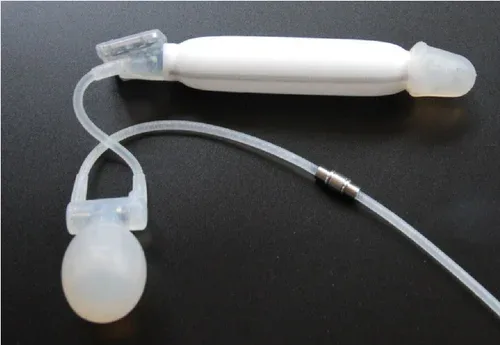
- True 3-piece inflatable system — The standard ZSI 475 includes two cylinders, a scrotal pump and a separate pelvic reservoir.
- Different from ZSI 475 FTM — The standard ZSI 475 is designed for implantation in native corpora cavernosa, while ZSI 475 FTM is a separate single-cylinder device designed specifically for a neophallus after phalloplasty.
- PVP hydrophilic coating — The cylinders use a polyvinylpyrrolidone coating designed to absorb an antimicrobial solution during implantation.
- Multiple adjustable sizes — The standard system includes 13, 16 and 19 cm cylinder pairs, with extenders allowing treatment of corporal lengths from approximately 12 to 24 cm or more; a separate 22 cm large-size configuration is also available.
- Mixed reliability evidence — Early multicenter results reported high satisfaction, but later independent experience identified a substantially higher mechanical-failure rate, making long-term durability less established than AMS 700 or Coloplast Titan.
About the ZSI 475®
What Is the ZSI 475?
The ZSI 475 is a 3-piece hydraulic penile prosthesis manufactured by the Swiss company Zephyr Surgical Implants.
It is designed to provide mechanically controlled penile rigidity for men with erectile dysfunction who are candidates for penile prosthesis surgery.
The prosthesis is implanted completely inside the body.
Two inflatable cylinders are positioned within the corpora cavernosa.
A manual pump is positioned inside the scrotum.
A separate saline-filled reservoir is positioned within the pelvis.
The components are connected through tubing to create a closed hydraulic system.
ZSI 475 Is a 3-Piece Implant
The standard ZSI 475 should be classified as a 3-piece inflatable penile prosthesis.
Its three functional component groups are:
Two paired intracavernosal cylinders
A scrotal pump
A separate pelvic reservoir
This is confirmed both by current manufacturer information and peer-reviewed clinical studies.
It should not be classified as a 2-piece penile implant.
ZSI 475 vs ZSI 475 FTM
The standard ZSI 475 and ZSI 475 FTM are different prostheses and should have separate CMS records.
The standard ZSI 475 is designed for men with native corpora cavernosa and uses two intracavernosal cylinders.
ZSI 475 FTM is specifically designed for implantation into a neophallus after phalloplasty.
The FTM version uses one inflatable cylinder, a separate reservoir and a pump designed for placement within the neoscrotum.
The two devices should therefore never be merged into one product page.
How the ZSI 475 Works
The device works through hydraulic fluid transfer.
When the patient repeatedly presses and releases the scrotal pump, saline moves from the pelvic reservoir into the paired cylinders.
The cylinders expand and become rigid.
Once the desired erection is achieved, the patient stops pumping.
To return the penis to a flaccid state, the patient activates the deflation valve located on the pump.
The saline then returns to the reservoir.
Closed Hydraulic System
The ZSI 475 is a closed hydraulic system.
The reservoir is filled with normal saline solution during implantation.
The same fluid circulates between the reservoir and cylinders during repeated inflation and deflation.
Routine refilling is not required under normal circumstances.
Loss of hydraulic function may indicate leakage or another mechanical problem and should be assessed by a prosthetic urologist.
Cylinder Construction
The ZSI 475 cylinders use a multilayer construction.
Manufacturer technical documentation describes three principal layers:
An external medical-grade silicone layer
A biocompatible polyester reinforcement layer
An internal medical-grade silicone layer
The reinforcing fabric is intended to improve resistance to repeated folding, pressure and puncture.
Cylinder Rigidity
When inflated, the cylinders are designed to provide sufficient axial rigidity for penetrative intercourse.
Manufacturer bench documentation reports resistance to internal pressure greater than 3.3 bar.
These are laboratory engineering measurements rather than direct clinical comparisons with other penile prostheses.
They should therefore not be used to claim that ZSI 475 is clinically more rigid than AMS 700 or Titan.
Cylinder Expansion
The ZSI 475 primarily increases cylinder diameter during inflation.
It is not designed as a dedicated longitudinal-expansion prosthesis comparable with AMS 700 LGX or Rigicon Infla10 AX.
The purpose of the implant is restoration of mechanical rigidity.
No predictable penile-length increase should be promised.
Current Standard Cylinder Sizes
Current manufacturer surgical documentation provides three standard cylinder pairs:
13 cm
16 cm
19 cm
The system also includes proximal and distal extenders that allow the surgeon to adapt the prosthesis to a range of corporal lengths.
Manufacturer information states that standard configurations can accommodate corpora from approximately 12 cm to 24 cm and beyond with extenders.
Large-Size ZSI 475
A separate large-size ZSI 475 configuration is available for longer corporal anatomy.
Manufacturer documentation describes a 22 cm base cylinder configuration intended for corporal lengths approximately 21 to 25 cm.
This configuration also has a larger inflated diameter than the standard sizes.
Cylinder Diameter
Manufacturer documentation describes different inflated diameters according to cylinder length.
Historical and current product documentation lists approximately:
13 cm cylinder — around 16 mm inflated diameter
16 cm cylinder — around 16 mm inflated diameter
19 cm cylinder — around 18 mm inflated diameter
22 cm large-size cylinder — approximately 21 mm inflated diameter
These dimensions describe prosthetic cylinder diameter and should not be converted into guaranteed postoperative penile girth.
Extenders
The ZSI 475 system includes proximal and distal extenders.
These allow the surgeon to adapt cylinder length to the measured corpora.
Manufacturer operating-room guidance describes using proximal extensions for lengths between the primary cylinder sizes and distal extenders for longer measurements.
Extenders are intended for anatomical sizing, not cosmetic length enhancement.
Reservoir
The ZSI 475 uses a separate reservoir implanted within the pelvis.
The reservoir stores saline while the cylinders are deflated.
During inflation, fluid moves into the cylinders.
During deflation, it returns to the reservoir.
Because the reservoir is a separate component, ZSI 475 should be compared with other 3-piece systems such as AMS 700, Coloplast Titan and Rigicon Infla10 rather than with AMS Ambicor.
Pump
The manual pump is implanted within the scrotum.
The patient presses and releases the pump repeatedly to inflate the cylinders.
A valve at the top of the pump is used for deflation.
Adequate hand strength, sensation and coordination are therefore necessary for independent operation.
PVP Hydrophilic Coating
ZSI 475 uses a hydrophilic polyvinylpyrrolidone, or PVP, coating.
The coating is designed to absorb an antimicrobial solution during surgical preparation.
This approach is conceptually similar to other hydrophilic penile prosthesis surfaces.
It should not be described as containing a permanently embedded fixed antibiotic combination.
Infection Prevention
The PVP coating is one component of infection-prevention strategy.
It does not eliminate infection risk.
Other important factors include surgical technique, skin preparation, antibiotic protocols, diabetes control, revision status and previous prosthesis infection.
Deep prosthesis infection may require removal or salvage surgery.
ZSI 475 vs AMS 700
Both ZSI 475 and AMS 700 are 3-piece inflatable penile prostheses.
Both use paired cylinders, a scrotal pump and a separate reservoir.
The major difference from an evidence perspective is maturity.
AMS 700 has decades of clinical use and extensive long-term mechanical-survival data.
ZSI 475 has a substantially smaller evidence base and published studies have reported conflicting durability results.
Therefore, ZSI 475 should not be presented as having equivalent long-term evidence simply because its hydraulic architecture is similar.
ZSI 475 vs Coloplast Titan
ZSI 475 and Titan are both 3-piece hydraulic implants.
Both use a separate reservoir and hydrophilic surface technology.
Titan has a significantly larger and longer-duration clinical evidence base.
The ZSI 475 uses its own multilayer silicone/polyester cylinder design and PVP coating.
There are insufficient robust comparative clinical data to conclude that one system is universally superior.
ZSI 475 vs Rigicon Infla10
Both prostheses are 3-piece inflatable systems manufactured by comparatively newer entrants to the penile prosthesis market.
Rigicon Infla10 has larger contemporary multicenter datasets, including several hundred patients.
Published ZSI 475 clinical cohorts are smaller.
Infla10 also offers distinct X and AX expansion configurations, whereas ZSI 475 is primarily a girth-expanding hydraulic cylinder.
ZSI 475 vs AMS Ambicor
ZSI 475 is a 3-piece prosthesis with a separate reservoir.
AMS Ambicor is a 2-piece prosthesis that incorporates fluid storage within the cylinder system.
This means Ambicor avoids separate pelvic reservoir placement.
ZSI 475 more closely follows the traditional 3-piece hydraulic architecture.
ZSI 475 vs Malleable Implant
A malleable prosthesis consists of continuously semi-rigid rods.
ZSI 475 can be inflated for intercourse and deflated afterward.
This generally allows better differentiation between erect and resting states.
The trade-off is greater mechanical complexity and the requirement to manipulate a scrotal pump.
Early Multicenter Clinical Outcomes
One early multicenter European study evaluated 29 ZSI 475 implantations in 28 patients.
Median follow-up was approximately 35 months.
The authors reported that all patients had a functional prosthesis at the end of follow-up.
Patient satisfaction was approximately 92.9%.
Reported complications included pump torsion requiring revision, tubing breakage and scrotal hematoma.
These results were encouraging but came from a small cohort.
One study author was also reported as a shareholder of the manufacturer, which should be considered when interpreting the findings.
Independent Single-Center Experience
A later independent study from the University of Bologna evaluated 15 patients implanted between 2014 and 2018.
Average follow-up was approximately 22 months.
Four patients experienced mechanical prosthesis failure during follow-up.
The authors therefore concluded that their initial experience showed a high rate of mechanical failure despite generally positive quality-of-life questionnaire results.
This study is important because it contrasts with the earlier favorable multicenter report.
Mechanical-Failure Concern
The 2025 systematic review comparing modern inflatable penile prostheses highlighted the ZSI 475's relatively high initial mechanical-failure rate.
The review reported an initial mechanical-failure figure of approximately 25.7% in the available ZSI evidence.
The authors considered the available ZSI data preliminary and inconclusive.
This is a significant limitation compared with established long-term devices.
Reliability Evidence Is Limited
There is currently no robust 10-year ZSI 475 device-survival dataset comparable with those available for AMS 700.
The available studies involve small patient numbers and relatively short follow-up.
For this reason, the CMS should avoid presenting a precise long-term lifespan claim as established clinical fact.
Manufacturer Lifespan Estimate
Zephyr's FAQ describes an estimated implant lifespan of approximately 5 to 7 years and states that its inflatable implant undergoes laboratory cycling tests.
This is a manufacturer estimate rather than a clinically validated median survival time.
It should not replace peer-reviewed survival evidence.
Five-Year Warranty
The current official ZSI 475 product page states a 5-year warranty.
This is notably different from the ZSI 475 FTM page, which states a 1-year warranty.
The CMS should therefore store the standard ZSI 475 warranty separately from the FTM device.
Warranty terms should still be confirmed for the implantation country and current distribution agreement.
Erectile Dysfunction After Prostatectomy
Men with persistent erectile dysfunction after radical prostatectomy may be candidates for ZSI 475 implantation.
The prosthesis creates rigidity mechanically and does not depend on cavernous nerve recovery.
Previous pelvic surgery may influence reservoir positioning.
Alternative reservoir placement may therefore be needed in selected patients.
Diabetes
Men with diabetes can develop severe vascular and neurological erectile dysfunction.
A penile implant can produce mechanical rigidity even when oral medication or injection therapy has failed.
However, diabetes can also influence surgical infection risk.
Appropriate medical optimization should therefore form part of preoperative assessment.
Peyronie's Disease
ZSI technical literature describes the device as potentially suitable for patients with Peyronie's disease.
A published single-center series also included patients who underwent additional corporoplasty and grafting for penile curvature.
The implant itself may help provide structural straightening, but significant residual curvature can require modeling, plication, incision or grafting.
There is far more published Peyronie's-specific evidence for AMS 700 CX and Coloplast Titan.
Corporal Fibrosis
Moderate fibrosis may still permit ZSI 475 implantation if adequate corporal dilation can be achieved.
Severe fibrosis can make cylinder placement more difficult.
The current operating manual describes corporal dilation during implantation.
For heavily scarred corpora, specialized narrow-cylinder prostheses or reconstructive techniques may sometimes be more appropriate.
Does ZSI 475 Increase Penile Length?
ZSI 475 should not be marketed as a penile-lengthening implant.
Its different cylinder lengths allow the surgeon to fit the prosthesis to the patient's measured corporal anatomy.
They do not represent selectable cosmetic penis lengths.
No specific external length gain should be guaranteed.
Does ZSI 475 Increase Penile Girth?
The cylinders expand circumferentially when inflated.
Different cylinder models also have different maximum inflated diameters.
However, visible penile girth depends on corporal dimensions, surrounding tissue and safe cylinder sizing.
The prosthesis should be positioned as erectile dysfunction treatment rather than cosmetic girth augmentation.
Concealability
When deflated, saline returns from the cylinders to the pelvic reservoir.
The cylinders become softer and easier to conceal under clothing than a continuously semi-rigid prosthesis.
Manufacturer information describes the device as soft when deflated.
Actual resting appearance depends on anatomy and surgical outcome.
Sensation and Orgasm
The implant is placed within the corpora cavernosa.
It does not intentionally remove penile sensory structures.
Manufacturer information states that the device is designed to preserve penile and glans sensitivity.
The implant restores rigidity but does not directly restore libido, sensation, ejaculation or orgasm if those functions are impaired by another condition.
Urination
The prosthesis is positioned within the corpora cavernosa rather than the urethra.
Under normal circumstances, it should not prevent urination.
Urinary complications can occur if urethral injury or erosion develops, but these are complications rather than expected device function.
Revision Surgery
Mechanical failure, infection, erosion, pump problems, tubing failure or component malposition may require revision surgery.
Revision may involve repair or replacement depending on the exact problem and device generation.
Patients should understand this possibility before choosing any hydraulic penile implant.
Regulatory Status
Current ZSI documentation identifies ZSI devices as CE marked.
A 2024 ZSI 475 family instruction-for-use document carries a CE mark with notified-body number 0476.
The device should therefore be listed as CE marked where applicable.
The ZSI 475 should not be listed as FDA approved in the United States unless future regulatory status changes.
MRI Status
Manufacturer patient information states that ZSI implants are safe in medical scanners.
However, for a precise medical-device comparison table, MRI status should be taken from the current model-specific IFU rather than interpreted from general marketing language.
The safest CMS wording is therefore to verify current ZSI documentation before publishing a formal MR Conditional or MR Safe classification.
Who May Be a Good Candidate for ZSI 475?
ZSI 475 may be considered for men with severe erectile dysfunction who have chosen a 3-piece inflatable penile prosthesis.
Candidates should have suitable corporal anatomy for standard-diameter cylinders.
They should have adequate manual dexterity to operate the pump.
It may also be considered in selected men after prostatectomy or with Peyronie's disease when the surgeon considers the device appropriate.
The shorter and less consistent durability evidence should be part of informed device selection.
What Should Patients Weigh Before Choosing ZSI 475?
The ZSI 475 offers the familiar functionality of a 3-piece hydraulic implant, adjustable sizing, PVP hydrophilic coating and a manufacturer-stated 5-year warranty.
Its main limitation is the evidence base.
Clinical studies are considerably smaller than those for AMS 700 and Titan, and published mechanical-failure findings are inconsistent.
Patients comparing prostheses should therefore consider not only device price and features but also long-term evidence, surgeon experience, service availability and revision support.
Is this device for you?
- •Men with severe treatment-resistant erectile dysfunction seeking a 3-piece inflatable penile prosthesis.
- •Patients wanting a conventional hydraulic erection and deflation mechanism.
- •Men whose corporal anatomy can accommodate standard ZSI 475 cylinders.
- •Selected patients after radical prostatectomy with persistent erectile dysfunction.
- •Selected men with erectile dysfunction and Peyronie's disease when additional straightening can be performed if necessary.
- •Patients with adequate hand dexterity to operate the manual scrotal pump.
- •Patients treated in markets where ZSI 475 is appropriately approved and supported.
- •Less mature evidence base — Published clinical series are much smaller than those for AMS 700 or Titan.
- •Conflicting reliability findings — Early favorable results contrast with later reports of substantial mechanical failure.
- •No established 10-year survival percentage — Long-term durability remains inadequately defined.
- •Requires manual pump operation — Patients with significant hand impairment may prefer a malleable prosthesis.
- •Separate reservoir required — Adds a third implanted hydraulic component.
- •Not a length-expanding implant — It should not be marketed for guaranteed penile elongation.
- •Mechanical failure may require revision — Tubing, pump and other failures have been reported.
- •Availability and service support vary by country — An important consideration for future revision or warranty claims.
How it compares
Every 3-piece inflatable implant a surgeon in our network may propose, side by side. The ZSI 475® column is highlighted.
| Attribute | ZSI 475®Zephyr Surgical ImplantsMid-range | AMS 700™ LGXBoston ScientificPremium | AMS 700™ CXBoston ScientificPremium | Coloplast Titan® Narrow BaseColoplastMid-range | Rigicon Infla10®RigiconMid-range | Coloplast Titan®ColoplastPremium | Rigicon Infla10® Pulse™ AXRigicon Mid-range | AMS 700™ CXRBoston ScientificPremium |
|---|---|---|---|---|---|---|---|---|
| Expansion | Girth / circumferential expansion | Length + girth | Girth / circumferential expansion | Restricted girth / circumferential expansion | Model dependent — X: girth; AX: length + girth | Girth / circumferential expansion | Length + girth | Girth / circumferential expansion |
| Rigidity | Hydraulic rigidity; reinforced three-layer cylinders | High hydraulic rigidity with controlled-expansion cylinders | High axial rigidity | High hydraulic rigidity for reduced-diameter corporal anatomy | High hydraulic axial rigidity | High axial rigidity; Bioflex® cylinders | High axial rigidity; reinforced four-layer inflatable cylinders | Hydraulic rigidity optimized for narrow corporal anatomy |
| Antibiotic coating | Hydrophilic PVP coating designed to absorb an intraoperative antimicrobial solution | InhibiZone™ available — rifampin + minocycline; non-InhibiZone configurations also available | InhibiZone™ antibiotic treatment available; rifampin + minocycline | HydroVANTAGE™ hydrophilic coating; absorbs surgeon-selected aqueous solution rather than containing fixed embedded antibiotics | HydroShield™ hydrophilic coating; absorbs surgeon-selected aqueous solution | Hydrophilic HydroVANTAGE™ coating; absorbs surgeon-selected aqueous solution — not a fixed embedded antibiotic combination | HydroShield™ hydrophilic coating; absorbs surgeon-selected aqueous solution | InhibiZone™ available — rifampin + minocycline; non-InhibiZone CXR configurations also exist |
| Reservoir | Separate saline-filled pelvic reservoir; 3-piece system | Separate fluid reservoir; 3-piece system | Separate fluid reservoir; 3-piece system | Separate Titan reservoir with Lock-out™ valve; 3-piece system | Separate AdaptiveReservoir™ with lock-out mechanism | Separate fluid reservoir with Lock-out™ valve; 3-piece system | Separate AdaptiveReservoir™ with lock-out valve; 3-piece system | Separate fluid reservoir; 3-piece system |
| Control | Manual scrotal pump with inflation and deflation valve | Scrotal inflation/deflation pump | Scrotal inflation/deflation pump | Scrotal Titan or Titan Touch pump depending on configuration | Pulse™ scrotal pump on current generation | Scrotal pump; Touch pump configurations available | Pulse™ scrotal pump | TENACIO™ or MS Pump™ depending on current configuration and market |
| Concealed when soft | Yes — cylinders deflate as saline returns to the reservoir | Yes — cylinders deflate for good concealability | Yes — cylinders deflate for improved concealment | Yes — cylinders deflate for improved concealment | Yes — cylinders deflate for improved concealment | Yes — inflatable cylinders deflate for improved concealment | Yes — inflatable cylinders soften when deflated | Yes — cylinders deflate for improved concealment |
| Cylinder material | Medical-grade silicone with biocompatible polyester reinforcement | — | — | Bioflex® | — | Bioflex® | — | — |
| Cylinder options | 13, 16 and 19 cm standard cylinders with extenders; separate 22 cm large-size configuration | 12, 15, 18 and 21 cm | 12, 15, 18 and 21 cm; 24 cm available by special order | Narrow Base: 11, 14, 16 and 18 cm; penoscrotal and infrapubic configurations | Infla10 X and Infla10 AX, plus market-dependent specialized configurations | Standard and narrow-base configurations; multiple lengths available | AX lengths: 12, 15, 18, 20, 22 and 24 cm | Current TENACIO configurations: 10, 12, 14, 16 and 18 cm |
| Length expansion | No dedicated longitudinal-expansion design | Yes — controlled longitudinal cylinder expansion; actual patient length change is anatomy dependent | No dedicated longitudinal-expansion design | No dedicated longitudinal-expansion design | Model dependent — AX provides controlled longitudinal expansion; X does not specifically target length expansion | Not specifically designed as a length-expanding cylinder | Up to 25% relative cylinder expansion, manufacturer stated and anatomy dependent | No dedicated longitudinal-expansion design |
| MRI status | Verify current model-specific ZSI IFU before publishing a formal MRI classification | MR Conditional under manufacturer-specified conditions | MR Conditional under manufacturer-specified conditions | MR Conditional under manufacturer-specified conditions | Verify current model-specific Rigicon IFU before publishing an MRI claim | MR Conditional under specified conditions | Use current Rigicon implant documentation / IFU for model-specific MRI conditions before publishing an MRI claim | MR Conditional under manufacturer-specified conditions |
| Cylinder material / construction | — | Controlled-expansion multilayer cylinder with parylene-coated surfaces | Multi-layer inflatable AMS 700 CX cylinder | — | — | — | Multi-layer inflatable cylinder; four-layer construction | Narrow controlled-expansion AMS 700 cylinder |
| Cylinder construction | — | — | — | — | Multi-layer inflatable cylinder system | — | — | — |
| Girth expansion | — | — | — | — | — | — | Up to approximately 46 mm cylinder diameter, manufacturer stated | — |
| Reliability | 90–95% at 5 yrs* | 90–95% at 5 yrs* | 90–95% at 5 yrs* | 90–95% at 5 yrs* | 90–95% at 5 yrs* | 90–95% at 5 yrs* | 90–95% at 5 yrs* | 90–95% at 5 yrs* |
*Type-level five-year mechanical survival from published series; not a model-specific figure. See each model page for detail.
At a glance
- Manufacturer
- Zephyr Surgical Implants
- Type
- 3-piece inflatable implant
- Price tier
- Mid-range
- Regulatory
- CE Mark
- Warranty
- Zephyr Surgical Implants currently states a 5-year warranty for the standard ZSI 475. Patients should verify the written warranty terms, territorial coverage, registration requirements and revision support applicable in the country of implantation.
- 3-piece hydraulic design — Two inflatable cylinders, scrotal pump and separate pelvic reservoir.
- Three-layer cylinder construction — Silicone and polyester reinforcement.
- PVP hydrophilic coating — Designed to absorb an antimicrobial solution during surgical preparation.
- Adjustable sizing system — 13, 16 and 19 cm standard cylinders with proximal and distal extenders.
- Large-size configuration — Separate 22 cm configuration for larger corporal measurements.
- Manual scrotal pump — Patient-controlled inflation and deflation.
- Saline-filled reservoir — Separate pelvic fluid storage.
- CE marked — Current family IFU carries CE marking.
- 5-year manufacturer warranty — Stated on the current standard ZSI 475 manufacturer page.
Surgeons who implant it
Surgeons in our network who work with the ZSI 475®. Availability of a specific model is always confirmed in your proposal.
Common questions
Is ZSI 475 a 2-piece or 3-piece penile implant?
Does ZSI 475 have a separate reservoir?
What is the difference between ZSI 475 and ZSI 475 FTM?
What sizes does ZSI 475 come in?
How reliable is ZSI 475?
How long does ZSI 475 last?
Does ZSI 475 have a warranty?
Does ZSI 475 increase penile length?
Does ZSI 475 increase girth?
What coating does ZSI 475 use?
Is ZSI 475 better than AMS 700?
Is ZSI 475 better than Coloplast Titan?
Can ZSI 475 be used after prostatectomy?
Can ZSI 475 be used for Peyronie's disease?
Is ZSI 475 CE marked?
Is ZSI 475 FDA approved?
Patient reviews
Been treated? Your honest review of ZSI 475® helps the next patient.
No one has reviewed this yet. If you have been treated, your experience would help the next person.
Write the first reviewSources
- Zephyr Surgical Implants — ZSI 475 Product Page
- Zephyr Surgical Implants — About ZSI 475
- Zephyr Surgical Implants — Current ZSI 475 Operating-Room Manual
- Zephyr Surgical Implants — ZSI 475 Technical Product Information
- Blewniewski et al. — Safety and Efficacy Outcomes of ZSI 475 Penile Prosthesis
- Colombo et al. — Initial Experience of a Single Center With the Use of ZSI 475 Penile Prosthesis
- Colombo et al. — Full Text
- Removal Rate and Mechanical Failure in Penile Prosthesis Implantation: A Systematic Review
- EAU Guidelines — Management of Erectile Dysfunction
- AUA — Erectile Dysfunction Guideline
- Zephyr Surgical Implants — product information