
AMS 700™ CXR
The AMS 700™ CXR is a 3-piece inflatable penile prosthesis with narrow controlled-expansion cylinders designed for men whose corporal anatomy cannot safely accommodate standard-diameter penile implant cylinders. It is particularly used in challenging cases involving corporal fibrosis, previous prosthesis infection or explantation, ischemic priapism and other causes of restricted corporal space.
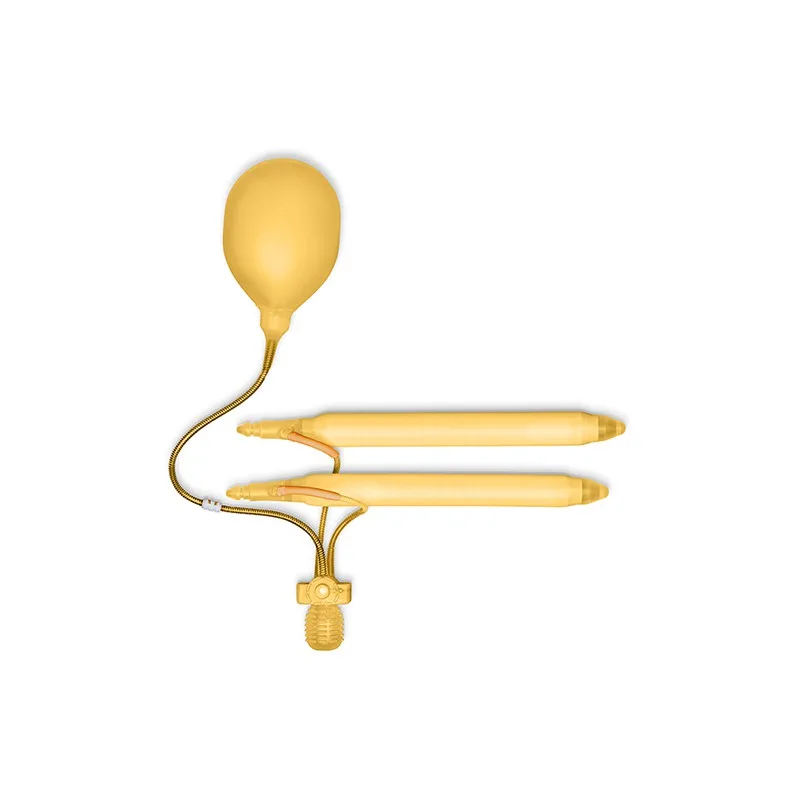
- Narrow-cylinder AMS 700 model — CXR is specifically designed for restricted corporal anatomy.
- Primarily girth expansion — Unlike AMS 700 LGX, CXR does not use a dedicated length-expanding cylinder design.
- Important role in corporal fibrosis — Published clinical evidence supports its use after previous infected implant removal, ischemic priapism and idiopathic fibrosis.
- 3-piece hydraulic system — The implant uses paired cylinders, a scrotal pump and a separate fluid reservoir.
- Specialized rather than universally preferable — CXR is valuable when standard cylinders cannot fit safely, but patients may experience less perceived penile girth or length than with larger cylinders.
About the AMS 700™ CXR
What Is the AMS 700 CXR?
The AMS 700 CXR is a 3-piece inflatable penile prosthesis manufactured by Boston Scientific.
It belongs to the AMS 700 family but uses narrower cylinders than the standard CX and LGX configurations.
The device is primarily designed for men whose corpora cavernosa are too narrow, scarred or fibrotic to safely accommodate standard-diameter inflatable cylinders.
The system consists of two intracavernosal cylinders, a scrotal inflation/deflation pump and a separate fluid reservoir.
What Does CXR Mean?
CXR stands for Controlled Expansion Restricted.
The defining feature is a reduced cylinder diameter designed for anatomically restricted corpora.
Its purpose is not to create additional penile length or girth.
Instead, it allows inflatable prosthesis implantation in situations where standard AMS 700 cylinders may be difficult or unsafe to place.
How the AMS 700 CXR Works
CXR functions according to the same general hydraulic principle as other 3-piece AMS 700 implants.
When the patient repeatedly compresses the scrotal pump, fluid moves from the reservoir into the paired cylinders.
As the cylinders fill, they become rigid and expand circumferentially.
After sexual activity, the patient activates the deflation mechanism.
Fluid returns to the reservoir and the cylinders become softer for concealment.
Why Are CXR Cylinders Narrower?
The corpora cavernosa normally contain enough internal space to accommodate standard inflatable cylinders.
However, fibrosis can significantly reduce this space.
Scar tissue may make corporal dilation difficult or may prevent safe insertion of standard CX or LGX cylinders.
CXR provides a narrower option.
This allows surgeons to preserve an inflatable prosthesis strategy in selected difficult cases rather than automatically using a malleable implant or abandoning implantation.
Corporal Fibrosis
Corporal fibrosis is one of the principal indications for CXR.
Fibrosis replaces normal compliant erectile tissue with dense scar tissue.
The corporal bodies may become narrower, less elastic and more difficult to dilate.
CXR is particularly useful because its smaller cylinder profile requires less corporal diameter.
Causes of Corporal Fibrosis
Several conditions can produce severe corporal fibrosis.
Important causes include:
Previous penile prosthesis infection and explantation
Ischemic priapism
Previous penile implant surgery
Penile trauma
Intracavernosal injection injury
Peyronie's disease
Prior reconstructive surgery
Idiopathic corporal fibrosis
The degree of fibrosis varies considerably between patients.
CXR After Previous Implant Infection
One of the most important indications for CXR is reimplantation after removal of an infected penile prosthesis.
Following explantation, the corpora can contract and develop dense scar tissue.
A 2024 clinical series evaluating CXR implantation in high-risk fibrosis patients found that previous explantation for infection accounted for approximately two-thirds of cases.
This highlights CXR's role as a reconstructive prosthesis rather than simply another routine AMS 700 model.
CXR After Ischemic Priapism
Prolonged ischemic priapism can permanently damage cavernosal smooth muscle.
Over time, severe fibrosis can develop.
When erectile function is irreversibly lost, penile prosthesis implantation may be required.
If implantation is delayed and substantial fibrosis develops, standard cylinders may no longer fit easily.
CXR can provide an inflatable option for selected patients with narrowed corpora following priapism.
CXR in Idiopathic Fibrosis
Some patients develop significant corporal fibrosis without a clearly identified cause.
Published CXR series have included patients with idiopathic fibrosis.
The same principles apply: the surgeon assesses corporal dimensions intraoperatively and selects a cylinder that can be placed safely without excessive force or tissue injury.
CXR vs AMS 700 CX
CX and CXR both primarily inflate in girth.
The principal difference is cylinder diameter and intended anatomy.
CX is a standard controlled-expansion cylinder for patients with adequate corporal dimensions.
CXR is narrower and is intended for restricted corporal spaces.
CXR should therefore not be described simply as a smaller version chosen according to patient preference.
It is primarily an anatomical solution.
CXR vs AMS 700 LGX
AMS 700 LGX is designed for controlled expansion in both length and girth.
CXR primarily provides controlled girth expansion.
LGX generally requires more compliant and adequately sized corpora.
CXR is designed for patients with restricted corporal dimensions.
A man with severe fibrosis may therefore be unsuitable for LGX even if he prefers length-expansion characteristics.
CXR vs Coloplast Titan Narrow Base
Both CXR and narrow-base Titan configurations can be considered in selected patients with restricted or fibrotic corpora.
They differ in cylinder construction, coating, hydraulic architecture and available dimensions.
There is insufficient evidence to establish universal superiority of one narrow-cylinder platform.
Choice depends heavily on actual corporal measurements, surgeon experience and availability.
CXR vs Malleable Penile Implant
Historically, severe corporal fibrosis sometimes led surgeons to use a malleable prosthesis because narrow rods can be easier to insert.
CXR provides an inflatable alternative in selected cases.
The potential advantage is the ability to achieve an inflated erection and a softer resting state.
The trade-off is greater hydraulic complexity and the need for pump operation.
Current Cylinder Lengths
Boston Scientific currently lists AMS 700 CXR with the TENACIO pump in:
10 cm
12 cm
14 cm
16 cm
18 cm
These sizes are currently listed for both penoscrotal and infrapubic preconnected configurations.
With the older MS Pump product line, 12, 14 and 16 cm are standard listed sizes, while 10 and 18 cm may be special-order configurations depending on market.
Controlled Girth Expansion
CXR is a controlled-expansion cylinder.
Boston Scientific classifies the model as inflating in girth.
It is not designed to provide the dedicated longitudinal expansion associated with LGX.
The patient's final penile diameter remains limited by the available corporal space.
Because CXR is specifically used in narrower anatomy, the resulting girth may be less than what would be achieved with a larger standard cylinder.
TENACIO™ Pump
Current Boston Scientific U.S. ordering information includes CXR configurations using the TENACIO pump.
The pump is implanted within the scrotum.
It allows the patient to transfer fluid from the reservoir into the cylinders and later return the fluid during deflation.
Adequate hand dexterity remains necessary.
MS Pump™ Configurations
AMS 700 CXR also exists in configurations using the established MS Pump.
Product availability varies by market.
This distinction is useful for the CMS because the cylinder family remains CXR even when the pump generation differs.
The pump should therefore be modeled as a component or configuration rather than as a completely separate penile prosthesis family.
Separate Reservoir
CXR is a true 3-piece implant.
It uses a separate fluid reservoir in addition to the cylinders and pump.
Boston Scientific's product matrix lists reservoir options for the CXR system.
The reservoir stores fluid while the cylinders are deflated.
During inflation, fluid is transferred into the cylinders.
Reservoir Placement in Complex Patients
Many CXR patients have undergone previous pelvic or prosthetic surgery.
This can make standard reservoir placement more difficult.
Alternative or ectopic reservoir placement may therefore be required.
The surgeon should account for previous prostatectomy, cystectomy, hernia surgery, urinary diversion and other operations when planning the procedure.
InhibiZone™ Antibiotic Treatment
Current preconnected CXR configurations are available with Boston Scientific's InhibiZone antibiotic surface treatment.
InhibiZone incorporates rifampin and minocycline into the prosthesis surface.
The treatment is designed to reduce bacterial colonization.
It does not eliminate the possibility of infection.
This is particularly important for CXR patients because many have already undergone previous infected prosthesis surgery and may have a higher baseline risk profile.
Non-InhibiZone CXR
Boston Scientific also lists non-preconnected CXR cylinders without InhibiZone.
The CMS should therefore avoid implying that every CXR configuration worldwide has identical antimicrobial treatment.
The accurate comparison-table wording is:
InhibiZone available; non-InhibiZone configurations also exist.
CXR and Scarred Corpora
Implanting an inflatable prosthesis into scarred corpora is technically more difficult than routine primary implantation.
Dilation may require specialized instruments and additional reconstructive techniques.
Corporal measurements may also differ between the two sides.
A recent CXR study found discordant corporal measurements in approximately one-quarter of patients.
This demonstrates the anatomical complexity of the population for whom CXR is typically used.
Asymmetric Sizing
Severe fibrosis may not affect both corpora equally.
One corporal body can be shorter, narrower or more heavily scarred than the other.
This can complicate cylinder sizing.
The 2024 CXR series reported asymmetric corporal measurements and differing rear-tip extender requirements in a substantial minority of patients.
These findings reinforce why CXR implantation should be considered reconstructive prosthetic surgery.
Rear-Tip Extenders
Rear-tip extenders are used to fine-tune prosthetic length after corporal measurement.
In difficult fibrosis cases, substantial rear-tip extender lengths may sometimes be required.
They should be selected according to anatomy rather than cosmetic goals.
Improper sizing can contribute to instability, pain, abnormal positioning or erosion.
Mechanical Reliability in Fibrotic Patients
CXR-specific long-term evidence is more limited than the broad AMS 700 CX evidence base because CXR is used in a smaller, higher-risk population.
A 2024 series of 49 CXR implants performed from 2007 to 2021 reported mechanical failure in 4.1% of patients over follow-up.
The study also reported infections, cylinder herniation and other complications.
These results should be interpreted in context.
The patients represented a difficult fibrosis population rather than routine primary penile implant recipients.
Revision and Explantation
In the same high-risk CXR cohort, approximately 8.2% of patients underwent revision and approximately 10.2% required explantation during follow-up.
Some patients had overlapping complications.
These rates should not be generalized to all AMS 700 recipients.
They reflect the increased complexity of patients requiring narrow CXR cylinders.
Infection Risk
In the 2024 fibrosis cohort, infection occurred in approximately 6.1% of patients.
Again, this rate reflects a particularly high-risk population.
Approximately two-thirds had previously had a prosthesis removed because of infection.
Previous infection, multiple operations and extensive scar tissue can all increase complication risk.
For this reason, the infection rate should not be used as a general AMS 700 infection estimate.
Cylinder Herniation
Cylinder herniation occurred in a small proportion of patients in the recent CXR fibrosis series.
Herniation involves abnormal protrusion or displacement of the cylinder through surrounding tissue.
Fibrosis, tissue weakness and previous operations can increase reconstructive complexity.
Significant herniation may require surgical revision.
Glans Ischemia and Necrosis
The recent high-risk CXR series reported one case of glans necrosis.
This is a rare but serious complication.
Patients with extensive vascular disease, prior surgery, severe fibrosis or other compromised tissue may carry increased risk.
The occurrence emphasizes the need for careful patient selection and tissue-preserving operative technique in complex prosthetic reconstruction.
Satisfaction With Rigidity
In the 2024 CXR series, approximately 73.5% of patients reported satisfaction with rigidity.
This is lower than satisfaction rates often reported in uncomplicated primary penile implant populations.
The principal sources of dissatisfaction were perceived loss of penile length and girth.
This finding is important for preoperative counselling.
Patients requiring CXR frequently begin with severe fibrosis and compromised penile dimensions.
Penile Length Expectations
CXR should never be promoted as a penile-lengthening device.
Patients requiring narrow cylinders may already have shortening from fibrosis, priapism, previous infection or multiple operations.
The prosthesis restores rigidity within the remaining corporal anatomy.
It cannot reliably restore tissue that has already been lost to fibrosis or contraction.
Penile Girth Expectations
Because CXR has a reduced cylinder diameter, some patients may perceive less penile girth than they expected.
This is an inherent trade-off of using a prosthesis that can safely fit narrowed corpora.
The priority is functional implantation without excessive tissue pressure.
Trying to force a larger cylinder into a severely restricted corporal space can increase surgical trauma and complication risk.
Tissue Expansion Strategy
In selected patients, narrow cylinders may sometimes function as a staged tissue-expansion strategy.
After a period of regular inflation and tissue accommodation, future revision to a larger cylinder may be possible.
This is not guaranteed.
The feasibility depends on fibrosis severity, tissue response, infection history and future surgical findings.
CXR After Salvage Surgery
Following successful prosthesis salvage, significant scar tissue may still develop.
CXR may be used when the corporal space cannot accommodate a standard cylinder.
However, active infection must be controlled before definitive prosthetic implantation.
The surgical strategy depends on the timing and severity of infection, tissue condition and previous implant history.
Concealability
Despite its narrower profile, CXR remains a conventional 3-piece inflatable prosthesis.
When deflated, fluid returns to the reservoir and the cylinders soften.
This generally provides better concealability than a continuously semi-rigid malleable implant.
Individual resting appearance varies with fibrosis, cylinder position and residual penile anatomy.
Sensation and Orgasm
CXR primarily restores penile rigidity.
It does not directly restore sensation, libido, orgasm or ejaculation.
If these functions are preserved before surgery, they may remain intact afterward unless another disease or previous operation has affected them.
Patients who have undergone radical prostatectomy will generally remain unable to ejaculate despite successful prosthetic erections.
Manual Dexterity
CXR requires use of a scrotal pump.
Patients need enough hand strength and coordination to inflate and deflate the prosthesis.
Severe hand disability may make a malleable implant easier to operate.
Manual ability should therefore be evaluated as part of candidacy.
MRI Status
AMS 700 penile prosthesis systems are MR Conditional under specific manufacturer conditions.
Patients should inform radiology personnel that they have an implanted penile prosthesis before undergoing MRI.
The exact conditions in the current device documentation should be followed.
Who May Be a Good Candidate for AMS 700 CXR?
CXR is primarily intended for men with severe erectile dysfunction whose corporal anatomy cannot safely accommodate standard-diameter inflatable cylinders.
Typical candidates include men with significant corporal fibrosis after previous prosthesis infection, explantation, ischemic priapism or other cavernosal injury.
It may also be considered in selected revision cases with restricted corporal dimensions.
Candidates should understand that the primary goal is restoration of functional rigidity, not maximization of penile size.
What Should Patients Weigh Before Choosing AMS 700 CXR?
CXR's major advantage is that it can make inflatable prosthesis implantation possible in anatomy that might otherwise be too narrow for standard cylinders.
Its trade-off is exactly the same feature.
Because the cylinder is narrower, patients may perceive reduced penile girth or length relative to expectations.
The population requiring CXR also has higher baseline surgical complexity and complication risk.
For these reasons, expectation management is especially important.
Is this device for you?
- •Severe corporal fibrosis where standard inflatable cylinders cannot safely fit.
- •Reimplantation after previous infected prosthesis removal when corporal narrowing has developed.
- •Erectile dysfunction after ischemic priapism with significant cavernosal fibrosis.
- •Complex penile prosthesis revision surgery involving restricted corporal dimensions.
- •Selected idiopathic fibrosis cases where standard cylinders are too large.
- •Patients who still prefer an inflatable prosthesis rather than a permanently semi-rigid malleable implant.
- •Narrower cylinder diameter — Functional advantage in restricted corpora but may result in less perceived girth.
- •No dedicated length expansion — CXR is primarily a girth-expansion cylinder.
- •Higher-risk patient population — Most CXR recipients have substantial fibrosis or previous prosthetic surgery.
- •Penile dimensions may already be reduced — CXR cannot reliably reverse shortening caused by established fibrosis.
- •Mechanical failure remains possible — A recent fibrosis series reported mechanical failure in 4.1%.
- •Infection risk may be elevated in revision patients — Especially following previous infected prosthesis removal.
- •Complex implantation — Scarred corpora may require advanced dilation and reconstructive techniques.
- •Revision may eventually be necessary — Some patients may require later replacement, correction or possibly upsizing.
How it compares
Every 3-piece inflatable implant a surgeon in our network may propose, side by side. The AMS 700™ CXR column is highlighted.
| Attribute | AMS 700™ CXRBoston ScientificPremium | AMS 700™ LGXBoston ScientificPremium | AMS 700™ CXBoston ScientificPremium | Coloplast Titan® Narrow BaseColoplastMid-range | Rigicon Infla10®RigiconMid-range | Coloplast Titan®ColoplastPremium | Rigicon Infla10® Pulse™ AXRigicon Mid-range | ZSI 475®Zephyr Surgical ImplantsMid-range |
|---|---|---|---|---|---|---|---|---|
| Expansion | Girth / circumferential expansion | Length + girth | Girth / circumferential expansion | Restricted girth / circumferential expansion | Model dependent — X: girth; AX: length + girth | Girth / circumferential expansion | Length + girth | Girth / circumferential expansion |
| Rigidity | Hydraulic rigidity optimized for narrow corporal anatomy | High hydraulic rigidity with controlled-expansion cylinders | High axial rigidity | High hydraulic rigidity for reduced-diameter corporal anatomy | High hydraulic axial rigidity | High axial rigidity; Bioflex® cylinders | High axial rigidity; reinforced four-layer inflatable cylinders | Hydraulic rigidity; reinforced three-layer cylinders |
| Antibiotic coating | InhibiZone™ available — rifampin + minocycline; non-InhibiZone CXR configurations also exist | InhibiZone™ available — rifampin + minocycline; non-InhibiZone configurations also available | InhibiZone™ antibiotic treatment available; rifampin + minocycline | HydroVANTAGE™ hydrophilic coating; absorbs surgeon-selected aqueous solution rather than containing fixed embedded antibiotics | HydroShield™ hydrophilic coating; absorbs surgeon-selected aqueous solution | Hydrophilic HydroVANTAGE™ coating; absorbs surgeon-selected aqueous solution — not a fixed embedded antibiotic combination | HydroShield™ hydrophilic coating; absorbs surgeon-selected aqueous solution | Hydrophilic PVP coating designed to absorb an intraoperative antimicrobial solution |
| Reservoir | Separate fluid reservoir; 3-piece system | Separate fluid reservoir; 3-piece system | Separate fluid reservoir; 3-piece system | Separate Titan reservoir with Lock-out™ valve; 3-piece system | Separate AdaptiveReservoir™ with lock-out mechanism | Separate fluid reservoir with Lock-out™ valve; 3-piece system | Separate AdaptiveReservoir™ with lock-out valve; 3-piece system | Separate saline-filled pelvic reservoir; 3-piece system |
| Control | TENACIO™ or MS Pump™ depending on current configuration and market | Scrotal inflation/deflation pump | Scrotal inflation/deflation pump | Scrotal Titan or Titan Touch pump depending on configuration | Pulse™ scrotal pump on current generation | Scrotal pump; Touch pump configurations available | Pulse™ scrotal pump | Manual scrotal pump with inflation and deflation valve |
| Concealed when soft | Yes — cylinders deflate for improved concealment | Yes — cylinders deflate for good concealability | Yes — cylinders deflate for improved concealment | Yes — cylinders deflate for improved concealment | Yes — cylinders deflate for improved concealment | Yes — inflatable cylinders deflate for improved concealment | Yes — inflatable cylinders soften when deflated | Yes — cylinders deflate as saline returns to the reservoir |
| Cylinder material / construction | Narrow controlled-expansion AMS 700 cylinder | Controlled-expansion multilayer cylinder with parylene-coated surfaces | Multi-layer inflatable AMS 700 CX cylinder | — | — | — | Multi-layer inflatable cylinder; four-layer construction | — |
| Cylinder options | Current TENACIO configurations: 10, 12, 14, 16 and 18 cm | 12, 15, 18 and 21 cm | 12, 15, 18 and 21 cm; 24 cm available by special order | Narrow Base: 11, 14, 16 and 18 cm; penoscrotal and infrapubic configurations | Infla10 X and Infla10 AX, plus market-dependent specialized configurations | Standard and narrow-base configurations; multiple lengths available | AX lengths: 12, 15, 18, 20, 22 and 24 cm | 13, 16 and 19 cm standard cylinders with extenders; separate 22 cm large-size configuration |
| Length expansion | No dedicated longitudinal-expansion design | Yes — controlled longitudinal cylinder expansion; actual patient length change is anatomy dependent | No dedicated longitudinal-expansion design | No dedicated longitudinal-expansion design | Model dependent — AX provides controlled longitudinal expansion; X does not specifically target length expansion | Not specifically designed as a length-expanding cylinder | Up to 25% relative cylinder expansion, manufacturer stated and anatomy dependent | No dedicated longitudinal-expansion design |
| MRI status | MR Conditional under manufacturer-specified conditions | MR Conditional under manufacturer-specified conditions | MR Conditional under manufacturer-specified conditions | MR Conditional under manufacturer-specified conditions | Verify current model-specific Rigicon IFU before publishing an MRI claim | MR Conditional under specified conditions | Use current Rigicon implant documentation / IFU for model-specific MRI conditions before publishing an MRI claim | Verify current model-specific ZSI IFU before publishing a formal MRI classification |
| Cylinder material | — | — | — | Bioflex® | — | Bioflex® | — | Medical-grade silicone with biocompatible polyester reinforcement |
| Cylinder construction | — | — | — | — | Multi-layer inflatable cylinder system | — | — | — |
| Girth expansion | — | — | — | — | — | — | Up to approximately 46 mm cylinder diameter, manufacturer stated | — |
| Reliability | 90–95% at 5 yrs* | 90–95% at 5 yrs* | 90–95% at 5 yrs* | 90–95% at 5 yrs* | 90–95% at 5 yrs* | 90–95% at 5 yrs* | 90–95% at 5 yrs* | 90–95% at 5 yrs* |
*Type-level five-year mechanical survival from published series; not a model-specific figure. See each model page for detail.
At a glance
- Manufacturer
- Boston Scientific
- Type
- 3-piece inflatable implant
- Price tier
- Premium
- Regulatory
- FDA Cleared
- Warranty
- Manufacturer warranty applies. Verify the current written Boston Scientific AMS 700 warranty for the country where the CXR prosthesis will be implanted.
- Narrow controlled-expansion cylinders — Designed for restricted corporal anatomy.
- 3-piece hydraulic design — Paired cylinders, scrotal pump and separate reservoir.
- Girth expansion — CXR expands circumferentially rather than using dedicated longitudinal expansion.
- Fibrosis-focused design — Particularly useful after previous infection, explantation, priapism or severe corporal scarring.
- TENACIO™ pump configurations — Current U.S. product line includes TENACIO CXR systems.
- MS Pump™ configurations — Established pump configurations remain listed in current product information.
- InhibiZone™ available — Rifampin and minocycline antibiotic surface treatment in applicable configurations.
- Multiple narrow-cylinder lengths — Current TENACIO configurations include 10, 12, 14, 16 and 18 cm.
- Separate reservoir — Retains the standard 3-piece hydraulic architecture.
Surgeons who implant it
Surgeons in our network who work with the AMS 700™ CXR. Availability of a specific model is always confirmed in your proposal.
Common questions
What is AMS 700 CXR?
What does CXR mean?
Is AMS 700 CXR a 3-piece penile implant?
What is the difference between AMS 700 CXR and CX?
What is the difference between CXR and LGX?
Who usually needs AMS 700 CXR?
Can CXR be used after an infected penile implant is removed?
Can CXR be used after priapism?
Does AMS 700 CXR increase penile length?
Does AMS 700 CXR increase girth?
How successful is AMS 700 CXR in severe fibrosis?
What complications have been reported with CXR?
Can a CXR later be replaced with a larger implant?
Is AMS 700 CXR FDA approved?
Can I have an MRI with AMS 700 CXR?
Patient reviews
Been treated? Your honest review of AMS 700™ CXR helps the next patient.
No one has reviewed this yet. If you have been treated, your experience would help the next person.
Write the first reviewSources
- Boston Scientific — AMS 700™ Inflatable Penile Prosthesis
- Boston Scientific — AMS 700 Product Line Matrix
- Long-Term Experience With AMS-700 CXR Inflatable Penile Prosthesis in High-Risk Patients With Corporal Fibrosis
- Penile Prosthesis Implantation in Special Populations and Corporal Fibrosis
- Penile Prosthesis Implantation for Erectile Dysfunction Following Priapism
- EAU Guidelines — Management of Erectile Dysfunction
- AUA — Erectile Dysfunction Guideline
- Boston Scientific — product information