
Penuma Penile Implant and Himplant: 7 Facts to Know Before Girth Surgery in 2026
Penuma penile implant, now Himplant, explained: FDA clearance, girth results, risks, removal, and why 2026 EAU guidance remains cautious.
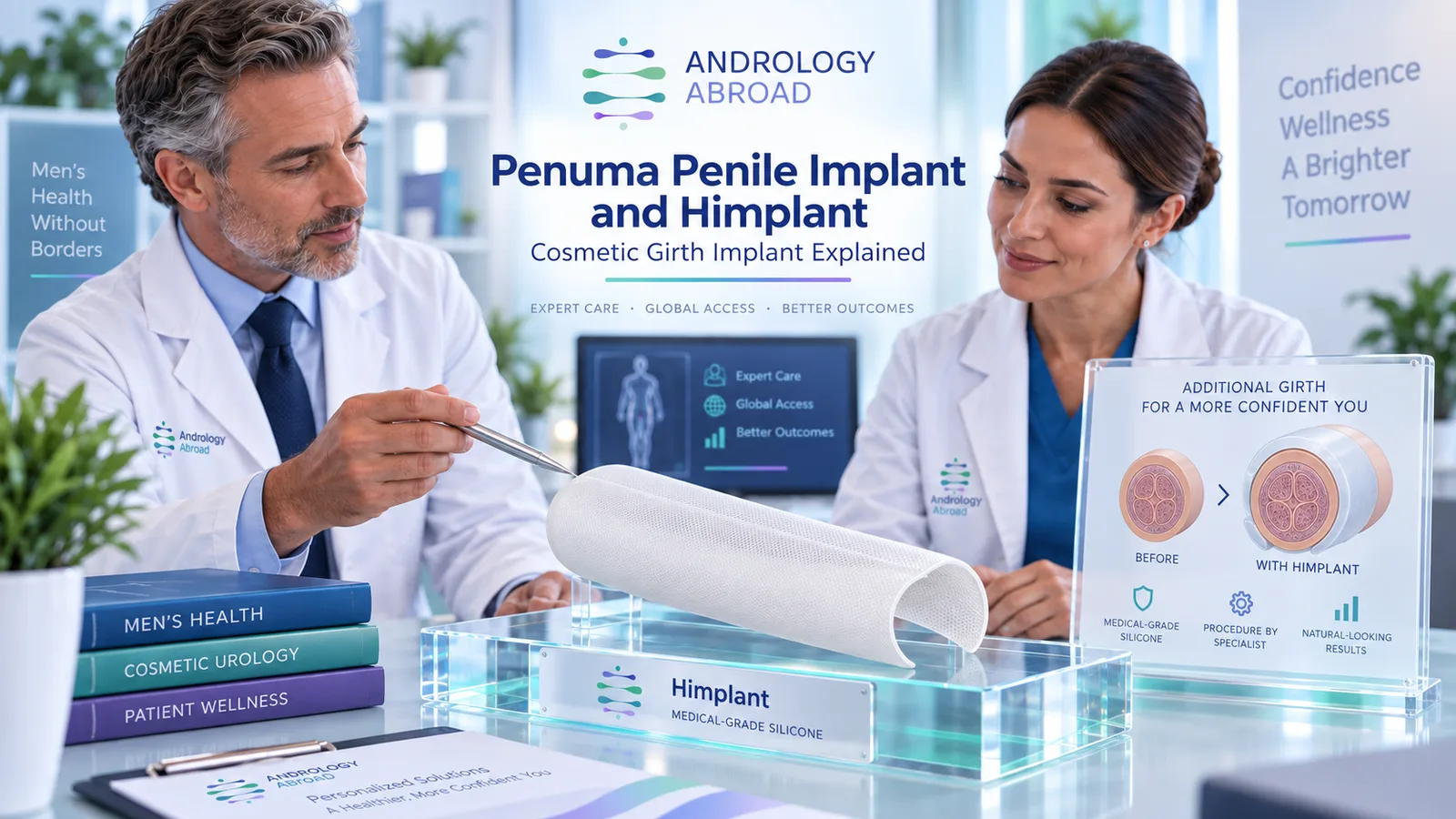
- Penuma is now commonly marketed as Himplant; it is a soft subcutaneous silicone sleeve for cosmetic penile augmentation, not the same device as an inflatable penile prosthesis used for erectile dysfunction.
- The FDA's K220760 510(k) clearance includes augmentation, reconstructive and cosmetic surgery and specifically permits cosmetic penile augmentation for aesthetic purposes.
- A 299-patient multicenter study reported average flaccid gains of 4.1 cm in length and 3.4 cm in girth, but also reported 1.3% infection, 2.0% seroma and 5.0% erosion.
- In that multicenter study, approximately 7% experienced non-cosmetic complications requiring explantation, and 93% retained the implant at a median follow-up of 11.6 months.
- Despite U.S. FDA clearance, the 2026 EAU guideline says long-term evidence remains insufficient and strongly recommends against subcutaneous Penuma-type implants for routine girth enhancement because they are considered experimental.
The Penuma penile implant, now marketed as Himplant, is a soft silicone sleeve placed beneath the penile skin for cosmetic augmentation. It is not the same as an inflatable penile prosthesis used to treat erectile dysfunction. FDA 510(k) clearance exists for cosmetic penile augmentation, but long-term evidence remains limited, and the 2026 European Association of Urology guideline still considers subcutaneous penile implants experimental for penile girth enhancement.
That distinction matters because the word “penile implant” describes two very different operations.
A man with severe erectile dysfunction may receive an inflatable or malleable penile prosthesis.
Its purpose is functional:
to create sufficient rigidity for penetrative intercourse when natural erections no longer work reliably.
A man considering Penuma or Himplant may have completely normal erections.
His goal is generally cosmetic:
to make the penis appear thicker and, particularly in the flaccid state, larger.
Those two men do not have the same condition.
They are not receiving the same implant.
And they should not be counselled as though the procedures are interchangeable.
This article explains what the Penuma penile implant actually is, why the name Himplant is now used, what FDA clearance does and does not mean, what published studies report about size and satisfaction, what complications have been documented, and why European guidelines remain substantially more cautious than device marketing.
Fact 1: Penuma and Himplant Refer to the Same Basic Silicone-Sleeve Concept
The names create unnecessary confusion.
Older published studies generally use:
Penuma®
while contemporary manufacturer materials use:
Himplant®.
Recent peer-reviewed literature explicitly describes Himplant as previously known as Penuma.
The device is fundamentally different from the cylinders placed inside the corpora cavernosa during conventional penile prosthesis surgery.
It is a medical-grade silicone sleeve or block positioned subcutaneously around part of the penile shaft.
The FDA 510(k) documentation describes the device as a Pre-Formed Penile Silicone Block made of medical-grade silicone with embedded polyester mesh. Current cleared configurations have included multiple sizes that the surgeon can contour for the individual patient.
The implant occupies space around the shaft rather than replacing the internal erectile mechanism.
Where is it placed?
The implant sits beneath the penile skin and superficial tissues, over the shaft.
It does not occupy the corpora cavernosa in the way an erectile prosthesis does.
It does not contain:
a hydraulic reservoir;
a scrotal inflation pump;
fluid-filled cylinders;
or a malleable metal core designed to create erectile rigidity.
That anatomical difference explains almost everything else.
A Penuma/Himplant procedure aims primarily to alter appearance and circumference.
A conventional penile prosthesis aims primarily to restore erectile function.
Penuma/Himplant vs an Erectile Penile Prosthesis
Feature | Penuma / Himplant | Inflatable penile prosthesis |
|---|---|---|
Primary goal | Cosmetic enlargement | Treat erectile dysfunction |
Typical candidate | Man seeking cosmetic girth enhancement | Man with significant ED |
Location | Subcutaneous sleeve around shaft | Cylinders inside corpora cavernosa |
Main material | Soft medical-grade silicone | Inflatable cylinders, pump, reservoir |
Creates hydraulic erection | No | Yes |
Patient pumps device | No | Yes |
Designed primarily to increase girth | Yes | No |
Replaces erectile rigidity | No | Yes |
FDA pathway | Cosmetic/reconstructive silicone implant clearance | Penile prosthesis device clearances |
Evidence base | Relatively limited and mostly retrospective | Much larger long-term prosthetic literature |
This is the most important table in the article.
A reader searching “penile implant for enlargement” can easily land on information about AMS 700 or Coloplast Titan and assume those devices are enlargement implants.
They are not.
If your main problem is erectile dysfunction, start with the penile implant procedure, not a cosmetic silicone sleeve.
If your erections work normally and the concern is circumference, the relevant pathway is penile girth enhancement.
Fact 2: Himplant Has FDA 510(k) Clearance—but “FDA-Cleared” Is More Precise Than “FDA-Approved”
This wording deserves careful attention.
The device is legitimately FDA-cleared.
But FDA clearance and FDA approval are not interchangeable regulatory terms.
The FDA record for K181387, decided in January 2019, identifies International Medical Devices' Pre-Formed Penile Silicone Block as a Class II device and found it substantially equivalent to an existing legally marketed predicate device. Its indication at that stage was cosmetic correction of soft-tissue deformities.
A later clearance, K220760, was issued in May 2022.
The official FDA indication says the Pre-Formed Penile Silicone Block is intended for:
augmentation, reconstructive and cosmetic surgery
and that in augmentation procedures it provides cosmetic augmentation of the penis for aesthetic purposes.
That is important because it confirms that cosmetic penile augmentation is not merely a marketing interpretation.
It is present in the cleared indication.
What does 510(k) clearance mean?
A 510(k) clearance means the FDA determined that the device was substantially equivalent to an appropriate legally marketed predicate for its indicated use.
It is different from a Premarket Approval, or PMA, pathway.
Therefore, when writing medically accurate copy, use:
“FDA-cleared”
rather than casually changing it to:
“FDA-approved.”
The current Himplant manufacturer website also describes it as an FDA-cleared cosmetic penile implant.
Does FDA clearance mean that the procedure is proven risk-free?
No.
FDA clearance does not eliminate:
infection;
erosion;
seroma;
implant removal;
cosmetic deformity;
scar tissue;
or other complications.
The FDA's own clearance letter reminds manufacturers that a substantial-equivalence determination is not a declaration that every other regulatory requirement has automatically been satisfied.
This is why FDA status should be described accurately without turning it into a general guarantee of outcome.
Fact 3: Penuma/Himplant Is Primarily a Cosmetic Girth Procedure—not an Erectile Dysfunction Implant
This distinction cannot be overemphasized.
Published research describes the silicone sleeve as designed primarily for men seeking cosmetic penile size augmentation, often with otherwise functional erections.
The conventional prostheses used for severe ED are fundamentally different.
These include:
three-piece inflatable penile implants;
two-piece inflatable implants;
and malleable penile prostheses.
Their purpose is to create sufficient rigidity when biological erections cannot.
The Himplant silicone sleeve does not use an internal pump.
It does not transfer fluid.
It does not mechanically replace the erectile cylinders of the corpora cavernosa.
Does Himplant treat erectile dysfunction?
It should not be presented as the standard penile prosthesis treatment for erectile dysfunction.
The FDA K220760 indication describes cosmetic, augmentation and reconstructive use, not a primary indication for treating erectile dysfunction.
There is emerging research exploring other applications.
A small published case series discussed Himplant use in four men after radical prostatectomy and reported improvements in appearance alongside functional observations. But four cases are not sufficient evidence to redefine the device as an established ED prosthesis.
For severe erectile dysfunction, current standard prosthetic treatment remains an inflatable or malleable penile prosthesis placed inside the corpora cavernosa.
So a man searching:
“penile implant for enlargement”
and a man searching:
“penile implant for erectile dysfunction”
should arrive at different treatment pathways.
That distinction is medically important and SEO-important.
What Does the Penuma Penile Implant Actually Change?
The strongest published evidence concerns:
flaccid girth
and
flaccid length or apparent flaccid projection.
That wording matters.
The silicone sleeve adds physical volume around the shaft.
As a result, the penis generally appears thicker.
The implant can also reduce the degree to which the flaccid penis retracts, making flaccid length appear greater.
This is not the same biological mechanism as creating new erectile tissue.
What about erect length?
Patients need especially careful counselling here.
The evidence does not support promising a specific gain in erect penile length.
The FDA-cleared indication is cosmetic augmentation.
The larger published studies have primarily reported flaccid dimensions.
Even the manufacturer has stated in an FDA adverse-event narrative that it does not claim the implant increases erect penile length.
That means advertising such as:
“Gain X centimetres of erect length with Himplant”
would go beyond the evidence discussed here.
Does it increase girth during erection?
Because the silicone sleeve remains around the shaft, it can add external circumference in both the flaccid and erect states.
However, published numerical outcome reporting has focused heavily on flaccid measurement.
A patient should therefore distinguish between:
documented average study measurements
and
individual promises about his final erect circumference.
No surgeon can responsibly guarantee the exact final number before surgery.
Fact 4: Published Studies Show Meaningful Girth Increases—but the Evidence Has Important Limitations
The published results are not trivial.
Significant size changes have been reported.
But the studies should be read for what they are.
Most are:
retrospective;
non-randomized;
performed by surgeons with experience in the technique;
focused on carefully selected patients;
and relatively short compared with the decades of follow-up available for conventional erectile prostheses.
The original 400-patient study
A 2018 retrospective study evaluated 400 patients who consented to analysis after cosmetic silicone-sleeve implantation.
Mean midshaft circumference increased from:
8.5 ± 1.2 cm
to
13.4 ± 1.9 cm.
That represented a reported 56.7% increase.
At long-term follow-up of two to six years, averaging four years:
81% reported high or very high satisfaction.
The study also reported:
4.8% seroma
4.5% scar formation
3.3% infection
and
3% device removal because of adverse events.
These are impressive size and satisfaction numbers.
But the study was:
single-surgeon;
retrospective;
and closely connected to the early development of the device.
That does not invalidate it.
It does mean the results should be confirmed by independent and multi-center experience.
Independent single-center experience
A later tertiary-center series included 49 patients undergoing Penuma implantation.
The study reported increased postoperative size but also documented:
one infection;
two erosions;
and four cases of persistent implant flaring, three of which required revision surgery.
The mean follow-up was only about six months.
This study helped show that the implant could be performed outside the original developer's practice, while also highlighting that cosmetic and structural complications do occur.
The 299-patient multi-institutional study
The strongest newer observational dataset is a 2024 study involving 299 patients across four institutions.
Mean follow-up was 11.6 months.
Researchers found an average increase in flaccid penile length of:
4.1 ± 1.5 cm
or about 50%
and an average increase in flaccid girth of:
3.4 ± 1.5 cm
or approximately 37%.
Reported complications included:
infection: 1.3%
seroma: 2.0%
erosion: 5.0%.
The study reported no new postoperative erectile dysfunction.
However, 21 patients, or about 7%, experienced non-cosmetic grade IIIb complications resulting in implant explantation.
At the median 11.6-month follow-up, 93% of implants remained in place.
One particularly important finding was that subcoronal flaring occurred in more than 10% of patients, although only about half of those cases required surgical correction.
These numbers provide a more complete picture than marketing alone.
They show both:
substantial cosmetic change;
and
a meaningful possibility of revision or explantation.
Penuma/Himplant Outcome Evidence at a Glance
Study | Patients | Main reported outcome | Notable complications |
|---|---|---|---|
Elist et al., 2018 | 400 | Midshaft circumference +56.7%; 81% high/very high long-term satisfaction | Seroma 4.8%, scar 4.5%, infection 3.3%, removal 3% |
Siegal et al., 2023 | 49 | Increased flaccid dimensions | 1 infection, 2 erosions, 4 persistent flaring cases |
Siegal et al., 2024 multicenter | 299 | Flaccid length +4.1 cm; girth +3.4 cm | Infection 1.3%, seroma 2%, erosion 5%, 7% explant for grade IIIb events |
These studies are useful.
They do not provide the kind of decades-long comparative evidence available for standard erectile prostheses.
That limitation becomes very important when we look at European guidance.
Fact 5: The 2026 EAU Guideline Is Much More Cautious Than Device Marketing
This is probably the most important evidence section for Andrology Abroad.
The European Association of Urology acknowledges the Penuma silicone implant.
It describes it as a soft silicone subcutaneous implant used for penile girth enhancement and summarizes published increases in circumference.
But the guideline also concludes that there are not enough long-term data on subcutaneous penile implants.
Its recommendation is explicit:
“Do not use ... subcutaneous penile implant (Penuma®) ... as they are considered experimental.”
The recommendation is rated Strong.
That creates a genuine tension patients should understand.
On one side:
the device has FDA 510(k) clearance for cosmetic penile augmentation;
published observational studies report substantial girth gains and often high satisfaction;
and multi-center experience now exists.
On the other:
European guideline authors still consider the evidence too limited for routine recommendation, particularly with respect to longer-term outcomes.
Those positions are not necessarily contradictory.
FDA and EAU answer different questions
FDA device clearance asks whether a device may legally enter the U.S. market under the applicable regulatory pathway and indication.
A clinical guideline asks:
Should clinicians recommend this intervention based on the total evidence available?
A device can have regulatory clearance while a professional guideline still considers the treatment investigational or insufficiently established.
That is exactly the situation a patient needs to understand here.
Therefore, a balanced article should say both.
It should not claim:
“Himplant is unapproved.”
That would be incorrect.
It should also not say:
“FDA clearance means leading European guidelines recommend it.”
That would also be incorrect.
Fact 6: Complications Can Require Revision or Complete Removal
Every cosmetic implant operation can produce complications.
For Penuma/Himplant, the important ones include:
seroma;
infection;
erosion;
implant flaring;
malposition;
scar or capsular change;
curvature;
sensory change;
and cosmetic dissatisfaction.
A 2025 review of penile-enhancement complications describes Penuma-specific problems including:
seroma, infection, distal flaring with potential erosion, capsular contracture, curvature and shortening.
Some can be managed conservatively.
Others require revision.
Some require complete explantation.
Seroma
A seroma is a pocket of fluid forming around the surgical area.
The original 400-patient study reported seroma in 4.8% of patients.
The 2024 multi-center study reported 2.0%.
In that multicenter cohort, some seromas were treated without major surgery using measures such as pressure or needle drainage.
Infection
Any synthetic implant can become infected.
Reported infection rates differed among studies:
3.3% in the initial 400-patient study;
and
1.3% in the 299-patient multi-center study.
In the 2024 multi-center series, infection cases resulted in implant removal.
This is different from minor superficial redness.
A true implant infection can require explantation because bacteria can persist around synthetic material.
Erosion
Erosion means the implant begins to compromise or move through surrounding tissues.
The multi-center study reported erosion in 5% of patients, higher than earlier series.
Those cases required surgical intervention and device removal.
This is one reason the authors specifically emphasized counselling about erosion.
Implant flaring
The distal portion of the silicone sleeve can become visibly prominent near the coronal area.
The multi-center study found flaring in more than 10% of patients.
About half required surgical correction.
This complication may be predominantly cosmetic, but cosmetic surgery is being performed specifically to improve appearance.
A visible contour abnormality therefore matters greatly to the patient.
Scar tissue and capsular contracture
The body naturally forms tissue around implanted foreign material.
In some patients, that process can distort appearance or create tightness.
The original study recorded scar formation in 4.5%.
More recent complication reviews also discuss contracture as a recognized problem.
Sensory change
Altered or reduced sensation has appeared in post-market adverse-event reports and manufacturer risk information.
An FDA MAUDE report from 2026 documents an allegation involving sensory loss, shortening and functional problems; importantly, that record contains both the patient allegation and the manufacturer's response, so it should not be treated as proof of causation or as an incidence estimate.
That illustrates a broader rule about MAUDE.
The FDA's adverse-event database is useful for identifying possible complications and safety signals.
It cannot tell you how common a complication is because there is no reliable denominator and individual reports may be incomplete.
Use clinical studies for rates.
Use MAUDE to understand the kinds of events that have been reported.
Is Penuma/Himplant Really “Reversible”?
The word reversible sounds reassuring.
It needs qualification.
The silicone sleeve can be surgically removed.
That does not mean removal is identical to pressing an undo button.
The penis has undergone:
dissection;
implantation;
scar formation;
and tissue healing.
After explantation, there can be:
retraction;
scar tissue;
shortening;
contour changes;
or the need for rehabilitation.
A 2022 publication followed 12 patients undergoing removal for cosmetic reasons and described a postoperative rehabilitation program. The authors reported restoration toward preoperative appearance during follow-up.
That is encouraging.
But twelve selected patients are not enough to guarantee that every explant will return exactly to the original state.
The 2024 multi-center study also noted that patients who required explantation were not reimplanted, because previous penile surgery was considered a contraindication under the study's selection protocol.
Therefore the most accurate wording is:
The device is surgically removable, but removal is another operation and cannot be assumed to restore every patient immediately or perfectly to his preoperative anatomy.
That is more useful than simply saying:
“Completely reversible.”
Fact 7: Patient Selection Is Especially Important
Cosmetic penile surgery has a unique challenge.
A medically healthy penis can still be perceived by its owner as inadequate.
For some men, the concern is proportional and realistic.
For others, it may be part of penile dysmorphic disorder or body dysmorphic disorder.
Surgery cannot reliably solve an untreated distorted body image.
The EAU therefore recommends measuring penile size objectively and screening appropriate men for body dysmorphic disorder before penile augmentation.
That recommendation applies to all cosmetic enlargement techniques—not only Himplant.
What does good preoperative assessment include?
At minimum:
medical history;
sexual history;
objective penile measurements;
erectile function;
expectations;
previous penile procedures;
tobacco or nicotine exposure;
diabetes and wound-healing risk;
and psychological assessment where concern appears disproportionate to objective anatomy.
The 2024 Penuma/Himplant multi-center study used fairly restrictive patient selection.
Patients with previous penile enhancement procedures were excluded.
Uncircumcised patients were offered circumcision before implantation.
The study also notes concern about conditions that increase poor wound healing risk, including uncontrolled diabetes, immune compromise and current smoking.
This matters when interpreting the published complication rates.
Those results did not come from an unrestricted general population.
They came from selected candidates.
A clinic that implants the device in patients outside the populations used in research may not reproduce published outcomes.
Does Himplant Make the Penis Longer?
It can make the flaccid penis appear and measure longer in published studies.
The 2024 multicenter study reported an average increase in flaccid length of 4.1 cm, approximately 50%.
But this finding needs context.
The implant can reduce flaccid retraction and add structural bulk.
That is not the same as surgically lengthening the corpora cavernosa.
Erect length is a different outcome
A patient should not translate:
“4.1 cm average flaccid gain”
into:
“I will gain 4.1 cm during erection.”
The studies do not support that conclusion.
Current manufacturer statements emphasize increased girth and potential changes in flaccid length rather than guaranteed erect-length enlargement.
If a patient's main concern is specifically penile length, he should first understand whether the issue is:
true short penile anatomy;
pubic fat/buried penis;
retraction;
Peyronie's shortening;
or body-image dissatisfaction.
Those problems have different solutions.
Does Himplant Increase Girth Permanently?
The device is intended to provide a long-lasting structural increase in penile circumference while it remains implanted.
Unlike hyaluronic acid filler, it is not gradually absorbed in the same manner.
Unlike autologous fat, it does not rely on survival of transferred fat cells.
That is one of the practical reasons some patients consider it.
However, “permanent” should not be confused with:
guaranteed lifetime retention.
Some implants are removed because of:
infection;
erosion;
dissatisfaction;
or another complication.
The 2024 multicenter study retained 93% of implants at a median 11.6 months.
Longer-term, independent datasets remain limited.
That limited long-term evidence is one of the reasons EAU guidance remains cautious.
Penuma/Himplant vs Hyaluronic Acid Filler
A patient considering girth enhancement often compares the implant with penile HA filler.
They are very different interventions.
Feature | Penuma / Himplant | Hyaluronic acid filler |
|---|---|---|
Type | Surgical silicone implant | Injectable gel |
Incision | Yes | Usually needle/cannula |
General/operative setting | Surgical procedure | Usually outpatient injection |
Duration | Designed to be long-lasting | Temporary / gradually resorbed |
Removal | Requires surgery | HA can sometimes be dissolved with hyaluronidase |
Published evidence | Limited retrospective implant studies | Growing but heterogeneous filler literature |
Main risk types | Infection, erosion, seroma, flaring, scar/contracture | Swelling, nodules, asymmetry, vascular/injection complications |
EAU 2026 position | Strong recommendation against subcutaneous implant as experimental | Weak recommendation permits HA/selected fillers after counselling |
This comparison is particularly interesting because the EAU guideline is more permissive toward HA and selected soft-tissue fillers than toward subcutaneous silicone implants.
The guideline gives a weak recommendation for HA, selected fillers and autologous fat, while strongly advising against subcutaneous Penuma-type implants because the long-term evidence remains insufficient.
That does not make HA risk-free.
It reflects the guideline panel's assessment of the current evidence.
Our main penile girth enhancement procedure page explains these options separately.
Penuma/Himplant vs Fat Transfer
Autologous fat transfer uses the patient's own fat.
Fat is usually harvested through liposuction, prepared and injected around the penile shaft.
The appeal is obvious:
there is no permanent synthetic sleeve.
But fat has another problem:
survival can be unpredictable.
Some volume can resorb.
Uneven survival can produce asymmetry or nodules.
The EAU guideline reports observational studies showing average circumference increases in the range of roughly 2–3.5 cm after fat injection, but also emphasizes that robust long-term data remain insufficient.
So this is not a simple choice between:
“safe natural fat”
and
“dangerous implant.”
Both approaches have uncertainties.
The appropriate decision depends on:
desired amount of change;
willingness to accept repeat procedures;
attitude toward permanent foreign material;
anatomy;
and risk tolerance.
Penuma/Himplant vs an Inflatable Penile Implant
These treatments should rarely compete for the same patient.
If a man has severe erectile dysfunction, he needs an ED evaluation.
If pills, injections and other appropriate treatments have failed and he wants definitive rigidity, an inflatable or malleable penile prosthesis may be appropriate.
If he has strong erections and wants additional circumference, an erectile prosthesis is generally the wrong tool.
Putting cylinders inside normally functioning corpora purely for cosmetic enlargement would expose the patient to an irreversible ED treatment pathway without an ED indication.
The EAU specifically advises against penile prosthesis implantation as a penile lengthening treatment.
So:
Himplant is not a substitute for AMS 700.
And:
AMS 700 is not a cosmetic Himplant alternative.
They solve different problems.
Does Himplant Affect Natural Erections?
The sleeve does not replace the corpora cavernosa.
Therefore, natural erectile physiology remains important.
The original 400-patient study reported no changes in erection, ejaculation or sexual function in its cohort.
The 299-patient multicenter study also reported 0% new postoperative erectile dysfunction during its follow-up period.
That is reassuring.
But it should not be translated into:
“There is zero possibility of erectile dysfunction.”
Post-market reports and device risk materials include erectile and sensory problems among possible reported complications.
The more accurate patient-level statement is:
Published cohort studies have generally preserved erectile function, but erectile or sensory changes remain possible surgical risks and should be part of informed consent.
What Happens if the Implant Becomes Infected?
Significant infection around synthetic implant material may require removal.
In the 2024 multicenter study, infection cases led to explantation.
An infected cosmetic sleeve is not equivalent to a minor skin infection.
Once bacteria adhere to implanted material, complete eradication can become difficult.
This is why:
patient selection;
sterile technique;
postoperative wound care;
and early recognition
matter.
Possible warning signs after implantation include:
increasing redness;
drainage;
fever;
progressively worsening pain;
wound opening;
or abnormal swelling.
Any patient with these symptoms should contact the operating surgeon rather than waiting for an online answer.
What Is Erosion?
Erosion occurs when implant pressure or positioning compromises the tissue overlying the device.
The implant can become too prominent or threaten tissue integrity.
The 2024 multicenter study's 5% erosion rate is important because it was higher than earlier publications.
The authors specifically concluded that patients should be counselled about this risk.
This is particularly relevant for a cosmetic procedure.
A patient is undergoing surgery because he is unhappy with appearance.
A complication that:
distorts the shaft;
requires another operation;
or requires removal
can have significant psychological consequences even when it is medically manageable.
What Is Penuma Flaring?
Flaring occurs when the distal edge of the silicone sleeve becomes visibly prominent near the head of the penis.
It can create an unnatural contour.
The 2024 study reported this in more than one in ten patients, although only around half of affected men underwent correction.
Some cases can apparently be corrected surgically.
But “correctable” still means:
another procedure;
another recovery;
another cost;
and another opportunity for complications.
Patients should understand that revision is not equivalent to a minor cosmetic touch-up.
Can Himplant Be Replaced After Removal?
This should never be assumed.
In the 2024 multi-institutional cohort, patients who underwent explantation were not reimplanted because previous penile surgery was considered a contraindication under the protocol used by those centers.
Other surgeons or future protocols may differ.
But this finding matters.
A patient considering the operation should not think:
“If something happens, they'll remove it and simply put another one in.”
That may not be an option.
Does Circumcision Matter?
The research protocols have often required circumcision.
In the multicenter study, uncircumcised patients were offered circumcision before implantation, and that procedure was completed at least three months beforehand.
This is relevant for men considering surgery from countries where circumcision is less common.
It can affect:
eligibility;
timing;
cost;
and the number of procedures required.
A clinic should tell the patient this before travel planning—not after arrival.
What About Previous Penile Filler or Fat Transfer?
Prior cosmetic penile surgery has also been an exclusion criterion in published silicone-sleeve research.
The 2024 multicenter study excluded men who had previously undergone:
dermal grafting;
fat injection;
injection of penile enhancement material;
or suspensory ligament release.
This matters enormously.
A patient who has already undergone filler, fat transfer or ligament surgery cannot assume that Penuma/Himplant evidence applies to him.
Previous surgery changes:
tissue planes;
scarring;
blood supply;
and risk.
If a provider advertises Himplant after multiple previous penile procedures, ask what evidence supports that specific scenario.
Penuma Penile Implant and Body Dysmorphic Disorder
Penile size anxiety is common.
Objective micropenis is not.
The EAU states that men seeking penile augmentation should have objective measurements and that those with normal size but disproportionate concern should be screened for body dysmorphic disorder or penile dysmorphic disorder.
This is not a way of dismissing cosmetic concerns.
It is a patient-safety issue.
Someone with severe body dysmorphic disorder may remain dissatisfied after technically successful enlargement.
The problem can move from:
“I am too small”
to
“The implant contour is wrong”
or
“I still need more.”
Surgery cannot reliably cure an underlying distorted self-image.
A surgeon willing to say:
“I do not think you should have this operation”
may be demonstrating more expertise than one willing to implant everyone who can pay.
Does Himplant Have a Warranty?
Current manufacturer materials advertise a limited lifetime warranty.
Patients need to understand what that phrase means.
A device warranty and a surgical guarantee are not necessarily the same.
Ask:
Does the warranty cover the replacement implant only?
Does it include hospital fees?
Does it include the surgeon?
Anaesthesia?
Travel?
Revision after erosion?
Removal?
Complications occurring abroad?
The FDA clearance letter itself notes that the FDA does not evaluate private warranty liability.
Therefore, warranty terms need to be read as a contract—not assumed from marketing language.
How Long Does Himplant Last?
There is no mature 20-year evidence base comparable with conventional penile prostheses.
The device is intended as a long-lasting implant.
Published follow-up includes:
multi-year experience in the original cohort;
and shorter multicenter follow-up.
The 2018 study reported outcomes out to two to six years, with an average follow-up around four years among the long-term respondents.
The multicenter study had median follow-up of only 11.6 months.
That is precisely why a guideline can acknowledge promising results while still saying:
we need more long-term evidence.
A 35-year-old patient should consider that carefully.
He may live with the consequences of the operation for decades.
Is Himplant Better Than Penile Filler?
There is no high-quality head-to-head trial proving a universal winner.
They solve the same broad cosmetic goal through very different approaches.
Someone might prefer Himplant because:
it is structural;
does not gradually dissolve like HA;
and published studies report substantial girth changes.
Someone else might prefer HA because:
it avoids permanent surgical implantation;
the volume can be adjusted;
and hyaluronic acid is theoretically reversible with hyaluronidase in appropriate circumstances.
The EAU currently places more support behind HA and selected soft-tissue fillers than subcutaneous silicone implants, although its recommendation for fillers is still weak because overall evidence quality remains limited.
The decision therefore should not be based on which advertisement shows the bigger number.
It should be based on:
risk;
reversibility;
expected duration;
desired degree of enlargement;
and the quality of evidence.
What Does “Pneuma Penile Implant” Mean?
Your SEO dataset includes “pneuma penile implant.”
There is no mainstream cosmetic implant discussed in the evidence here under the name “Pneuma.”
In many searches, this appears to be a misspelling or phonetic variation of:
Penuma penile implant.
I would include the phrase naturally once in supporting keywords because it reflects actual search behavior.
I would not use “Pneuma” throughout the article or create a separate device identity.
That would reduce medical accuracy.
What Are the Main Advantages Patients May See?
Based on published studies, potential advantages include:
substantial increase in flaccid girth;
greater apparent flaccid length;
long-lasting structural volume;
no repeated injections;
high satisfaction in many selected patients;
and retention of natural erectile physiology in most published cohorts.
Those are legitimate benefits to discuss.
The article should not hide them simply because the procedure is controversial.
Likewise, the benefits should not erase the limitations.
What Are the Main Disadvantages?
The main disadvantages are:
it requires surgery;
it introduces permanent foreign material;
erosion can occur;
infection can require removal;
flaring or contour abnormalities may require revision;
seroma can occur;
explantation is another operation;
the penis may require rehabilitation after removal;
long-term independent evidence remains limited;
and major European guidance still considers the technique experimental.
Those are not minor details.
They determine whether the risk-benefit ratio makes sense for an otherwise healthy penis.
Who May Be a Reasonable Candidate to Discuss Himplant?
Based on the populations studied rather than a universal eligibility rule, discussion may be reasonable for an adult man who:
has realistic cosmetic goals;
understands the operation is elective;
has normal or acceptable erectile function;
is medically fit for surgery;
does not smoke or can comply with nicotine restrictions;
does not have uncontrolled diabetes or major wound-healing problems;
does not have severe body dysmorphic disorder;
has no incompatible prior penile enhancement surgery;
and accepts the possibility of revision or explantation.
Eligibility still belongs to the operating surgeon.
Who Should Be Particularly Cautious?
Extra caution is appropriate when there is:
poorly controlled diabetes;
immunosuppression;
active smoking;
infection;
previous penile enhancement surgery;
significant penile scarring;
unrealistic expectations;
significant erectile dysfunction;
or suspected body dysmorphic disorder.
If the primary problem is erectile dysfunction, treating appearance without addressing function may miss the actual medical need.
For erectile dysfunction, use the erectile dysfunction condition guide and the penile implant procedure rather than assuming a cosmetic sleeve is the equivalent operation.
Questions to Ask Before Penuma or Himplant Surgery
A serious consultation should answer at least these questions:
Is my concern mainly girth, flaccid retraction, true penile length or body-image dissatisfaction?
Are my erections normal enough that a cosmetic implant is appropriate?
Which exact Himplant/Penuma model will be used?
What FDA-cleared indication applies to this device?
How many of these implants does the surgeon perform annually?
What is the surgeon's personal erosion rate?
What is the personal infection rate?
How often do patients need revision for flaring?
How often has the surgeon removed the device?
What happens anatomically after removal?
What postoperative rehabilitation is used after explantation?
Would I still qualify if I have previously received filler or fat transfer?
Do I need circumcision first?
What change in flaccid girth is realistic for my anatomy?
What change in erect length, if any, is actually being promised?
What does the warranty pay for?
Who pays for revision or explantation?
What happens if I live in another country?
What does the surgeon think about the EAU's experimental classification?
What alternatives would produce a smaller result with a lower degree of surgical commitment?
Question 19 is especially useful.
A well-informed surgeon should know that professional guidelines are more cautious than manufacturer marketing.
The answer does not need to agree with the EAU.
It should show that the surgeon understands the evidence.
Penuma/Himplant: FDA Clearance vs EAU Recommendation
This is the comparison every serious article should make explicit.
Question | Current answer |
|---|---|
Does the device have U.S. FDA 510(k) clearance? | Yes |
Is cosmetic penile augmentation included in the FDA-cleared indication? | Yes |
Is that the same as PMA “FDA approval”? | No |
Are published clinical outcome studies available? | Yes |
Are most studies randomized trials? | No |
Do studies report substantial girth increases? | Yes |
Have infection, erosion and explantation occurred? | Yes |
Is there extensive multi-decade independent evidence? | No |
Does the 2026 EAU guideline recommend routine subcutaneous Penuma-type implants for girth enhancement? | No |
How does EAU classify it? | Experimental because long-term data remain insufficient |
That is the most balanced summary of the evidence in 2026.
Why the Difference Between FDA and EAU Matters for Medical Tourism
Medical tourists frequently see regulatory terms used as sales language.
A clinic may say:
“FDA-cleared.”
That is useful information.
It should trigger the next question:
“What do independent clinical guidelines say?”
Conversely, someone may say:
“Europe does not recommend it, therefore it has no FDA clearance.”
That would also be wrong.
Andrology Abroad should make both positions visible.
That is stronger medical SEO because it answers the exact question sophisticated patients—and AI answer engines—are likely to ask.
What Should a Cosmetic Girth Consultation Measure?
Objective baseline measurements should be documented.
The EAU recommends assessment of:
penile length;
girth;
shape;
sexual function;
and beliefs around penile size.
At minimum, a surgeon should know:
flaccid length;
stretched length;
midshaft circumference;
and relevant erectile measurements where appropriate.
Without a baseline, the patient and surgeon may later disagree about what changed.
This is particularly important because cosmetic satisfaction is strongly influenced by expectation.
Can a Penuma/Himplant Correct a Retractile Penis?
Some published studies include men with significant flaccid penile retraction.
The sleeve can add structure and reduce the tendency of the penis to retract completely inward.
This can produce a visually larger flaccid result.
However, a retractile penis should not automatically be treated with a silicone implant.
Other conditions can mimic or contribute to apparent retraction, including:
obesity;
suprapubic fat;
adult acquired buried penis;
cold-related or anxiety-related contraction;
and scar tissue.
If the shaft is buried by a large suprapubic fat pad, treating the fat pad may address the visible problem more directly than adding an implant.
Does Himplant Change Orgasm or Ejaculation?
The implant does not directly involve the ejaculatory ducts, prostate or nerves responsible for orgasm.
Published cohorts have generally not shown widespread changes in orgasm or ejaculation.
The initial 400-patient series specifically reported no changes in sexual function, erections or ejaculation.
However, sensory changes and sexual-function complaints have appeared in adverse-event reporting.
Therefore:
normal function is the expected goal, not a guaranteed outcome.
What Happens if the Result Is Too Large?
This is another reason cosmetic surgery needs realistic preoperative planning.
A larger implant does not necessarily mean a better result.
The surgeon has to balance:
shaft diameter;
glans proportion;
skin capacity;
implant position;
and the risk of distal pressure or flaring.
An excessively large or poorly fitted implant can look unnatural and may increase mechanical pressure on the tissues.
The FDA clearance documentation itself describes multiple sizes that are contoured at the surgeon's discretion.
Sizing is therefore part of the operation—not simply a patient selecting “XXL” from a catalogue.
Is There an Ideal Penile Girth?
No universally accepted number defines an ideal girth.
EAU guidance notes that penile size assessment remains complicated by measurement variability and psychological expectations.
The guideline cites average erect circumference around 11.66 cm, but average anatomy should not be converted into a cosmetic target for every patient.
The correct objective is proportion and patient-specific anatomy rather than chasing the largest possible circumference.
Is Penuma/Himplant the Only Cosmetic Penile Implant?
The manufacturer currently describes Himplant as the first and only FDA-cleared cosmetic penile implant on the market. That is a manufacturer claim, and should be attributed as such rather than written as independent editorial fact without qualification.
Other cosmetic girth strategies exist, including:
HA fillers;
other soft-tissue fillers;
autologous fat;
grafting procedures;
and experimental scaffold techniques.
The fact that a method exists does not mean it has equivalent evidence.
The 2026 EAU guideline specifically distinguishes between these approaches and their differing evidence levels.
Can Penuma/Himplant Be Combined With Other Enlargement Procedures?
Published evidence does not support treating every augmentation method as interchangeable or safely stackable.
In fact, the multicenter silicone-sleeve study excluded patients who had previously undergone several other penile enhancement procedures.
That means statements such as:
“Get filler first and Himplant later.”
or
“Combine ligament release, fat and Himplant for maximum size.”
cannot simply be assumed safe from the existing Penuma literature.
Combining procedures changes:
tissue planes;
blood supply;
scar formation;
infection risk;
and mechanical forces.
If combination treatment is proposed, ask for evidence relating to that exact combination.
Is Penuma/Himplant Worth It?
There is no universal answer.
The published evidence supports several real points:
the device can produce substantial cosmetic girth change;
many carefully selected patients report high satisfaction;
natural erectile function has usually been preserved in published cohorts;
and the device has FDA clearance for cosmetic augmentation.
The evidence also supports important limitations:
infection can require removal;
erosion occurred in 5% in a recent multicenter cohort;
around 7% in that study experienced non-cosmetic complications requiring explantation;
flaring can require revision;
and high-quality long-term evidence remains limited.
The European guideline position is therefore understandable even if some experienced implant surgeons believe selected patients can benefit.
A man considering the operation needs to decide whether the cosmetic gain is worth the possibility of converting a healthy penis into one that requires additional surgery.
That is a very personal risk-benefit calculation.
The Bottom Line on Penuma Penile Implant and Himplant
The Penuma penile implant—now marketed as Himplant—is a soft silicone subcutaneous implant designed primarily to increase penile girth and improve cosmetic appearance. It is fundamentally different from an inflatable or malleable penile prosthesis used to treat erectile dysfunction.
That distinction should come first.
A conventional penile prosthesis is implanted inside the corpora cavernosa to create rigidity.
Himplant is placed around the shaft to add volume.
It does not contain:
a pump;
hydraulic cylinders;
or a reservoir.
Its primary FDA-cleared role is cosmetic augmentation rather than conventional treatment of erectile dysfunction.
The device also has genuine U.S. regulatory clearance.
The FDA's K220760 decision describes the Pre-Formed Penile Silicone Block as intended for augmentation, reconstructive and cosmetic surgery and specifically states that augmentation use provides cosmetic penile enhancement for aesthetic purposes.
So it would be inaccurate to say:
“Penuma is not FDA cleared.”
But it is equally important not to turn clearance into a guarantee.
The evidence remains largely retrospective.
The original 400-patient series reported substantial circumference increase and 81% high or very high long-term satisfaction, while documenting 4.8% seroma, 4.5% scar formation, 3.3% infection and 3% removal for adverse events.
A more recent 299-patient, four-center study found mean increases of:
4.1 cm in flaccid length
and
3.4 cm in flaccid girth.
It also reported:
1.3% infection
2.0% seroma
and
5.0% erosion.
Approximately 7% experienced non-cosmetic complications requiring explantation, and 93% of implants remained in place at median follow-up of 11.6 months.
That is not a trivial complication profile for an elective operation on a functioning penis.
And this is where the guideline disagreement becomes especially relevant.
The 2026 European Association of Urology guideline acknowledges the device and the reported gains but states that long-term evidence remains insufficient and gives a strong recommendation against using subcutaneous Penuma-type implants for penile girth enhancement because they remain experimental.
Patients therefore deserve to hear both truths:
Himplant is FDA-cleared for cosmetic penile augmentation.
And:
major European guidance still considers this approach experimental.
Those facts can coexist.
The decision should depend on:
objective penile measurements;
erectile function;
expectations;
psychological screening;
previous penile procedures;
medical risk;
the surgeon's specific experience;
and willingness to accept the possibility of revision or explantation.
If your concern is penile circumference, start with the broader penile girth enhancement condition guide and penile girth enhancement procedure.
For current treatment-cost comparisons, use penile girth enhancement costs.
If the problem is actually erectile dysfunction rather than size, review the penile implant procedure instead.
And if you want your anatomy, goals and treatment options reviewed individually, contact Andrology Abroad.
The most useful question is not:
“How many inches can Himplant add?”
It is:
“For a healthy penis that already functions, is the expected cosmetic improvement worth the long-term surgical and implant-related risks for me?”
That is the question an informed consultation should answer.
Common questions
What is a Penuma penile implant?
Is Himplant the same as Penuma?
Is the Penuma penile implant FDA approved?
How much girth does Penuma or Himplant add?
Does Penuma make the penis longer?
Can Penuma or Himplant treat erectile dysfunction?
What are the main Himplant or Penuma complications?
Can a Penuma penile implant be removed?
Why does the EAU call Penuma experimental if it is FDA cleared?
Which is better: Himplant, penile filler or fat transfer?
Sources
- U.S. Food and Drug A
- Source: European Association of Urology — 2026 Sexual and Reproductive Health Guidelines: Penile Size Abnormalities and Dysmorphophobia
- Siegal AR, Celtik KE, Razdan S, et al. A multi-institutional update on surgical outcomes after penile silicone sleeve implantation. Therapeutic Advances in Urology. 2024.
- Elist JJ, Valenzuela R, Hillelsohn J, Feng T, Hosseini A. A Single-Surgeon Retrospective and Preliminary Evaluation of the Safety and Effectiveness of the Penuma Silicone Sleeve Implant for Elective Cosmetic Correction of the Flaccid Penis. Journal of Sexual Medicine. 2018.
- iegal AR, Zisman A, Sljivich M, Razdan S, Valenzuela RJ. Outcomes of a Single Center's Initial Experience With the Penuma Penile Implant. Urology. 2023.
- Wilson SK, Picazo ALL. Update on the Penuma: an FDA-cleared penile implant for aesthetic enhancement of the flaccid penis. International Journal of Impotence Research. 2022.
- Barham DW, Lee J, Ghaziyar H, Gelman J. Complications of the Penuma penile implant for genital enhancement. Journal of Sexual Medicine. 2025.
- Complications and management of penile enhancement procedures. 2025.
- International Medical Devices — Himplant official patient information
Last reviewed 22 September 2026. We re-review this article by 22 September 2026. This article is for information and is not a substitute for advice from a doctor who knows your history.