
Penile Implant Size Options: What Surgeons Actually Measure
Penile implant size options explained in 7 facts: how surgeons measure cylinders, use rear-tip extenders and protect length without unsafe oversizing.
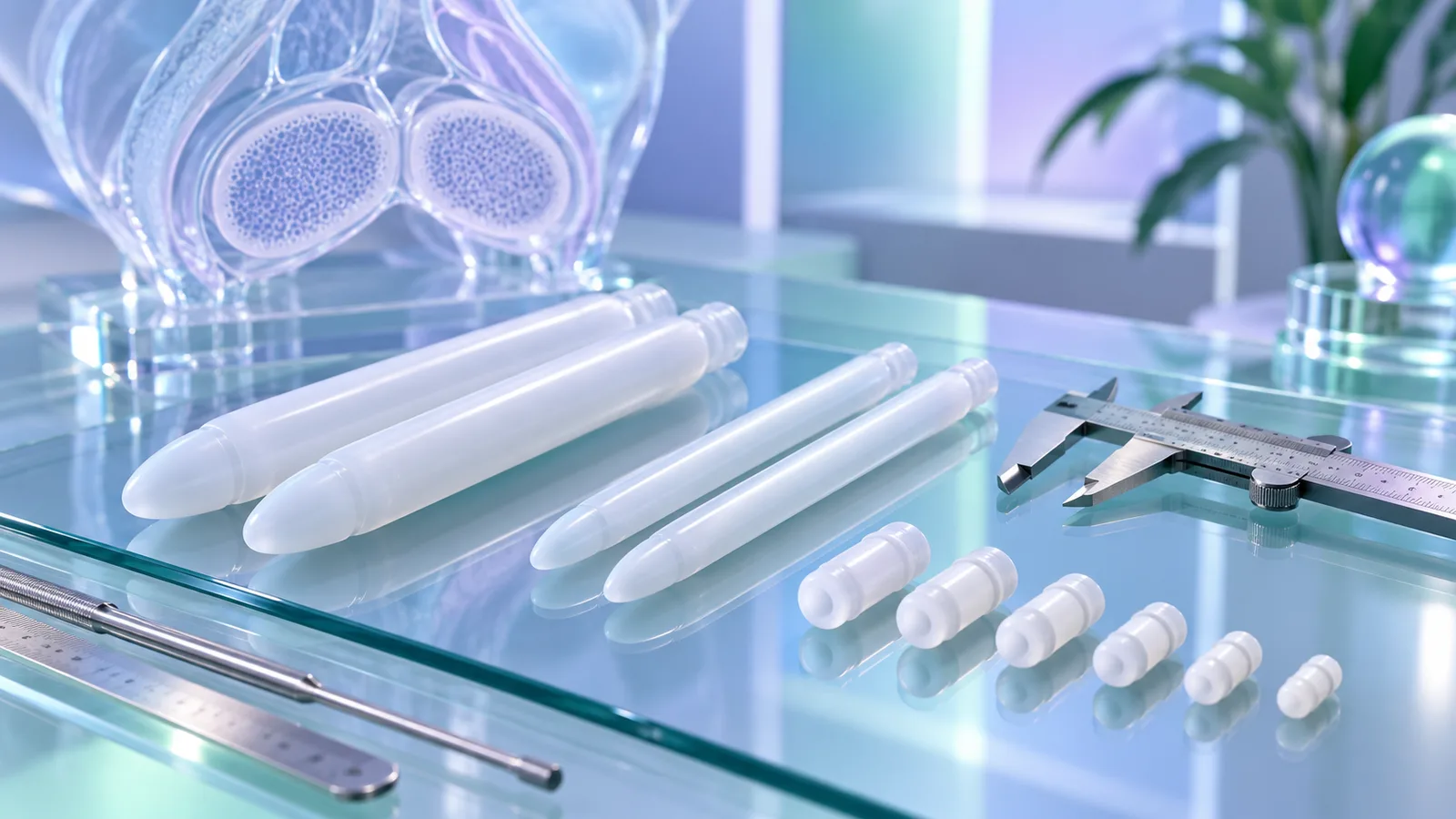
- Penile implant size options are selected from internal measurements of the corpora cavernosa during surgery, not from the visible length of the penis or the patient's preferred cylinder size.
- The surgeon measures each corpus distally and proximally, combines those measurements, and also assesses corporal diameter before choosing the prosthesis.
- Rear-tip extenders help a prosthesis fit the internal corporal length but do not add visible penile length and should not be viewed as enlargement components.
- Oversizing a penile implant can contribute to pain, buckling, abnormal pressure or erosion, while undersizing can reduce distal support; the correct goal is anatomical fit.
- Penile prosthesis surgery is intended to restore rigidity rather than enlarge the penis, and perceived postoperative shortening can occur even when objective penile measurements are preserved.
Penile implant size options are chosen from measurements made inside the corpora cavernosa during surgery—not from the visible length of the penis or a patient's preferred size. The surgeon measures the internal erectile chambers, checks their width and tissue quality, then selects cylinders and rear-tip extenders that fit safely. A correctly sized implant restores rigidity; it is not designed primarily to enlarge the penis.
This distinction matters because implant sizing is one of the most misunderstood parts of penile prosthesis surgery.
Patients often ask questions such as:
“What size penile implant will I get?”
“Can I choose a 22 cm implant?”
“Does a larger cylinder mean a larger penis?”
“Will an AMS 700 LGX make me longer?”
“Can the surgeon put in the biggest implant possible?”
These questions are understandable.
Penile implant manufacturers do produce cylinders in different lengths and diameters. Surgeons also use components called rear-tip extenders, which add length to the proximal end of some prostheses.
But those numbers do not work like clothing sizes.
A 21 cm implant does not mean the patient will have a 21 cm visible erection.
The proximal part of the corpora cavernosa extends deep inside the pelvis. A significant portion of the prosthesis therefore lies inside the body where it cannot be seen.
The surgeon's job is not to choose the longest cylinder available.
The goal is to fill each corpus cavernosum correctly from its proximal base to its distal end without creating excessive pressure, buckling or inadequate support.
A 2026 review of inflatable penile prosthesis cylinder selection summarizes this clearly: total corporal length, corporal diameter, fibrosis, implant characteristics and rear-tip extender use all influence the final prosthesis choice.
This guide explains what surgeons actually measure, what implant numbers mean, why oversizing can be dangerous, what rear-tip extenders do, why some patients perceive shortening even when objective length is preserved, and when traction or other length-preservation strategies may be considered.
Penile Implant Size Options: What Does “Size” Actually Mean?
When surgeons discuss penile implant size, they may be referring to several different measurements.
They are not all the same.
Cylinder length
This is the length of the prosthetic cylinder inserted within a corpus cavernosum.
For an inflatable prosthesis, two cylinders are implanted—one in each corpus.
The length selected is based mainly on the total internal corporal measurement.
Rear-tip extender length
Some prostheses use non-inflatable pieces attached to the proximal end of the cylinder.
These are called rear-tip extenders, or RTEs.
The cylinder plus rear-tip extender combination is used to match the patient's internal corporal length.
Cylinder diameter
The erectile chambers also need enough width to accommodate the prosthesis.
This matters particularly when scar tissue or fibrosis has narrowed the corporal space.
A 2026 narrative review states that the cavernosal body is generally dilated to at least 12 mm for a standard inflatable cylinder, while smaller or narrow-base cylinders may be used when approximately 10 mm of dilation is available. These are operative sizing principles rather than numbers patients should attempt to select themselves.
Inflatable versus non-inflatable length
A prosthesis may include portions that do not expand during inflation.
Rear-tip extenders, for example, support the proximal implant position but are not the same as the active inflatable portion of the cylinder.
This distinction becomes important when discussing rigidity and attempts to maximize usable cylinder length.
External penile length
This is what patients normally mean by “size.”
Doctors may measure:
stretched penile length;
flaccid length;
erect length;
visible length from the skin;
or bone-pressed length from the pubic bone.
None of these measurements alone tells the surgeon which cylinder length to open during surgery.
The internal corporal measurement ultimately determines the prosthesis dimensions.
Why the Implant Is Longer Than the Penis You Can See
The corpora cavernosa do not begin at the skin where the penis visibly leaves the body.
They continue backward.
Each corpus forms a crus, an internal segment anchored to the pelvic bones.
That means a penile implant extends through:
the visible shaft + the internal corporal root.
Imagine that a surgeon measures a total corporal length of 21 cm.
That does not mean 21 cm will be visible outside the body after surgery.
Several centimetres of the implant may sit within the proximal corporal segment inside the pelvis.
This is one reason comparing implant cylinder numbers between patients is almost meaningless.
Patient A might receive a 22 cm prosthesis and have a shorter visible penis than Patient B who receives a 20 cm prosthesis.
Their:
pubic anatomy;
corporal root length;
body weight;
fat pad;
external shaft length;
and surgical history
may all differ.
Implant size is an anatomical fitting measurement, not a score.
What Surgeons Measure Before Penile Implant Surgery
The definitive cylinder measurement is usually made during surgery, but preoperative measurements can still be useful.
A urologist may assess:
stretched penile length;
visible penile length;
penile girth;
curvature;
fibrosis;
pubic fat distribution;
previous scars;
glans support;
and the degree of erectile tissue loss.
The European Association of Urology considers objective penile measurement important when a patient complains about penile shortness.
The EAU describes stretched penile length as a basic measurement and notes that bone-to-tip measurements can correlate better with erect length than measurements beginning at the skin surface, particularly in overweight or obese men.
That has an important practical consequence.
A man may feel that he has a very short penis when much of the shaft is simply hidden within a large pubic fat pad.
In that situation, the internal corpora may be substantially longer than the visible shaft suggests.
Implant cylinder sizing will reflect the internal anatomy rather than the amount of penis visible above the surrounding tissue.
If your main concern is penile length rather than erectile rigidity, our guide to penile length concerns explains why visible and anatomical length are not always the same.
Stretched Penile Length Is Not the Implant Cylinder Size
Stretched penile length is useful clinically, but it should not be confused with intracorporal length.
The physician typically stretches the flaccid penis gently and measures from a defined landmark to the tip of the glans.
Depending on the method, the starting point may be:
the pubic bone;
or the penopubic skin junction.
Bone-pressed measurement reduces the effect of the pubic fat pad.
The EAU notes that measurement methods vary and that skin-to-tip measurement may underestimate erect penile length compared with bone-to-tip measurement.
The internal corporal measurement is different.
During implantation, the surgeon measures from inside the corporotomy toward the distal tip of the corpus and separately toward the proximal corporal root.
Those values are then combined.
So a patient may have:
stretched external length = one number
and
total intracorporal length = another number.
Both can be correct.
They measure different anatomy.
How Surgeons Measure Penile Implant Size During Surgery
The most important measurements are taken after the corpora cavernosa have been surgically opened and prepared.
This happens after the surgeon makes the corporal incisions, called corporotomies.
A measuring instrument is then passed in two directions.
Distal measurement
The instrument is passed toward the glans.
The surgeon measures how far the corporal space extends from the corporotomy toward the distal end of the penis.
Proximal measurement
The measuring instrument is then passed backward toward the corporal root.
This measures the deeper portion of the corpus cavernosum located within the body.
Total corporal length
The distal and proximal measurements are added.
For example:
Distal measurement: 10 cm
Proximal measurement: 11 cm
Total corporal measurement: 21 cm
The surgeon then selects a prosthesis configuration that matches that internal space.
Published surgical descriptions recommend measuring both sides and checking that the values are reasonably symmetrical. A discrepancy greater than expected can signal incomplete dilation, crossover or perforation rather than simply “one side being longer.”
This is one reason implant sizing is performed by the surgeon rather than determined from an external photograph or a patient's height.
Why Both Corpora Are Measured
There are two corpora cavernosa.
They usually have similar dimensions, but the surgeon measures both.
This serves two purposes.
First, it confirms the anatomy.
Second, it can reveal a problem during dilation.
If one side suddenly measures much longer than the other, the surgeon needs to determine why.
Possible explanations include:
corporal crossover;
proximal perforation;
incomplete dilation;
anatomical asymmetry;
or measurement technique.
A technical review of intraoperative complications notes that when the right and left measurements are close, surgeons commonly use the same cylinder length to maintain symmetry.
The patient normally receives matching prosthetic cylinders rather than independently choosing different sizes for each side.
Why the Surgeon Measures Diameter as Well as Length
Length gets most of the attention because patients associate penis size with centimetres.
But corporal width can be equally important.
The implant has to physically fit inside the erectile chamber.
In a patient with healthy, non-scarred corpora, the surgeon can usually dilate the space enough for a standard cylinder.
In severe fibrosis, this may not be possible.
A current 2026 review recommends around 12 mm of cavernosal dilation for standard inflatable cylinders and approximately 10 mm for narrow-base devices.
This is where different implant models can become clinically important.
Manufacturers produce standard and narrower cylinder designs.
Examples used in difficult fibrotic corpora include narrow versions such as:
AMS 700 CXR;
Coloplast Titan Narrow Base;
and other smaller-diameter prosthetic configurations depending on the market.
The purpose is not cosmetic downsizing.
It is to allow a prosthesis to be implanted safely when scar tissue limits the available corporal diameter.
What Happens in Severe Penile Fibrosis?
Severe corporal fibrosis changes the sizing problem completely.
Scar tissue can develop after:
prolonged ischemic priapism;
previous penile prosthesis infection;
removal of an implant;
repeated penile operations;
Peyronie's disease;
trauma;
or other causes.
Fibrotic tissue does not dilate as easily as healthy erectile tissue.
The surgeon may need specialized cavernotomes or other instruments to create enough space.
In extreme cases, a standard cylinder simply cannot be inserted safely.
A narrow cylinder may then be selected.
A current review of prosthesis implantation in fibrotic corpora notes that smaller-diameter implants can sometimes act as tissue expanders, allowing future upsizing if the corporal space becomes more accommodating over time.
That means the first prosthesis in a severely scarred penis may not represent the cylinder the surgeon would choose in a routine primary implant.
The anatomy sets the limit.
The patient's preference cannot safely override it.
What Are Rear-Tip Extenders?
Rear-tip extenders are one of the most misunderstood components of penile prosthesis sizing.
They are small, non-inflatable segments attached to the proximal end of certain penile implant cylinders.
Their purpose is to help the prosthesis match the patient's total corporal length and position the functioning cylinder appropriately.
They sit deep within the proximal corpora.
They do not project out of the penis.
They are not a penis-lengthening accessory.
They do not create visible centimetres simply because the number printed on the box is larger.
Imagine a patient with a total corporal measurement of 21 cm.
Depending on the implant system and surgical configuration, the surgeon might use:
a 20 cm cylinder + 1 cm rear-tip extender
or another combination compatible with the device and anatomy.
The total internal fit remains approximately 21 cm.
The rear-tip extender is part of the fitting system.
Do More Rear-Tip Extenders Make the Penis Longer?
No.
This is an important myth.
If two implant configurations both fill the same 21 cm corpus, using more rear-tip extender does not create additional penile length.
It simply changes how much of the total prosthetic construct is:
active cylinder
versus
non-inflatable proximal extension.
A laboratory study evaluated different cylinder and RTE combinations that all produced the same 22 cm overall length.
The authors found greater bending or deflection as more of the prosthesis length was made up of rear-tip extenders rather than active cylinder. They suggested that maximizing functional cylinder length and minimizing unnecessary RTE length may improve rigidity mechanics, although laboratory findings cannot be assumed to predict every clinical outcome.
A later review similarly described RTE biomechanics as an area where clinical evidence remains incomplete.
So the goal is not “zero rear-tip extenders at all costs.”
It is appropriate prosthesis configuration for the patient's anatomy and device system.
Why Rear-Tip Extenders Exist at All
If rear-tip extenders do not make the penis longer, patients sometimes ask why surgeons use them.
There are several reasons.
They allow manufacturers to offer a manageable range of main cylinder sizes while still fitting patients whose corporal measurements fall between those sizes.
They can also affect:
proximal fit;
tubing position;
pump location;
device configuration;
and management of selected anatomical situations.
Different implant systems have different design rules.
Surgeons therefore use rear-tip extenders according to:
total corporal length;
proximal measurement;
surgical approach;
tubing position;
and prosthesis model.
A rear-tip extender is best thought of as an internal fitting component, not an enlargement device.
Why “Give Me the Biggest Implant” Is the Wrong Goal
A larger implant is not automatically better.
The correct prosthesis should reach the ends of the corporal space without creating excessive pressure.
Oversizing can cause problems.
Undersizing can also cause problems.
That means penile implant sizing is a balancing exercise.
The ideal cylinder is:
long enough to provide proper support
but
not so long that it buckles or presses abnormally on tissue.
Professor David Montague and Kenneth Angermeier described the problem directly in a classic sizing paper, noting that overly long cylinders can lead to mechanical and anatomical complications.
The modern principle remains the same.
More centimetres on the implant package are not a surgical achievement.
Correct fit is.
What Can Happen if a Penile Implant Is Too Long?
An excessively long prosthesis can create abnormal pressure.
Possible consequences include:
pain;
cylinder buckling;
abnormal deformity;
tissue erosion;
distal pressure;
poor positioning;
mechanical wear;
and revision surgery.
A classic MRI-based study found a strong association between cylinder buckling and persistent postoperative penile pain. The authors identified excessive cylinder length or improper proximal positioning as potential causes.
Modern devices and techniques have evolved, but the basic mechanical principle has not changed.
A cylinder must fit the corporal space.
If it is too long, the excess length has nowhere appropriate to go.
It may bend.
It may press.
It may distort.
That is why “oversizing for extra length” is not a responsible surgical strategy.
Can an Implant Be Too Short?
Yes.
An undersized cylinder can fail to support the distal penis properly.
Possible problems include:
poor glans support;
instability;
cosmetic deformity;
discomfort;
or inadequate functional support.
A published revision series discussing undersized implants describes floppy glans and distal support problems as recognized consequences in selected patients.
So surgeons cannot simply choose a smaller cylinder to reduce erosion risk in every patient either.
Again, the goal is the correct fit.
Not:
largest possible
and not:
smallest possible.
The Expert Principle Behind Correct Cylinder Sizing
A 2026 review by urologists Yi-Kai Chang, Nicholas Gillman and Eric Chung summarizes modern sizing principles across current inflatable penile prosthesis systems.
Their conclusion is useful for patients because it shifts attention away from the number on the cylinder package.
“A properly sized cylinder that sits nicely within the corporal body and cycles well is the prerequisite for an optimal IPP function.”
— Chang, Gillman and Chung, International Journal of Impotence Research, 2026.
That is the real definition of a “good size.”
Not the biggest.
Not the longest.
The one that fits and functions correctly.
Does a Penile Implant Make You Bigger?
For most men, penile prosthesis implantation should not be considered a penis enlargement procedure.
The operation is designed to restore rigidity.
A surgeon measures the corporal space that already exists and fills it with an appropriately sized prosthesis.
The implant does not normally create new corporal tissue.
It does not safely add several centimetres beyond the dimensions the anatomy can accommodate.
This is especially important because the search term “does a penile implant make you bigger” can lead patients toward misleading marketing.
A company may describe:
cylinder expansion;
increased girth;
length expansion;
or “maximum sizing”
in ways that sound like cosmetic enlargement.
These features need to be interpreted carefully.
A cylinder can expand within the corporal envelope as it inflates.
That does not mean the surgeon can make the penis arbitrarily larger than its anatomical limits.
If the patient has severe erectile dysfunction and has not had a full erection for years, the post-implant erection may look larger than his recent weak erections.
That is not necessarily enlargement.
It may simply represent restoration of firmness and dimensions that were no longer being reached naturally.
Why Some Men Think the Implant Made Them Shorter
Perceived length loss is one of the most important counselling issues in penile prosthesis surgery.
A man may receive a technically successful implant.
The cylinders may fit correctly.
The prosthesis may function perfectly.
And he may still say:
“My penis is shorter.”
This complaint is real and should not be dismissed.
But subjective shortening and objectively measured shortening are not always the same thing.
A well-known prospective study by Deveci and colleagues measured stretched penile length before and after implantation.
The researchers found no statistically significant measured decrease, yet 72% of the 56 patients reported that they felt their penis had become shorter.
The EAU discusses the same discrepancy in its current guideline on acquired penile shortening.
This tells us something important:
patient perception cannot be explained by the ruler alone.
Why Perceived Length and Measured Length Can Differ
Several factors can contribute.
Years of erectile dysfunction
A patient may compare the implant erection with the best erection he remembers from ten or twenty years earlier.
That is not necessarily the same as the penis immediately before surgery.
Radical prostatectomy
Prostate cancer surgery can be associated with penile shortening and changes in erectile tissue before an implant is ever placed.
Peyronie's disease
Scar tissue and curvature can reduce functional and perceived penile length.
Corporal fibrosis
Fibrosis can physically limit expansion and complicate prosthesis sizing.
Weight gain
A larger pubic fat pad hides part of the shaft.
The internal penis may be unchanged while the visible portion becomes shorter.
Soft glans
The implant cylinders do not inflate the glans itself.
If the glans does not engorge strongly, the patient may perceive the overall erection as shorter or less full.
Different reference points
Patients rarely measure the penis using the same standardized technique every time.
A memory of previous size is not a calibrated preoperative measurement.
Psychological expectation
If a man believes an implant will enlarge the penis, unchanged dimensions may be interpreted as a disappointing loss.
These factors explain why expectation management is as important as cylinder selection.
Does Research Show That Penile Length Is Usually Preserved?
Several studies suggest that prosthesis surgery itself does not necessarily reduce objective penile length when proper sizing is used.
A prospective study of 133 men measured stretched penile length before implant placement and erect dimensions immediately after surgery.
The mean pre-implant stretched length was 12.8 cm, while the mean immediate postoperative erect length was 13.1 cm.
The authors concluded that implant surgery did not significantly reduce penile size compared with preoperative measurements.
This should not be interpreted as a promise that every patient gains length.
The measurements were made under controlled study conditions.
Patients had different implant types and underlying diseases.
The study's broader lesson is that properly performed prosthesis implantation does not automatically shorten the penis.
Why Penile Length Satisfaction Still Matters
Even when objective length is preserved, perceived shortening can affect satisfaction.
The earlier Deveci study found that subjective shortening was common.
Another prospective study evaluated whether simply showing patients their preoperative stretched penile length would improve postoperative satisfaction.
It found no significant difference in overall or length satisfaction between men who were explicitly shown their preoperative measurement and those who were not.
That suggests the problem is more complicated than saying:
“Here is your measurement; remember it.”
Good counselling needs to explain what the penis may look and feel like after surgery.
Patients should understand:
the shaft may be rigid while the glans remains softer;
the pubic fat pad affects visible length;
the implant fits existing anatomy;
and surgery is not intended to create extra length beyond the corporal space.
Can the AMS 700 LGX Increase Length?
The AMS 700 LGX is often discussed because its cylinders are designed to expand in both length and girth during inflation.
That characteristic is real.
But it is frequently misunderstood.
The LGX does not give the surgeon permission to implant a cylinder longer than the corpora safely accommodate.
The device is selected and sized based on the same anatomical principles as other prostheses.
The expansion occurs within the limits of the corporal tissues.
Current EAU guidance summarizes a study involving men implanted with an AMS 700 LGX in which mean stretched penile length increased over follow-up, but such results relate to specific patients, techniques and postoperative protocols rather than a guaranteed enlargement effect for every recipient.
A surgeon should therefore avoid promising:
“LGX will give you X centimetres.”
The responsible explanation is:
The LGX has length- and girth-expansion characteristics, but your final dimensions are limited by your anatomy, fibrosis, previous surgery and postoperative tissue response.
What About AMS 700 CX and CXR?
The AMS 700 family includes several cylinder designs.
AMS 700 CX
The CX is designed primarily around controlled girth expansion and axial rigidity rather than the same longitudinal expansion characteristics associated with the LGX.
AMS 700 CXR
The CXR is a narrower-cylinder option.
It can be useful in patients whose corpora cannot safely accommodate standard-width cylinders because of fibrosis or restricted anatomy.
A 2026 review specifically discusses differences among AMS 700 LGX, CX and CXR configurations and emphasizes that cylinder type should be selected according to corporal dimensions and surgical conditions.
This is why a patient should not arrive at consultation insisting:
“I want LGX because it is the biggest.”
The correct model depends on the case.
What About Coloplast Titan and Titan Narrow Base?
The Coloplast Titan is another widely used three-piece inflatable system.
Like the AMS family, it is available in configurations designed for different corporal dimensions.
A narrow-base option may be selected when standard cylinder diameter is difficult to accommodate.
Again, the implant family does not determine patient size.
The anatomy determines which member of the implant family can be placed safely.
Patients with severe fibrosis may hear that they need a “narrow” implant and worry that this automatically means poor sexual function.
That conclusion is not justified.
A narrow cylinder may be the safest way to establish reliable rigidity in a scarred corpus.
In selected patients, later revision to a larger cylinder may even be possible if the corporal space expands over time.
What About Malleable Penile Implant Sizes?
Malleable implants also come in different lengths and diameters.
The sizing principle is similar.
The surgeon measures the corpora and selects rods that fit.
Some malleable systems can be trimmed or combined with extenders depending on the design.
Diameter matters because an excessively thick rod can place unnecessary pressure on tissues.
A larger-diameter malleable prosthesis should therefore not be selected simply because the patient wants greater girth.
Correct fit remains more important than maximizing dimensions.
This is particularly relevant in:
diabetes;
impaired sensation;
spinal cord injury;
severe fibrosis;
and other situations where tissue pressure and erosion risk deserve careful attention.
Does a Bigger Cylinder Give More Girth?
Not in the simple way patients often imagine.
Cylinder diameter contributes to the internal prosthetic structure.
Inflatable cylinders also expand when filled.
But final penile girth depends on:
the patient's tunica albuginea;
residual corporal tissue;
fibrosis;
device design;
cylinder inflation;
glans and spongiosal filling;
and overall anatomy.
The surgeon cannot safely choose an oversized cylinder merely to force additional girth.
The corporal tissue has limits.
If girth enhancement rather than erectile dysfunction is the primary goal, penile prosthesis implantation is not the correct operation for a man with normal erectile function.
Can Penile Traction Before Implant Surgery Preserve Length?
This is an area of real but limited evidence.
A small pilot study evaluated 10 men with perceived penile shortening before inflatable prosthesis surgery.
They used penile traction for approximately 2–4 hours per day for 2–4 months before implantation.
No participant had measured or perceived length loss after surgery, and seven of the ten had some measured gain compared with their initial pre-traction stretched length. The largest reported gain was up to 1.5 cm.
That sounds encouraging.
But it was a very small, non-controlled pilot study.
It does not prove that every penile implant patient should use traction.
The protocol was also demanding.
Patients needed hours of daily use over months.
So traction should not be presented as a guaranteed preoperative enlargement treatment.
Instead, it may be discussed with an experienced urologist in selected patients concerned about acquired penile shortening.
You can read more about the method on our penile traction therapy page.
What About Vacuum Devices Before Implant Surgery?
Vacuum erection devices have also been studied as a possible method of stretching or conditioning penile tissues before prosthesis placement.
The principle is similar to traction:
repeated mechanical expansion may help maximize available tissue dimensions before a permanent prosthesis is implanted.
However, protocols differ and evidence is limited.
Patients should not create their own aggressive preoperative stretching or vacuum programme.
Excessive pressure can cause:
bruising;
skin injury;
pain;
bleeding;
or aggravation of existing penile disease.
If length preservation is a major concern, the correct approach is to discuss it early with the implant surgeon.
The planning window before surgery matters more than trying an aggressive intervention days before the operation.
Can Daily Implant Cycling Increase Length After Surgery?
Postoperative cycling is often used after inflatable penile prosthesis surgery.
Once healing has progressed enough, the patient is taught to inflate and deflate the device regularly.
Cycling serves several purposes:
learning pump operation;
maintaining device familiarity;
expanding the prosthetic space;
and allowing tissues around the cylinders to accommodate inflation.
Some prospective studies using aggressive sizing and structured postoperative inflation protocols reported improvements in penile dimensions over one to two years.
One series using a Coloplast Titan protocol reported that 67.8% of participants were satisfied with length at two years, while 77% felt their penile length was either longer or the same as before surgery.
An earlier one-year study from the same research programme also evaluated length and girth maintenance with postoperative rehabilitation.
These studies involved specific surgical and rehabilitation protocols.
They should not be converted into a universal promise that “cycling will make the penis grow.”
The safer message is:
Regular cycling according to the surgeon's instructions may help the implant reach its intended functional expansion and may support length preservation in selected patients.
Why You Should Not Begin Aggressive Cycling Too Early
The newly operated tissues need to heal.
The corpora have been opened.
The pump pocket is healing.
The surgical wound is healing.
Early swelling and pain are expected.
Trying to force maximum inflation before the surgeon approves cycling can increase discomfort and may interfere with recovery.
Different surgeons begin cycling at different times.
The schedule may depend on:
wound healing;
swelling;
device type;
Peyronie's reconstruction;
fibrosis;
and complications.
Patients should therefore follow the operating surgeon's instructions rather than a generic internet programme.
Does Radical Prostatectomy Affect Penile Implant Size?
It can affect penile dimensions before the implant is inserted.
Radical prostatectomy is associated with erectile dysfunction and can also be associated with perceived or measured penile shortening.
The EAU identifies prostate cancer treatments, particularly radical prostatectomy, among important causes of acquired penile shortening.
A patient who undergoes penile implant surgery years after prostatectomy may therefore already have:
reduced stretched length;
fibrosis;
limited erectile expansion;
or altered expectations.
The prosthesis cannot necessarily restore the penis to the maximum dimensions the patient remembers before prostate cancer surgery.
The implant surgeon measures the anatomy that exists at the time of implantation.
This is why early erectile rehabilitation and length-preservation discussions after prostate cancer treatment may matter for some men.
Does Peyronie's Disease Affect Implant Size?
Yes.
Peyronie's disease can alter both penile length and shape.
Fibrous plaque can cause:
curvature;
narrowing;
indentation;
hourglass deformity;
hinge instability;
and shortening.
When severe erectile dysfunction coexists with Peyronie's disease, a penile implant may treat the rigidity problem and may also help straighten the penis.
But the surgeon is working within scarred tissues.
The corporal dimensions may not match those of a patient with erectile dysfunction alone.
Additional procedures may also be required.
These include:
modelling;
plication;
plaque incision;
grafting;
or other reconstructive techniques.
The more severe the fibrosis or deformity, the more important individualized sizing becomes.
A preoperative promise of a particular cylinder length would therefore be inappropriate.
What About Micropenis?
True micropenis is different from the common complaint of feeling that the penis is too small.
The EAU defines true micropenis using stretched penile length significantly below the expected range for age and population, generally more than 2.5 standard deviations below the mean.
A man with a genuine congenital micropenis requires specialized evaluation.
A penile prosthesis may be considered in selected adults when severe erectile dysfunction is present, but prosthesis surgery does not create normal corporal anatomy if the underlying penis is congenitally very small.
Cylinder selection is limited by the actual corporal dimensions.
If your concern is that your penis may meet the medical definition of micropenis, review the micropenis condition page rather than assuming an implant is an enlargement treatment.
Does Body Weight Affect Penile Implant Size?
Body weight does not directly determine cylinder length.
A taller or heavier man does not automatically need a larger penile implant.
However, obesity can affect visible penile length.
A substantial suprapubic fat pad can cover part of the proximal shaft.
The internal corpora may be normal in size while less of the penis is externally visible.
This explains why bone-pressed measurements can be more informative than skin-to-tip measurements in overweight men.
An implant will not remove the pubic fat pad.
Therefore, even an ideally sized prosthesis may not produce the visible length the patient expects if significant penile burial remains.
This should be recognized before surgery.
Why Post-Implant Photos Are Poor Evidence of Size
Patients often search for “penile implant before and after” photographs to predict their own result.
Photos are weak evidence for several reasons.
They may use:
different camera distances;
different angles;
different levels of inflation;
different pubic fat compression;
different lighting;
different positions;
or different stages of healing.
They also tell you nothing about the patient's internal corporal measurements.
A person with a 22 cm implant is not necessarily visually larger than someone with a 19 cm implant.
Without anatomical context, the cylinder number adds little.
Clinical measurement is more useful than comparison photography.
Does the Manufacturer Determine Implant Size?
Manufacturers determine which cylinder sizes and diameters are available.
The surgeon determines which available configuration best fits the patient.
Modern inflatable systems come in predetermined cylinder lengths.
That means the surgeon normally chooses the closest suitable size and uses compatible components to match the internal corporal measurement.
The 2026 cylinder-selection review notes that major modern prosthesis systems have different:
cylinder sizes;
tubing arrangements;
narrow-base options;
expansion characteristics;
and rear-tip extender configurations.
This is one reason surgeons become familiar with particular device families.
Good sizing requires knowledge of both:
the patient's anatomy
and
the implant's engineering.
Does Surgeon Experience Matter for Sizing?
Yes.
Measurement sounds simple:
insert measuring device, read centimetres, choose cylinder.
In reality, several surgical judgments affect accuracy.
The surgeon needs to recognize:
whether the corporal dilation is complete;
whether a crossover has occurred;
whether a perforation is present;
whether fibrosis limits expansion;
whether the distal tips are correctly positioned;
and whether the selected implant cycles without buckling or excess pressure.
A current review identifies surgeon expertise as one factor that can influence final cylinder selection even after corporal length and diameter have been measured.
That is why penile prosthesis sizing cannot be reduced to a catalogue.
Should the Surgeon Tell You Your Expected Size Before Surgery?
The surgeon can discuss a realistic range.
He or she can measure your stretched penile length and explain what that measurement suggests.
But promising an exact final cylinder length before opening and measuring the corpora is different.
The final intracorporal dimensions are confirmed during the operation.
This is particularly true when there is:
fibrosis;
prior implant surgery;
Peyronie's disease;
priapism history;
or previous pelvic reconstruction.
A responsible surgeon may say:
“Your current stretched length is approximately X cm, and I expect to preserve as much functional length as your corporal anatomy safely permits.”
That is much more credible than:
“I guarantee I will implant 24 cm.”
Should You Ask the Surgeon What Cylinder Size Was Implanted?
Yes.
After surgery, patients should keep their prosthesis documentation.
Useful information includes:
manufacturer;
model;
cylinder size;
rear-tip extender size if applicable;
date of implantation;
surgeon;
and device identification information.
You do not need to use the number to compare yourself with other men.
Its value is medical.
If you ever need:
device assessment;
MRI information;
mechanical troubleshooting;
or revision surgery,
knowing exactly what was implanted can help.
Does a “Longer Implant” Last Longer?
No simple relationship has been established.
Mechanical longevity depends on:
implant design;
material fatigue;
pump function;
tubing;
cylinder wear;
usage;
surgical positioning;
and other factors.
The fact that a patient has a 24 cm cylinder does not mean the prosthesis will last longer than an 18 cm cylinder.
Likewise, a smaller penis does not mean the implant is less durable.
Correct sizing is more important than absolute size.
Does a “Bigger” Implant Create a Stronger Erection?
Again, not necessarily.
Rigidity depends on:
cylinder design;
inflation pressure;
cylinder positioning;
corporal support;
rear-tip configuration;
and mechanical integrity.
A longer cylinder is not automatically firmer.
The rear-tip extender laboratory literature is a good example.
Different configurations producing the same total prosthesis length demonstrated different bending characteristics depending on how much of the construct consisted of active cylinder versus non-inflatable rear-tip extension.
So “more centimetres” is not a direct measure of erection quality.
What Is the Most Important Number Before Implant Surgery?
For most patients concerned about postoperative length, the most useful preoperative number is a standardized stretched penile length, interpreted together with the physical examination.
It creates a realistic reference point.
It can also reveal when the major issue is not true corporal shortness but:
penile burial;
obesity;
curvature;
fibrosis;
or unrealistic expectations.
However, even this number should not be treated as a guarantee.
The final result depends on:
anatomy;
implant type;
fibrosis;
glans behavior;
postoperative healing;
and the patient's perception.
Seven Sizing Facts Patients Should Know
1. The surgeon measures inside the penis
The final prosthesis length is based mainly on intracorporal measurements taken during surgery.
2. Implant centimetres are not visible penis centimetres
Part of the prosthesis sits inside the pelvic corporal roots.
3. Bigger is not better
Oversizing can cause pain, buckling, pressure and erosion.
4. Too small is also a problem
Undersizing can lead to inadequate distal support or deformity.
5. Rear-tip extenders do not lengthen the visible penis
They help match the prosthesis to internal corporal length.
6. Diameter matters as much as length in fibrosis
A scarred penis may require a narrow-base prosthesis even when corporal length is adequate.
7. An implant restores rigidity, not unlimited size
No surgeon can safely implant beyond the dimensions allowed by the corporal anatomy.
Questions to Ask Your Surgeon About Penile Implant Size
Before surgery, consider asking:
What is my stretched penile length?
How do you measure it?
Do I have corporal fibrosis?
Does Peyronie's disease affect my available length?
Has previous prostate surgery shortened the penis?
Which prosthesis family do you recommend?
Why do you recommend that model?
Do I need a standard or narrow cylinder?
How do you measure the corpora during surgery?
Do you use rear-tip extenders?
What should I realistically expect regarding postoperative length?
Could my glans remain softer than the shaft?
Would preoperative traction be useful in my case?
When will postoperative cycling begin?
Will I receive documentation showing my final implant dimensions?
The answers matter more than the simple question:
“What is the biggest implant you can put in?”
When Penile Traction May Be Worth Discussing
Penile traction should not be prescribed automatically before every prosthesis.
But it may be worth discussing when the patient has acquired shortening from:
Peyronie's disease;
radical prostatectomy;
long-standing severe erectile dysfunction;
or previous prosthesis removal.
The small pilot study discussed earlier suggests preoperative traction can preserve or modestly improve measured length in selected patients, but the evidence is limited and the treatment requires substantial daily adherence.
For that reason, traction should be individualized.
It is not a guaranteed method for adding several centimetres before surgery.
When Size Anxiety Should Be Addressed Before Surgery
Some men with medically normal penile dimensions remain convinced that their penis is extremely small.
This can create a serious problem before prosthesis surgery.
If the patient believes:
“The implant will finally give me a large penis,”
a technically perfect operation can still produce disappointment.
The EAU recommends assessing penile size objectively and considering psychological evaluation when a man's concern is disproportionate to measured anatomy.
This is not about dismissing the patient.
It is about separating:
erectile dysfunction
from
penile size distress.
An implant is highly effective at solving the first problem in appropriately selected patients.
It may not solve the second.
Penile Implant Size Options in Severe Erectile Dysfunction
Men with severe erectile dysfunction sometimes have not seen a full erection for years.
Their reference point becomes distorted.
A weak erection may appear:
shorter;
thinner;
softer;
and less projected.
After implantation, reliable axial rigidity can restore a much more functional shape.
This can feel like an increase in size compared with the patient's recent erections.
But again, that should be described as restoration of rigidity, not guaranteed enlargement.
The implant is filling the available corporal space.
It is not creating a new penis.
What If Your Main Goal Is Enlargement Rather Than Erectile Function?
Then penile prosthesis surgery may be the wrong procedure.
An implant is designed primarily for men with erectile dysfunction.
If natural erections are good and the concern is only length, other clinical questions should be addressed first.
These may include:
whether penile dimensions are actually below normal;
whether a pubic fat pad is hiding shaft length;
whether Peyronie's disease has caused shortening;
whether traction is appropriate;
and whether the perceived size problem reflects normal variation.
Our penile length concerns, micropenis, and penile traction therapy pages cover those issues separately.
A penile prosthesis should not be implanted into a man with otherwise normal erectile function merely because he wants a larger cylinder.
How Penile Implant Size Affects Cost
Larger implant dimensions do not necessarily mean proportionally higher surgery cost.
Patients sometimes assume:
“If I need a 24 cm device, I will pay more than someone receiving 18 cm.”
That is generally not how package pricing is structured.
The major cost differences usually come from:
implant family;
inflatable versus malleable design;
premium model;
hospital;
surgeon;
anaesthesia;
complexity;
and country.
Within a particular device family, cylinder length is usually a sizing variable rather than the main driver of the patient's total quote.
However, complex fibrosis, revision surgery or unusual reconstructive needs can increase cost because the operation becomes more difficult.
So the financial question should focus on:
device model and surgical complexity
rather than centimetres.
Penile Implant Sizing in Revision Surgery
Revision is different from first-time implantation.
The corpora may already contain:
scar tissue;
a fibrous capsule;
previous cylinder spaces;
thinning;
erosion risk;
or deformity.
The surgeon may find that the new corporal measurements differ from the previous implant.
A longer previous device does not mean the same length should automatically be inserted again.
A 2024 revision series involving impending cylinder erosion found that previous implants could be longer than the measured corporal space at revision, illustrating why existing device length should not be blindly copied.
Revision sizing therefore requires new measurement and new judgment.
Can You Upgrade to a Longer Implant Later?
Sometimes, but this is not guaranteed.
In selected patients who initially require narrow or downsized cylinders because of severe fibrosis, the prosthesis may act as a tissue expander.
A later operation may permit upsizing.
This is a specialized reconstructive strategy.
It should not be presented as:
“Get a small implant now and upgrade to a bigger penis later.”
Revision carries:
infection risk;
surgical cost;
tissue injury risk;
and recovery.
No one should undergo avoidable revision merely to chase a cylinder number.
How to Set a Realistic Size Expectation Before Surgery
A useful preoperative conversation should include five points.
First, measure the current penis objectively.
Second, explain that the prosthesis is fitted to the internal corporal anatomy.
Third, explain that part of the device lies inside the body.
Fourth, discuss conditions that may already have reduced length, such as:
prostatectomy;
Peyronie's disease;
fibrosis;
or long-standing erectile dysfunction.
Fifth, discuss the glans.
The prosthesis supports the corpora, not the glans directly.
This conversation is more valuable than promising a particular implant length.
The Bottom Line on Penile Implant Size Options
Penile implant size options are selected according to the patient's anatomy, not personal preference.
During surgery, the urologist measures each corpus cavernosum in two directions:
distally toward the glans
and
proximally toward the internal corporal root.
Those measurements are combined to determine the total internal corporal length.
The surgeon also evaluates corporal diameter.
Standard inflatable cylinders generally require more space than narrow-base options, which can become important in men with severe fibrosis. A 2026 review describes approximately 12 mm of dilation for standard cylinders and around 10 mm for narrower devices as common technical thresholds.
Rear-tip extenders may then be used to make the final prosthetic configuration match the internal length.
They do not add visible centimetres.
They are internal fitting components.
The implant should not be oversized in an attempt to create a larger penis.
Excessive length can contribute to buckling, pain, abnormal pressure and erosion.
Undersizing also has consequences because the prosthesis may fail to support the distal shaft adequately.
The correct implant is therefore the one that fits.
Not the biggest implant available.
Penile prosthesis surgery is designed to restore reliable rigidity.
It is not primarily an enlargement operation.
That distinction is particularly important because subjective penile shortening after surgery is common.
In one study, 72% of patients perceived a loss of length even though investigators found no statistically significant objective reduction in stretched penile length.
Other prospective data have found penile length to be broadly preserved when preoperative and postoperative dimensions are measured carefully.
Both findings can be true.
A patient can have objectively preserved dimensions while still feeling shorter because of:
previous prostate surgery;
Peyronie's disease;
fibrosis;
weight gain;
a softer glans;
or unrealistic comparison with erections from many years earlier.
This is why good penile implant surgery includes expectation management before the operation.
If you are considering implantation, start with the main penile implant procedure guide.
If length is one of your main concerns, review penile length concerns and ask the surgeon to explain your stretched penile length before surgery.
In selected men with acquired shortening, penile traction therapy may also be worth discussing, although evidence specifically before implant surgery remains limited.
And if you believe you may have a true congenital micropenis, that requires a different assessment from routine erectile dysfunction.
The most useful question to ask your implant surgeon is not:
“What is the biggest cylinder you can give me?”
It is:
“What are my actual corporal measurements, which implant fits them best, and what length can I realistically expect after healing?”
That is the question good prosthetic sizing is designed to answer.
Common questions
What penile implant size options are available?
How does a surgeon measure penile implant size?
Does a penile implant make you bigger?
Can I ask my surgeon for a larger penile implant?
What are penile implant rear-tip extenders?
Rear-tip extenders are non-inflatable components attached to the proximal end of certain penile implant cylinders. They help the surgeon match the prosthesis to the patient's internal corporal length and device configuration. They sit inside the body and do not directly increase visible penile length.
Why does my implant size sound longer than my penis?
Will a penile implant make my penis shorter?
Can penile traction preserve length before implant surgery?
Does AMS 700 LGX guarantee extra penile length?
Sources
- Chang YK, Gillman N, Chung E. Optimizing cylinder selection in inflatable penile prosthesis surgery: a narrative review. International Journal of Impotence Research. 2026.
- European Association of Urology. EAU Guidelines on Sexual and Reproductive Health — Penile Size Abnormalities and Dysmorphophobia.
- Deveci S, Martin D, Parker M, Mulhall JP. Penile Length Alterations Following Penile Prosthesis Surgery. European Urology. 2007.
- Habous M, Giona S, Tealab A, et al. Penile length is preserved after implant surgery. BJU International. 2019.
- Montague DK, Angermeier KW. Cylinder sizing: less is more. International Journal of Impotence Research. 2003.
- Thirumavalavan N, Cordon BH, Gross MS, et al. Rear Tip Extenders and Penile Prosthesis Rigidity: A Laboratory Study of Coloplast Prostheses. Journal of Sexual Medicine. 2018.
- Levine LA, Rybak J. Traction therapy for men with shortened penis prior to penile prosthesis implantation: a pilot study. Journal of Sexual Medicine. 2011.
- Henry GD, Carrion R, Jennermann C, Wang R. Prospective evaluation of postoperative penile rehabilitation: penile length/girth maintenance 1 year following Coloplast Titan inflatable penile prosthesis. Journal of Sexual Medicine. 2015.
- Patient satisfaction and penile morphology changes with postoperative penile rehabilitation 2 years after Coloplast Titan prosthesis. International Journal of Impotence Research.
- Troubleshooting intraoperative complications of penile prosthesis placement. Translational Andrology and Urology.
Last reviewed 10 September 2026. We re-review this article by 31 December 2026. This article is for information and is not a substitute for advice from a doctor who knows your history.