
Penile Implant Surgery: What Happens, Step by Step (2026)
Implant penile surgery explained in 9 steps, from admission and anaesthesia to cylinder placement, reservoir positioning, recovery and hospital discharge.
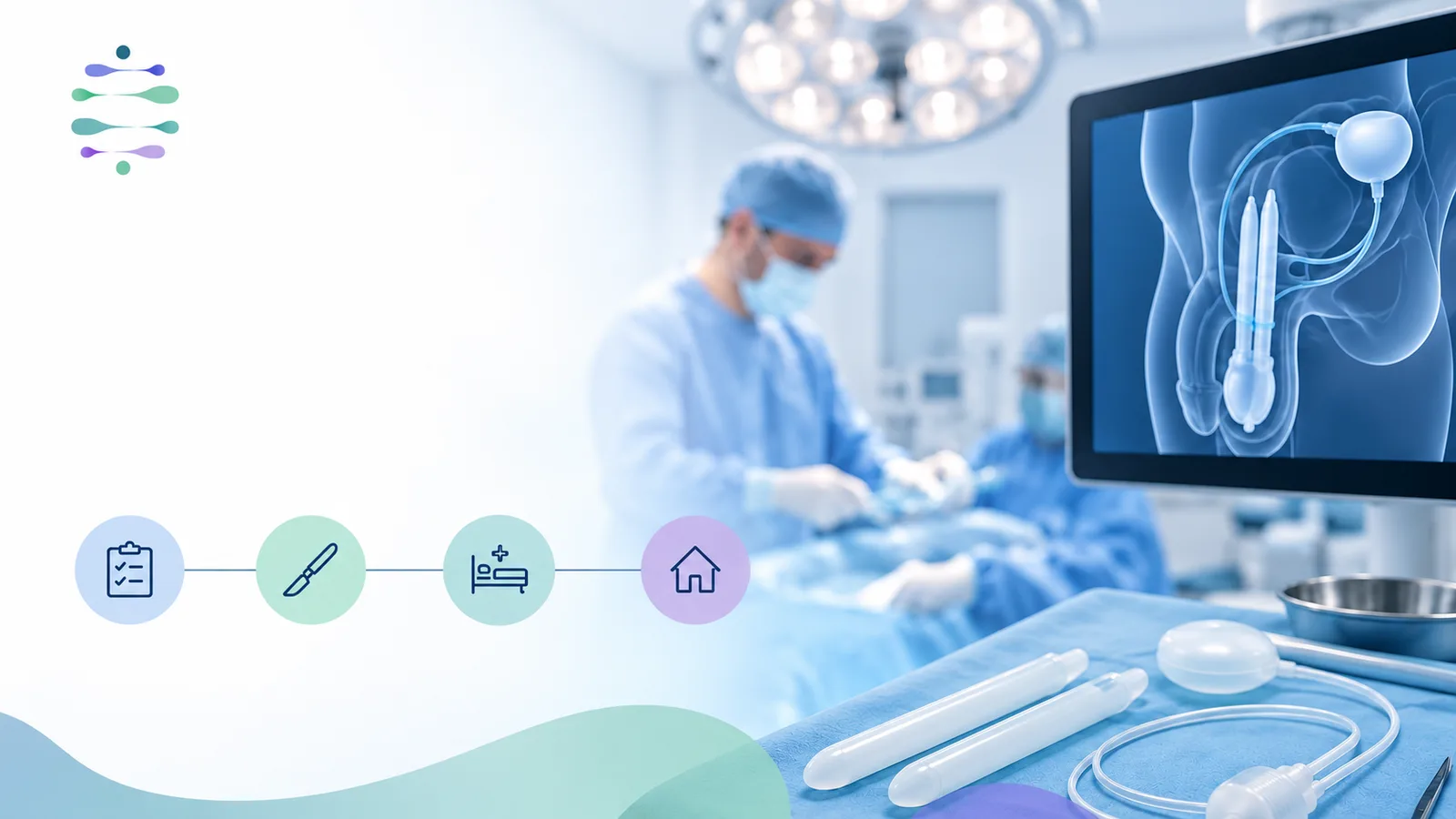
- Implant penile surgery usually involves anaesthesia, opening and measuring both corpora cavernosa, inserting two cylinders, positioning the pump and reservoir, testing the device and closing the wound.
- Penoscrotal and infrapubic approaches are both established methods for inflatable penile implant placement, and the best approach depends on anatomy, previous surgery and surgeon experience.
- The reservoir of a three-piece penile implant is placed internally in the pelvic or abdominal-wall region; previous prostate or abdominal surgery may lead the surgeon to use an alternative reservoir position.
- An inflatable penile implant may be deliberately left partially inflated after surgery as part of a postoperative strategy that can help compress tissues and reduce bleeding or haematoma.
- Some patients are discharged the same day while others stay overnight; safe discharge depends on pain control, bleeding, urination, medical history and the complexity of surgery rather than a fixed timetable.
Implant penile surgery places an inflatable or malleable prosthesis inside the two erectile chambers of the penis to restore reliable rigidity. For a routine inflatable implant, the operation usually involves anaesthesia, a small incision, measuring the corpora, placing two cylinders, positioning the pump and reservoir, testing the device, closing the wound and monitoring the patient before discharge.
The surgery itself is only one part of the process.
A patient may spend much longer preparing for the operation, recovering from anaesthesia and being observed afterward than the surgeon spends placing the device.
That is why descriptions such as “the operation takes about an hour” can be technically correct but still fail to explain what surgery day really feels like.
For a patient, the process usually begins hours before the incision.
There is hospital admission, identity checks, medication review, consent, fasting confirmation, examination, anaesthesia assessment, intravenous antibiotics and preparation of the surgical area.
After the operation, there is another sequence: recovery-room monitoring, pain control, examination of the dressing, checking urine output, controlling swelling and deciding whether the patient can safely go home or should remain in hospital overnight.
For international patients, there is one more layer. Surgery is not the end of the treatment journey. Early postoperative review and a safe plan for remaining in the destination country matter before flying home.
This guide follows penile implant surgery step by step, beginning with admission and ending with discharge.
It also explains two parts of the operation that many short descriptions skip: how surgeons choose between the penoscrotal and infrapubic approaches, and where the reservoir of a three-piece implant actually goes.
How Implant Penile Surgery Works in 9 Main Steps
A straightforward three-piece inflatable penile implant operation can be understood as nine main stages:
Hospital admission, medical checks and anaesthesia preparation.
Antibiotics, sterile skin preparation and urinary catheter placement when used.
A penoscrotal or infrapubic surgical incision.
Opening, dilating and measuring the two corpora cavernosa.
Selecting and placing the correct-size cylinders.
Positioning the fluid reservoir.
Creating a scrotal pocket and positioning the pump.
Connecting, inflating and testing the complete device.
Closing the wound, applying a dressing and beginning postoperative observation.
The order of some steps varies with the surgeon's preferred technique.
A malleable implant is also simpler because it has no hydraulic pump or separate reservoir.
A complex revision, severe corporal fibrosis, previous infection or major Peyronie's reconstruction can make the procedure considerably more involved than the routine sequence described here.
For a basic overview of the different implant types before reading the surgical details, see the penile implant procedure page.
What Does the Day of Penile Implant Surgery Look Like?
Patients often imagine surgery day as the moment they are wheeled into the operating theatre.
In reality, several stages occur before and after the operation.
A typical timeline may look roughly like this:
Stage | What is happening |
|---|---|
About 1–3 hours before surgery | Admission, identity checks, consent, medication review, anaesthesia assessment and IV placement |
Shortly before surgery | Antibiotics, transfer to operating theatre, anaesthesia and sterile preparation |
During surgery | Incision, corporal measurement, implant placement, pump/reservoir placement and device testing |
About 45–90 minutes in many uncomplicated cases | Typical operative period, although complex surgery may take longer |
First 1–3 hours afterward | Recovery from anaesthesia, vital-sign monitoring and pain control |
Later the same day | Wound and swelling checks, food and fluids as appropriate, mobilisation and urine assessment |
Same day or overnight | Discharge for selected patients or continued hospital observation |
Postoperative day 1 | Catheter or drain removal when used, reassessment and discharge in many overnight pathways |
This is not a fixed timetable.
Hospitals and surgeons use different protocols.
A man undergoing his first uncomplicated implant may follow a very different pathway from a patient having a revision after infection or surgery through severe fibrosis.
Likewise, some centres routinely perform penile prosthesis surgery as same-day surgery, while others prefer an overnight stay.
The important point is that the operation is one part of a full perioperative pathway rather than an isolated 60-minute event.
Before Surgery: What Happens During Preoperative Assessment?
Good penile implant surgery starts before the operating room.
The surgeon needs to confirm that a prosthesis is appropriate and understand any factors that could make the procedure more difficult or increase risk.
The medical history commonly includes questions about:
the cause and duration of erectile dysfunction;
previous tablets, injections or vacuum-device treatment;
previous prostate or pelvic surgery;
radiation therapy;
Peyronie's disease;
previous penile implants;
previous implant infection;
priapism;
corporal fibrosis;
urinary symptoms;
diabetes;
cardiovascular disease;
smoking;
current medication;
blood-thinning medication;
drug allergies;
and previous anaesthetic problems.
The physical examination helps the surgeon understand penile anatomy, scar tissue, previous incisions, curvature and the likely dimensions available for implant placement.
Expectations also matter.
Penile prosthesis surgery is intended to restore rigidity.
It is not primarily a penile enlargement operation.
A patient who expects the surgeon to use the “largest possible implant” to create additional length may need more counselling before surgery.
The correct cylinder is the cylinder that safely fits the corporal anatomy.
Why Medication Review Matters Before Penile Implant Surgery
The surgical team needs an accurate list of every medicine and supplement the patient takes.
This is particularly important for anticoagulants and antiplatelet medicines because penile prosthesis surgery involves dissection in tissues that can bleed and swell.
Examples include aspirin, clopidogrel, warfarin, apixaban, rivaroxaban and other medicines that affect clotting.
However, patients should never stop these medicines on their own.
The risk of surgical bleeding has to be balanced against the reason the medication was prescribed.
Someone taking antiplatelet medication after coronary treatment may have a very different risk profile from another patient taking low-dose aspirin for a less urgent indication.
The surgeon, anaesthetist and relevant treating doctor should decide what happens.
Diabetes medication may also require adjustment around fasting and surgery.
The same applies to some blood-pressure medicines and other drugs.
The safest rule is simple:
Bring the complete medication list and follow the perioperative instructions given specifically to you.
Why Infection Screening Matters Before an Implant
A penile prosthesis is a permanent foreign material placed inside the body.
That makes infection prevention particularly important.
A surgeon generally does not want to place an elective prosthesis while a patient has an active infection.
Symptoms such as fever, burning urination, new urinary frequency, cloudy urine, skin infection or drainage should therefore be reported before surgery.
This does not mean every patient automatically needs every possible urine or blood test.
Testing should reflect the patient's history, symptoms and the surgeon's protocol.
The broader principle is that known active infection should be addressed before elective prosthesis implantation whenever possible.
The reason is straightforward.
If bacteria contaminate prosthetic material and establish a device infection, antibiotics alone may not be enough. Significant prosthesis infection can require further surgery, including removal or salvage of the device.
The Night Before Surgery
Patients are usually given fasting instructions before anaesthesia.
The exact time for stopping food and clear fluids can differ between institutions and anaesthesia protocols, so the hospital's instructions should take priority over generic advice found online.
Patients may also receive instructions about showering or skin cleansing.
You should not shave the genital area yourself unless the surgical team specifically tells you to do so.
Small shaving cuts can damage the skin, and the hospital can manage hair removal using its own protocol if needed.
The patient should also confirm practical details before leaving for hospital:
arrival time;
required identification;
medication list;
medical reports;
implant choice if already agreed;
whether a companion can attend;
expected hospital stay;
and transport after discharge.
For a patient travelling abroad, the hotel and hospital arrangements should already be clear before surgery day.
Hour 0: Admission to the Hospital
On arrival, the administrative part of surgery begins.
The patient is registered and usually receives an identification wristband.
A nurse reviews basic information, allergies and medication.
Vital signs such as blood pressure, pulse, temperature and oxygen saturation may be recorded.
Any required blood tests or other final investigations are checked.
The team confirms when the patient last ate and drank.
The operation and surgical site are confirmed.
Consent should not be treated as a formality.
The patient should still be able to ask questions.
If the implant type, surgeon, hospital or planned operation is different from what the patient understood beforehand, that needs to be resolved before anaesthesia.
Confirming the Exact Penile Implant
Before the operation, the patient should know whether the plan is for:
a three-piece inflatable prosthesis;
a two-piece inflatable prosthesis;
or a malleable prosthesis.
For an inflatable device, the manufacturer and model should also be clear.
The final cylinder length cannot normally be chosen until the corpora have actually been measured during surgery.
That is normal.
The surgeon can know which device family is planned without knowing the patient's final internal corporal measurement in advance.
This is an important distinction.
A surgeon should not select a cylinder length based only on the externally visible length of the penis.
The relevant measurement is made inside the corpora cavernosa during the operation.
Meeting the Anaesthetist
Before surgery, the anaesthetist reviews the patient's health and anaesthetic plan.
Penile implant surgery may be performed under general anaesthesia or regional/spinal anaesthesia depending on the patient, hospital and surgical team.
With general anaesthesia, the patient is unconscious for the procedure.
With spinal or regional anaesthesia, sensation is blocked in the lower part of the body, although additional sedation may be used.
The anaesthetic team may ask about:
previous anaesthesia;
heart disease;
lung disease;
sleep apnoea;
allergies;
dentures;
smoking;
medication;
and when food or liquid was last consumed.
An intravenous cannula is normally placed so that fluids, antibiotics, anaesthetic medication and pain medication can be given.
Antibiotics Before the Incision
Preventing infection is a major priority in prosthetic urology.
Antibiotics are generally administered around the time of surgery according to the institution's protocol and patient-specific factors.
Many modern penile prostheses also incorporate infection-reduction technologies.
Some devices contain antibiotic impregnation, while others have hydrophilic surfaces designed to absorb an antimicrobial solution chosen by the surgical team.
These features reduce risk but do not make sterile technique unnecessary.
A coated implant can still become infected.
Infection prevention depends on the whole process:
appropriate patient selection, skin preparation, antibiotics, careful operating-room technique, minimal contamination and good postoperative care.
Entering the Operating Theatre
Once anaesthesia begins, the patient is positioned for surgery.
The genital area and surrounding skin are prepared using an antiseptic solution.
Sterile drapes isolate the surgical field.
A urinary catheter may be inserted.
The catheter drains the bladder and can help the surgeon identify the urethra during dissection.
It can also simplify urine management while the patient is recovering from anaesthesia.
Some surgeons remove the catheter at the end of surgery.
Others leave it until later that day or the following morning.
The protocol depends on the operation and surgeon.
Penoscrotal vs Infrapubic Penile Implant Surgery
One of the most common technical questions is where the incision is made.
For three-piece inflatable implants, two major surgical approaches are widely used:
penoscrotal and infrapubic.
Both can produce successful penile implant placement.
Published comparative reviews have not established one universal approach as superior for every patient.
The best approach often depends on surgeon experience and individual anatomy.
What is the penoscrotal approach?
In the penoscrotal approach, the surgeon makes an incision around the junction where the penis meets the scrotum.
This provides direct access to the corpora cavernosa and good exposure for placing the pump into the scrotum.
The approach is widely used.
A major practical advantage is the visibility and access it provides to the proximal corpora and scrotal pump space.
It can also be useful in complex cases.
The reservoir still has to be placed higher in the pelvis or abdominal-wall region for a three-piece device.
That part is reached through the same surgical field using the appropriate anatomical route or an alternative reservoir-placement technique.
What is the infrapubic approach?
The infrapubic incision is made above the base of the penis near the pubic region.
This approach gives the surgeon direct access to the proximal corporal bodies and can make reservoir placement straightforward.
The scrotal pump is then positioned through a tract from above.
An infrapubic approach may avoid a primary scrotal incision.
However, that does not make it automatically less invasive or universally better.
The anatomy around the dorsal penile nerves and the ability to position the pump appropriately must be respected.
Which incision is better?
There is no simple winner.
Reviews comparing the two approaches generally conclude that both are viable.
Some published analyses suggest differences in operative time or particular technical advantages, but convincing evidence that one approach consistently gives lower complication rates has not been established.
The surgeon's familiarity with the chosen approach is therefore important.
A surgeon who performs hundreds of prostheses through one approach should not necessarily change technique because a patient has watched a penile implant surgery video showing another incision.
A good consultation should explain why the approach makes sense for the particular anatomy and surgical history.
Step 1: Reaching the Corpora Cavernosa
After the skin incision, the surgeon carefully dissects through the tissue layers to reach the tunica albuginea.
The tunica is the strong fibrous layer surrounding each corpus cavernosum.
There are two corpora cavernosa, one on each side.
These are the erectile chambers that normally expand with blood during a natural erection.
The prosthesis cylinders will occupy space within these chambers.
The surgeon places sutures that will later help close the corporal openings.
Small incisions called corporotomies are then made into the tunica.
This gives access to the internal corporal spaces.
Step 2: Creating Space Inside the Corpora
The corporal spaces must be prepared to accept the cylinders.
Special dilators are passed carefully within each corpus cavernosum.
The surgeon works both distally toward the glans and proximally toward the deeper root of the penis.
This is one of the technically important parts of the procedure.
The aim is to create a smooth internal channel without injuring the urethra, perforating the corporal wall or crossing from one corpus into the other.
The direction of dilation matters.
Experienced prosthetic surgeons understand the internal anatomy rather than simply pushing an instrument forward.
In patients with normal erectile tissue, dilation may be relatively straightforward.
In severe fibrosis, it can be much more difficult.
Why Corporal Fibrosis Makes Implant Surgery Harder
Corporal fibrosis means scar tissue has replaced part of the normal soft erectile tissue.
It can occur after:
prolonged ischemic priapism;
previous prosthesis infection;
previous implant removal;
repeated intracavernosal injections;
trauma;
or other causes.
Dense fibrosis can make normal dilation difficult.
Specialized instruments and reconstructive techniques may be needed.
The operation can take longer.
The available diameter for standard cylinders may also be reduced.
This is why a patient who has severe fibrosis should not assume his surgery is identical to routine first-time implantation.
Andrology Abroad has a separate page on penile prosthesis complications, which is useful when previous implant surgery or infection is part of the history.
Step 3: Measuring the Corpora
Once the spaces are prepared, the surgeon measures each corpus cavernosum internally.
This determines the required implant length.
The internal measurement includes more of the penis than the part visible outside the body.
A significant portion of each corpus extends backward into the pelvis.
That is why a 20-centimetre cylinder does not mean the patient has 20 centimetres of visible penile length.
A prosthesis component runs both distally along the visible shaft and proximally into the internal corporal root.
The surgeon records the measurements and selects the appropriate cylinder configuration.
Rear-tip extenders may be used with some systems to match the total corporal length.
Accurate sizing matters.
Why the Surgeon Does Not Simply Use the Longest Cylinder
Patients occasionally assume longer cylinders will create a longer penis.
That is not how implant sizing works.
An undersized implant can fail to support the distal shaft adequately.
An oversized cylinder can buckle, cause chronic pressure, pain, erosion or abnormal positioning.
The surgeon therefore wants the correct anatomical fit, not the biggest number printed on the packaging.
The goal of penile implant placement is to restore rigidity safely.
Trying to create extra length by over-sizing a prosthesis would trade an unrealistic cosmetic goal for medical risk.
Step 4: Placing the Cylinders
After measurement, the two prosthesis cylinders are inserted into the prepared corpora cavernosa.
Each cylinder should extend from the proximal corporal root toward the distal penis.
The distal tips should sit symmetrically.
The surgeon checks that the cylinders lie correctly and that one has not crossed into the opposite corporal space.
With an inflatable device, the cylinders are then tested.
Inflation allows the surgeon to assess:
symmetry;
distal position;
overall fit;
straightness;
cylinder expansion;
and whether the corporal closures behave normally.
If the patient also has Peyronie's disease, inflation can reveal how much curvature remains after cylinder placement.
Additional corrective techniques may sometimes be required in that setting.
Step 5: Where Does the Penile Implant Reservoir Go?
A three-piece inflatable prosthesis needs an internal fluid reservoir.
The reservoir is not placed inside the penis.
It is usually positioned deeper in the pelvic or lower abdominal region.
Traditionally, the space of Retzius, behind the pubic bone, has been a common reservoir location.
However, modern prosthetic surgery also uses alternative or “ectopic” reservoir positions.
These alternatives have become especially important because many penile implant patients have previously undergone pelvic surgery.
Radical prostatectomy is a common example.
Prior abdominal surgery, pelvic surgery or hernia repair can change the normal tissue planes and make traditional reservoir placement less attractive.
In selected patients, a surgeon may therefore use a submuscular or other ectopic position.
Modern reviews emphasize that reservoir placement should be tailored to the patient's surgical history and anatomy rather than following one technique in every patient.
Why Previous Prostate Surgery Changes Reservoir Planning
Many penile implant patients developed erectile dysfunction after prostate cancer surgery.
Radical prostatectomy can alter the pelvic anatomy.
The usual space behind the pubic bone may contain scar tissue or may no longer be as straightforward to enter.
That does not mean a three-piece prosthesis cannot be implanted.
Instead, the surgeon may choose an alternative reservoir position.
This is an important example of why prosthesis surgery is more than inserting two cylinders.
The surgeon is planning three separate device components in three anatomical regions:
cylinders in the corpora, a pump in the scrotum and a reservoir in the pelvis or abdominal-wall region.
The parts then have to function together as one hydraulic system.
Step 6: Creating the Scrotal Pump Pocket
The pump of an inflatable prosthesis sits inside the scrotum.
The surgeon creates a pocket within the scrotal tissues.
The goal is to place the pump where it is:
secure;
comfortable;
sufficiently low in the scrotum;
and accessible to the patient's fingers after healing.
The pump should not be confused with a testicle.
It sits separately within the scrotum.
Position matters because the patient will eventually need to locate the pump repeatedly to inflate and deflate the prosthesis.
A pump placed too high can be harder to use.
Postoperative swelling can also make the pump feel much less accessible at first than it will after healing.
Patients should not panic if they cannot easily identify every part of the pump immediately after surgery.
Step 7: Connecting the Device
The pump, reservoir and cylinders must now be connected.
The system contains fluid and functions hydraulically.
The surgeon ensures the tubing is appropriately routed and that connections are secure.
Air should not be trapped unnecessarily within the system.
The prosthesis is then cycled.
Fluid is transferred into the cylinders to create an erection.
The device can then be deflated again.
This intraoperative test confirms that the system is working before the incision is closed.
A surgeon may repeat inflation more than once while checking fit, symmetry and position.
What Does the Surgeon Check During the Penile Implant Demonstration in Theatre?
The patient is under anaesthesia, so he does not see this part.
But one of the most important moments of the operation is the first full test of the prosthesis.
The surgeon is looking for several things simultaneously.
The cylinders should fill evenly.
The distal ends should sit appropriately beneath the glans.
The shaft should have adequate axial rigidity.
There should not be an obvious cylinder crossover.
The prosthesis should not buckle because of poor sizing.
The tubing should not be kinked.
The pump should operate normally.
The reservoir should fill and empty properly.
If there is curvature, the surgeon evaluates whether it is acceptable or needs further correction.
Only after the surgeon is satisfied with the system is final closure completed.
Step 8: Closing the Corpora and Surgical Incision
The corporotomy openings are closed around the implanted cylinders.
The surrounding tissue layers are then closed carefully.
With a penoscrotal approach, the scrotal tissue is also reconstructed around the pump so the device remains in the intended pocket.
The skin incision is closed.
The exact closure materials vary.
Many surgeons use absorbable sutures so external stitches do not need routine removal.
A drain may be placed in some cases.
Other surgeons do not routinely use one.
Drain use remains a matter of surgical protocol and patient-specific risk rather than a universal requirement.
Why Is a Penile Implant Left Partially Inflated After Surgery?
This is one of the most confusing parts of postoperative care.
Some patients wake up and notice that the penis appears partly erect.
They may assume something has gone wrong.
In reality, surgeons may deliberately leave an inflatable penile prosthesis partially inflated.
One reason is haemostasis.
The expanded cylinders can provide internal pressure, while a compressive external dressing provides pressure from outside.
Together, these measures can help reduce the space available for postoperative bleeding and haematoma formation.
A review of penile prosthesis complications specifically describes compressive dressings, drainage when indicated and partial device inflation as strategies used to reduce postoperative haematoma.
Published postoperative protocols vary considerably.
Some centres leave devices around half to three-quarters inflated for a period.
Others use less inflation or deflate the prosthesis sooner.
There is no single percentage or duration that every surgeon follows.
Patients should therefore follow their own surgeon's protocol rather than comparing their postoperative appearance with someone else's photograph online.
Does Partial Inflation Protect Penile Length?
Some postoperative programmes also use partial inflation and later cycling as part of tissue-expansion and capsule-management strategies.
However, the immediate reason for partial inflation after surgery is commonly related to supporting tissues and controlling bleeding.
Patients should not interpret the early partial erection as their final implant size.
The penis may be:
swollen;
bruised;
compressed by a dressing;
positioned upward;
and only partly inflated.
It is therefore a poor time to judge final length, girth or cosmetic appearance.
The postoperative penis often looks very different from the healed penis several weeks later.
Step 9: Dressing, Drain and Catheter
After closure, a sterile dressing is applied.
A compressive wrap may be used around the penis and scrotum.
The penis may be positioned upward toward the lower abdomen during the immediate postoperative period.
A drain may be left in the scrotum depending on the surgeon's protocol.
A urinary catheter may also remain temporarily.
When overnight admission is used, both the drain and catheter may be removed the following day in many pathways.
This is not universal.
The patient's surgical complexity, bleeding, urinary function and hospital routine all affect timing.
What Happens in the Recovery Room?
When surgery finishes, the patient is transferred to a post-anaesthesia recovery area.
The first priority is not teaching the patient how to use the implant.
It is confirming safe recovery from anaesthesia.
Nurses monitor:
breathing;
oxygen levels;
heart rate;
blood pressure;
consciousness;
pain;
nausea;
bleeding;
and the surgical dressing.
The patient may initially feel sleepy or disoriented.
Pain medication is given as required.
Some modern pain-control pathways use local or regional anaesthetic techniques in addition to standard medication.
The aim is to reduce severe immediate postoperative discomfort while avoiding unnecessary opioid exposure when possible.
What Will the Penis and Scrotum Look Like Immediately After Surgery?
Swelling and bruising are expected.
The amount varies considerably.
The scrotum can become visibly enlarged.
The penis may appear partly erect because the implant has been intentionally left partially inflated.
There may be a bulky compression dressing.
A catheter may still be visible.
A drain may be present.
None of these should be confused with the final appearance.
Patients should also expect the tissues to feel tender.
The pump may be difficult to feel accurately because the scrotum is swollen.
This usually becomes easier as swelling decreases.
Is Penile Implant Surgery Same-Day Surgery?
It can be.
Modern penile implant surgery is performed as an outpatient procedure in many centres.
Selected patients can recover from anaesthesia, pass the required postoperative checks and go home the same day.
Other centres continue to use a 23-hour or overnight observation pathway.
International patients may also be kept overnight for practical reasons even when they are medically stable.
The decision depends on:
age;
medical history;
anaesthesia recovery;
pain control;
urinary function;
bleeding;
surgical complexity;
distance from medical care;
and institutional practice.
There is no prize for leaving the hospital sooner.
Safe discharge matters more than whether surgery is labelled “outpatient.”
What Has to Happen Before Discharge?
Before leaving hospital, the team usually wants to know that the patient is medically stable.
The precise discharge checklist differs, but common considerations include:
stable vital signs;
acceptable pain control;
no concerning bleeding;
manageable nausea;
ability to drink;
appropriate mobility;
urine management;
understanding of the dressing;
understanding of medication instructions;
and knowing when and where follow-up will occur.
If a catheter is removed before discharge, the team may want confirmation that the patient can empty his bladder.
Urinary retention can occur after surgery and anaesthesia.
If the patient cannot urinate adequately, temporary catheterisation may be needed.
What Happens During an Overnight Hospital Stay?
If the patient remains overnight, nurses continue to monitor pain, swelling, the dressing and urine output.
The surgical team usually reviews the patient the following morning.
A drain, if used, may be removed depending on output and the surgeon's protocol.
The urinary catheter may also be removed.
The patient is examined for concerning swelling or bleeding.
Discharge instructions are reviewed.
The first days after surgery should already be planned before the patient leaves the hospital.
What Happens During the First 24 Hours After Penile Implant Surgery?
The first day is mainly about:
rest, pain control, swelling control and protecting the operation.
Walking short distances may be encouraged when safe.
Heavy physical activity is not.
The patient should follow the surgeon's instructions regarding showering, dressing removal, supportive underwear and medication.
Some protocols use supportive underwear or a scrotal support after the main dressing is removed.
The patient should avoid repeatedly touching or testing the prosthesis simply because he is curious.
The pump and tissues need time to heal in their intended positions.
Formal device training usually comes later.
Why You Do Not Normally Use the Implant Immediately
The prosthesis may already work mechanically when the operation finishes.
That does not mean the body is ready for intercourse.
There has been an incision.
The corpora have been opened and closed.
A pump pocket has been created.
Tissues around the reservoir have been manipulated.
The scrotum and penis are swollen.
Sexual activity before adequate healing could increase pain and disrupt recovery.
Many patient-facing medical sources describe a return to sexual activity around four to six weeks after uncomplicated surgery, although the surgeon must confirm readiness for the individual patient.
Formal cycling of the device may begin earlier or later depending on technique and protocol.
What Happens at the First Follow-Up?
The first review may occur within the first one or two weeks, although timing varies.
The surgeon or clinical team looks at:
wound healing;
swelling;
bruising;
pain;
pump position;
signs of infection;
and any urinary problems.
This appointment is not necessarily the moment the patient begins having intercourse.
Healing progresses in stages.
Later, the patient is taught how to operate the device properly.
With an inflatable implant, this means learning both inflation and deflation.
That teaching matters because new patients often find the pump much harder to operate than experienced users.
What Can Go Wrong During Penile Implant Placement?
Most procedures do not experience major intraoperative complications, but patients should understand that the operation involves real surgical risks.
Potential problems include:
Corporal crossover
A dilator or cylinder may accidentally cross from one corpus cavernosum into the other if the internal path is not maintained correctly.
Surgeons check for this during dilation and placement.
Corporal perforation
The wall of the corpus can be perforated, particularly when anatomy is difficult or heavily scarred.
Urethral injury
The urethra lies close to the corpora.
An injury may lead the surgeon to stop or modify the operation, depending on its location and severity.
Bleeding
The penis and scrotum are highly vascular tissues.
Careful haemostasis, compression, partial inflation and selective drain use are all parts of postoperative bleeding management.
Reservoir injury to nearby structures
Traditional reservoir placement occurs near the bladder and pelvic structures.
Previous pelvic surgery can change the anatomy and is one reason alternative reservoir locations have become important.
Device-placement problems
Cylinder length, pump location, tubing orientation and reservoir position all matter.
A technical problem recognized in theatre may be corrected before closure.
What Are the Early Warning Signs After Discharge?
Some discomfort, swelling and bruising are expected.
But there is a difference between normal postoperative recovery and signs that need medical review.
Patients should contact the surgical team promptly for symptoms such as:
fever;
worsening redness;
pus or unusual wound drainage;
rapidly increasing swelling;
uncontrolled bleeding;
severe or escalating pain;
inability to urinate;
wound separation;
darkening or concerning colour change of penile skin or glans;
or a feeling that the device is pushing through tissue.
If a patient is severely unwell, emergency assessment may be more appropriate than waiting for a remote message reply.
This is particularly important for international patients.
A provider offering surgery abroad should tell the patient before surgery who to contact after discharge and what to do if an urgent problem develops.
Is Primary Penile Implant Surgery Different From Revision Surgery?
Very much so.
A first-time uncomplicated implant usually starts with corporal anatomy that has not previously contained a prosthesis.
Revision surgery begins in an already-operated field.
There may be:
scar tissue;
old tubing;
a previous pump pocket;
a previous reservoir;
altered anatomy;
mechanical failure;
or infection history.
Revision surgery can therefore take longer and require different judgment.
If infection is present, the surgical priorities change even more.
A salvage procedure involves removing infected prosthetic material, extensive washout and deciding whether immediate replacement is appropriate.
Day 3 of this content plan focuses on primary penile implant surgery, not salvage or complex revision.
Andrology Abroad has separate content for those procedures because they should not be presented as though they were identical operations.
How Does Peyronie's Disease Change the Operation?
A patient with Peyronie's disease and severe erectile dysfunction may receive a penile prosthesis because the implant can restore rigidity while also helping straighten the penis.
But prosthesis placement alone does not always eliminate curvature.
After the cylinders are inflated, the surgeon assesses the remaining deformity.
If clinically significant curvature remains, additional techniques may be used.
These can include:
modelling;
plication;
incision;
grafting in selected situations;
or other reconstructive steps.
That transforms the operation from a straightforward ED implant into a combined prosthetic and reconstructive procedure.
The expected operative time, risks and postoperative appearance may therefore differ.
What About a Malleable Penile Implant Operation?
Malleable implantation shares several fundamental steps with inflatable surgery.
The corpora are accessed, dilated and measured.
Two rods of appropriate length are then placed within them.
The major difference is that there is:
no hydraulic pump;
no fluid reservoir;
and no tubing connecting multiple components.
This makes the device mechanically simpler.
The surgery may therefore involve fewer implantation steps.
However, malleable prostheses still require accurate sizing, sterile technique and careful corporal placement.
“Simple device” does not mean “minor surgery.”
The patient still has an implanted prosthesis and faces risks such as infection, erosion, pain and dissatisfaction if expectations are poorly matched.
What Does a Penile Implant Surgery Video Not Show?
Patients often search for a penile implant surgery video before deciding whether to proceed.
A video can be useful for understanding anatomy.
But it can also distort the experience.
Surgical footage generally shows the technical operation rather than the full patient journey.
It does not show the days or weeks of assessment beforehand.
It may not show the anaesthesia consultation.
It rarely shows the detailed conversation about length expectations.
It may skip the decision about reservoir location.
It may compress an hour of surgery into several minutes.
And it usually ends before the patient experiences swelling, dressing, pain control or device training.
So a video can answer:
“What does the surgeon's hand do?”
It is much less useful for answering:
“What will this whole treatment experience be like for me?”
That distinction is important.
Why Surgeon Experience Matters in Penile Prosthesis Surgery
Penile implantation requires several judgments that cannot be reduced to a device instruction manual.
The surgeon has to decide:
which incision is appropriate;
how aggressively to dilate;
how to manage fibrosis;
how to measure accurately;
where to place the reservoir;
how to create a usable pump pocket;
whether curvature needs correction;
and what to do when unexpected anatomy appears.
The implant brand cannot make those decisions.
For patients considering treatment in Türkiye, Andrology Abroad lists individual surgeon profiles rather than treating every urologist as interchangeable.
For example, you can review the published profile of Prof. Dr. Zülfü Sertkaya as part of comparing specialist backgrounds.
A profile is not a substitute for a direct consultation, but it gives patients a clearer starting point than choosing a surgery package without knowing who operates.
Why the Hospital Matters Too
Penile implant surgery is a prosthetic operation with infection-prevention requirements, anaesthesia and the possibility of managing complications.
The hospital is therefore part of the treatment decision.
International patients should know the facility before arriving for surgery.
Questions worth asking include:
Is the operation performed in a licensed hospital?
Is anaesthesia provided by a qualified anaesthetist?
Is overnight admission available if needed?
Can urgent imaging or laboratory testing be performed?
Is there access to emergency care?
Who manages the patient if a postoperative complication develops?
You can review Andrology Abroad's hospital and clinic directory when comparing treatment settings.
The purpose is not to choose a hospital based on luxury.
The important features are clinical infrastructure, surgical standards and the ability to support the operation safely.
A Published Expert View on Penile Prosthesis Surgery
The 2025 International Consultation on Sexual Medicine brought together a panel of leading prosthetic-urology and sexual-medicine experts, including Mayo Clinic urologist Tobias S. Köhler, MD, to update recommendations for penile prosthesis treatment.
Their review summarized more than five decades of implant development and contemporary evidence.
“PP provides excellent outcomes for the treatment of ED.”
— Tobias S. Köhler, MD, and colleagues, Sexual Medicine Reviews, 2025.
That sentence is encouraging, but the same consensus also emphasizes clinical judgment and shared decision-making.
A successful operation is not simply one in which all three pieces of an implant are successfully inserted.
The treatment has to be appropriate for the patient in the first place.
Questions to Ask Before Penile Implant Surgery
Before agreeing to the operation, a patient should be able to answer these questions:
What type of penile implant will I receive?
What manufacturer and model are you planning?
Why is that device appropriate for me?
Who will perform the operation?
How much penile prosthesis surgery does the surgeon perform?
Will the incision be penoscrotal or infrapubic?
Why is that approach being recommended in my case?
Where will the reservoir be positioned?
Has previous prostate or abdominal surgery changed the reservoir plan?
How will my penis be measured during surgery?
Will my implant be left partially inflated afterward?
Will I have a catheter?
Will I have a surgical drain?
Will I stay in hospital overnight?
When will I be reviewed after discharge?
When will I begin cycling the device?
When can I resume sexual intercourse?
What should I do if I develop fever or increasing swelling?
Who manages complications after I return home?
What is the plan if the implant becomes infected or fails mechanically?
A clinician should be able to explain these questions in language the patient understands.
Penile Implant Surgery Abroad: What Changes for International Patients?
The operation itself should not become medically different simply because the patient travelled.
The cylinders still need accurate measurement.
The pump still needs good positioning.
The reservoir still needs safe placement.
Sterile technique remains essential.
What changes is the logistics around the operation.
An international patient needs to think about:
how long to stay in the destination;
the first postoperative review;
access to the surgical team;
transport after discharge;
hotel distance from the hospital;
emergency arrangements;
medical interpretation;
and communication after returning home.
Flying out immediately after surgery simply because a package is marketed as “three days” should not take priority over the surgeon's assessment of safe recovery.
If you are considering travelling for penile implant surgery, contact Andrology Abroad for an individual assessment rather than assuming a standard timeline applies to every patient.
What Happens After You Return Home?
The surgical wound continues to heal after hospital discharge.
Swelling normally reduces gradually.
The scrotal pump becomes easier to identify.
Discomfort should improve rather than progressively worsen.
The patient later learns to cycle an inflatable implant.
After healing, the prosthesis is used to create erections when desired.
The patient should keep the device identification and warranty information provided by the manufacturer.
Future healthcare professionals may need to know which device was implanted.
Long-term follow-up is particularly important if pain, difficulty inflating the device, abnormal positioning or other changes develop later.
A penile implant is designed for many years of use, so the relationship with prosthetic care does not end when the incision closes.
Penile Implant Surgery: What Happens From Admission to Discharge?
The full journey can be summarized simply.
The patient arrives fasting and undergoes final medical and anaesthetic checks.
Antibiotics are administered and anaesthesia begins.
The genital area is prepared under sterile conditions and a catheter may be placed.
The surgeon makes a penoscrotal or infrapubic incision.
The corpora cavernosa are opened, prepared and measured.
Two correctly sized cylinders are placed.
For a three-piece inflatable implant, a reservoir is positioned in the pelvic or abdominal-wall region and a pump is placed inside the scrotum.
The system is connected and tested.
The corpora and surgical incision are closed.
The device may deliberately be left partially inflated.
A compressive dressing is applied, and a catheter or drain may be left temporarily.
The patient then recovers from anaesthesia while the team monitors pain, bleeding, swelling, urine output and general stability.
Some patients go home the same day.
Others stay overnight.
The following morning, a catheter or drain may be removed if used, and the patient is discharged when the surgeon is satisfied with the early recovery.
The implant may already function mechanically at that point.
The patient's body, however, is only beginning to heal.
Sexual use comes later.
The Bottom Line
Penile implant surgery is a structured prosthetic operation rather than simply inserting a device into the penis.
In a standard three-piece inflatable procedure, the surgeon has to create and measure two corporal spaces, select and place the cylinders, decide where the reservoir can be positioned safely, create a usable scrotal pump pocket, connect the hydraulic system and test the entire prosthesis before closure.
Two main incision approaches—penoscrotal and infrapubic—are established, and neither is universally superior for every patient.
Previous prostate or abdominal surgery can affect reservoir placement, which is why modern surgeons may choose alternative positions rather than placing every reservoir in the traditional space behind the pubic bone.
After surgery, an inflatable device may intentionally be left partially inflated. This can be used together with compression and other postoperative measures to help limit bleeding and haematoma formation.
The patient then moves through recovery from anaesthesia, pain control, swelling assessment and urine monitoring before either same-day discharge or an overnight stay.
For most patients, the biggest misconception is that surgery ends when the surgeon closes the incision.
It does not.
Successful penile prosthesis treatment also depends on wound healing, device education, realistic expectations and access to follow-up.
The most useful question before surgery is therefore not only:
“Which implant am I getting?”
It is:
“Who is placing it, where is each component going, how will my recovery be managed, and who will look after me if something does not go according to plan?”
Those questions tell you much more about the quality of a penile implant pathway than a device logo or a surgical video alone.
Common questions
How long does penile implant surgery take?
Where is the incision for penile implant surgery?
Where does the penile implant reservoir go?
Why is a penile implant left partially inflated after surgery?
Do you have a catheter during penile implant surgery?
Do you stay overnight after penile implant surgery?
Is penoscrotal or infrapubic penile implant surgery better?
When can I use the penile implant after surgery?
What happens if the surgeon finds severe penile fibrosis?
What should I expect immediately after penile implant surgery?
Sources
- American Urological Association — Erectile Dysfunction: AUA Guideline
- Köhler TS, Munarriz R, Parker J, et al. Penile prosthesis for erectile dysfunction: recommendations from the 5th International Consultation on Sexual Medicine. Sexual Medicine Reviews. 2025.
- Mayo Clinic — Penile implants. Updated July 23, 2026.
- Cavayero CT, et al. Penile Prosthesis Implantation. StatPearls / NCBI Bookshelf.
- Palmisano F, Boeri L, Cristini C, et al. Comparison of Infrapubic vs Penoscrotal Approaches for 3-Piece Inflatable Penile Prosthesis Placement: Do We Have a Winner? Sexual Medicine Reviews. 2018.
- Ricapito A, et al. Penoscrotal approach for inflatable penile prosthesis implant: why it is still the most used. 2023.
- Van Dyke M, et al. Current Concepts of Penile Implant Reservoir Placement and Potential Complications. 2021.
- Sedigh O, et al. Penile implant reservoir placement methods: is there a gold standard? 2026.
- Scherzer ND, Dick B, Gabrielson AT, et al. Penile Prosthesis Complications: Planning, Prevention, and Decision Making. Sexual Medicine Reviews. 2019.
- O'Rourke TK, et al. Prevention, identification, and management of post-operative penile implant complications of infection, hematoma, and device malfunction. Translational Andrology and Urology.
Last reviewed 8 September 2026. We re-review this article by 28 February 2027. This article is for information and is not a substitute for advice from a doctor who knows your history.