
Tactra™
The Tactra™ is a malleable penile prosthesis manufactured by Boston Scientific for men with erectile dysfunction who are candidates for penile implant surgery. It uses paired bendable rods with a Nitinol core and dual-layer silicone construction, providing permanent internal rigidity that can be manually positioned upward for intercourse and downward for concealment without a pump or fluid reservoir.
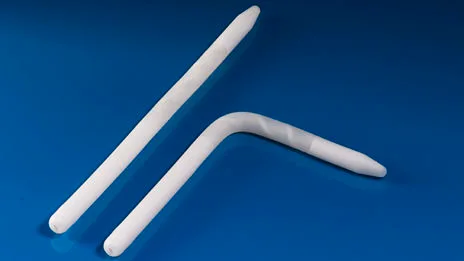
- Malleable rather than inflatable — Tactra uses two bendable rods and has no pump or hydraulic reservoir.
- Nitinol core — A nickel-titanium core provides rigidity while allowing repeated manual positioning.
- Dual-layer silicone construction — The Nitinol core is surrounded by proprietary silicone designed for a more natural tissue feel.
- Three diameters — Current models are available in 9.5, 11 and 13 mm diameters and can be trimmed intraoperatively to fit corporal length.
- Simple operation — The patient manually positions the penis for intercourse or concealment, making Tactra particularly relevant when operating an inflatable pump would be difficult.
About the Tactra™
What Is the Tactra Penile Prosthesis?
Tactra is a malleable penile prosthesis manufactured by Boston Scientific.
It is surgically implanted within the corpora cavernosa to provide permanent structural rigidity for men with erectile dysfunction.
Unlike an inflatable penile prosthesis, Tactra contains no hydraulic fluid, scrotal pump or separate reservoir.
Instead, two flexible semi-rigid cylinders remain inside the penis continuously.
The patient manually positions the penis when rigidity is required for sexual activity and repositions it downward afterward.
How Tactra Works
Tactra does not create an erection by filling with fluid.
The implanted rods remain mechanically firm at all times.
For sexual intercourse, the patient manually raises the penis into the desired position.
Afterward, the penis can be manually positioned downward toward the body for concealment.
This simplicity is the defining functional difference between Tactra and a 3-piece inflatable prosthesis.
Paired Rod Design
Tactra consists of two individual prosthetic cylinders.
One cylinder is placed inside each corpus cavernosum.
Together they provide sufficient structural support for penetrative intercourse.
There are no hydraulic connections between the rods.
There is also no abdominal component.
Nitinol Core
The internal structural component of Tactra is made from Nitinol.
Nitinol is an alloy of nickel and titanium.
Its mechanical properties allow the prosthesis to combine rigidity with repeated controlled bending.
This makes it possible to position the penis upward for intercourse and downward for concealment without requiring hydraulic components.
Dual-Layer Silicone Construction
Boston Scientific surrounds the Nitinol core with proprietary dual layers of silicone.
The silicone provides the external prosthetic surface contacting corporal tissue.
The design is intended to combine the mechanical support of the metal core with a softer outer feel.
Articulating Flex Zone
Tactra incorporates an articulating flex zone.
This region is designed to facilitate bending of the implanted rods when the penis is positioned downward.
The purpose is improved concealability while retaining adequate axial support during intercourse.
Soft Distal Tip
The distal end of each Tactra cylinder incorporates a rounded silicone tip.
This design is intended to provide a softer interface near the distal corpora and glans.
Correct cylinder sizing remains essential because even a soft distal tip can create excessive tissue pressure if the prosthesis is oversized.
No Pump
Tactra does not require a scrotal pump.
This can be an important advantage for patients with reduced hand dexterity.
Inflatable penile implants require repeated pump compression and activation of a deflation mechanism.
Tactra instead requires only manual repositioning of the penis.
No Reservoir
Tactra has no fluid reservoir.
Therefore, no reservoir needs to be positioned in the abdomen or pelvis.
This eliminates reservoir-related complications and can simplify implantation in patients with complex pelvic surgical histories.
Current Diameters
Boston Scientific currently offers Tactra in three cylinder diameters:
9.5 mm
11 mm
13 mm
The surgeon selects the diameter according to corporal anatomy.
A larger diameter should never be forced into inadequate corporal space simply to create greater penile girth.
Current Length Ranges
The cylinders are designed to be trimmed intraoperatively.
Current manufacturer specifications list:
9.5 mm diameter: 14–23 cm
11 mm diameter: 16–25 cm
13 mm diameter: 18–27 cm
These ranges allow the surgeon to adapt the prosthesis to different corporal measurements.
Cut-to-Length Design
Tactra uses a cut-to-length sizing strategy.
Laser-etched markings on the cylinders assist the surgeon during sizing.
After measuring the corpora, the surgeon trims the prosthesis to the appropriate length.
This differs from inflatable prostheses that are supplied in multiple fixed cylinder lengths.
Rear-Tip Extenders
Insertion-fit rear-tip extenders are supplied with the Tactra system.
They allow additional adjustment at the proximal end of the implant.
Their purpose is anatomical fit and stable proximal positioning.
Rear-tip extenders should not be interpreted as a method for increasing external penile length.
Tactra vs Inflatable Penile Implant
The principal difference is mechanical complexity.
Tactra remains semi-rigid continuously.
An inflatable implant can transition between a softer deflated state and a substantially rigid inflated state.
Tactra is easier to operate and has fewer mechanical components.
Inflatable prostheses generally provide more natural flaccidity and concealability.
Neither design is universally superior.
Tactra vs AMS 700
AMS 700 is a 3-piece hydraulic prosthesis.
It contains paired inflatable cylinders, a scrotal pump and a separate reservoir.
Tactra contains only paired malleable cylinders.
AMS 700 generally provides a more natural transition between flaccidity and erection.
Tactra offers simpler operation and avoids hydraulic-component failure.
Tactra vs AMS Ambicor
AMS Ambicor is a 2-piece inflatable prosthesis.
It uses paired inflatable cylinders and a scrotal pump, with hydraulic fluid stored within the cylinder system.
Tactra requires no pump.
Ambicor generally provides better deflated concealability, while Tactra is mechanically simpler.
Tactra vs Coloplast Genesis
Tactra and Coloplast Genesis are both contemporary malleable penile prostheses.
Both use paired bendable cylinders without a pump or reservoir.
Their internal construction, available dimensions and bending characteristics differ.
Tactra uses a Nitinol core with dual-layer silicone.
There is insufficient high-quality comparative clinical evidence to state that either is universally superior.
Tactra vs Rigicon Rigi10
Tactra and Rigi10 are malleable penile prostheses designed around permanent internal rigidity and manual positioning.
They differ in core design, available sizes, materials and manufacturer-specific engineering features.
Device selection should consider anatomy, surgeon experience, availability and long-term evidence rather than marketing claims alone.
Rigidity
Tactra's Nitinol core provides axial rigidity.
Boston Scientific reports bench testing in which paired Tactra cylinders resisted approximately 5.5 times the 1.1 pounds of axial pressure cited by the manufacturer as necessary for vaginal intromission.
This is a laboratory engineering claim.
It should not be converted into a claim of superior clinical rigidity compared with competing implants without direct comparative patient evidence.
Manufacturer Durability Testing
Boston Scientific reports that Tactra cylinders were cycled through 0° to 90° bending for 100,000 cycles without mechanical failure.
The manufacturer describes this as equivalent to twice an expected device life of ten years.
This is bench testing rather than clinical survival evidence.
It does not mean that every Tactra implant is clinically guaranteed to function for ten or twenty years.
Clinical Reliability Evidence
Tactra was FDA cleared in 2019 and is substantially newer than older malleable platforms.
As a result, there is not yet a mature Tactra-specific 10- or 15-year clinical survival dataset comparable with long-established penile prostheses.
The strongest durability information currently promoted for Tactra is manufacturer bench-cycle testing.
For an evidence-based device database, this distinction should remain explicit.
Why Malleable Implants Have Fewer Mechanical Failure Modes
Tactra contains no pump, valves, tubing or fluid reservoir.
This removes several mechanical failure points present in hydraulic prostheses.
However, malleable does not mean mechanically indestructible.
Structural problems, abnormal bending, positioning issues or component damage can still occur.
Infection
Tactra implantation carries a risk of prosthetic infection.
Infection can involve the surgical wound, corporal space or implant itself.
Deep infection may require removal of the prosthesis or specialist salvage surgery.
Risk is influenced by diabetes, revision surgery, active infection, tissue quality and surgical factors.
Antibiotic Coating
Current Boston Scientific product information does not describe Tactra as having the InhibiZone antibiotic treatment used on applicable AMS 700 configurations.
Tactra should therefore not be labeled as InhibiZone-coated unless current model-specific manufacturer documentation explicitly changes this.
The safe CMS entry is:
No fixed antibiotic coating claim verified.
Erosion
Erosion occurs when an implant damages or passes through surrounding corporal, urethral or distal penile tissue.
Continuous semi-rigidity means that appropriate sizing is particularly important.
Excessive cylinder length or diameter can increase tissue pressure.
Reduced penile sensation, previous surgery, fibrosis and infection may also increase risk.
Concealability
Tactra can be manually bent downward for concealment.
The articulating flex zone is specifically designed to facilitate this positioning.
However, the penis remains supported by semi-rigid rods.
It therefore does not become as soft as a fully deflated 3-piece inflatable prosthesis.
This is one of the most important trade-offs patients should understand.
Manual Dexterity
Tactra can be particularly useful for patients who cannot reliably operate an inflatable pump.
The patient does not need repeated finger compression to transfer hydraulic fluid.
However, enough hand function is still required to reposition the penis.
Severe disability should therefore be assessed individually rather than assuming every malleable prosthesis is effortless to operate.
Neurological Conditions
Selected men with neurological disease or spinal cord injury may benefit from the simplicity of a malleable prosthesis.
The implant can provide rigidity for sexual activity without requiring complex pump operation.
In some neurological patients, a penile prosthesis may also facilitate management of external urinary devices.
Reduced sensation and impaired tissue integrity can influence erosion risk, so patient selection remains important.
Tactra and Corporal Fibrosis
Malleable implants can be useful in selected patients with corporal fibrosis.
Their simpler construction may permit implantation in anatomy where hydraulic components are less desirable.
However, severe fibrosis can still make corporal dilation difficult.
Cylinder diameter must be selected according to the actual space available.
Tactra After Infected Implant Removal
A malleable prosthesis may be used in selected salvage strategies after an infected inflatable penile prosthesis.
The concept can help preserve corporal space and reduce contraction while avoiding immediate reimplantation of a more complex hydraulic system.
Whether Tactra itself is appropriate depends on infection status, tissue condition and surgeon strategy.
Active uncontrolled infection is not an indication for routine implantation.
Tactra After Radical Prostatectomy
Men with persistent erectile dysfunction after radical prostatectomy can be candidates for Tactra.
Because Tactra does not require reservoir placement, previous pelvic surgery does not create the same reservoir-positioning considerations associated with a 3-piece implant.
The trade-off is continuous semi-rigidity rather than hydraulic flaccidity.
Tactra and Peyronie's Disease
Men with Peyronie's disease and severe erectile dysfunction may be candidates for penile prosthesis surgery.
A malleable implant can provide rigidity and internal structural support.
However, significant residual curvature may require additional corrective procedures.
Much of the contemporary Peyronie's prosthesis literature focuses on inflatable devices because their cylinders can assist with modeling.
Device choice should therefore be individualized.
Does Tactra Increase Penile Length?
Tactra is not a penile-lengthening implant.
The cylinders are trimmed to match the patient's measured corporal anatomy.
A longer prosthesis should never be intentionally inserted to create additional penile length.
Oversizing can increase pain, distal pressure, deformity and erosion risk.
Does Tactra Increase Penile Girth?
Tactra is available in 9.5, 11 and 13 mm diameters.
The surgeon selects the diameter that safely fits the corpora.
This can influence postoperative shaft fullness, but the device should not be marketed as cosmetic penile-girth enhancement.
No specific increase in external circumference can be guaranteed.
Does Tactra Restore a Natural Erection?
No.
Tactra creates permanent mechanical support within the penis.
It does not restore arterial blood flow, cavernous nerve function or the physiological erectile mechanism.
The patient positions the penis when intercourse is desired.
Sensation and Orgasm
The prosthesis is implanted within the corpora cavernosa and is intended to restore rigidity.
It does not directly restore libido, penile sensation, ejaculation or orgasm.
Men who retain these functions before implantation may generally continue to experience them afterward, depending on their underlying condition and previous surgery.
Revision or Replacement
Tactra can be surgically removed or replaced if infection, erosion, pain, positioning problems or device-related complications occur.
A patient may also later elect conversion to an inflatable penile prosthesis if anatomy and medical circumstances permit.
Revision surgery can be more difficult because scar tissue develops around implanted cylinders.
MRI Status
Boston Scientific identifies Tactra as MR Conditional.
This means MRI may be performed only under manufacturer-specified scanning conditions.
Patients should inform radiology personnel about the implant and provide their implant information before undergoing MRI.
FDA Status
Tactra received U.S. FDA 510(k) clearance in 2019.
The FDA clearance number is:
K183619
The clearance covers the 9.5 mm, 11 mm and 13 mm Tactra Penile Prosthesis configurations.
Who May Be a Good Candidate for Tactra?
Tactra may be appropriate for men with severe erectile dysfunction who want or require a mechanically simple penile prosthesis.
It may be particularly useful when hand dexterity makes an inflatable pump difficult to operate, when avoiding reservoir placement is desirable, or when a surgeon prefers a malleable prosthesis for selected fibrosis, salvage or reconstructive cases.
Candidates must understand that the penis remains semi-rigid continuously.
What Should Patients Weigh Before Choosing Tactra?
Tactra's major advantages are simplicity, immediate mechanical rigidity, absence of a pump or reservoir and reduced hydraulic complexity.
Its principal trade-off is concealability.
Unlike a 3-piece inflatable implant, Tactra cannot become truly flaccid.
Patients should therefore compare ease of operation against resting appearance, comfort, concealment and their willingness to manipulate a scrotal pump.
Key features
Is this device for you?
- •Severe treatment-resistant erectile dysfunction when a penile prosthesis is indicated.
- •Severe treatment-resistant erectile dysfunction when a penile prosthesis is indicated.
- •Men with limited manual dexterity who may struggle with an inflatable scrotal pump.
- •Patients in whom reservoir placement is undesirable because Tactra has no abdominal or pelvic reservoir.
- •Selected corporal fibrosis cases where a malleable implant is anatomically appropriate.
- •Selected prosthesis salvage or reconstructive cases where a malleable strategy is preferred.
- •Patients who accept continuous semi-rigidity in exchange for simpler operation.
- •Always semi-rigid — The penis does not become truly flaccid.
- •Less concealability than a 3-piece inflatable implant — It can be positioned downward but remains structurally supported.
- •No natural inflation/deflation transition — Rigidity is permanent.
- •Not a penile-lengthening implant — Cylinder length is matched to anatomy.
- •Not a cosmetic girth implant — Diameter is chosen according to safe corporal fit.
- •Infection and erosion remain possible — Simpler mechanics do not eliminate surgical complications.
- •Clinical longevity evidence is still developing — Tactra was FDA cleared in 2019.
- •Future revision may be necessary — Infection, erosion, pain or other complications can require replacement or removal.
How it compares
Every malleable (semi-rigid) implant a surgeon in our network may propose, side by side. The Tactra™ column is highlighted.
| Attribute | Tactra™ Boston ScientificPremium | Zephyr ZSI 100Zephyr Surgical Implants (ZSI)Economy | Coloplast Genesis®ColoplastEconomy | Rigicon Rigi10™Rigicon Mid-range |
|---|---|---|---|---|
| Expansion | None — fixed-diameter malleable cylinders | None — fixed-diameter malleable rods | None — fixed-diameter malleable cylinders | None — fixed-diameter malleable rods |
| Rigidity | Permanent semi-rigid axial support from Nitinol core | Permanent semi-rigid axial support from an inner metal core within a bi-material silicone body | Permanent semi-rigid axial support from silver wire coil / helix core | Permanent semi-rigid axial support from stainless-steel core with titanium reinforcement |
| Antibiotic coating | No fixed antimicrobial coating claim verified in current manufacturer product information | Hydrophilic PVP coating stated by the manufacturer to work against infection; not a fixed embedded antibiotic combination | HydroVANTAGE™ hydrophilic coating; absorbs surgeon-selected aqueous solution rather than containing fixed embedded antibiotics | HydroShield™ hydrophilic coating; absorbs surgeon-selected dipping solution rather than containing fixed embedded antibiotics |
| Reservoir | None | None | None | None |
| Control | Manual positioning by bending the penis | Manual positioning by bending the penis | Manual positioning by bending the penis | Manual positioning by bending the penis |
| Concealed when soft | Partially — bends downward for concealment but does not become truly flaccid | Partially — the implant remains semi-rigid; no published bending angle | Partially — bends downward and resists spring-back but does not become truly flaccid | Partially — up to approximately 135° bending with limited spring-back, but the implant remains semi-rigid |
| Cylinder material | Dual-layer silicone surrounding a Nitinol core | NuSil medical-grade silicone with an inner metal core; bi-material central body at 65, 35 and 20 Shore | Flexible silicone elastomer with internal silver wire coil / helix core | Silicone-covered flexible rod with stainless-steel core and titanium-reinforced caps |
| Cylinder options | 9.5 mm × 14–23 , cm 11 mm × 16–25 cm , 13 mm × 18–27 cm | Diameters 9 mm, 11 mm and 13 mm | 9.5 mm × 14–23 cm 11 mm × 16–25 cm 13 mm × 18–27 cm | 9 mm × 23 cm 10 mm × 23 cm 11 mm × 25 cm 12 mm × 25 cm 13 mm × 25 cm 14 mm × 25 cm |
| Length expansion | None — cylinders are trimmed to anatomical length | None — length is reduced by trimming to match corporal anatomy | None — trimmable cylinders are sized to corporal anatomy | None — rod length is adjusted to corporal anatomy using sizing and extenders |
| MRI status | MR Conditional under manufacturer-specified conditions | Not verified — no manufacturer statement located; confirm before publishing | Verify current model-specific Coloplast documentation before publishing a formal MRI classification | MR Conditional at 1.5T and 3.0T under manufacturer-specified conditions |
| Reliability | 90–95% at 5 yrs* | 90–95% at 5 yrs* | 90–95% at 5 yrs* | 90–95% at 5 yrs* |
*Type-level five-year mechanical survival from published series; not a model-specific figure. See each model page for detail.
At a glance
- Manufacturer
- Boston Scientific
- Type
- Malleable (semi-rigid) implant
- Price tier
- Premium
- Regulatory
- FDA 510(k) — United States, K183619
- Warranty
- Verify the current written Boston Scientific Tactra warranty applicable in the country where the prosthesis will be implanted. Warranty coverage, exclusions and replacement terms may vary by market.
- Malleable / semi-rigid design — No hydraulic components.
- Paired cylinders — One implanted in each corpus cavernosum.
- Nitinol core — Nickel-titanium structural core designed for rigidity and repeated bending.
- Dual-layer silicone — Proprietary silicone construction around the core.
- Articulating flex zone — Designed to improve downward positioning and concealment.
- Soft rounded distal tip — Designed for distal comfort.
- Three diameters — 9.5, 11 and 13 mm.
- Cut-to-length sizing — Cylinders can be trimmed intraoperatively.
- Rear-tip extenders included — Permit additional anatomical sizing.
- No pump or reservoir — Simple mechanical operation.
Surgeons who implant it
Surgeons in our network who work with the Tactra™ . Availability of a specific model is always confirmed in your proposal.
Common questions
Is Tactra an inflatable penile implant?
How does Tactra work?
What is Tactra made from?
What sizes does Tactra come in?
Does Tactra have a pump?
Does Tactra have a reservoir?
How long does Tactra last?
Is Tactra easier to use than an inflatable implant?
Is Tactra better than AMS 700?
Is Tactra better than Coloplast Genesis?
What is the difference between Tactra and Rigicon Rigi10?
Does Tactra increase penile length?
Does Tactra increase penile girth?
Can Tactra be used after prostatectomy?
Can Tactra be used in corporal fibrosis?
Can Tactra later be replaced with an inflatable implant?
Is Tactra FDA cleared?
Can patients with Tactra have an MRI?
Patient reviews
Been treated? Your honest review of Tactra™ helps the next patient.
No one has reviewed this yet. If you have been treated, your experience would help the next person.
Write the first reviewSources
- Boston Scientific — Tactra™ Malleable Penile Prosthesis
- Boston Scientific — Tactra Features & Benefits
- Boston Scientific — Tactra Patient Device Support
- FDA — Tactra Penile Prosthesis 510(k) K183619
- EAU Guidelines — Management of Erectile Dysfunction
- AUA — Erectile Dysfunction Guideline
- Boston Scientific — product information