
Coloplast Genesis®
The Coloplast Genesis® is a malleable penile prosthesis designed to provide permanent internal rigidity for men with erectile dysfunction who are candidates for penile implant surgery. It uses paired trimmable silicone elastomer rods with a silver wire coil core and hydrophilic surface coating, allowing the penis to be manually positioned for intercourse and repositioned downward for concealment without a pump or fluid reservoir.
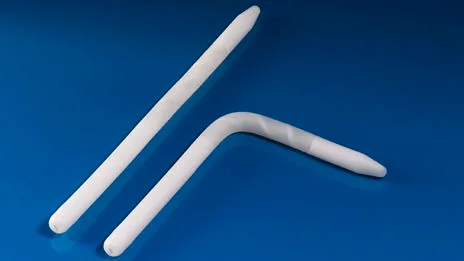
- Malleable rather than inflatable — Genesis uses paired bendable rods with no pump, tubing or hydraulic reservoir.
- Hydrophilic coating — Its surface absorbs aqueous solutions selected during surgical preparation rather than containing a fixed embedded antibiotic combination.
- Silver wire core — A silver wire coil and helix construction provides rigidity while helping the implant maintain its manually selected position.
- Three diameters — Genesis is available in 9.5, 11 and 13 mm diameters with trimmable lengths.
- Simple operation — Manual positioning can make Genesis particularly relevant for patients who have difficulty operating an inflatable prosthesis pump.
About the Coloplast Genesis®
What Is the Coloplast Genesis?
Genesis is a malleable penile prosthesis manufactured by Coloplast.
It is implanted surgically within the corpora cavernosa to provide structural rigidity for men with erectile dysfunction.
Unlike a hydraulic penile implant, Genesis does not inflate or deflate.
Two semi-rigid prosthetic rods remain within the penis continuously.
The patient manually positions the penis upward when rigidity is needed for intercourse and downward afterward for concealment.
How Genesis Works
Genesis creates rigidity mechanically rather than hydraulically.
One prosthetic rod is placed inside each corpus cavernosum.
The internal core allows each rod to bend while retaining enough column strength for penetrative intercourse.
There is no fluid transfer.
There is no pump to squeeze.
There is no valve to activate.
There is no abdominal or pelvic reservoir.
This mechanical simplicity is one of the principal advantages of a malleable prosthesis.
Paired Rod Design
Genesis uses two independent malleable rods.
Each is positioned within one corpus cavernosum.
Together they provide bilateral structural support to the penile shaft.
The rods remain implanted permanently unless they are removed or replaced surgically.
Silver Wire Coil Core
Genesis uses an internal silver wire core.
Contemporary reviews describe the prosthesis as having a silver core within a flexible silicone elastomer structure.
Current Coloplast technical material further describes a silver wire coil and helix construction designed to prevent spring-back and resist buckling.
The core allows the penis to be repositioned while maintaining the selected position.
Silicone Elastomer Construction
The Genesis prosthetic rods use a flexible silicone elastomer structure around the internal core.
The silicone forms the primary interface between the prosthesis and surrounding corporal tissue.
This combination provides a balance between axial support and bendability.
Hydrophilic Coating
One of the most important distinguishing features of Genesis is its hydrophilic surface coating.
Coloplast states that Genesis is the only currently marketed malleable penile prosthesis using this type of hydrophilic coating.
The coating is covalently bonded to the device and absorbs aqueous solutions during surgical preparation.
This gives the surgeon flexibility in selecting an appropriate preparation solution.
HydroVANTAGE™ Hydrophilic Coating
Coloplast product documentation identifies the Genesis surface technology as HydroVANTAGE™ hydrophilic coating.
The coating absorbs fluid when the implant is soaked before insertion.
Depending on the surgeon's protocol, an appropriate aqueous antimicrobial solution may be used during preparation.
The device should therefore not be described as containing one fixed antibiotic combination.
Hydrophilic Coating vs InhibiZone
Genesis and applicable AMS prostheses use different antimicrobial-surface strategies.
Genesis has a hydrophilic surface that absorbs a surgeon-selected aqueous solution.
Boston Scientific's InhibiZone technology incorporates rifampin and minocycline into applicable prosthesis surfaces.
These are different technologies.
Neither eliminates the possibility of prosthetic infection.
No Pump
Genesis does not contain a scrotal pump.
This eliminates the need for repeated finger compression to produce rigidity.
It can therefore be particularly useful for patients with limited finger or hand dexterity, muscle fatigue or restricted range of movement.
The patient must still be capable of manually positioning the penis.
No Reservoir
Genesis has no abdominal or pelvic reservoir.
This simplifies the prosthetic architecture and eliminates reservoir-related complications.
It can also be advantageous in selected patients with complex pelvic surgical histories.
No Hydraulic Tubing
There is no hydraulic tubing connecting components.
This removes another potential mechanical failure point associated with inflatable prostheses.
The implant's functional mechanism is entirely mechanical.
No Internal Moving Hydraulic Parts
Genesis contains no pump, valves or other hydraulic mechanisms.
This contributes to its mechanical simplicity.
However, a malleable prosthesis should not be described as incapable of failure.
Structural damage, erosion, infection, displacement and other prosthesis-related complications remain possible.
Positionability
Genesis is designed to remain in the position selected by the patient.
The internal coil structure reduces spring-back.
For intercourse, the penis is manually positioned outward or upward.
Afterward, it can be positioned downward toward the body.
This allows greater concealability than would be possible with a completely rigid rod.
Approximately 90° Bend Flexibility
A contemporary review of commercially available malleable prostheses describes Genesis as having approximately 90 degrees of bend flexibility.
The practical purpose is positioning rather than creating a natural flaccid state.
The implant remains semi-rigid even when bent downward.
Current Diameters
Genesis is currently available in three diameters:
9.5 mm
11 mm
13 mm
Cylinder diameter is selected according to measured corporal anatomy.
The largest cylinder that can be safely accommodated is not necessarily the best cylinder for every patient.
Excessive diameter can increase tissue pressure and complications.
Current Length Ranges
Current Coloplast information lists:
9.5 mm diameter: 14–23 cm
11 mm diameter: 16–25 cm
13 mm diameter: 18–27 cm
The cylinders are trimmable.
This allows the surgeon to adapt the prosthesis to individual corporal length.
Trimmable Cylinders
Genesis does not require the surgeon to select among numerous fixed cylinder lengths.
Instead, the rods can be cut during surgery.
After measuring the corpora, the surgeon trims the cylinders to the appropriate length and attaches the selected tail cap.
This provides substantial intraoperative sizing flexibility.
Tail Caps
Genesis includes three interchangeable tail-cap lengths.
Current technical literature describes:
Standard / 0 cm
+0.5 cm
+1.0 cm
The tail caps allow fine adjustment after the prosthesis has been trimmed.
Their purpose is anatomical sizing and proximal stability rather than cosmetic penile lengthening.
Anatomical Distal Tip
Current Coloplast documentation describes an anatomical distal tip designed to provide a natural profile and discreet appearance.
The distal end sits within the distal corporal body.
Correct sizing remains essential because excessive distal pressure can contribute to pain or erosion regardless of tip design.
Column Strength
The distal shaft is designed to provide enough column strength to resist buckling during intercourse.
This is important because a malleable prosthesis does not become hydraulically rigid.
Its ability to support penetration depends on the mechanical properties of the rods themselves.
Manufacturer Bend-Cycle Testing
Current Coloplast technical material states that Genesis has been engineered for mechanical durability and tested through more than 8,000 bend cycles.
This is manufacturer bench testing.
It should not be interpreted as a clinical survival percentage or a guaranteed number of years of implant function.
Clinical Reliability
Genesis has fewer mechanical components than an inflatable penile prosthesis.
There is no pump, reservoir, tubing or hydraulic valve to fail.
Contemporary reviews consequently describe mechanical failure of malleable prostheses as uncommon.
However, there is not a strong Genesis-specific 10- or 15-year Kaplan-Meier survival dataset comparable with the major inflatable prosthesis platforms.
For the CMS, patient satisfaction is therefore a better evidence-based numeric outcome than an invented mechanical-survival percentage.
Clinical Satisfaction
A comparative clinical study evaluated 60 men with malleable prostheses.
Twenty-four had Coloplast Genesis and 36 had AMS Spectra.
Mean follow-up was approximately 19.9 months.
The Genesis group had an overall EDITS satisfaction index of approximately 77.1%.
The Spectra group had a satisfaction index of 75.6%.
The difference was not statistically significant.
The study therefore did not establish superiority of one device.
Genesis vs Tactra
Genesis and Boston Scientific Tactra are both contemporary malleable penile prostheses.
Both are available in 9.5, 11 and 13 mm diameters with comparable trimmable length ranges.
Their internal construction differs.
Genesis uses a silver wire coil/helix core within silicone elastomer.
Tactra uses a Nitinol nickel-titanium core surrounded by dual-layer silicone.
Genesis also has a hydrophilic coating.
Tactra's current product information does not describe the same hydrophilic surface technology.
There is insufficient comparative clinical evidence to state that either device is universally superior.
Genesis vs Rigicon Rigi10
Genesis and Rigi10 are both malleable penile implants.
Both provide permanent internal support without a hydraulic pump or reservoir.
They differ in core construction, surface technology, sizing and manufacturer-specific mechanical characteristics.
Genesis has a longer commercial history, having been introduced in the mid-2000s.
Device selection should be based on anatomy, surgeon experience, evidence and local availability.
Genesis vs ZSI 100
Genesis and ZSI 100 are both non-inflatable penile prostheses.
Both avoid pumps and reservoirs.
Their materials, dimensions, bending characteristics and surface technologies differ.
Genesis is particularly distinguished by its hydrophilic coating and trimmable sizing system.
Genesis vs 3-Piece Inflatable Penile Implant
A 3-piece inflatable prosthesis can transition between a relatively soft deflated state and a rigid inflated state.
Genesis remains semi-rigid continuously.
Genesis offers simpler operation and fewer mechanical components.
The 3-piece implant generally offers better concealability and a more natural flaccid-to-erect transition.
The appropriate choice depends on patient priorities and functional ability.
Genesis vs AMS Ambicor
AMS Ambicor is a 2-piece inflatable prosthesis.
It requires operation of a scrotal pump but does not require a separate abdominal reservoir.
Genesis requires neither pump nor reservoir.
Ambicor can become softer after deflation.
Genesis remains mechanically supported at all times.
Manual Dexterity
Genesis can be particularly useful when finger dexterity is insufficient for reliable operation of an inflatable pump.
Coloplast specifically identifies patients with hand or finger dexterity problems, hand muscle fatigue and limited reach or mobility as potential beneficiaries of the simple malleable design.
The patient must still have enough mobility to position the penis manually.
Neurological Conditions
Selected patients with spinal cord injury, multiple sclerosis or other neurological disorders may be candidates for a malleable prosthesis.
The simple operation can be useful when neurological impairment affects hand function.
However, reduced penile sensation and compromised tissue quality can increase the importance of pressure management and surveillance for erosion.
Genesis After Radical Prostatectomy
Persistent erectile dysfunction following radical prostatectomy is an established indication for penile prosthesis surgery.
Genesis can provide reliable mechanical rigidity without depending on cavernous nerve recovery.
Because it has no pelvic reservoir, reservoir positioning after prostatectomy is not an issue.
Patients must accept the continuously semi-rigid resting state.
Genesis and Diabetes
Men with severe diabetes-related erectile dysfunction may be candidates for Genesis when conservative treatments are ineffective or unsuitable.
The implant bypasses the vascular and neurological mechanisms required for a natural erection.
Diabetes can increase surgical risk in some patients, particularly when glycemic control is poor.
Appropriate medical optimization remains important.
Genesis and Peyronie's Disease
Coloplast lists Peyronie's disease among the conditions for which Genesis may be used.
Malleable rods can provide internal structural support when erectile dysfunction coexists with curvature.
However, the implant alone may not completely correct significant deformity.
Additional straightening procedures can be required.
Published Peyronie's Experience
Published literature has described favorable outcomes using Genesis in selected men with erectile dysfunction and Peyronie's disease.
Nevertheless, much of the modern prosthesis literature for severe Peyronie's disease focuses on inflatable implants because inflated cylinders can facilitate modeling.
Device selection should therefore depend on curvature, fibrosis, erectile dysfunction severity and patient priorities.
Corporal Fibrosis
Genesis may be useful in selected men with corporal fibrosis.
Malleable implants have simpler geometry than hydraulic systems and can be useful in reconstructive prosthetic surgery.
However, fibrosis can still prevent placement of larger-diameter rods.
The surgeon must select a diameter that can be safely accommodated.
Prosthesis Salvage
Malleable implants can play an important role in selected penile prosthesis infection salvage strategies.
A malleable prosthesis can maintain corporal space while avoiding immediate replacement with a more complex hydraulic system.
This concept is sometimes called malleable implant salvage.
The decision requires specialist evaluation and appropriate management of the infection.
Priapism
Prolonged ischemic priapism can cause irreversible erectile tissue damage and corporal fibrosis.
Penile prosthesis implantation may eventually be required.
Malleable prostheses are among the options used in this setting.
Early implantation may sometimes reduce the difficulty created by progressive fibrosis, while delayed cases can require complex corporal dilation.
Infection
Genesis implantation carries a risk of prosthetic infection.
Its hydrophilic coating can absorb an antimicrobial solution during preparation, but this does not make the device infection-proof.
Deep infection can require device removal or salvage surgery.
Previous implant infection, revision surgery, poorly controlled diabetes and compromised tissue can increase risk.
Erosion
Because Genesis remains semi-rigid continuously, the rods exert persistent structural pressure within the corpora.
Correct sizing is therefore particularly important.
Oversizing can increase distal pressure.
Patients with reduced sensation, previous prosthesis surgery, spinal cord injury, severe fibrosis or compromised tissue may have an increased erosion risk.
Concealability
Genesis is designed to bend downward and maintain that position.
Its internal helix reduces spring-back, helping concealment.
However, the penis does not become truly flaccid.
A 3-piece inflatable prosthesis generally provides better concealability because fluid can be removed from the cylinders.
Does Genesis Increase Penile Length?
No.
Genesis is not a penile-lengthening prosthesis.
The cylinders are trimmed to match the patient's measured corporal length.
Selecting or leaving an excessively long rod can increase pain, abnormal positioning and erosion risk.
No postoperative length increase should be guaranteed.
Does Genesis Increase Penile Girth?
Genesis is available in 9.5, 11 and 13 mm diameters.
The diameter selected can affect shaft support and fullness.
However, the purpose is to match corporal anatomy, not to perform cosmetic girth enhancement.
No specific increase in external penile circumference should be promised.
Does Genesis Restore a Natural Erection?
No.
Genesis mechanically supports the penis.
It does not restore cavernous nerve activity, arterial inflow or normal erectile physiology.
The rods remain within the corpora continuously and are manually positioned when intercourse is desired.
Sensation and Orgasm
The primary purpose of Genesis is restoration of penile rigidity.
It does not directly restore libido, penile sensation, orgasm or ejaculation.
Patients who retain normal sensory and orgasmic function before implantation may generally retain those functions afterward, depending on their underlying condition.
Revision and Replacement
Genesis can be removed or replaced if infection, erosion, persistent pain, malposition or another complication develops.
Conversion from Genesis to an inflatable prosthesis may also be possible in selected patients.
Revision surgery can be more difficult than primary implantation because scar tissue develops around the prosthesis.
MRI Status
MRI compatibility should be verified using the current Coloplast model-specific implant documentation before publishing a formal MR Conditional claim.
Patients should always inform radiology personnel about their penile prosthesis before MRI and provide their implant identification information.
Who May Be a Good Candidate for Genesis?
Genesis may be appropriate for men with severe treatment-resistant erectile dysfunction who want or require a simple malleable penile prosthesis.
It can be particularly relevant for men with limited hand dexterity who may struggle to operate an inflatable pump.
Selected patients with previous pelvic surgery, neurological impairment, corporal fibrosis, priapism or reconstructive prosthesis requirements may also benefit.
The patient must accept that the penis remains semi-rigid continuously.
What Should Patients Weigh Before Choosing Genesis?
Genesis offers simple operation, no pump, no reservoir, adjustable intraoperative sizing and fewer mechanical components than an inflatable implant.
Its hydrophilic coating is another distinctive feature.
The main trade-off is that the penis never becomes truly flaccid.
Patients should therefore compare simplicity and ease of operation against concealability, resting comfort and the more natural flaccid-to-erect transition offered by an inflatable prosthesis.
Is this device for you?
- •Severe treatment-resistant erectile dysfunction when penile prosthesis surgery is indicated.
- •Patients with limited hand or finger dexterity who may struggle to operate an inflatable pump.
- •Patients preferring mechanical simplicity without pump, tubing or reservoir.
- •Selected men after radical prostatectomy who want a malleable prosthesis.
- •Selected neurological patients where simple operation is particularly valuable.
- •Selected corporal fibrosis or priapism cases when a malleable prosthesis is appropriate.
- •Selected salvage or reconstructive cases where maintaining corporal space is important.
- •Continuously semi-rigid — Genesis cannot become truly flaccid.
- •Less concealability than a 3-piece inflatable — It bends downward but retains structural rigidity.
- •No hydraulic erection transition — Rigidity is mechanically present continuously.
- •Not designed for penile lengthening — Rods are trimmed to anatomy.
- •Not designed for cosmetic girth enhancement — Diameter is selected according to safe corporal fit.
- •Infection remains possible — Hydrophilic coating does not eliminate infection.
- •Erosion remains possible — Particularly in compromised tissue or reduced-sensation patients.
- •Limited device-specific long-term survival evidence — There is no robust Genesis-specific 10- or 15-year survival percentage.
How it compares
Every malleable (semi-rigid) implant a surgeon in our network may propose, side by side. The Coloplast Genesis® column is highlighted.
| Attribute | Coloplast Genesis®ColoplastEconomy | Zephyr ZSI 100Zephyr Surgical Implants (ZSI)Economy | Tactra™ Boston ScientificPremium | Rigicon Rigi10™Rigicon Mid-range |
|---|---|---|---|---|
| Expansion | None — fixed-diameter malleable cylinders | None — fixed-diameter malleable rods | None — fixed-diameter malleable cylinders | None — fixed-diameter malleable rods |
| Rigidity | Permanent semi-rigid axial support from silver wire coil / helix core | Permanent semi-rigid axial support from an inner metal core within a bi-material silicone body | Permanent semi-rigid axial support from Nitinol core | Permanent semi-rigid axial support from stainless-steel core with titanium reinforcement |
| Antibiotic coating | HydroVANTAGE™ hydrophilic coating; absorbs surgeon-selected aqueous solution rather than containing fixed embedded antibiotics | Hydrophilic PVP coating stated by the manufacturer to work against infection; not a fixed embedded antibiotic combination | No fixed antimicrobial coating claim verified in current manufacturer product information | HydroShield™ hydrophilic coating; absorbs surgeon-selected dipping solution rather than containing fixed embedded antibiotics |
| Reservoir | None | None | None | None |
| Control | Manual positioning by bending the penis | Manual positioning by bending the penis | Manual positioning by bending the penis | Manual positioning by bending the penis |
| Concealed when soft | Partially — bends downward and resists spring-back but does not become truly flaccid | Partially — the implant remains semi-rigid; no published bending angle | Partially — bends downward for concealment but does not become truly flaccid | Partially — up to approximately 135° bending with limited spring-back, but the implant remains semi-rigid |
| Cylinder material | Flexible silicone elastomer with internal silver wire coil / helix core | NuSil medical-grade silicone with an inner metal core; bi-material central body at 65, 35 and 20 Shore | Dual-layer silicone surrounding a Nitinol core | Silicone-covered flexible rod with stainless-steel core and titanium-reinforced caps |
| Cylinder options | 9.5 mm × 14–23 cm 11 mm × 16–25 cm 13 mm × 18–27 cm | Diameters 9 mm, 11 mm and 13 mm | 9.5 mm × 14–23 , cm 11 mm × 16–25 cm , 13 mm × 18–27 cm | 9 mm × 23 cm 10 mm × 23 cm 11 mm × 25 cm 12 mm × 25 cm 13 mm × 25 cm 14 mm × 25 cm |
| Length expansion | None — trimmable cylinders are sized to corporal anatomy | None — length is reduced by trimming to match corporal anatomy | None — cylinders are trimmed to anatomical length | None — rod length is adjusted to corporal anatomy using sizing and extenders |
| MRI status | Verify current model-specific Coloplast documentation before publishing a formal MRI classification | Not verified — no manufacturer statement located; confirm before publishing | MR Conditional under manufacturer-specified conditions | MR Conditional at 1.5T and 3.0T under manufacturer-specified conditions |
| Reliability | 90–95% at 5 yrs* | 90–95% at 5 yrs* | 90–95% at 5 yrs* | 90–95% at 5 yrs* |
*Type-level five-year mechanical survival from published series; not a model-specific figure. See each model page for detail.
At a glance
- Manufacturer
- Coloplast
- Type
- Malleable (semi-rigid) implant
- Price tier
- Economy
- Warranty
- Verify the current written Coloplast Genesis warranty applicable in the country where the prosthesis will be implanted. Warranty duration, replacement terms and exclusions may vary by market.
- Malleable / semi-rigid design — Permanent mechanical support without hydraulic components.
- Silver wire coil and helix core — Provides rigidity, positionability and resistance to spring-back.
- Silicone elastomer construction — Flexible outer prosthetic structure.
- HydroVANTAGE™ hydrophilic coating — Absorbs surgeon-selected aqueous solution during preparation.
- Three diameters — 9.5, 11 and 13 mm.
- Trimmable cylinders — Allows individualized corporal sizing.
- Three tail-cap options — Standard, +0.5 cm and +1.0 cm.
- Approximately 90° positionability — Allows manual positioning for intercourse and concealment.
- No pump or reservoir — Simple patient operation and prosthetic architecture.
- No hydraulic moving components — Fewer mechanical failure points than an inflatable system.
Surgeons who implant it
Surgeons in our network who work with the Coloplast Genesis®. Availability of a specific model is always confirmed in your proposal.
Common questions
Is Coloplast Genesis an inflatable penile implant?
How does Genesis work?
What is Genesis made from?
What sizes does Genesis come in?
Can Genesis be trimmed during surgery?
Does Genesis have an antibiotic coating?
What is special about the Genesis hydrophilic coating?
How reliable is Coloplast Genesis?
How long does Genesis last?
Is Genesis easier to use than an inflatable implant?
Is Genesis better than Tactra?
Is Genesis better than an inflatable penile implant?
Does Genesis increase penile length?
Does Genesis increase penile girth?
Can Genesis be used after radical prostatectomy?
Can Genesis be used for Peyronie's disease?
Can Genesis be used after priapism?
Can Genesis later be replaced with an inflatable implant?
Patient reviews
Been treated? Your honest review of Coloplast Genesis® helps the next patient.
No one has reviewed this yet. If you have been treated, your experience would help the next person.
Write the first reviewSources
- Coloplast — Genesis® Malleable Penile Prosthesis
- Coloplast — Genesis Product Information and Sizing
- Coloplast — Genesis Current HCP Technical Information
- Chung — State-of-Art Review of Current Malleable Penile Prosthesis Devices
- Full-Text Review — Contemporary Malleable Penile Prostheses
- Casabé et al. — Satisfaction Assessment With Genesis and Spectra Malleable Prostheses
- EAU Guidelines — Management of Erectile Dysfunction
- AUA — Erectile Dysfunction Guideline
- Coloplast — product information