
Rigicon Rigi10™
The Rigicon Rigi10™ is a malleable penile prosthesis designed to provide permanent internal rigidity for men with erectile dysfunction who are candidates for penile implant surgery. It uses paired bendable rods with Flexible Rod Technology™, a stainless-steel core, HydroShield™ hydrophilic coating and six available diameters, allowing the penis to be manually positioned for intercourse or concealment without a pump or reservoir.
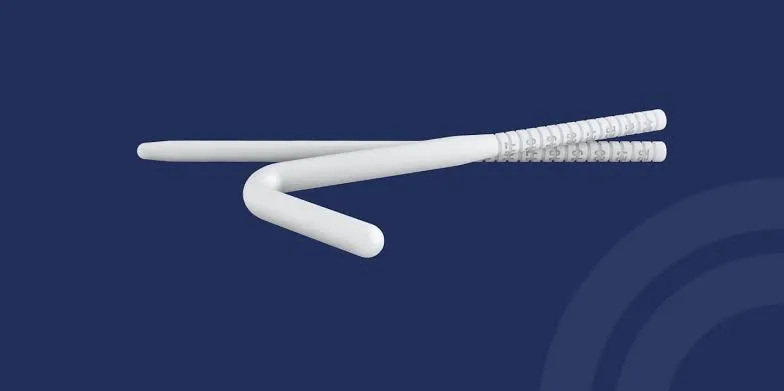
- Malleable rather than inflatable — Rigi10 uses two bendable rods and contains no hydraulic pump, tubing or fluid reservoir.
- Six available diameters — Current models are available in 9, 10, 11, 12, 13 and 14 mm, offering more diameter choices than many competing malleable platforms.
- Flexible Rod Technology™ — The rods can bend up to approximately 135° with limited spring-back for positioning and concealment.
- HydroShield™ hydrophilic coating — The device surface and rear-tip extenders can absorb a surgeon-selected dipping solution during surgical preparation.
- Strong early survival data — A 605-patient multinational study reported approximately 99.2% freedom from revision at 3 years, with no mechanical failures reported during the study period.
About the Rigicon Rigi10™
What Is the Rigicon Rigi10?
Rigi10 is a malleable penile prosthesis manufactured by Rigicon for the surgical treatment of erectile dysfunction.
The implant consists of two semi-rigid rods placed within the corpora cavernosa.
Unlike an inflatable penile prosthesis, Rigi10 does not use hydraulic fluid.
There is no scrotal pump.
There is no fluid reservoir.
There is no connecting tubing.
Instead, the implanted rods provide continuous mechanical support and can be manually repositioned by the patient.
How Rigi10 Works
Rigi10 remains semi-rigid continuously.
When intercourse is desired, the patient manually positions the penis outward or upward.
After intercourse, the penis can be positioned downward toward the body for concealment.
The implant therefore bypasses the natural vascular erectile mechanism.
It does not require medication, injection therapy or pumping before intercourse.
Paired Rod Design
One Rigi10 rod is inserted into each corpus cavernosum.
Together, the rods create bilateral structural support.
The implants remain completely internal.
No part of the prosthesis extends outside the body.
Flexible Rod Technology™
A major engineering feature of Rigi10 is Rigicon's Flexible Rod Technology.
The core is designed to provide both axial rigidity and substantial bendability.
Current manufacturer information describes bending angles of up to approximately 135°.
This allows the rods to be positioned for intercourse and then bent downward afterward.
Reduced Spring-Back
A malleable implant must provide enough stiffness for penetration while also remaining in the position selected by the patient.
Rigi10 is designed to minimize spring-back.
This means the implant is intended to remain more readily in the downward position after the patient manually bends it.
The practical goal is improved concealability and comfort during daily activities.
Stainless-Steel Core
Current Rigicon product information identifies a stainless-steel internal core.
The metal core provides the structural support necessary for penile rigidity.
This differentiates Rigi10 from Tactra, which uses a Nitinol core, and from Genesis, which uses its own silver wire coil construction.
Titanium-Reinforced Caps
Rigicon states that the Rigi10 stainless-steel core is reinforced with titanium caps.
These components contribute to the rod's column strength.
Manufacturer bench testing indicates that the system provides the axial support required for penetrative intercourse.
These engineering findings should not be interpreted as proof of clinical superiority over competing malleable implants.
Soft Distal Tip
Rigi10 incorporates a soft-to-touch distal tip.
The distal portion lies near the end of the corpora beneath the glans.
The softer design is intended to improve comfort during normal activity.
Correct sizing remains essential because excessive distal pressure can still contribute to pain, erosion or tissue injury.
Angled Tip
Current Rigi10 product information also describes an angled distal-tip design.
The tip geometry is intended to support anatomical positioning during implantation.
The practical benefit depends on corporal anatomy and surgeon technique.
HydroShield™ Hydrophilic Coating
Rigi10 uses Rigicon's HydroShield hydrophilic coating.
The coating is present on both the main prosthesis surface and the SecureFit rear-tip extenders.
During surgical preparation, the hydrophilic surface can absorb a solution selected by the surgeon.
This may include an antimicrobial dipping solution according to local protocol.
HydroShield Is Not a Fixed Antibiotic Combination
HydroShield should not be described as containing permanently embedded rifampin, minocycline or another fixed antibiotic combination.
It is a hydrophilic surface that allows the surgeon to select the dipping solution used during preparation.
This is conceptually closer to the hydrophilic strategy used by Coloplast than to Boston Scientific's InhibiZone technology.
Current Diameters
Current Rigicon ordering information lists six Rigi10 diameters:
9 mm
10 mm
11 mm
12 mm
13 mm
14 mm
This broad size range is one of the main distinguishing characteristics of the device.
The 14 mm configuration is currently listed as unavailable for sale in the United States.
Current Rod Lengths
Current ordering information lists:
9 mm: 23 cm
10 mm: 23 cm
11 mm: 25 cm
12 mm: 25 cm
13 mm: 25 cm
14 mm: 25 cm
The rods are adjusted intraoperatively according to corporal measurements.
SecureFit™ Rear-Tip Extenders
Each Rigi10 prosthesis includes SecureFit rear-tip extenders.
Current kits include:
0.5 cm extenders
1.0 cm extenders
Two of each size are supplied.
The extenders attach to the proximal end of the rods to fine-tune overall prosthetic length.
Their purpose is anatomical sizing rather than cosmetic penile lengthening.
Wider Diameter Choice
A notable difference between Rigi10 and several competing malleable prostheses is the number of diameter options.
Tactra and Genesis are commonly available in three diameters.
Rigi10 currently offers six.
This can provide greater flexibility when matching the prosthesis to corporal dimensions.
It should not be interpreted as a recommendation to use the widest possible implant.
Safe anatomical fit remains the priority.
Rigi10 vs Tactra
Rigi10 and Boston Scientific Tactra are both contemporary malleable penile prostheses.
Both use paired bendable rods without a pump or reservoir.
Their internal structures differ.
Rigi10 uses a stainless-steel core reinforced with titanium caps.
Tactra uses a Nitinol nickel-titanium core surrounded by dual-layer silicone.
Rigi10 also has HydroShield hydrophilic coating and currently offers six diameters.
Tactra is currently marketed in three diameters.
No high-quality head-to-head evidence establishes universal superiority.
Rigi10 vs Coloplast Genesis
Both Rigi10 and Genesis are malleable penile prostheses with hydrophilic surface technology.
Genesis uses a silver wire coil or helix core.
Rigi10 uses a stainless-steel core with titanium reinforcement.
Rigi10 currently provides six diameter options, whereas Genesis is commonly available in three.
Both can be manually positioned for intercourse and concealment.
Rigi10 vs ZSI 100
Rigi10 and ZSI 100 are both semi-rigid penile prostheses.
They differ in internal architecture, coating, dimensions and regulatory availability.
Rigi10 has a relatively large contemporary multicenter safety dataset.
Device selection should consider anatomy, surgeon experience, availability and long-term evidence.
Rigi10 vs Inflatable Penile Implant
The central difference is that Rigi10 is always semi-rigid.
An inflatable prosthesis can transition between a comparatively soft resting state and a rigid inflated state.
Rigi10 is mechanically simpler and easier to operate.
An inflatable implant generally provides better concealability and a more natural flaccid-to-erect transition.
Rigi10 vs AMS 700
AMS 700 is a 3-piece hydraulic prosthesis.
It requires cylinders, a scrotal pump and a separate reservoir.
Rigi10 consists only of two malleable rods.
AMS 700 has a substantially longer clinical evidence history.
Rigi10 offers simpler operation and eliminates hydraulic component failures.
No Pump
Rigi10 does not require a scrotal inflation pump.
This can make it particularly attractive to patients with limited hand dexterity.
The patient must still be capable of manually repositioning the penis.
No Reservoir
There is no abdominal or pelvic reservoir.
This simplifies surgical anatomy and eliminates reservoir-specific complications.
It may be relevant in selected patients with extensive prior pelvic surgery.
No Hydraulic Tubing
The prosthesis has no hydraulic tubing.
This removes the possibility of tubing leakage or disconnection seen with inflatable systems.
Mechanical simplicity is one of the fundamental advantages of all malleable penile prostheses.
Rigidity
Rigi10 uses its internal metal core to provide persistent axial support.
The device therefore does not have to be activated before sexual intercourse.
Clinical rigidity depends on correct sizing, anatomy and implant position.
The rod should provide enough structural support for penetration while remaining bendable for concealment.
Manufacturer Durability Testing
Rigicon reports extensive simulated bend-cycle testing.
The rods are repeatedly bent between approximately 0° and 90° during bench evaluation.
The manufacturer reports satisfactory durability without mechanical failure under the tested conditions.
These results are laboratory evidence and should not be substituted for clinical implant-survival data.
Rigi10 Clinical Evidence
Rigi10 has a stronger device-specific early clinical evidence base than many newer malleable implants.
A multicenter study evaluated 605 first-time Rigi10 implantations performed by 46 physicians across 15 countries.
Mean follow-up was approximately 21.6 months.
Only six patients required revision or explantation.
Three-Year Implant Survival
Kaplan-Meier analysis in the 605-patient study estimated approximately 99.2% implant survival free from revision at three years.
This is currently the most useful device-specific reliability number for the Rigi10 CMS page.
It should still be described as early- to medium-term evidence rather than long-term 10- or 15-year survival.
Revision Rate
Revision or explantation occurred in approximately 0.99% of the 605 patients.
Half of the revisions were associated with patient dissatisfaction rather than mechanical malfunction.
This distinction is important when interpreting device reliability.
Mechanical Failure
No mechanical malfunctions were reported in the 605-patient cohort during the available follow-up.
This is encouraging.
However, it does not mean that mechanical failure is impossible over the lifetime of the implant.
Longer observation is needed to determine late failure rates.
Infection
Two of the 605 patients developed device infection.
This corresponds to approximately 0.33%.
These early results are favorable but should not be interpreted as a guaranteed infection rate in every clinical setting.
Infection risk varies according to patient factors, surgical technique, revision status and other variables.
Erosion
One patient in the multicenter cohort required removal because of erosion.
This represented approximately 0.16% of the study population.
Erosion remains an important potential complication of any malleable implant because the cylinders maintain continuous structural pressure within the corpora.
Patient Dissatisfaction
Three patients in the 605-patient study were dissatisfied and elected conversion to an inflatable penile prosthesis.
This highlights an important counselling point.
A technically successful malleable implant may still be unsatisfactory if the patient expects the resting softness of an inflatable device.
Evidence Limitations
The 605-patient study provides useful early multinational evidence.
However, it was based on manufacturer patient-information forms submitted following implantation.
Several authors disclosed relationships with penile prosthesis manufacturers, including Rigicon.
These factors should be considered when interpreting the results.
Independent longer-term clinical studies remain valuable.
Rigi10 and Manual Dexterity
One of the major potential advantages of Rigi10 is simple operation.
Patients do not need to repeatedly compress a scrotal pump.
This may make the implant suitable for selected men with arthritis, neurological impairment, reduced grip strength or other limitations.
The ability to reposition the penis manually is still necessary.
Rigi10 and Neurological Disease
Malleable implants can be useful in selected men with spinal cord injury or neurological disease.
Their mechanical simplicity can make sexual activity easier when fine hand movements are impaired.
However, reduced penile sensation can increase erosion risk because pressure-related tissue injury may not be detected early.
Regular follow-up is particularly important in such patients.
Rigi10 After Radical Prostatectomy
Men with severe erectile dysfunction after radical prostatectomy may be candidates for Rigi10.
Because the implant provides rigidity mechanically, it does not depend on recovery of the cavernous nerves.
The lack of a pelvic reservoir can also simplify implantation compared with some 3-piece prostheses.
Rigi10 and Diabetes
Men with treatment-resistant diabetes-related erectile dysfunction may be candidates for a malleable penile implant.
Rigi10 bypasses the vascular and neurological mechanisms required for a natural erection.
However, poorly controlled diabetes may increase infection risk.
Medical optimization remains important before prosthesis surgery.
Rigi10 and Peyronie's Disease
Malleable prostheses can be considered in selected men who have both severe erectile dysfunction and Peyronie's disease.
The rods provide structural rigidity.
Significant curvature may require additional straightening procedures.
Inflatable implants are more extensively studied in complex Peyronie's reconstruction, so device selection should be individualized.
Rigi10 and Corporal Fibrosis
Malleable implants can be useful when corporal fibrosis makes hydraulic implant placement difficult.
Rigi10's six diameter options may allow the surgeon to select a smaller rod when corporal space is restricted.
Severe fibrosis may still require specialized dilation or reconstructive techniques.
Priapism
Prolonged ischemic priapism can permanently damage cavernosal tissue and lead to dense fibrosis.
A malleable prosthesis may be used in selected patients with irreversible erectile dysfunction following priapism.
Implantation strategy depends strongly on timing and the severity of fibrosis.
Prosthesis Salvage
Malleable penile prostheses have an established role in selected salvage strategies after infected inflatable prostheses.
They can help preserve corporal space while reducing hydraulic complexity.
Whether Rigi10 specifically is appropriate depends on the infection, tissue condition and surgeon's salvage protocol.
Concealability
Rigi10 can be manually bent downward.
Its high bending angle and reduced spring-back are intended to improve concealment.
However, the penis remains semi-rigid.
It does not become truly flaccid as it can with a deflated 3-piece inflatable implant.
Does Rigi10 Increase Penile Length?
No.
Rigi10 is not a penile-lengthening device.
The implant is sized according to the patient's measured corporal anatomy.
Rear-tip extenders are used for anatomical fit.
They should not be used to intentionally create external penile elongation.
Does Rigi10 Increase Penile Girth?
Rigi10 offers six cylinder diameters.
This allows the surgeon to choose a rod that closely matches corporal width.
The selected implant may influence postoperative shaft fullness, but this is not a cosmetic girth-enhancement procedure.
No specific external circumference increase should be guaranteed.
Does Rigi10 Restore a Natural Erection?
No.
Rigi10 creates mechanical penile rigidity.
It does not restore normal arterial filling, veno-occlusion or cavernous nerve function.
The rods remain inside the corpora continuously.
Sensation and Orgasm
The prosthesis is intended primarily to restore rigidity.
It does not directly restore libido, penile sensation, orgasm or ejaculation.
If these functions remain intact before surgery, they can often remain intact afterward depending on the patient's underlying condition.
Revision or Conversion
Rigi10 can be surgically removed or replaced.
Patients may later undergo conversion to an inflatable prosthesis if anatomy and medical circumstances permit.
Revision surgery can become more complex because corporal scar tissue develops around implanted rods.
MRI Status
Rigi10 is MR Conditional.
Current Rigicon MRI documentation permits scanning under specified conditions at both 1.5 Tesla and 3.0 Tesla.
The manufacturer specifies a maximum spatial field gradient of 4,000 Gauss/cm and a whole-body averaged SAR of 2 W/kg for 15 minutes per pulse sequence under normal operating mode.
Patients should provide their implant information to radiology personnel before MRI.
FDA Status
Rigi10 received FDA 510(k) clearance in the United States.
The clearance number is:
K181673
The FDA decision date was April 15, 2019.
The FDA identifies the device as a penile prosthesis intended to provide penile rigidity in men with erectile dysfunction.
CE Status
Current Rigi10 outside-U.S. instructions for use carry CE marking.
The device can therefore be listed as CE marked where applicable.
Product sizes and availability may differ between countries.
14 mm Availability
Current Rigicon ordering information states that the 14 mm Rigi10 configuration is not available for sale in the United States.
This should be reflected if the CMS later adds country-specific device availability.
The other listed diameters remain part of the current global product range.
Warranty
Rigicon currently advertises a Product Replacement Lifetime Warranty for the Rigi10 family in countries and regions where the product is sold.
Coverage is limited to device replacement for qualifying defects in materials or workmanship.
It applies to the original patient and is non-transferable.
The warranty does not cover surgical fees, hospital costs, physician fees or removal and reimplantation expenses.
Terms vary according to jurisdiction.
Who May Be a Good Candidate for Rigi10?
Rigi10 may be appropriate for men with severe treatment-resistant erectile dysfunction who prefer or require a mechanically simple penile prosthesis.
It may be especially relevant for men with limited manual dexterity, patients for whom avoiding hydraulic components is desirable, and selected men with corporal fibrosis, neurological impairment or complex prior pelvic surgery.
Patients should understand that the penis remains semi-rigid continuously.
What Should Patients Weigh Before Choosing Rigi10?
Rigi10 offers simple operation, six diameter options, hydrophilic coating, strong early device-survival data and no hydraulic pump or reservoir.
The major trade-off is concealability.
Although the device can bend significantly downward, the penis does not become fully flaccid.
Patients should compare this simplicity with the more natural resting appearance offered by inflatable prostheses.
The Rigi10 evidence base is encouraging but still shorter-term than the decades of follow-up available for some established penile prosthesis platforms.
Is this device for you?
- •Severe treatment-resistant erectile dysfunction when penile prosthesis surgery is indicated.
- •Patients with limited manual dexterity who may find an inflatable pump difficult to operate.
- •Patients wanting simple mechanical operation without a pump, tubing or reservoir.
- •Patients requiring flexible diameter selection because Rigi10 offers six current diameter options.
- •Selected corporal fibrosis cases where a malleable prosthesis is appropriate.
- •Selected neurological patients where simple manual positioning is preferable.
- •Selected salvage or reconstructive cases when a malleable implant strategy is chosen.
- •Continuously semi-rigid — The penis does not become truly flaccid.
- •Less concealability than a 3-piece inflatable implant — High bendability helps but does not recreate hydraulic flaccidity.
- •No natural inflation/deflation cycle — Rigidity is always mechanically present.
- •Not designed for penile lengthening — Length is matched to corporal anatomy.
- •Not designed for cosmetic girth enhancement — Diameter is chosen according to safe fit.
- •Long-term data remain limited — The strongest study currently provides approximately 3-year survival evidence.
- •Infection and erosion remain possible — Despite low rates in the initial clinical study.
- •Revision may still be necessary — Dissatisfaction or complications can require removal or conversion.
How it compares
Every malleable (semi-rigid) implant a surgeon in our network may propose, side by side. The Rigicon Rigi10™ column is highlighted.
| Attribute | Rigicon Rigi10™Rigicon Mid-range | Zephyr ZSI 100Zephyr Surgical Implants (ZSI)Economy | Tactra™ Boston ScientificPremium | Coloplast Genesis®ColoplastEconomy |
|---|---|---|---|---|
| Expansion | None — fixed-diameter malleable rods | None — fixed-diameter malleable rods | None — fixed-diameter malleable cylinders | None — fixed-diameter malleable cylinders |
| Rigidity | Permanent semi-rigid axial support from stainless-steel core with titanium reinforcement | Permanent semi-rigid axial support from an inner metal core within a bi-material silicone body | Permanent semi-rigid axial support from Nitinol core | Permanent semi-rigid axial support from silver wire coil / helix core |
| Antibiotic coating | HydroShield™ hydrophilic coating; absorbs surgeon-selected dipping solution rather than containing fixed embedded antibiotics | Hydrophilic PVP coating stated by the manufacturer to work against infection; not a fixed embedded antibiotic combination | No fixed antimicrobial coating claim verified in current manufacturer product information | HydroVANTAGE™ hydrophilic coating; absorbs surgeon-selected aqueous solution rather than containing fixed embedded antibiotics |
| Reservoir | None | None | None | None |
| Control | Manual positioning by bending the penis | Manual positioning by bending the penis | Manual positioning by bending the penis | Manual positioning by bending the penis |
| Concealed when soft | Partially — up to approximately 135° bending with limited spring-back, but the implant remains semi-rigid | Partially — the implant remains semi-rigid; no published bending angle | Partially — bends downward for concealment but does not become truly flaccid | Partially — bends downward and resists spring-back but does not become truly flaccid |
| Cylinder material | Silicone-covered flexible rod with stainless-steel core and titanium-reinforced caps | NuSil medical-grade silicone with an inner metal core; bi-material central body at 65, 35 and 20 Shore | Dual-layer silicone surrounding a Nitinol core | Flexible silicone elastomer with internal silver wire coil / helix core |
| Cylinder options | 9 mm × 23 cm 10 mm × 23 cm 11 mm × 25 cm 12 mm × 25 cm 13 mm × 25 cm 14 mm × 25 cm | Diameters 9 mm, 11 mm and 13 mm | 9.5 mm × 14–23 , cm 11 mm × 16–25 cm , 13 mm × 18–27 cm | 9.5 mm × 14–23 cm 11 mm × 16–25 cm 13 mm × 18–27 cm |
| Length expansion | None — rod length is adjusted to corporal anatomy using sizing and extenders | None — length is reduced by trimming to match corporal anatomy | None — cylinders are trimmed to anatomical length | None — trimmable cylinders are sized to corporal anatomy |
| MRI status | MR Conditional at 1.5T and 3.0T under manufacturer-specified conditions | Not verified — no manufacturer statement located; confirm before publishing | MR Conditional under manufacturer-specified conditions | Verify current model-specific Coloplast documentation before publishing a formal MRI classification |
| Reliability | 90–95% at 5 yrs* | 90–95% at 5 yrs* | 90–95% at 5 yrs* | 90–95% at 5 yrs* |
*Type-level five-year mechanical survival from published series; not a model-specific figure. See each model page for detail.
At a glance
- Manufacturer
- Rigicon
- Type
- Malleable (semi-rigid) implant
- Price tier
- Mid-range
- Regulatory
- FDA 510(k), CE Mark, MRI
- Warranty
- Rigicon offers a Product Replacement Lifetime Warranty for Rigi10 in eligible markets, subject to the company's Limited Warranty and local law. Coverage is limited to qualifying device replacement for defects in materials or workmanship and does not cover surgical, hospital, physician, removal or reimplantation costs. Terms should be verified for the implantation country.
- Malleable / semi-rigid design — Permanent structural support without hydraulic components.
- Flexible Rod Technology™ — Up to approximately 135° bending capability.
- Stainless-steel core — Provides axial structural rigidity.
- Titanium-reinforced caps — Reinforce the internal rod construction.
- HydroShield™ hydrophilic coating — Present on rods and rear-tip extenders.
- Six diameters — 9, 10, 11, 12, 13 and 14 mm.
- Two main rod lengths — 23 cm and 25 cm depending on diameter.
- SecureFit™ rear-tip extenders — 0.5 and 1.0 cm options supplied.
- No pump or reservoir — Simple manual operation.
- MR Conditional — Manufacturer specifies scanning conditions at 1.5T and 3.0T.
Surgeons who implant it
Surgeons in our network who work with the Rigicon Rigi10™. Availability of a specific model is always confirmed in your proposal.
Common questions
Is Rigi10 an inflatable penile implant?
How does Rigi10 work?
What is Rigi10 made from?
How far can Rigi10 bend?
What sizes does Rigi10 come in?
Is the 14 mm Rigi10 available in the United States?
Does Rigi10 have rear-tip extenders?
What coating does Rigi10 use?
Does HydroShield contain antibiotics?
How reliable is Rigi10?
What was the infection rate in the Rigi10 study?
Can Rigi10 mechanically fail?
Is Rigi10 better than Tactra?
Is Rigi10 better than Coloplast Genesis?
Is Rigi10 easier to use than an inflatable implant?
Does Rigi10 increase penile length?
Does Rigi10 increase penile girth?
Can Rigi10 be used after prostatectomy?
Can Rigi10 be used with corporal fibrosis?
Can Rigi10 be used after priapism?
Can Rigi10 later be changed to an inflatable implant?
Is Rigi10 FDA cleared?
Is Rigi10 CE marked?
Can patients with Rigi10 have an MRI?
Does Rigi10 have a lifetime warranty?
Patient reviews
Been treated? Your honest review of Rigicon Rigi10™ helps the next patient.
No one has reviewed this yet. If you have been treated, your experience would help the next person.
Write the first reviewSources
- Rigicon — Rigi10™ Malleable Penile Prosthesis
- Rigicon — Rigi10 Ordering Information
- Wilson et al. — Safety Outcomes of the First Rigi10™ Malleable Penile Prostheses Implanted Worldwide
- Full-Text Rigi10 Multicenter Study
- FDA — Rigi10 Malleable Penile Prosthesis K181673
- Rigicon — Rigi10 MRI Compatibility Statement
- Rigicon — Rigi10 Outside-U.S. Instructions for Use
- State-of-the-Art Review of Current Malleable Penile Prosthesis Devices
- Contemporary Malleable Penile Prostheses — Full Review
- EAU Guidelines — Management of Erectile Dysfunction
- AUA — Erectile Dysfunction Guideline
- Rigicon — product information