
Testi10™ Testicular Prosthesis
The Testi10 is a testicular prosthesis made by Rigicon for men and boys missing one or both testicles through congenital absence, orchiectomy, torsion or similar causes. Unlike most competitors it is not a single device but a family of three: a Firm model made from solid medical-grade silicone elastomer with a fixation mesh, a Saline-Filled model supplied empty and filled by the surgeon during the operation, and a Saline model prefilled at the factory.
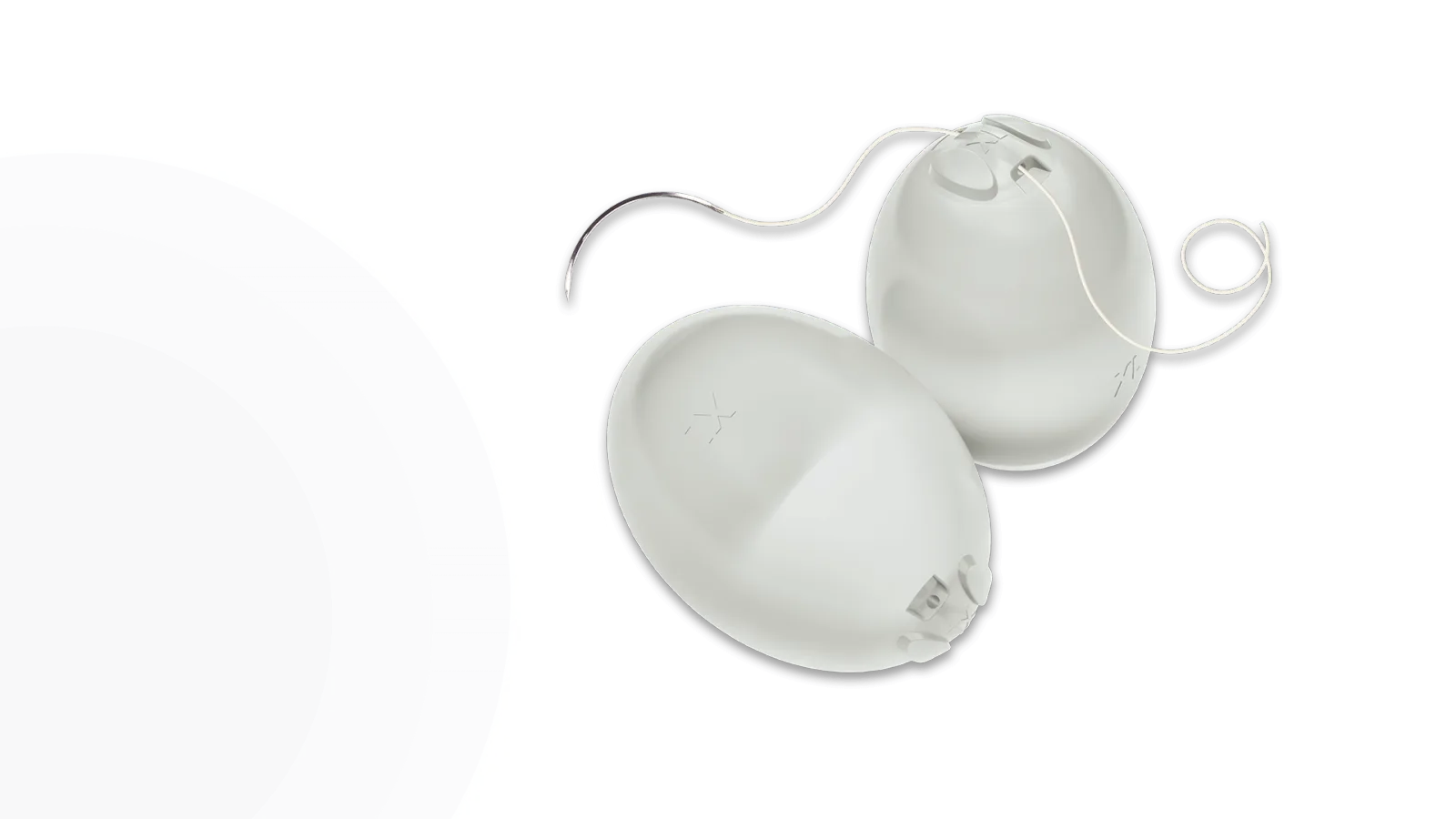
- Three models, not one — Firm, Saline-Filled and Saline, each suiting a different preference and surgical approach.
- Five sizes — XS through XL, a wider range than several competing prostheses offer.
- 99.8% survival from revision at 54 months — In a retrospective review of 427 patients, 382 adults and 45 adolescents.
- Only one revision in the whole cohort — And it followed a suspected inadvertent puncture during surgical filling, which is an argument for the prefilled model.
- No adolescent revisions at all — Survival in the adolescent subgroup was 100%.
- Fixation mesh on the Firm model — Allows straightforward anchoring in the scrotum.
- MR Conditional — Rigicon states the prosthesis can be safely scanned under conditions described in its literature.
- Cosmetic only — No testosterone, no sperm, no endocrine function.
About the Testi10™ Testicular Prosthesis
What Is the Testi10 Testicular Prosthesis?
The Testi10 is a surgically implanted artificial testicle made by Rigicon.
It is designed to replicate the structure and feel of a natural testicle.
Rigicon states it is used for replacement of one or two testicles due to monorchism, orchiectomy, congenital anorchism, cryptorchidism or similar procedures, and that it is applicable in testicular cancer cases.
The device sits entirely inside the scrotum.
Rigicon's own instructions for use describe the device as intended to prevent psychological sequelae, and as advisable for patients diagnosed with testicular agenesis or whose testicle or testicles were surgically removed.
Three Models
This is what distinguishes the Testi10 from most competitors, and the page should lead with it.
Rigicon's instructions for use describe three models of the Testi10: firm, saline-filled and saline.
Firm — made of medical-grade silicone elastomer, with a mesh for easy fixation in the scrotum. It is a solid device with no fluid.
Saline-Filled — manufactured empty and filled with sterile saline during the operation.
Saline — manufactured full, with the saline filled into the prosthesis during manufacturing.
All models are provided sterile and are available in five sizes.
Most manufacturers offer one construction. Rigicon offers a solid option, a surgeon-filled option and a prefilled option, which lets the surgical team choose based on how they prefer to work rather than accepting whatever the manufacturer decided.
Firm vs Saline: What Actually Differs
The Firm model is solid silicone. It cannot leak, cannot rupture and cannot deflate. Rigicon describes it as giving a slightly firmer feel, and as a durable and simple option for restoring scrotal appearance.
The saline models are softer. Rigicon describes the prefilled saline design as offering a simplified surgical procedure and a soft, natural feel.
The trade-off is straightforward. Solid silicone eliminates an entire failure mode at the cost of feeling slightly firmer than a natural testicle. Saline feels more natural but introduces the possibility, however rare, of leakage.
Rigicon states that both options are fully internal and that the surgeon will help determine the best choice based on lifestyle and preference.
Saline-Filled vs Saline: Why the Difference Matters
This distinction sounds trivial and is not.
The Saline-Filled model is filled by the surgeon during the operation. The Saline model arrives already filled.
Surgeon filling allows the volume to be adjusted to match the patient's remaining testicle. Prefilling removes a surgical step and the handling risk that comes with it.
The single revision in Rigicon's 427-patient study is directly relevant here. A 40-year-old patient was found to have a leaking prosthesis approximately one week after surgery, suspected to be due to inadvertent puncture by the surgeon during the sterile saline filling process.
One event across 427 patients is not a pattern. But it is a reminder that the filling step is where the risk sits, and it is a reasonable thing for a patient to ask about.
The Five Sizes
All three models are supplied in five sizes: extra small, small, medium, large and extra large.
Published dimensions for the Firm model are:
XS — 2.7 cm length, 2.1 cm diameter, 6 cc
S — 3.2 cm length, 2.6 cm diameter, 12 cc
M — 4.1 cm length, 2.9 cm diameter, 18 cc
L — 4.7 cm length, 3.2 cm diameter, 22 cc
XL — 5.1 cm length, 3.2 cm diameter, 26 cc
Verification note for the editor: these dimensions come from secondary sources reproducing Rigicon's published size charts, not from a document fetched directly from Rigicon. Confirm against the current Testi10 instructions for use before publishing, and confirm the saline model dimensions separately, since they may differ from the Firm figures above.
Five sizes with an XL at 26 cc gives a wider range than several competing devices, which matters because sizing is the strongest predictor of satisfaction with any testicular prosthesis.
The Fixation Mesh
The Firm model has a mesh for easy fixation in the scrotum.
Migration, where the prosthesis rides upward or sits asymmetrically, is one of the recurring complaints about testicular prostheses.
A fixation feature lets the surgeon anchor the device in a chosen position rather than relying on the scrotal pocket alone.
Ask the surgeon whether they intend to fix the device and how.
The Clinical Evidence
The Testi10 has a device-specific published study, which is more than many testicular prostheses can claim.
An IRB-approved retrospective review drew on data from Patient Information Forms and covered 427 patients, 382 adults and 45 adolescents, each with at least one testicular prosthesis implanted.
Only one adult patient required revision surgery, following rupture of a saline-filled prosthesis.
There were no post-implantation revisions required for adolescent patients.
Kaplan–Meier calculation of survival from removal or revision was 99.8% for all patients at 54 months, 99.7% for adults and 100% for adolescents.
The authors reported that complication rates in this study were lower than those in previously published studies, and concluded that testicular prosthesis implantation is generally safe with very rare incidence of revision surgery for this device.
How to Read That Evidence
The 99.8% figure is genuinely strong and should be on the page. It should also be presented with its limitations, exactly as your Rigi10 page handles the equivalent question.
The study was retrospective and drew on manufacturer Patient Information Forms rather than prospective independent data collection.
One author is a paid employee of Rigicon responsible for assembling the PIF data, and another is a Rigicon consultant.
That does not invalidate the findings. It does mean the study belongs in the same category as the Rigi10 605-patient study: useful early manufacturer-linked evidence, not independent long-term follow-up.
Note also that revision or removal is a narrower endpoint than complication. A study counting revisions will report better numbers than one counting every adverse event. The Torosa pivotal trial reported around 14.5% prosthesis-related complications while a real-world audit of the same device found one removal in 236 implants. The Testi10 study measures the second kind of thing.
What It Does Not Do
The prosthesis is implanted for cosmetic reasons only and does not have any functions of a real testicle.
It produces no testosterone.
It produces no sperm.
It has no effect on fertility, libido, erectile function or hormone levels.
Rigicon's own patient material states plainly that if both testes are absent, patients should ask about testosterone therapy.
Will It Look and Feel Natural?
Rigicon's patient-facing material is unusually candid on this, and the page should follow its lead rather than overpromising.
The device aims to match a natural testicle closely, but may feel a little firmer or sit slightly higher.
Rigicon also states that when properly sized and implanted the look and feel is natural and typically undetectable to others, and that most people adapt quickly and forget they have an artificial testicle.
Both statements are true at once. The implant is usually undetectable to anyone else and slightly noticeable to the man himself.
Adjustability After Implantation
Rigicon states that because the device is filled with saline, its rigidity, size and shape can be altered after implantation if the patient desires.
Treat this claim carefully on the page. Any such adjustment is a procedure, not something a patient does at home, and it would only apply to the saline models rather than the Firm.
Verification note for the editor: confirm with Rigicon what this adjustment involves in practice before presenting it as a patient benefit.
MRI Status
Rigicon states that its testicular prostheses are MR Conditional, and that patients can be safely scanned by meeting the conditions described in the manufacturer's literature.
Rigicon's patient material also advises always informing radiology staff.
Verification note for the editor: obtain the specific MRI conditions document from Rigicon, as was done for the Rigi10 page, and reproduce the field strength and SAR limits rather than only the MR Conditional label.
Recovery
Placement is typically a short procedure and the implant is entirely internal.
Rigicon's patient material indicates many people are cleared to resume normal activity after one to two weeks, while advising patients to follow their surgeon's advice.
Expect scrotal swelling and bruising in the early period, with supportive underwear usually recommended.
Follow the operating surgeon's specific instructions rather than generic timelines.
Timing: At Orchiectomy or Later
A testicular prosthesis can be placed at the time of testicle removal or as a separate later operation.
Simultaneous placement avoids a second anaesthetic and a second recovery, and published evidence for testicular prostheses generally supports its safety at the time of orchidectomy.
Delayed placement remains possible, though scrotal contracture after healing can make it more difficult.
The presence of adolescent patients in the Testi10 study reflects that torsion and congenital cases often present in younger patients, where timing decisions differ.
Testi10 in Adolescents
The 427-patient study included 45 adolescents, with no post-implantation revisions in that group and 100% survival from removal or revision.
Adolescent and paediatric implantation raises questions adults do not face, principally whether and when a device will need upsizing as the patient grows.
The five-size range, from a 6 cc XS upward, is relevant here.
Discuss the expected timeline for any future exchange with a paediatric urologist rather than assuming one implant will serve for life.
Testi10 vs Coloplast Torosa
These are the two contemporary devices most likely to be compared.
Torosa is a saline-filled device supplied empty in four sizes, filled by the surgeon, with a suture tab for fixation. It is the only testicular implant with FDA approval, granted through the premarket approval pathway.
Testi10 offers three constructions rather than one, five sizes rather than four, and a mesh fixation feature on its Firm model.
On published evidence both have device-specific data, and the Testi10 study is the more recent and reports the better revision figure, though against a narrower endpoint and with manufacturer involvement in the data.
No head-to-head trial exists. In practice, availability and surgeon familiarity usually decide.
Testi10 vs Solid Silicone Prostheses Generally
Solid silicone testicular prostheses are widely used outside the United States.
The Testi10 Firm is itself a solid silicone device, so this is a comparison within Rigicon's own range rather than against it.
Where a patient specifically wants no fluid in the device, the Firm model is the answer, and the fixation mesh is a genuine advantage over plain solid implants.
Who May Be a Good Candidate
Men who have had a testicle removed for testicular cancer and want to restore scrotal appearance.
Men and boys with congenital anorchism, monorchism or cryptorchidism.
Patients who have lost a testicle to torsion.
Patients who want a choice between solid and saline constructions rather than a single option.
Patients who need a size at either end of the range, where five sizes help.
Patients considering orchiectomy who want to discuss a prosthesis before surgery rather than after.
What Patients Should Weigh
The device restores appearance and, for most men, does so well enough that others cannot tell.
It restores nothing else.
Complication rates for modern testicular prostheses are low but not zero, and infection, extrusion, migration and capsular contracture remain possible with any implant of this type.
Sizing and positioning drive satisfaction more than brand does, which makes the preoperative conversation the part most worth investing in.
Regulatory Status
Flag for verification before publishing. Rigicon's regulatory position for the Testi10 could not be confirmed from public sources.
This matters because Coloplast markets the Torosa as the only FDA-approved testicular implant. If accurate, that claim shapes how the Testi10 can be described in a US context, and the distinction between FDA approval and FDA clearance may be doing work in it.
Before publishing, confirm directly with Rigicon: FDA status and pathway if any, CE marking, and country-by-country availability. Do not state or imply US regulatory status either way until confirmed.
Rigicon is headquartered in the United States and its published Testi10 material carries the standard US caution that federal law restricts the device to sale by or on the order of a physician, but that notice alone should not be treated as confirmation of an approval pathway.
Warranty
Flag for verification before publishing. Rigicon advertises a Product Replacement Lifetime Warranty for its Rigi10 penile prosthesis family in eligible markets, but equivalent warranty terms for the Testi10 could not be confirmed.
Do not assume the Rigi10 warranty extends to the Testi10. Obtain the Testi10-specific warranty document from Rigicon.
Is this device for you?
- •Men who have had a testicle removed for testicular cancer and want to restore scrotal appearance.
- •Adolescents and younger patients, where the study reported no revisions and 100% survival.
- •Patients who want a choice of construction — solid silicone, surgeon-filled saline or prefilled saline.
- •Patients wanting a firmer, fluid-free device where the Firm model removes leakage as a possibility.
- •Patients concerned about implant migration, where the Firm model's fixation mesh helps.
- •Patients needing a size at either end of the range, where five sizes give more options than four.
- •Surgeons who prefer a prefilled device and want to remove the intraoperative filling step.
- •Cosmetic only — No testosterone, no sperm, no endocrine or fertility function.
- •Firmer feel and slightly higher position — Rigicon's own material acknowledges the device may feel a little firmer or sit slightly higher than a natural testicle.
- •Saline models can rupture — Rare, but the one revision in the published study was a leaking saline-filled device.
- •Evidence is manufacturer-linked — Retrospective, based on manufacturer Patient Information Forms, with Rigicon-affiliated authors.
- •Narrow endpoint — The 99.8% figure measures revision and removal, not all complications.
- •Regulatory status unconfirmed — Verify FDA, CE and country availability before publishing.
- •Warranty unconfirmed — Do not assume the Rigi10 lifetime warranty applies.
- •Size chart from secondary sources — Confirm dimensions against current Rigicon documentation.
- •General implant risks remain — Infection, extrusion, migration and capsular contracture are possible with any device of this type.
How it compares
Every testicular prosthesis a surgeon in our network may propose, side by side. The Testi10™ Testicular Prosthesis column is highlighted.
| Attribute | Testi10™ Testicular ProsthesisRigicon, Inc.Premium | Torosa® Saline-Filled Testicular ProsthesisColoplastMid-range | Mentor Testicular ProsthesisMentor CorporationMid-range |
|---|---|---|---|
| Fill type | Three options — solid silicone (Firm), sterile saline filled during surgery (Saline-Filled), sterile saline filled at manufacture (Saline) | Saline — filled intraoperatively with sterile, isotonic, pyrogen-free Sodium Chloride USP | Saline — filled intraoperatively with sterile, isotonic, pyrogen-free Sodium Chloride USP. Pre-1995 Mentor devices were silicone gel-filled. |
| Shell material | Medical-grade silicone elastomer | Solid silicone elastomer | Silicone elastomer |
| Fill port | Present on the Saline-Filled model for intraoperative filling; not applicable to the Firm model | Self-sealing injection port | Self-sealing injection port |
| Fixation | Mesh for easy fixation in the scrotum on the Firm model | Suture tab at the lower pole; fixation optional at the surgeon's discretion | Suture tab; fixation at the surgeon's discretion |
| Sizes | Five per model — XS, S, M, L, XL Firm model published dimensions: XS 2.7 × 2.1 cm, 6 cc; S 3.2 × 2.6 cm, 12 cc; M 4.1 × 2.9 cm, 18 cc; L 4.7 × 3.2 cm, 22 cc; XL 5.1 × 3.2 cm, 26 cc | Extra small 2.2 × 3.0 cm, 7 cc / Small 2.5 × 3.5 cm, 11 cc Medium 2.7 × 4.0 cm, 16 cc / Large 2.9 × 4.5 cm, 20 cc | Four in current form — 7 cc, 11 cc, 16 cc and 20 cc |
| Placement | Entirely intrascrotal | Entirely intrascrotal; typically an outpatient procedure | Entirely intrascrotal |
| Timing | At orchiectomy or as a delayed secondary procedure | At orchiectomy or as a delayed secondary procedure | At orchiectomy or as a delayed secondary procedure |
| Endocrine function | None — cosmetic replacement only | None — cosmetic replacement only | None — cosmetic replacement only |
| Antibiotic or hydrophilic coating | None specified by the manufacturer for this device | None specified by the manufacturer | — |
| MRI status | MR Conditional per the manufacturer, under conditions described in Rigicon's literature; obtain the specific conditions document | Not verified — no manufacturer statement located; confirm before publishing | Not verified — no manufacturer statement located for either the historic or current device |
| Expected lifespan | — | — | Not a lifetime implant; replacement surgery expected over time |
| Reliability | 90–95% at 5 yrs* | 90–95% at 5 yrs* | 90–95% at 5 yrs* |
*Type-level five-year mechanical survival from published series; not a model-specific figure. See each model page for detail.
At a glance
- Manufacturer
- Rigicon, Inc.
- Type
- Testicular prosthesis
- Price tier
- Premium
- Warranty
- Warranty terms for the Testi10 Testicular Prosthesis should be confirmed directly with Rigicon or the implanting centre before surgery. Rigicon advertises a Product Replacement Lifetime Warranty for its Rigi10 penile prosthesis family in eligible markets, but that programme should not be assumed to extend to the Testi10. Device warranties for implants generally cover device replacement only and do not extend to surgical, hospital, physician, removal or reimplantation costs, and terms vary by jurisdiction.
- Three model options — Firm solid silicone, Saline-Filled for intraoperative filling, and Saline prefilled at manufacture.
- Five sizes — XS through XL across all models.
- Medical-grade silicone elastomer — Used throughout the range.
- Fixation mesh on the Firm model — For straightforward anchoring in the scrotum.
- Prefilled option — Simplifies the surgical procedure and removes the filling step.
- Supplied sterile — All models.
- Fully internal — Nothing sits outside the body.
- MR Conditional — Per the manufacturer, under conditions described in its literature.
- Device-specific published study — 427 patients across adults and adolescents.
Surgeons who implant it
Surgeons in our network who work with the Testi10™ Testicular Prosthesis. Availability of a specific model is always confirmed in your proposal.
Common questions
What is the Testi10 testicular prosthesis?
How many versions of the Testi10 are there?
Which model should I choose?
What sizes does the Testi10 come in?
Does a Testi10 implant produce testosterone?
How reliable is the Testi10?
What was that one failure?
Should I be worried about the implant leaking?
Is the study independent?
Can adolescents have a Testi10?
Will it look and feel like a real testicle?
Will anyone be able to tell?
Can it be adjusted after surgery?
Can I have an MRI with a Testi10?
How long is recovery?
Can it be placed at the same time as my orchiectomy?
How does the Testi10 compare with the Coloplast Torosa?
Is the Testi10 available in my country?
Patient reviews
Been treated? Your honest review of Testi10™ Testicular Prosthesis helps the next patient.
No one has reviewed this yet. If you have been treated, your experience would help the next person.
Write the first reviewSources
- Rigicon — Testi10 Testicular Prosthesis, Instructions for Use (PDF)
- Rigicon — Testi10 Saline Testicular Prosthesis (product page)
- Rigicon — Testicular Replacement (patient information)
- Rigicon — Testi10 Saline Testicular Prosthesis, prefilled (patient page)
- Atwater et al. — Short-term revision rate of Rigicon Testi10 testicular prosthesis in adolescents and adults: a retrospective chart review (Int J Impot Res 2025;37:303–309)
- Turek & Master — Safety and Effectiveness of a New Saline Filled Testicular Prosthesis (J Urol 2004)
- Hayon, Michael & Coward — The modern testicular prosthesis: patient selection and counseling, surgical technique, and outcomes (Asian J Androl 2020)
- Kogan — The clinical utility of testicular prosthesis placement in children with genital and testicular disorders
- Yossepowitch et al. — Testicular prostheses for testis cancer survivors: patient perspectives and predictors of long-term satisfaction (J Urol 2011)
- Bodiwala, Summerton & Terry — Testicular prostheses: development and modern usage (Ann R Coll Surg Engl 2007)
- Robinson et al. — Is it safe to insert a testicular prosthesis at the time of radical orchidectomy for testis cancer (BJU Int 2016)
- EAU Guidelines — Testicular Cancer
- Rigicon, Inc. — product information