
Uniflate 1000®
The Uniflate 1000 was a two-piece inflatable penile prosthesis introduced by Surgitek, Inc. in the 1980s. It competed directly with the Mentor GFS and shared its basic architecture: paired cylinders connected to a scrotal resipump that combined pump and reservoir. Two features set it apart. Its cylinders were built in two layers, an outer silicone layer and an inner Dacron layer, creating two chambers per cylinder so the outer chamber could add girth. And the resipump carried a self-sealing penetrable port on its underside, allowing fluid volume to be adjusted transcutaneously. The device did not secure FDA approval, tubing fracture proved a persistent problem, and Surgitek left the penile prosthesis market. This page is written for men who already have a Uniflate implanted.
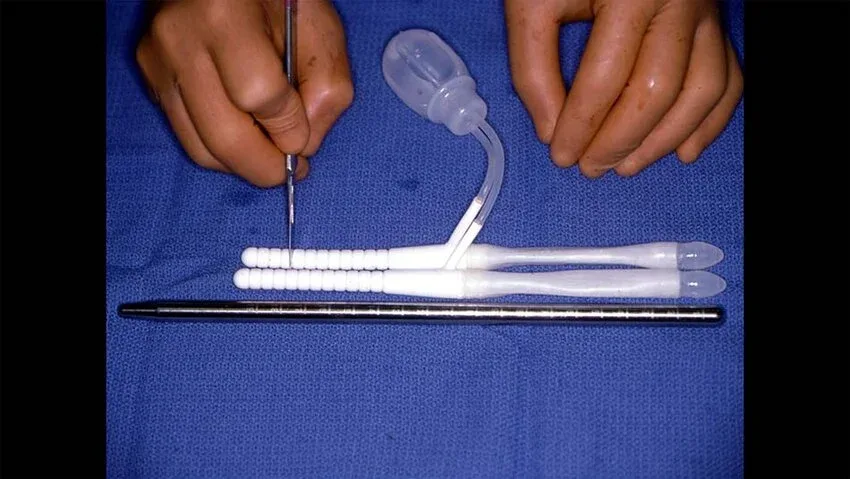
- Discontinued, and its manufacturer left the field — Surgitek no longer manufactures or markets penile prostheses, and no successor company supports the device.
- Dual-chamber cylinders — Cylinders had an outer silicone layer and an inner Dacron layer, forming two chambers, with the outer chamber adding girth.
- Self-sealing fill port — A penetrable port on the bottom of the resipump allowed fluid volume to be adjusted through the skin.
- Preassembled, prefilled and trimmable — The device was supplied ready to implant with a trimmable tail, and was easier to implant than the Ambicor that succeeded it.
- Tubing fracture was the recurring failure — Persistent tubing fracture contributed to mechanical failures.
- It never obtained FDA approval — Despite its design features, the device failed to secure US Food and Drug Administration approval.
- Almost no independent outcome data exists — The largest reported series, 84 patients, was published in the manufacturer's own clinical market study rather than in the peer-reviewed literature.
About the Uniflate 1000®
What Was the Uniflate 1000?
The Uniflate 1000 was an inflatable penile prosthesis for the surgical treatment of severe erectile dysfunction.
It was made by Surgitek, Inc. and introduced in the 1980s.
It was a two-piece device: paired cylinders implanted in the corpora cavernosa, connected to a single scrotal component that served as both pump and reservoir, known as a resipump.
Surgitek introduced it at essentially the same time as Mentor introduced the GFS, and the two competed directly.
Both devices allowed transcutaneous resipump volume adjustment and both held a similar maximum fluid volume.
Surgitek's Place in Implant History
Surgitek was an active player in penile prosthetics during the 1980s.
In 1986 it launched the Flexi-Flate, a one-piece self-contained inflatable implant composed of two hydraulic cylinders with no parts outside the penis, released the same year as the AMS Hydroflex.
A revised Flexi-Flate II followed, and the Uniflate 1000 arrived as the company's two-piece entry, with its surgical procedural guide dated 1989.
Surgitek is no longer manufacturing or marketing penile prostheses.
If you have a Surgitek device of any kind, there is no company to contact about it.
The Dual-Chamber Cylinder
This is the design feature worth understanding, because nothing else on the market worked this way.
The Uniflate cylinders had two layers: an outer silicone layer and an inner Dacron layer.
Those two layers created two chambers within each cylinder.
The inner chamber provided rigidity in the conventional way.
The outer chamber added further girth to the cylinder.
The intent was to address the central weakness of every two-piece implant, which is that a small scrotal reservoir cannot deliver the girth expansion a large abdominal reservoir can. Splitting the cylinder into two chambers was an attempt to get more apparent girth out of the same limited fluid volume.
The Self-Sealing Fill Port
The Uniflate resipump carried a self-sealing penetrable port on its underside.
The device was filled through that port.
It also meant fluid volume could be adjusted transcutaneously after implantation, without opening the scrotum.
The competing Mentor GFS also allowed office-based fluid adjustment, but through a different mechanism.
For a surgeon in that era this was a practical advantage: an implant that lost a little volume, or a patient who needed slightly more, could sometimes be managed in clinic rather than in theatre.
Preassembled, Prefilled and Trimmable
The Uniflate 1000 was supplied preassembled and prefilled, with a trimmable tail.
Preassembly matters in a hydraulic implant, because every connection made in theatre is a potential leak point.
The trimmable tail allowed the surgeon to adjust proximal length to the patient's corporal measurement.
Contemporary reviews note that the Ambicor, which succeeded this generation of devices, is more difficult to implant than historical two-piece implants such as the Uniflate 1000.
Ease of implantation was a genuine strength of the device.
Tubing Fracture
The Uniflate's characteristic failure was fracture of the tubing.
Tubing fracture emerged as a persistent issue and contributed to mechanical failures.
This is the same category of problem that drove Mentor to remove the connectors from the GFS and produce the connectorless Mark II, and that eventually pushed the whole industry toward preconnected components.
A man whose Uniflate stopped inflating, or that inflated and then would not hold, was most likely experiencing a tubing failure with loss of fluid.
Regulatory Failure
The Uniflate 1000 did not obtain FDA approval.
Despite its promising features, the device failed to secure approval from the US Food and Drug Administration.
This is the decisive fact in its history, and it separates the Uniflate from the Mentor GFS and Mark II, which were marketed in the United States and later withdrawn on clinical grounds.
Verification note for the editor: the literature is not fully consistent here. Implantation series exist, including one of 84 patients, and the device appears in surgical procedural guides and museum collections, which suggests clinical use during an investigational or pre-approval period. Before publishing, decide whether to state the FDA position as flatly as the source does or to add a qualifier.
The Evidence Base Is Very Thin
This needs stating plainly rather than dressed up.
The largest reported Uniflate series, 84 patients reported by Barrett in 1989, appears in a Surgitek clinical market study rather than in a peer-reviewed journal.
Manufacturer market-study data is the weakest form of clinical evidence there is. It is not independently reviewed, its methodology is not published, and it exists to support sales.
Independent mentions of the device in the peer-reviewed literature are incidental. In one series on implantation in corporal fibrosis, a single patient's Uniflate failed two years after surgery and was replaced with a Mentor Alpha-1.
There is no long-term device survival study for the Uniflate 1000 comparable to what exists for the Mentor devices.
Any page that presents confident reliability statistics for this implant is inventing them.
How Patients Operated the Device
The patient squeezed the scrotal resipump to move fluid into the cylinders.
The penis became rigid.
A release mechanism returned fluid to the resipump.
As with all two-piece implants, the deflated state was not truly flaccid, because residual fluid remained in the cylinders.
There was no abdominal or pelvic reservoir.
Uniflate 1000 vs Mentor GFS
These were the two competing two-piece implants of the same moment.
Both used paired cylinders and a scrotal resipump.
Both allowed transcutaneous adjustment of resipump volume, and both held a similar maximum fluid volume.
The GFS cylinders expanded to a fixed girth and came in two width sizes. The Uniflate instead used dual-chamber cylinders with an outer girth chamber.
The GFS reached the US market and generated published outcome data. The Uniflate did not secure FDA approval and generated almost none.
Uniflate 1000 vs Mentor Mark II
The Mark II was Mentor's answer to the reliability problems of the first-generation two-piece devices, and its defining change was the removal of tubing connectors.
The Uniflate's persistent problem was tubing fracture.
Both devices were, in different ways, defeated by the same underlying engineering challenge: keeping a low-volume hydraulic system leak-free inside a body for decades.
Both were discontinued.
Uniflate 1000 vs Flexi-Flate
Both were Surgitek products but they are different classes of implant.
The Flexi-Flate, introduced in 1986, was a one-piece self-contained device with two hydraulic cylinders and no components outside the penis.
The Uniflate 1000 was a two-piece device with a separate scrotal resipump.
If your records simply say "Surgitek implant," the distinction matters: a self-contained device has nothing in the scrotum, while a Uniflate has a scrotal component.
Uniflate 1000 vs Ambicor
The Ambicor is the only two-piece inflatable still available and is the modern equivalent of this device class.
AMS introduced it in 1994 with prefilled and preconnected components.
It is harder to implant than the Uniflate was, but it is supported, regulated and backed by contemporary outcome data.
Any man who wants the two-piece concept today is looking at an Ambicor, not a Uniflate.
Uniflate 1000 vs Three-Piece Implants
A three-piece implant places a much larger reservoir in the abdomen or pelvis.
That extra fluid produces greater girth expansion, genuine flaccidity when deflated, and a reserve that accommodates changes in the corpora over years.
The Uniflate's dual-chamber cylinder was a clever attempt to compensate for a small reservoir. The market's verdict was that it did not compensate enough.
Three-piece devices such as the Coloplast Titan and AMS 700 dominate the market today.
If You Already Have a Uniflate 1000
This is the situation most readers of this page are in.
A Uniflate implanted around 1990 is now more than three decades old.
The device is out of production, the manufacturer has left the field entirely, and no cylinders, tubing or resipumps exist.
No warranty is in force and no repair is possible.
If it still inflates, deflates and produces a usable erection without pain, there is no automatic need to remove it.
If it has failed, leaks, will not hold pressure, has become painful, or shows any sign of erosion or infection, it needs urological assessment.
Identifying an Unlabelled Old Implant
Many men with implants this old have no operative records.
A urologist can often identify the general class of device from examination and imaging: whether there is a scrotal component, whether there is an abdominal reservoir, and how the cylinders behave.
Distinguishing a Uniflate from a Mentor GFS on imaging alone is not always possible.
In practice this rarely changes management, because every discontinued two-piece device is handled the same way: assess, and remove or exchange if it has failed.
Revision and Replacement Surgery
Replacing a decades-old prosthesis is not the same operation as a first implant.
Scar tissue forms around implanted cylinders over time and can restrict corporal space.
Removal of the old device and placement of a new one is usually performed in a single operation where tissue conditions allow.
Corporal dilation, scar excision or downsizing to narrower cylinders may be required.
Where fibrosis is severe, a malleable implant may be the only device that can be placed safely.
Explantation Without Replacement
Some men choose removal without a new implant.
Erectile function does not return after explantation.
Removing cylinders from scarred corpora typically results in shortening and permanent loss of erection.
Where a device is removed for infection, delayed reimplantation is generally harder than immediate exchange.
This decision deserves an unhurried conversation with an implant surgeon.
Does the Uniflate Restore a Natural Erection?
No.
Like all penile prostheses, it produced mechanical rigidity.
It did not restore arterial inflow, veno-occlusion or cavernous nerve function.
It did not affect libido, sensation, orgasm or ejaculation, which depend on nerves and hormones rather than on the erectile mechanism.
Does the Uniflate Increase Penile Size?
No.
The dual-chamber design was intended to improve girth expansion relative to other two-piece devices of its era, not to enlarge the penis beyond its own dimensions.
Cylinder length was matched to the corpora using the trimmable tail.
No penile prosthesis is a lengthening device.
MRI and the Uniflate 1000
Flag for verification before publishing. No manufacturer MRI conditions statement exists for the Uniflate 1000, and no successor company can issue one.
Recommended page wording: patients with a Uniflate 1000 should inform radiology staff of their implant before any MRI scan, and the radiologist should assess the device individually. Note that the cylinders contain a Dacron layer as well as silicone, which the radiologist should be told.
Do not state or imply that the device is MR Conditional or MR Safe.
Regulatory Status
The Uniflate 1000 failed to secure FDA approval and is not approved or supplied in any market today.
Surgitek no longer manufactures or markets penile prostheses.
Men seeking a penile implant today will be offered a currently regulated device.
Warranty
There is no warranty.
Surgitek has left the penile prosthesis market, the device is discontinued, and no manufacturer replacement programme applies.
Any surgery involving an existing Uniflate is treated as revision surgery and priced accordingly.
Why This Page Exists
The Uniflate 1000 cannot be chosen by anyone today.
It matters for two reasons.
First, men still carry these devices and need accurate information when one fails, particularly because no manufacturer exists to answer questions about it.
Second, its dual-chamber cylinder was a genuinely inventive attempt to solve the two-piece girth problem, and the fact that it still did not survive tells you how hard that problem was.
Is this device for you?
- •Men who already have a Uniflate 1000 implanted and want to understand what they are carrying.
- •Men with an unidentified old Surgitek implant trying to work out which device they have.
- •Men whose implant has failed or leaks and who are considering revision or replacement.
- •Men whose device has no manufacturer to contact and who need to know that is normal for this implant.
- •Patients and clinicians researching implant history and the evolution of two-piece design.
- •Not available and never FDA approved — The device cannot be selected by any patient today.
- •No manufacturer exists — Surgitek has left the penile prosthesis field entirely.
- •No parts, no warranty, no repair — Failure means revision surgery.
- •Tubing fracture — The characteristic mechanical failure of this device.
- •No independent reliability data — Nothing comparable to the published Mentor survival figures.
- •Limited girth expansion — The dual-chamber design mitigated but did not solve the small-reservoir problem.
- •Incomplete flaccidity — Residual cylinder fluid prevents a genuinely soft state.
- •No antimicrobial surface — Predates antibiotic-impregnated and hydrophilic coatings.
- •Revision complexity increases with time — Decades of corporal scarring make exchange harder than a primary implant.
How it compares
Every 2-piece inflatable implant a surgeon in our network may propose, side by side. The Uniflate 1000® column is highlighted.
| Attribute | Uniflate 1000®Surgitek, Inc.Economy | Mentor Mark IIMentor CorporationEconomy | Mentor GFS™Mentor CorporationEconomy | AMS Ambicor™Boston ScientificPremium |
|---|---|---|---|---|
| Expansion | Dual-chamber cylinders — inner chamber for rigidity, outer chamber adding girth | Fixed predetermined girth; two cylinder widths suppliedFixed predetermined girth; two cylinder widths supplied | Fixed predetermined girth; two cylinder widths supplied | Primarily girth / rigidity; not a dedicated length-expanding cylinder |
| Rigidity | Hydraulic, on demand; constrained by scrotal resipump volume | Hydraulic, on demand; constrained by 25 mL fluid volume and prone to decline over years | Hydraulic, on demand; lower than a three-piece system due to limited fluid volume | Hydraulic inflatable rigidity |
| Antibiotic coating | None — predates both InhibiZone and hydrophilic coating technology | None — predates both InhibiZone and hydrophilic coating technology | None — predates both InhibiZone and hydrophilic coating technology | Do not publish a fixed antimicrobial-coating claim without verifying the current model-specific product documentation |
| Reservoir | None separate; scrotal resipump serves as both pump and reservoir, with a self-sealing penetrable fill port | None separate; 25 mL scrotal resipump serves as both pump and reservoir | None separate; reservoir combined with pump into a scrotal resipump | Integrated within proximal cylinder system; no separate abdominal reservoir |
| Control | Manual — squeeze the scrotal resipump to inflate, release mechanism to deflate | Manual — squeeze the scrotal resipump to inflate, release mechanism to deflate | Manual — squeeze the scrotal resipump to inflate, release mechanism to deflate | Scrotal pump; bend-to-deflate mechanism |
| Concealed when soft | Partially — residual cylinder fluid prevents true flaccidity | Partially — residual cylinder fluid prevents true flaccidity | Partially — residual cylinder fluid prevents true flaccidity | Yes, although generally less completely flaccid than many 3-piece implants |
| Cylinder material | Two-layer construction: outer silicone layer, inner Dacron layer | Silicone inflatable cylinders, connectorless tubing | Silicone inflatable cylinders with connecting tubing (Mark II connectorless) | Silicone elastomer construction |
| Cylinder options | Supplied preassembled and prefilled with a trimmable tail; size range not documented by any active manufacturer | Two width sizes; length options historical and not documented by any active manufacturer | Two widths; length options historical and not currently documented by any active manufacturer | 12.5 mm, 14 mm and 15.5 mm diameters; 14–22 cm lengths depending on diameter |
| Length expansion | None — proximal length adjusted by trimming, not by expansion | None — girth-expanding design only | None — girth-expanding design only | No dedicated longitudinal-expansion design |
| MRI status | Not verified — no manufacturer statement exists; individual radiological assessment required, and the Dacron cylinder layer should be declared | Not verified — no current manufacturer statement available; individual radiological assessment required | Not verified — no current manufacturer statement available; individual radiological assessment required | MR Conditional at specified 1.5T and 3.0T conditions |
| Reliability | 90–95% at 5 yrs* | 90–95% at 5 yrs* | 90–95% at 5 yrs* | 90–95% at 5 yrs* |
*Type-level five-year mechanical survival from published series; not a model-specific figure. See each model page for detail.
At a glance
- Manufacturer
- Surgitek, Inc.
- Type
- 2-piece inflatable implant
- Price tier
- Economy
- Warranty
- The Uniflate 1000 is a discontinued device with no active manufacturer warranty, replacement programme or spare parts. Surgitek, Inc. no longer manufactures or markets penile prostheses and no successor company supports the device. Men with an existing Uniflate who require device removal or exchange are treated under standard revision penile prosthesis surgery pathways, and all costs are quoted as revision surgery.
- Two-piece inflatable design — Paired cylinders plus a scrotal resipump; no abdominal or pelvic reservoir.
- Dual-chamber cylinders — Outer silicone layer and inner Dacron layer creating two chambers, the outer adding girth.
- Self-sealing penetrable fill port — On the bottom of the resipump, allowing transcutaneous volume adjustment.
- Preassembled and prefilled — Supplied ready to implant, reducing intraoperative connections.
- Trimmable tail — Proximal length adjusted to corporal measurement.
- Relatively simple implantation — Easier to implant than the Ambicor that succeeded it.
- No antibiotic or hydrophilic coating — Predates both technologies.
- Discontinued — Not manufactured, not supplied, no parts, no warranty, no manufacturer.
Surgeons who implant it
Surgeons in our network who work with the Uniflate 1000®. Availability of a specific model is always confirmed in your proposal.
Common questions
Can I still get a Uniflate 1000?
Who made the Uniflate 1000?
What kind of implant was it?
What made the Uniflate cylinders unusual?
What was the fill port for?
Was the Uniflate 1000 FDA approved?
What was the main problem with the device?
How reliable was it?
How did it compare with the Mentor GFS?
Is the Uniflate the same as the Flexi-Flate?
My implant is over 30 years old. Does it need to come out?
Can a Uniflate 1000 be repaired?
I do not know which implant I have. Can it be identified?
What would replace a Uniflate 1000 today?
Is revision surgery harder than the first implant?
What happens if I have it removed without replacement?
Can I have an MRI with a Uniflate 1000?
Is there any warranty on my Uniflate 1000?
Patient reviews
Been treated? Your honest review of Uniflate 1000® helps the next patient.
No one has reviewed this yet. If you have been treated, your experience would help the next person.
Write the first reviewSources
- Update on penile prosthesis — PMC
- Chung — Penile prosthesis implant: scientific advances and technological innovations over the last four decades
- Patel et al. — Recent technological development of penile prosthesis: a literature review
- Mulcahy & Gross — The Development of Modern Penile Implants
- William P. Didusch Center for Urologic History — Surgitek Uniflate-1000 catalogue entry
- Alloplastics in the Treatment of Erectile Dysfunction (cites Barrett DM, Uniflate 1000 experience with 84 patients, Surgitek 1989)
- Clinical experience with a self-contained inflatable penile implant: the Flexi-Flate (PubMed)
- Penile implant success in patients with corporal fibrosis using multiple incisions and minimal scar tissue excision
- Ambicor Two-Piece Inflatable Penile Prosthesis: Background and Contemporary Outcomes
- The last survivor of unitary and two-piece inflatables — the Ambicor
- A history of penile implants — PMC
- EAU Guidelines — Management of Erectile Dysfunction
- AUA — Erectile Dysfunction Guideline
- Surgitek, Inc. — product information