
AMS Ambicor™
The AMS Ambicor™ is a 2-piece inflatable penile prosthesis for men with erectile dysfunction who are candidates for penile implant surgery. It combines paired inflatable cylinders with a scrotal pump and stores hydraulic fluid within the cylinder system, eliminating the separate abdominal reservoir required by a conventional 3-piece implant.
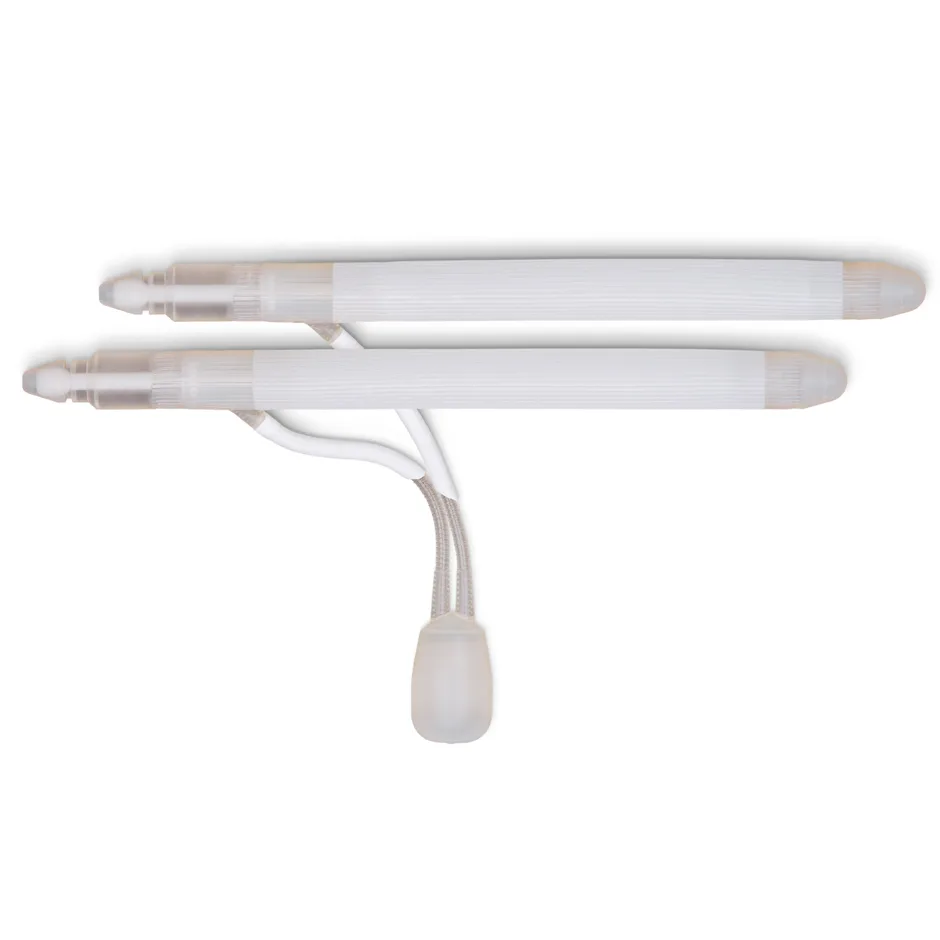
- True 2-piece inflatable system — Ambicor consists of paired intracavernosal cylinders and a scrotal pump without a separate abdominal or pelvic reservoir.
- Pre-filled and pre-connected — The system is supplied as a closed hydraulic unit, simplifying implantation compared with a conventional 3-piece prosthesis.
- Useful when reservoir placement is undesirable — Ambicor can be particularly relevant in selected patients with previous pelvic or abdominal surgery or scarring.
- Simple patient operation — Inflation requires repeated pump compression, while deflation is performed by bending the penis downward according to the manufacturer’s instructions.
- Established clinical history — Published series report high patient satisfaction and relatively low mechanical-failure rates, although most Ambicor-specific outcome studies are older and smaller than the evidence base for major 3-piece platforms.
About the AMS Ambicor™
What Is the AMS Ambicor?
The AMS Ambicor is a 2-piece inflatable penile prosthesis manufactured by Boston Scientific.
It is designed for men with erectile dysfunction who have selected penile prosthesis implantation after appropriate assessment and counselling.
Unlike conventional 3-piece inflatable implants, Ambicor does not require a separate abdominal or pelvic fluid reservoir.
The implant consists of paired inflatable cylinders positioned inside the corpora cavernosa and a pump implanted within the scrotum.
Fluid storage is incorporated into the proximal portions of the cylinders.
This integrated reservoir design is the defining feature of Ambicor.
Why Is Ambicor Called a 2-Piece Implant?
The term 2-piece refers to the two main prosthetic component groups.
The first component is a pair of inflatable cylinders implanted within the penis.
The second component is the scrotal pump.
There is no third independent abdominal reservoir.
The hydraulic fluid required for inflation is stored within reservoir sections incorporated into the cylinders themselves.
This distinguishes Ambicor from systems such as the AMS 700, Coloplast Titan and Rigicon Infla10, which are all 3-piece penile prostheses.
How the AMS Ambicor Works
Ambicor creates an erection hydraulically.
When the patient squeezes and releases the pump positioned in the scrotum, fluid moves from the integrated cylinder reservoirs into the inflatable portions of the cylinders.
As the cylinders fill, they become increasingly rigid.
This produces the mechanical support required for penetrative sexual activity.
The implant therefore bypasses the vascular mechanism responsible for a natural erection.
After intercourse, the patient deflates the device and fluid moves back into the integrated reservoir areas.
The cylinders become softer and the penis can then be positioned more comfortably.
Integrated Fluid Reservoirs
Ambicor's most distinctive engineering feature is the absence of a separate abdominal reservoir.
Instead, hydraulic fluid is stored within reservoir chambers at the proximal ends of the cylinders.
When the pump is activated, fluid moves forward into the inflatable cylinder portions.
During deflation, fluid returns to these integrated storage chambers.
This allows the prosthesis to function as an inflatable system while eliminating a separate reservoir-placement step.
Why Avoiding a Separate Reservoir Can Matter
Reservoir placement is an additional component of conventional 3-piece penile prosthesis surgery.
In most patients it can be performed safely.
However, previous pelvic surgery, scarring or altered anatomy can make reservoir placement more technically complex.
Examples may include radical pelvic surgery, urinary diversion, complex abdominal surgery or certain hernia repairs.
Ambicor eliminates this aspect of implantation.
For selected patients, that can be its most important advantage.
Modern ectopic reservoir-placement techniques have also made 3-piece implantation possible in many patients with previous pelvic surgery, so Ambicor is an option rather than an automatic requirement.
Pre-Filled and Pre-Connected Design
Boston Scientific supplies the Ambicor as a pre-filled and pre-connected prosthesis.
The cylinders and pump form a closed hydraulic circuit before implantation.
The surgeon therefore does not need to separately connect a reservoir and complete the same type of hydraulic assembly required for many 3-piece systems.
This can simplify certain operative steps.
A simpler component configuration does not eliminate the need for careful corporal measurement, cylinder placement, pump positioning and infection-prevention technique.
Ambicor Cylinder Construction
The Ambicor system contains paired cylinders connected to the scrotal pump using kink-resistant tubing.
The components are constructed using silicone elastomer materials.
One cylinder is implanted inside each corpus cavernosum.
The cylinders contain both the inflatable functional portion and integrated fluid-storage regions.
The device is therefore structurally different from an AMS 700 cylinder, which receives fluid from a completely separate reservoir.
Available Cylinder Diameters
Boston Scientific currently lists Ambicor cylinders in three diameters:
12.5 mm
14 mm
15.5 mm
Different diameters are combined with different available cylinder lengths.
The surgeon selects the appropriate configuration according to intraoperative corporal measurements.
Cylinder diameter should be determined by safe anatomical fit rather than an attempt to maximize penile girth.
Available Cylinder Lengths
Current Ambicor configurations range from 14 cm to 22 cm depending on cylinder diameter.
The currently listed combinations include:
12.5 mm × 14 cm
12.5 mm × 16 cm
12.5 mm × 18 cm
14 mm × 16 cm
14 mm × 18 cm
14 mm × 20 cm
15.5 mm × 18 cm
15.5 mm × 20 cm
15.5 mm × 22 cm
Rear-tip extenders are also available to fine-tune prosthetic length.
Rear-Tip Extenders
Ambicor is supplied with rear-tip extenders in several sizes.
Rear-tip extenders allow the surgeon to adjust total implant length to match the measured corporal space.
They are used for anatomical sizing rather than cosmetic penile lengthening.
The final cylinder and extender combination should adequately fill the corpora without excessive distal or proximal pressure.
Ambicor Pump
The pump is implanted inside the scrotum.
After healing, the patient locates it through the scrotal skin.
Repeated squeezing and releasing of the pump bulb transfers fluid into the cylinders.
Boston Scientific describes Ambicor as requiring relatively few pump squeezes to reach functional rigidity.
The exact number required can vary with cylinder size, patient technique and device state.
How Ambicor Is Inflated
Inflation is performed by repeatedly squeezing and releasing the scrotal pump.
Each pump action transfers hydraulic fluid from the proximal cylinder reservoirs into the active inflatable portions of the cylinders.
As fluid accumulates, cylinder rigidity increases.
The patient continues until sufficient rigidity for intercourse is achieved.
Patients should receive direct postoperative training because familiarity with the implanted pump strongly influences ease of use.
How Ambicor Is Deflated
Ambicor uses a distinctive deflation mechanism.
According to Boston Scientific's patient instructions, the penis is bent downward to approximately 55–65 degrees and held in that position for several seconds.
This permits fluid to move back toward the integrated cylinder reservoirs.
The penis is then returned to its resting position.
Because Ambicor does not use the same dedicated deflation button architecture as many modern 3-piece systems, its deflation method is an important part of patient counselling.
Ambicor vs AMS 700
Ambicor and AMS 700 are both inflatable penile prostheses manufactured by Boston Scientific, but their architectures differ substantially.
Ambicor is a 2-piece system with integrated cylinder reservoirs.
AMS 700 is a 3-piece system containing paired cylinders, a scrotal pump and a separate abdominal or pelvic reservoir.
The separate reservoir generally allows the AMS 700 cylinders to empty more completely when deflated and provides greater hydraulic volume for inflation.
Ambicor eliminates reservoir placement and has fewer separate components.
The appropriate choice depends on anatomy, previous surgery, concealability priorities, manual dexterity and patient preference.
Ambicor vs AMS 700 LGX
AMS 700 LGX is specifically engineered to provide controlled expansion in both length and girth.
Ambicor is not marketed as a length-expanding cylinder platform.
Its primary purpose is to provide reliable hydraulic rigidity using a reservoir-free 2-piece architecture.
Patients who prioritize maximum erection-to-flaccidity differentiation or controlled dimensional expansion may therefore prefer a 3-piece system when anatomically appropriate.
Patients for whom avoiding reservoir placement is particularly valuable may favor Ambicor.
Ambicor vs Coloplast Titan
Coloplast Titan is a 3-piece inflatable penile prosthesis with a separate reservoir.
Titan generally provides a larger distinction between its inflated and deflated states and is known for substantial axial rigidity.
Ambicor is mechanically simpler because no abdominal reservoir is required.
There is insufficient contemporary comparative evidence to claim that one is universally superior.
The devices address somewhat different priorities.
Ambicor vs Rigicon Infla10
Rigicon Infla10 is a 3-piece inflatable prosthesis containing paired cylinders, a scrotal pump and a separate fluid reservoir.
Some Infla10 configurations also offer specific girth or length-and-girth expansion characteristics.
Ambicor does not use a separate reservoir and therefore offers a simpler two-component architecture.
Infla10 and Ambicor should therefore not be grouped together simply because both are hydraulic implants.
Ambicor vs Malleable Penile Implant
A malleable implant contains two continuously semi-rigid rods.
It requires no pump or hydraulic fluid.
Ambicor is inflatable and can become more rigid for intercourse and softer afterward.
This provides better concealability than a continuously semi-rigid prosthesis in many patients.
However, Ambicor still requires sufficient hand dexterity to operate a scrotal pump and perform the deflation maneuver.
A malleable prosthesis may therefore remain easier to use for patients with significant hand impairment.
Concealability
Ambicor provides a softer resting state than a malleable penile prosthesis because hydraulic fluid can be moved away from the main inflatable cylinder portions.
However, the integrated reservoir design means that the cylinders retain more internal volume than many 3-piece cylinders when deflated.
As a result, Ambicor may not achieve the same degree of flaccidity as some contemporary 3-piece systems.
Whether this difference matters varies considerably between patients.
Rigidity
Ambicor is designed to provide sufficient rigidity for penetrative intercourse.
The cylinders become pressurized as fluid is pumped forward.
In an early multicenter clinical series, the large majority of responding patients reported erections suitable for intercourse.
Rigidity should nevertheless be evaluated as part of the overall implant experience rather than as an isolated bench-test characteristic.
Does Ambicor Increase Penile Length?
Ambicor should not be presented as a penile-lengthening implant.
Cylinder dimensions are selected according to the measured corporal anatomy.
The goal is to safely fill the corpora and restore functional rigidity.
Deliberately oversizing the cylinders in an attempt to increase penile length can cause pain, abnormal pressure, erosion and tissue damage.
Patients who have experienced shortening after radical prostatectomy, Peyronie's disease, fibrosis or longstanding erectile dysfunction should receive realistic counselling before surgery.
Does Ambicor Increase Girth?
Cylinder inflation increases the diameter and firmness of the prosthetically supported penis compared with the deflated state.
However, Ambicor is not primarily designed as a cosmetic girth-enhancement procedure.
The amount of apparent girth depends on cylinder size, corporal dimensions and surrounding tissue.
No fixed postoperative circumference should be promised.
Ambicor After Radical Prostatectomy
Men with persistent erectile dysfunction after radical prostatectomy may be candidates for penile prosthesis implantation.
Ambicor can be particularly relevant in patients whose previous pelvic surgery makes a separate reservoir undesirable.
However, radical prostatectomy alone does not prevent implantation of a 3-piece prosthesis.
Modern alternative reservoir-placement techniques mean many post-prostatectomy patients can receive either configuration.
The decision should therefore be individualized.
Ambicor After Other Pelvic Surgery
Patients with significant abdominal or pelvic surgical history may have scar tissue or altered anatomy in spaces commonly used for reservoir placement.
Examples can include radical cystectomy, urinary diversion, extensive pelvic reconstruction or complex abdominal procedures.
Because Ambicor does not require a separate reservoir, it can simplify the prosthetic strategy in selected cases.
Careful surgical assessment remains necessary because previous operations may also affect corporal tissue, infection risk and scrotal anatomy.
Ambicor and Peyronie's Disease
Ambicor has been implanted in men with erectile dysfunction associated with Peyronie's disease.
An inflatable prosthesis can provide internal structural support and may reduce some penile curvature.
However, most modern evidence regarding aggressive penile modeling and complex Peyronie's reconstruction involves 3-piece devices.
For significant curvature requiring advanced straightening techniques, device choice should be individualized according to surgeon experience and deformity characteristics.
Manual Dexterity
Ambicor requires use of a scrotal pump.
The patient must also be capable of performing the bending maneuver required for deflation.
Patients with severe hand arthritis, neurological impairment, major weakness or limited dexterity may have difficulty operating the system.
Manual function should therefore be assessed before implantation.
Infection
Infection is one of the major potential complications of every penile prosthesis.
A prosthetic infection can involve cylinders, pump, tubing or surrounding tissues.
Symptoms may include increasing pain, redness, swelling, drainage, fever, erosion or abnormal fixation of components.
Deep infection can require device removal or specialist salvage surgery.
Patient optimization and meticulous infection-prevention technique remain important.
Does Ambicor Use InhibiZone™?
Ambicor should not automatically be described as using the same InhibiZone antibiotic treatment associated with specific AMS 700 configurations.
Boston Scientific's current Ambicor consumer and product materials focus on the two-piece pre-filled, pre-connected design rather than marketing Ambicor as an InhibiZone-treated product.
Because device coatings and manufacturing configurations can change by market and generation, the exact implanted product documentation should be checked before publishing a model-specific antibiotic-coating claim.
For the comparison table, the safest entry is therefore to state that no fixed antimicrobial coating claim should be made without verification of the specific current Ambicor configuration.
Mechanical Failure
Although Ambicor has fewer major components than a 3-piece implant, it remains a hydraulic mechanical device.
Potential failure can involve the pump, cylinders, tubing or fluid circuit.
An early 131-patient series with mean follow-up of approximately 43 months reported mechanical failure in 2.3% of implanted patients.
A separate published series reported overall device survival of approximately 91% beyond 48 months.
These studies support reasonable durability but are older and should not be presented as contemporary 10- or 15-year survival estimates.
Clinical Reliability Evidence
The most frequently cited Ambicor-specific study included 131 men implanted between 1995 and 1999.
Mean follow-up was 43.4 months.
Mechanical failure occurred in three patients, corresponding to approximately 2.3% of the cohort.
The same study reported an estimated device survival of approximately 97% at 70 months.
These figures are useful because Ambicor-specific evidence is relatively limited.
However, they reflect an earlier implantation era and should be interpreted accordingly.
Patient Satisfaction
In the same two-center study, overall patient satisfaction was approximately 96.4%, while partner satisfaction was approximately 91.2%.
More than 90% of responding patients indicated that they would recommend the device to others.
These results demonstrate that the Ambicor design can achieve high satisfaction in appropriately selected patients.
Satisfaction depends heavily on expectation management, comfort, ease of operation, penile dimensions and absence of complications.
Erosion
Cylinder erosion occurs when the prosthesis compromises surrounding corporal or urethral tissue.
Risk factors can include infection, poor tissue quality, reduced sensation, previous surgery and inappropriate sizing.
Suspected erosion requires specialist evaluation and may require removal or revision.
Pump Problems
The pump must remain accessible within the scrotum.
Problems can include discomfort, migration, scar fixation, difficulty locating the pump or mechanical malfunction.
Correct placement and postoperative patient education are therefore important.
MRI Compatibility
The Ambicor product line is classified as MR Conditional.
Boston Scientific's device documentation provides specific conditions for scanning at 1.5 Tesla and 3.0 Tesla.
MR Conditional does not mean unrestricted MRI compatibility.
Patients should tell the radiology team about the penile prosthesis and provide their implant identification card or device documentation before undergoing MRI.
Who May Be a Good Candidate for Ambicor?
Ambicor may be particularly appropriate for men who want an inflatable penile prosthesis but would benefit from avoiding a separate abdominal or pelvic reservoir.
This can include selected patients with significant previous pelvic or abdominal surgery.
It may also appeal to patients who prefer a simpler hydraulic system with fewer separate components than a conventional 3-piece implant.
Candidates must be able to operate the scrotal pump and deflation mechanism.
What Should Patients Weigh Before Choosing Ambicor?
The principal advantage of Ambicor is its reservoir-free 2-piece architecture.
This must be balanced against some limitations.
Its integrated reservoir can produce less complete cylinder collapse than many 3-piece systems.
It does not offer the specialized length-expansion behavior of devices such as AMS 700 LGX.
Its contemporary evidence base is also smaller than that of major 3-piece prosthesis families.
The appropriate choice should therefore depend on anatomy and priorities rather than assuming that fewer components automatically means a better prosthesis.
Is this device for you?
- •Men with erectile dysfunction who want an inflatable implant but prefer to avoid a separate abdominal or pelvic reservoir.
- •Selected patients with previous pelvic or abdominal surgery where conventional reservoir placement may be less desirable.
- •Patients with abdominal scarring that may complicate traditional reservoir placement.
- •Men who value a simpler hydraulic architecture than a conventional 3-piece implant.
- •Patients who want better concealability than a malleable implant while retaining an inflatable erection.
- •Patients with adequate hand dexterity to operate the scrotal pump and perform the Ambicor deflation maneuver.
- •Less complete flaccidity than some 3-piece systems — Integrated fluid storage means the cylinders do not empty into a distant reservoir.
- •No separate reservoir is both strength and limitation — It simplifies placement but reduces hydraulic storage capacity compared with a 3-piece design.
- •Requires pump operation — Patients with limited dexterity may prefer a malleable prosthesis.
- •Unique deflation technique — Ambicor requires bending the penis downward rather than simply pressing a standard 3-piece deflation control.
- •Not designed for longitudinal cylinder expansion — It should not be compared with AMS 700 LGX as a length-expanding prosthesis.
- •Older evidence base — Most Ambicor-specific clinical outcome studies were performed many years ago.
- •Mechanical failure remains possible — Pump, cylinders, tubing or hydraulic integrity can eventually require revision.
- •Infection and erosion remain possible — The absence of a separate reservoir does not eliminate standard penile prosthesis complications.
How it compares
Every 2-piece inflatable implant a surgeon in our network may propose, side by side. The AMS Ambicor™ column is highlighted.
| Attribute | AMS Ambicor™Boston ScientificPremium | Mentor Mark IIMentor CorporationEconomy | Mentor GFS™Mentor CorporationEconomy | Uniflate 1000®Surgitek, Inc.Economy |
|---|---|---|---|---|
| Expansion | Primarily girth / rigidity; not a dedicated length-expanding cylinder | Fixed predetermined girth; two cylinder widths suppliedFixed predetermined girth; two cylinder widths supplied | Fixed predetermined girth; two cylinder widths supplied | Dual-chamber cylinders — inner chamber for rigidity, outer chamber adding girth |
| Rigidity | Hydraulic inflatable rigidity | Hydraulic, on demand; constrained by 25 mL fluid volume and prone to decline over years | Hydraulic, on demand; lower than a three-piece system due to limited fluid volume | Hydraulic, on demand; constrained by scrotal resipump volume |
| Antibiotic coating | Do not publish a fixed antimicrobial-coating claim without verifying the current model-specific product documentation | None — predates both InhibiZone and hydrophilic coating technology | None — predates both InhibiZone and hydrophilic coating technology | None — predates both InhibiZone and hydrophilic coating technology |
| Reservoir | Integrated within proximal cylinder system; no separate abdominal reservoir | None separate; 25 mL scrotal resipump serves as both pump and reservoir | None separate; reservoir combined with pump into a scrotal resipump | None separate; scrotal resipump serves as both pump and reservoir, with a self-sealing penetrable fill port |
| Control | Scrotal pump; bend-to-deflate mechanism | Manual — squeeze the scrotal resipump to inflate, release mechanism to deflate | Manual — squeeze the scrotal resipump to inflate, release mechanism to deflate | Manual — squeeze the scrotal resipump to inflate, release mechanism to deflate |
| Concealed when soft | Yes, although generally less completely flaccid than many 3-piece implants | Partially — residual cylinder fluid prevents true flaccidity | Partially — residual cylinder fluid prevents true flaccidity | Partially — residual cylinder fluid prevents true flaccidity |
| Cylinder material | Silicone elastomer construction | Silicone inflatable cylinders, connectorless tubing | Silicone inflatable cylinders with connecting tubing (Mark II connectorless) | Two-layer construction: outer silicone layer, inner Dacron layer |
| Cylinder options | 12.5 mm, 14 mm and 15.5 mm diameters; 14–22 cm lengths depending on diameter | Two width sizes; length options historical and not documented by any active manufacturer | Two widths; length options historical and not currently documented by any active manufacturer | Supplied preassembled and prefilled with a trimmable tail; size range not documented by any active manufacturer |
| Length expansion | No dedicated longitudinal-expansion design | None — girth-expanding design only | None — girth-expanding design only | None — proximal length adjusted by trimming, not by expansion |
| MRI status | MR Conditional at specified 1.5T and 3.0T conditions | Not verified — no current manufacturer statement available; individual radiological assessment required | Not verified — no current manufacturer statement available; individual radiological assessment required | Not verified — no manufacturer statement exists; individual radiological assessment required, and the Dacron cylinder layer should be declared |
| Reliability | 90–95% at 5 yrs* | 90–95% at 5 yrs* | 90–95% at 5 yrs* | 90–95% at 5 yrs* |
*Type-level five-year mechanical survival from published series; not a model-specific figure. See each model page for detail.
At a glance
- Manufacturer
- Boston Scientific
- Type
- 2-piece inflatable implant
- Price tier
- Premium
- Regulatory
- FDA Approved
- Warranty
- Manufacturer warranty applies. Verify the current written Boston Scientific warranty for AMS Ambicor in the country of implantation.
- 2-piece hydraulic design — Paired inflatable cylinders and a scrotal pump.
- No separate abdominal reservoir — Hydraulic fluid is stored within integrated proximal cylinder reservoirs.
- Pre-filled and pre-connected — The prosthesis is supplied as a closed hydraulic system.
- Simple inflation — Repeated pump compression transfers fluid into the cylinders.
- Bend-to-deflate system — Deflation is performed using the manufacturer-specified penile bending maneuver.
- Multiple cylinder diameters — Available in 12.5 mm, 14 mm and 15.5 mm configurations.
- Cylinder lengths from 14–22 cm — Availability depends on cylinder diameter.
- Rear-tip extenders included — Supports precise corporal sizing.
- Kink-resistant tubing — Connects the paired cylinders with the pump.
- MR Conditional — May undergo MRI under manufacturer-specified scanning conditions.
Common questions
Is AMS Ambicor a 2-piece or 3-piece penile implant?
Is AMS Ambicor currently available?
How long does AMS Ambicor last?
Is Ambicor better for men who have had prostate surgery?
Does Ambicor increase penile length?
Does Ambicor increase girth?
How do you inflate AMS Ambicor?
How do you deflate AMS Ambicor?
Does AMS Ambicor have a reservoir?
Is AMS Ambicor FDA approved?
Can I have an MRI with AMS Ambicor?
Is Ambicor better than a malleable penile implant?
Patient reviews
Been treated? Your honest review of AMS Ambicor™ helps the next patient.
No one has reviewed this yet. If you have been treated, your experience would help the next person.
Write the first reviewSources
- Boston Scientific — AMS Ambicor Directions for Use / MRI Information
- Boston Scientific — Using Your AMS Ambicor™ Penile Implant
- Levine, Estrada & Morgentaler — Mechanical Reliability and Safety of, and Patient Satisfaction With, the Ambicor Inflatable Penile Prosthesis
- FDA — AMS Ambicor Inflatable Penile Prosthesis PMA Record
- Boston Scientific — product information